The story of Mika Westwolf, a 22-year-old Indigenous woman who was killed in a hit-and-run near Arlee in March, is getting nationwide media attention. One reason is that the person who struck her, Sunny White, who’s facing vehicular homicide charges, has children named Aryan and Nation. And the case comes at a time when the Missing and Murdered Indigenous Women epidemic has, finally, entered our national discourse. The MMIW movement aims to spotlight the disproportionate number of Native American women who experience violence. Part of what fuels the epidemic is the lack of resources, media attention, and investigation that goes into these cases. At the heart of this issue is, of course, enduring racism entangled with historical, systemized trauma.
But in the case of Westwolf, another major reason people are paying attention is because her family has launched a powerful campaign called Mika Matters. In advance of White’s November 8 arraignment at the Lake County Courthouse, we spoke with Westwolf’s mother, Carissa Heavy Runner, to discuss how her personal desire to keep her daughter’s memory alive has led to a broader campaign to help Indigenous families obtain justice, build support, and, in the process, heal.
This has been unimaginably difficult for you and your family personally, but you have taken this personal tragedy to shine a spotlight on the much larger issue of MMIW. Tell us about that work.
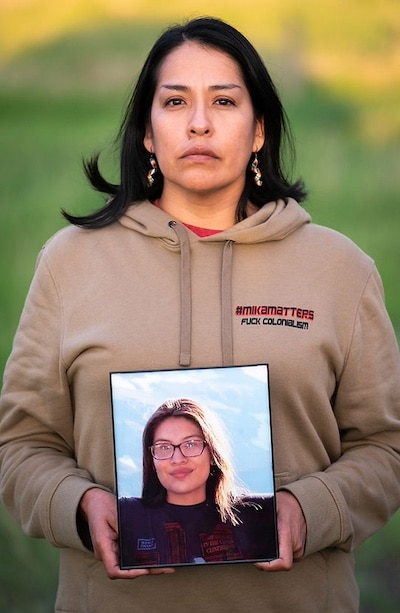
We wanted to show that this issue has been ongoing for years. This isn’t something new, even though, for some people, this was the first time they were hearing it. So we did a sign-in sheet and we called it “Loved ones Lost”—and that is also posted on the website—where people that have lost someone to murder or they are missing their loved ones, and never received justice, could write their name down. They didn’t have to go into specifics about what happened. They gave their tribal affiliation, and the date of death. And we told them that would help us show the world that this has been ongoing.
We’ve realized a lot from working different events like local powwows in Arlee and Browning, Montana, and also different events in Missoula. I think we had over 100 names on the list at the Browning powwow in comparison to a Missoula event where there were maybe one or two names. And most likely the names written down were by an indigenous person. So people could see the huge difference of who it’s really affecting.
We’d ask people, “Have you heard about Mika Westwolf?” Some people have. For some people the recent event at the Beartracks celebration was the first time they heard of it. That just shows you how what everyone sees on their social media and even the news is all different. How the algorithms affect what people see and what they don’t see, right? And so that’s why I knew it was so important to keep my daughter’s name out there. Even just doing some laundry in Missoula, someone would see my pin I would wear with a picture of my daughter, and they would make a comment. Or make a comment on my sweatshirt or my T-shirt I was wearing. And there wasn’t a better moment to share about Mika. So I would share the story, and that’s how I realized that even someone who was living in Missoula didn’t know about this problem.
I realized, “OK, we’re gonna have to keep doing this. Keep working events. Keep doing whatever we could.” And then it led to, eventually, where we didn’t have to organize an event. Other people were organizing an event, and we got the invite to be a part of it, to set up our Mika Matters booth. Or they would ask me to speak, or lead the walk. So, that was very awesome. I’m very thankful for that.
What has been your experience with other Indigenous families, who have similarly lost a loved one in this way?

When we did the walk, I reached out to these other families who had lost someone, you know, to a hit and run. Who had lost a child. And that’s how we brought attention to these three other families. I wanted to give them a platform to share their story. Because that’s the most important part. Not being able to share is what prevents you from being able to move forward and to start the healing process. To share your story of what happened to you. For others to see your pain, feel your pain, is where it begins. And I know it was probably hard for them. I encouraged them about the importance of us doing this together, because I didn’t want to just focus—I couldn’t just focus on my daughter. I know that this is a bigger issue. And so I wanted to help other families have that opportunity that they may have not gotten in the beginning. They got to say in their own words what they’ve probably been holding onto—some of them—for years.
Bonnie [Asencio] told me, “I could feel the healing, feel the weight off my shoulders after the first day of the walk…” They got to do something publicly and special for their child. At each accident site, we stopped and we did a prayer. Some families wanted to do songs. And the family got to share their story of what happened. Being able to share your feelings, cry, be there, can hopefully help start the healing process. And that’s what I felt we were successful with.
How did it feel when you first heard there was an arrest in Mika’s case?
It felt bittersweet. Because I was happy to finally receive the word that charges were filed and she was arrested. But then, it was just like, instantly, I’m like, “Wait, this is just still the beginning. This is just still us getting our foot in the door.”
What we had to do these past seven months just to get to this point—it was hard. How the lead investigator has treated us and then talking to the other families, how they were treated the same way or even worse. And I knew that’s what we were going to be up against. That’s why we had to not lose momentum. Keeping Mika’s story out there, doing events, and just continuing to get support. Launching the petition to get signatures. And that is what we were going to have to do and keep doing until we put enough pressure on Lake County. Because we felt the local authorities weren’t being cooperative. And there was a lack of communication.
What is an example of the county’s approach?
It seemed like [the county] focus was just all on drugs. My husband was saying, “Drugs are always gonna be there. But this is people’s lives. People are going missing and getting murdered—and it’s growing.” That needs to be your priority.
I mean, I know I have to try and trust that law enforcement is going to do their job. But I’ve been trying to be strategic, not just being all mad and angry in the beginning. Because I was not going to give them an opportunity to cut communication with me. It’s been very hard to not be angry, to not show the frustration in my voice. It’s been very hard, but I’ve been able to maintain my composure. If I were to raise my voice, they would just use any little thing to break the connection with me—when that connection was already lacking in the beginning.
From your experience, do you think investigators tend to not believe there is an MMIW epidemic or they don’t care? Or they aren’t trained or funded enough?
I think a big part of it is the lack of media coverage. We definitely do not get the same amount of coverage. So there isn’t follow-up in the investigation. And I don’t know if you ever watched that documentary, Murder in Big Horn, that Ivan and Ivy McDonald made. There’s this part where one of the law enforcement men says he doesn’t believe that MMIW is real.
And I just think that they don’t care. They don’t care about our lives the same as anyone else’s. It all starts in the beginning with the investigation and communication with the family. Just hearing the family out about who their child was. But we are instantly judged. I mean, nobody in this world is perfect. Youth are going to behave like youth. But that should not dictate how the investigation is conducted. Who they are and where they come from, especially if they’re Native or if they’re poor, that should not be an issue. But I feel that that is often part of it.
How do you talk with non-Natives about the importance of this issue?
I feel like the message, the way I realized I could reach people was, “What if this was your child? What would you do? What would you do if you’re in my position?”
I know it’s hard for a lot of non-Natives to understand if you don’t deal with racism growing up and almost on a daily basis. Racism is alive and real. It hasn’t really changed and, you know, that’s the hard part of understanding. But when I say, “What if this was your child?” I know that’s how I’m able to reach out to all people. If this was your child, you would do anything. You would give your life. You would, you know?
I’m doing this for my daughter and I’m doing it for other Indigenous people. We have been dealing with this issue for a long time. Growing up, I remember hearing stories from aunties, friends, or their aunt or uncle, about how someone would go missing, or they just ended up murdered. They had no idea who did it. Nothing happened. And that goes into the next generation. I don’t want my little nieces to have to worry about this when they get older, to feel like their life is less important than anyone else, having to look over their shoulder and worry about feeling safe. I feel like we are almost dehumanized. Just looked at as less than important. Where even the deaths won’t be investigated properly.
How will it be for you to be in the same room with Sunny White?
I stated in another interview that you can’t fight hate with hate. I said I will fight with love. So I’m going to add to that statement.
All the love I have for my daughter and my love for humanity, that is what has driven me to pursue this journey to justice. I will continue to choose to move forward in my life with love and forgiveness. I don’t get to take on the role of a judge and jury. I wouldn’t want to. And being angry and wanting revenge, that’s not gonna help me heal or be able to move forward in my life. It’s just gonna hold me back. Forgiveness releases the other person, sets them free from me, so that I’m not having any anger or resentment toward that person. So there’s a break in that connection. That will allow me to move forward in my life.
And I want to plead that the county attorney and the judge do not take the easy way out with the plea bargain. I fear that for the county to avoid a trial and the cost related expenses, you know, that come along with it. So I encourage people to make signs to push that plea bargaining is unacceptable.
How can people reading this take action to help raise awareness about MMIW?
Anyone should come to the courthouse if they can. Show their support over social media for Mika and to raise awareness about the MMIW epidemic. If they purchased the Mika Matters shirt, wear it. Or wear red in support, because it’s more crucial than ever now to show that support. The only way we are stronger is together, when we’re united. I encourage people to show up. And I ask for peaceful support. We cannot lower ourselves to be hateful, to be angry, shouting things, showing aggression. We are better than that. Actions speak louder than words. And anyone is welcome to be at the courthouse and future events.
You’ve shown a lot of strength and leadership. But I also imagine that, as a mother who lost her daughter, you probably don’t feel like you have a choice.
I know I have to do it. And people say, “Oh, you’ve done this, you’ve done that.” And I’m like, “No. I’m speaking. I’m fighting. I’m pushing, but this all started with my daughter. It’s her. It’s her spirit. She captured the hearts of people.” And that’s why I felt it was so important for me in the beginning to control my daughter’s narrative. Especially because of how I felt like they’re trying to victim-blame. I wanted to show who she was, and who she could have been. I wanted to show the things that she had already accomplished in her short life. To humanize her.
We have to speak for our loved ones and fight for our loved ones. We have to be their voice.