The Missoula City Council on Monday will consider a resolution that would require the Missoula Redevelopment Agency — a body that oversees development in the city’s urban renewal districts — to obtain council approval for all expenditures above $50,000.
Proponents of the measure say the council should apply the same level of oversight to the redevelopment agency’s spending as it would apply to any other department. Although the mayor appoints members to the board that oversees the MRA and the council sets the agency’s budget, the agency does not have to seek approval for individual projects unless it intends to purchase city land or issue debt.
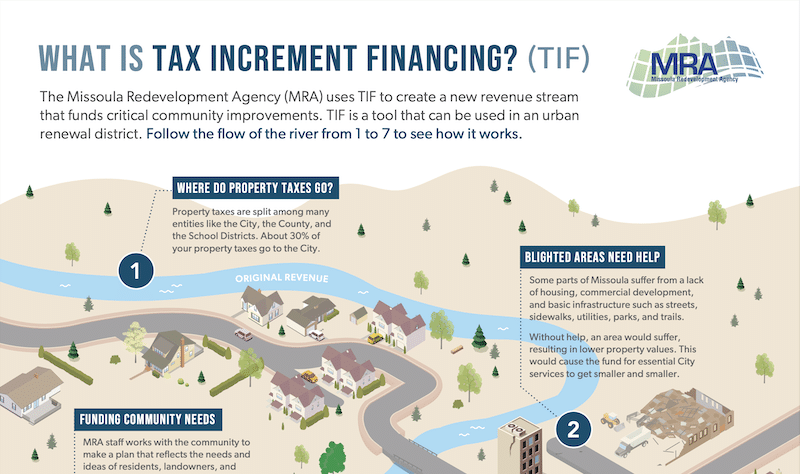
The MRA develops commercial and some residential projects through tax-increment financing, or TIF, an economic development tool that came into use during the urban renewal era of the 1970s that allows cities to earmark future property tax revenues for new redevelopment. It is a popular, if controversial, mechanism that reduces tax liability for private entities while allowing cities to encourage investment in areas previously deemed “blighted.”
Missoula has six such urban renewal districts. Each district has its own budget ranging from just under $1 million to over $10 million. The change would mean the agency would need to seek council approval for just about all of its expenditures.
“Currently the MRA is spending taxpayer dollars to the tune of millions of dollars a year without elected body approval or without approval of the voters,” Councilmember Daniel Carlino, one of the resolution’s proponents, told the city council’s budget committee last month. “Missoulians deserve the right to either vote on how they want their tax money spent or who’s going to be spending their tax money.”
In an interview this week, Carlino said he supports most of the projects that the MRA finances — for example, the Scott Street-Ravara housing development on the Northside, which includes income-restricted affordable housing — but questioned the wisdom of using tax dollars for downtown bank buildings or a facade improvement for Wendy’s.
“Stockman Bank clearly doesn’t need our help for redevelopment,” Carlino said.
But the resolution — supported by Carlino and councilmembers Bob Campbell, Sandra Vasecka and Kristen Jordan — received a cold welcome at the budget committee meeting last week. The committee voted against the proposal 7 to 4. While that doesn’t block it from consideration before the full council next week, it does signal reticence among the body.
Opponents noted that subjecting complicated projects to the whims of a political body could create undue risk for developers who have already spent months or years in the planning and legal phase.
“If this is coming to city council — I mean, we have folks who weren’t here this morning, we have folks who are online, we have votes where people online aren’t present and their screen is black. I don’t think we’re the most predictable force out there when someone is making a huge investment in something,” Councilmember Gwen Jones said.
And the longevity of the MRA’s board — with some members serving successive four-year terms, something Carlino criticized — provides dependability and expertise for investors, MRA director Ellen Buchanan told the committee last week.
“This system was created in 1978 or 1979. It’s almost 50 years old and it’s certainly been extremely successful,” Buchanan said. “All you have to do is look around the urban core of the city of Missoula.”
But if requiring political approval for MRA projects means more instability for developers, so be it, proponents of the proposal argue. Developers, Carlino noted, don’t automatically qualify for taxpayer funds just because they’ve put some planning work in.
“No developer is entitled to taxpayer money, and shouldn’t be guaranteed to have that money without the proper due process,” he said. “If they want to make investments before going through the official process to get taxpayer money, that is an investment they can make and they’re not entitled to any taxpayer money.”
The ledger #️⃣
19%
Increase in the number of nights spent at homeless shelters in Missoula from 2022 to 2023, according to the Poverello Center’s recently published annual report. The report said 1,455 individual people spent a combined 60,549 nights at shelters over the course of 2023. The increase demonstrates Missoula’s chronic affordability crisis but also reflects the fact that the city, county and Poverello Center entered into an agreement last year to open the usually seasonal Johnson Street Shelter ahead of schedule. The shelter has stayed open since.
The week ahead 🗓️
- The Missoula City Council will meet Monday evening at 6 p.m. and, among other things, consider the Missoula Redevelopment Agency spending cap proposal.
- The Missoula Parking Commission will elect new board members at its Oct. 8 meeting, which begins at noon.
The feed 🗞️
Tester, Sheehy make closing arguments at Missoula debate (Montana Free Press)
More Republican voters are moving to Montana than Democrats (Montana Free Press)
Report: Montana sees high population growth rate; western part of state bears brunt (The Missoulian)
Residents create non-profit in effort to change Missoula urban camping ordinance (KPAX)
Kalispell shelter closure will leave homeless in the cold: ‘I expect people to die’ (The Missoulian)