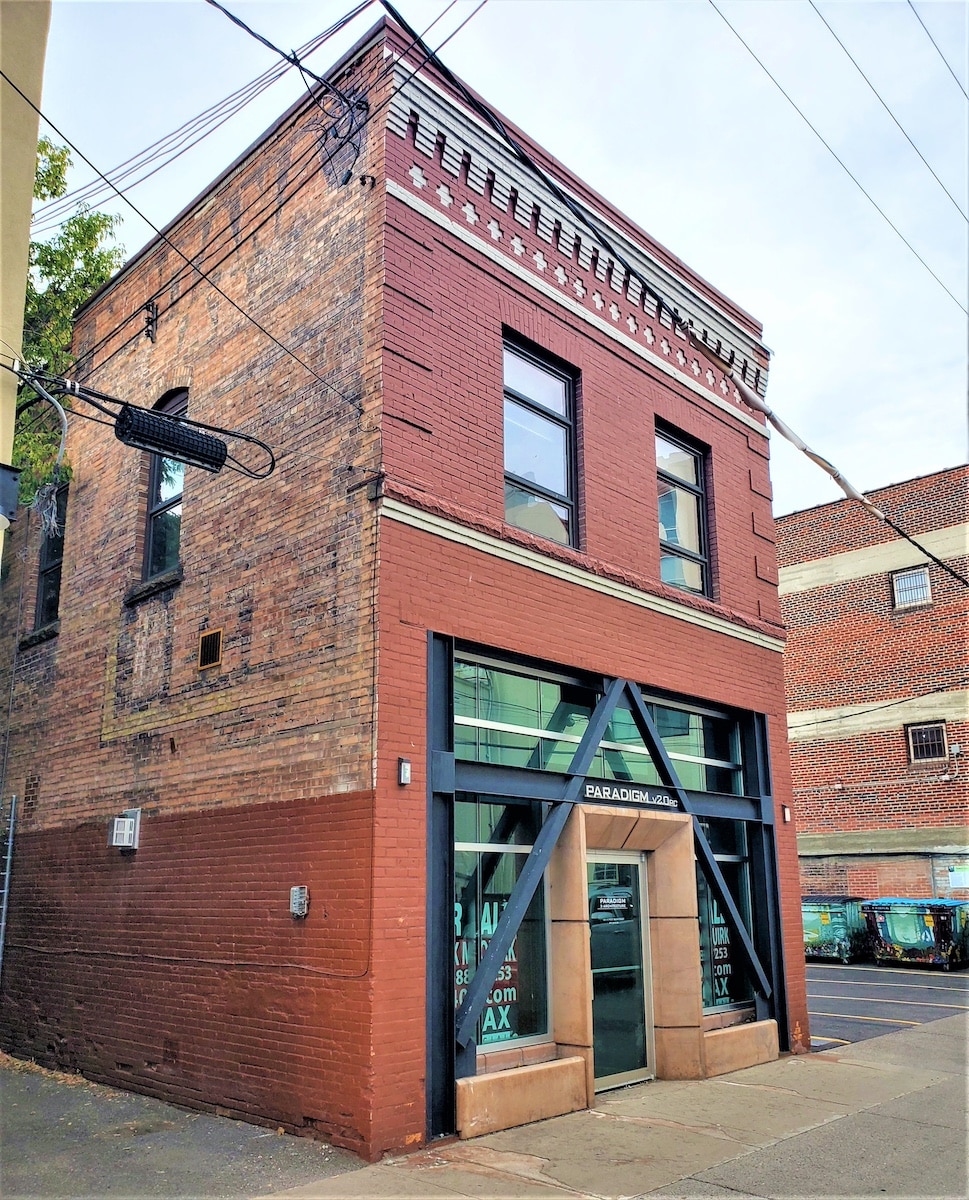
If you walk north on Higgins past the Florence building in downtown Missoula, you will come to the mouth of an alley, where a colorful mural painted on the brick wall draws you in. And if you turn down that alley and walk to about the middle of it, you will find a building on the side of which is another painted wall — this one a sign — that enticed people into this alley over 100 years ago. High up on the side of the building, large painted letters spell out the name of the original business located here: “MONTANA BAR.” Below the saloon’s name, the sign simply says: “BEER.”
It’s easy to miss this ghost sign, not only because it’s faded, but because it’s now obscured by additions to other nearby buildings.
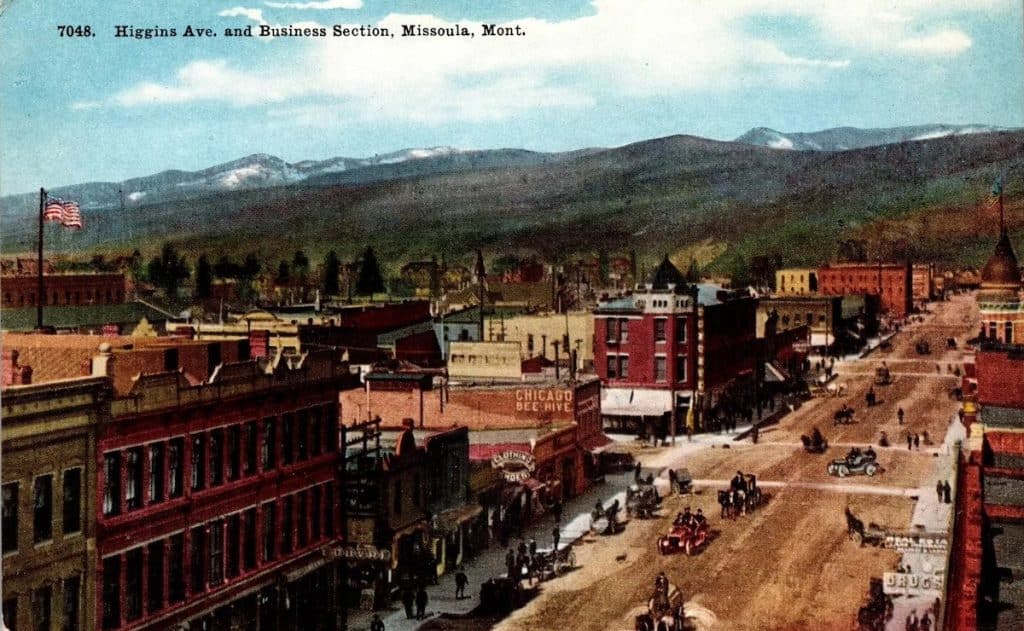
The building that housed the Montana Bar, however, is easy to spot. It is the only structure in the alley built with its primary entrance facing into the alley. Look up: the top of the building facing the alley has a decorative cornice and a small false front. It’s peculiar. A false front — the pompadour of architecture — is generally built facing the street where everyone is walking by, not tucked away from view. But if, in 1909, you wanted to put a saloon in the middle of one of the rowdiest, highest-traffic places in Missoula, this alley is exactly where you would put it.
In the early 1900s, Missoula’s red light district and rough-and-tumble saloons were located along West Front Street. As notorious as that made West Front, this alley that ran parallel to Front Street was even more notorious. Bounded by Front, Main, Higgins and Stevens (now Ryman) streets, Missoulians called this little thoroughfare “Paradise Alley,” and, later, “Pig Alley.”
If, in 1909, you wanted to put a saloon in the middle of one of the rowdiest, highest-traffic places in Missoula, this alley is exactly where you would put it.
Missoula’s colorful alley names were almost certainly inspired by New York City’s Paradise and Pig Alleys, 19th century slums known for Irish street gangs, crime, vice, cholera and, in the case of Pig Alley, actual semi-feral hogs. Eventually, these slums were canonized in popular culture through vaudeville songs like “The Sunshine of Paradise Alley” (1895) and the D.W. Griffith film “The Musketeers of Pig Alley” (1912). Much later, Allen Ginsberg nodded to Paradise Alley in his 1956 poem “Howl.” But well before these popularizations, other cities, from Los Angeles to Great Falls, christened their own notorious alleys with the same names.
The earliest reference to a Paradise Alley in Missoula dates back to 1897 — ironically the same year that New York City demolished its Paradise Alley — when The Anaconda Standard carried a story about a Missoula man named Joe Zanders who was looking for a fight. Zanders finally managed to rouse a sleeping drunk at the bar, who then proceeded to beat the shit out of Zanders. It was, according to the Standard, the hottest fight in Missoula’s Paradise Alley “for several weeks.”
Three years later, in 1900, The Anaconda Standard announced: “Missoula now is in line with the other large cities of the union in the respect that it has a Paradise alley.” The naming, the Standard said, had been put off because there wasn’t money to paint the sign yet.
In the early 1900s, stories about Paradise Alley popped up occasionally.
In July of 1900, a white man and a “colored” woman were arrested in the alley for being drunk and disturbing the peace. The man was fined. The woman was given five hours to leave town.
In July of 1903, an Alaskan malamute badly bit Frank Hontoon, familiarly known as “Hawkshaw, the detective.” The dog had been posted up in his usual spot by the Louvre Saloon, which was located at the entrance to Paradise Alley. After he returned from the hospital, Hontoon got his pistol and shot the dog, who belonged to “Blanche Wilson” (not her real name) a “variety actress” at the Gem Theater (a Front Street establishment with a rear entrance in Paradise Alley). Wilson was broken hearted. She vowed revenge.
Newspapers also noted the insalubrious conditions of Missoula’s Paradise Alley in the first years of the 20th century. The city’s transportation networks were rough dirt streets and wooden plank sidewalks. Some of the wealthier classes had started driving automobiles by this time. But horses, and their copious feces, still prevailed. Gigantic puddles cratered Higgins Avenue, their surface frosted with a green scum. Among this “chain of lakes,” as The Anaconda Standard put it in 1900, was a large one in front of Paradise Alley that the Standard satirically claimed was named “The Gravedigger’s Joy” because of how it helped spread germs. The alley itself, the Standard said, had “always been a dirty hole and a place in which disease found a lurking place.”
Later that year, Missoula’s health officer “cleaned and sanitated” Paradise Alley (as the Daily Missoulian rather vaguely put it). A few years later, electric wires were strung across the alley and the wooden sidewalks were torn up and replaced with cement. The sanitation and modernization of the area seemed to bring some peace to alley.
In 1909, the owner of Louvre, George Nink, decided to move his saloon elsewhere. Paradise Alley lost one of its beloved bartenders and its anchor bar. But a few months later, in May, the newspapers announced that Joseph Wagner was erecting a new building in the alley itself. This was the building that would become the Montana Bar.
Wagner was already well-known in Missoula. He launched the Missoula Brewery in 1888 and owned and operated several bars on West Front Street, including the Montana Saloon, which he eventually closed and re-opened as the Montana Bar in Paradise Alley. The address of the building was, and remains, 125 ½ West Main.
When the bar opened in October 1909, the newspapers claimed that Wagner was escaping the “center of socialist disturbance just in time” — a reference to Missoula’s historic free speech fight, which took place that fall around the corner of Front and Higgins. But given the reputation of Paradise Alley, the Daily Missoulian’s hope that Wagner’s bar would be as “quiet as the neighborhood into which it has moved” can only have been a joke. By this point, the alley’s nickname was shifting away from Paradise Alley to “Pig Alley,” dropping any semblance of romanticism, however ironic.
The earliest newspaper article referring to Missoula’s Pig Alley dates back to May 21, 1910, in a story about two men who tried to rob another man, Fred Murphy. Murphy beat them up, dragged them to the police station and then left, refusing to press charges.
A stream of newspaper articles about Pig Alley followed in 1910 and 1911: There were several robberies and a lot of pulling drunks out of refuse piles and puddles. A man who had caused the police trouble for many years was found “under a box in Pig Alley.” “Fistic warfare” was a regular occurrence, along with some more brutal attacks, such as when an unknown assailant smashed a barber’s head in with a stone, leaving the man’s eye lying on his cheek.
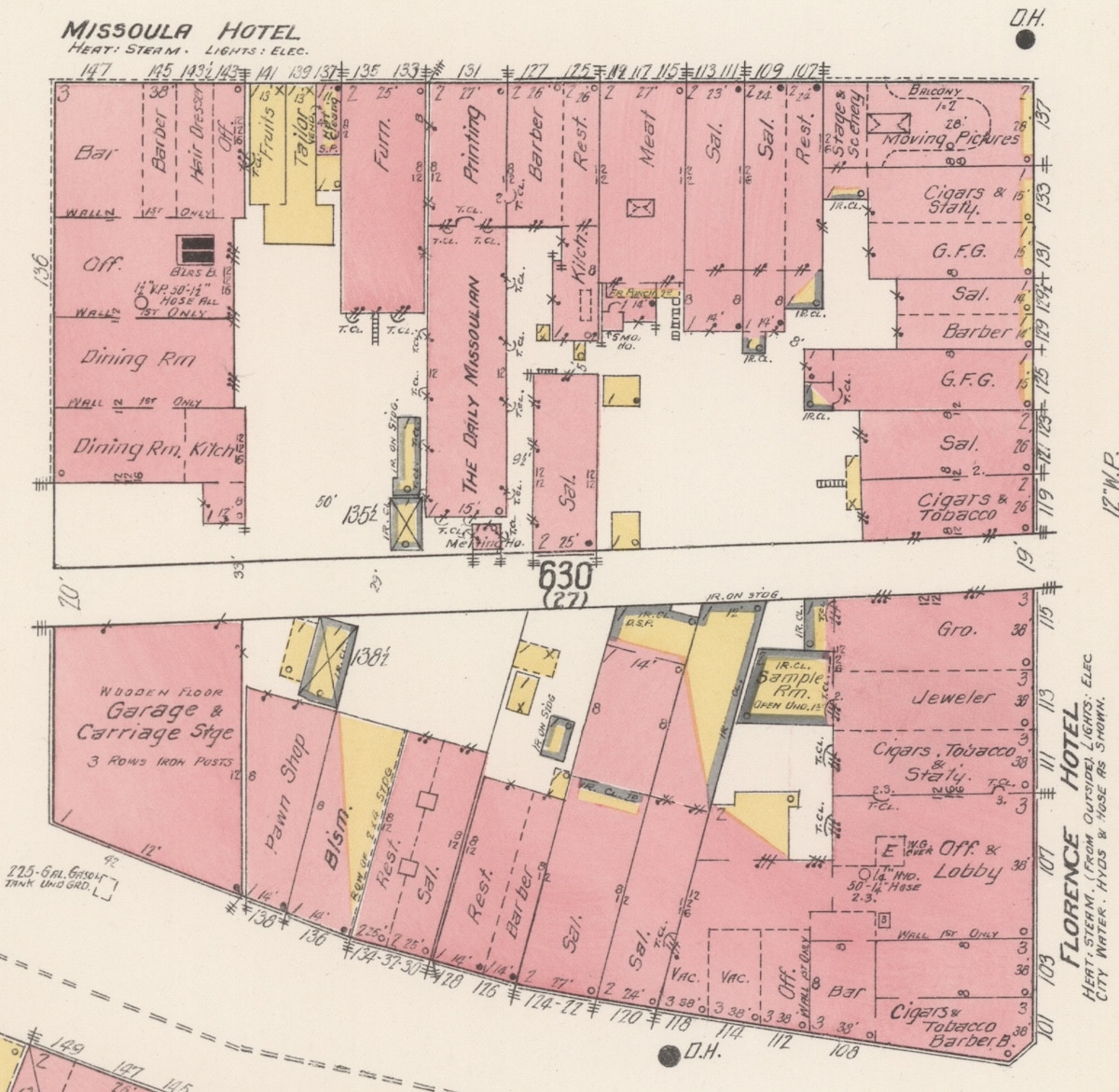
By 1912, the Sanborn Fire Insurance Map shows nine saloons surrounding the alley, with back doors presumably emptying into it. Dead in the middle of the alley is the Montana Bar, making it a 10-saloon alley.
It wasn’t just the saloon crowd that made the Pig Alley a lively place. Next to the Montana Bar (and later behind it, too) was the headquarters of the Daily Missoulian newspaper. Reporters barely had to step out of the back door to write a sensational story about Missoula’s down-and-out. But the Missoulian attracted its own rowdy crowd: newsboys. The turf wars between newsboys picking up their papers in Pig Alley featured prominently in Norman Macleod’s 1941 (and recently re-released) autobiographical novel “The Bitter Roots.”
Missoula-boy-turned-New-York-literary-editor John K. Hutchens (whose father, Martin Hutchens, was the editor of the Daily Missoulian) called the alley “a grimy area memorable for the ferocity of fights among restless newsboys waiting for their papers.” And a 1969 Missoulian column described the days of the teens and ’20s “when every kid had to prove himself before he could make it out of the alley.”
Throughout the 1910s, the fisticuffs, knife fights, robberies and police arrests continued. One night in 1916, 16 drunks were arrested in the alley, with one sentenced to dig “graves for dogs.” That same year, however, Montanans voted in favor of a state prohibition referendum. The law went into effect at the end of 1918, eventually dooming Pig Alley.
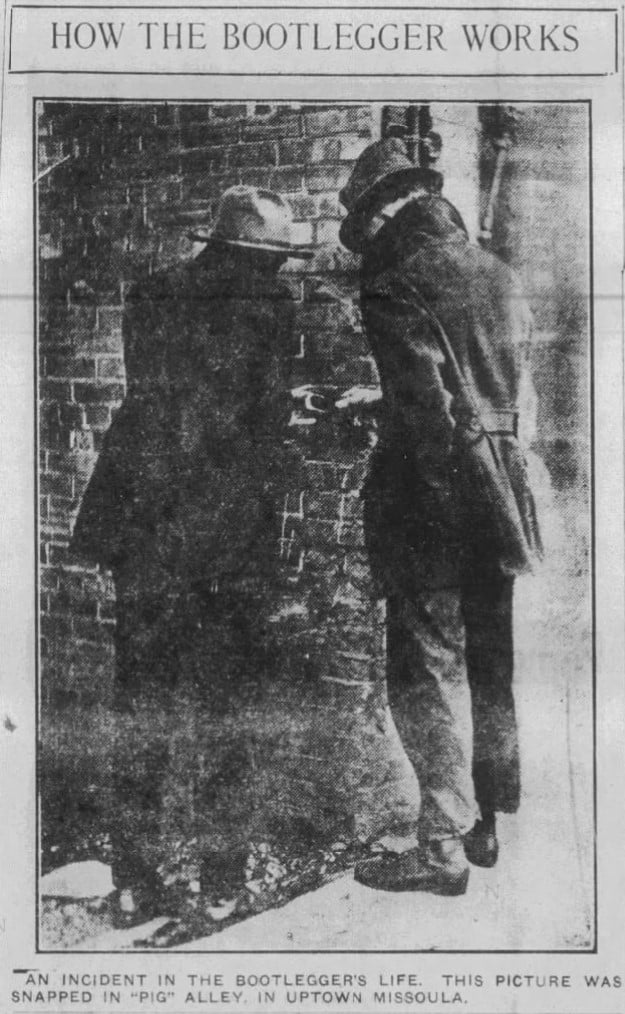
But it didn’t happen overnight. Pig Alley became a center for selling and distributing bootlegged liquor after prohibition. The cops now not only arrested drunks in the alley, but also the people who illegally sold them liquor. In a move common across the country, former saloons like the Montana Bar became purveyors of “soft drinks” after prohibition. But this hardly fooled the police, who raided the former Montana Bar several times during prohibition. After arrests of several owners failed to shut down the illegal sale of alcohol, the courts declared the Montana Bar a “common nuisance” in 1923, completely banning any use of the building.
More broadly, police and citizen reformers pushed to smother bootlegging activity in Pig Alley and in other parts of the city. While prohibition was far from a success in Missoula as elsewhere, the raucous days of Pig Alley in the 1910s dissipated in the 1920s.
By the time prohibition ended in 1933, “Pig” and “Paradise” alley were gone, although the nicknames lingered on for some time. In the 1930s, Jake Abuya re-opened 125 ½ West Main as a bar, Jake’s Bar. As late as 1956, it was still described as being located “Down Paradise Alley, Back of Penny’s.” Stabbings were no longer common, but Jake’s Bar was home to both the hard-drinking Missoulian reporters and the University of Montana’s rowdiest student organization, the “Kams and Dregs.” Dressed in a uniform of blue jeans, an untucked white workshirt, and a “customized hat’,” the co-ed organization listed its official purpose as “disorganization” and pulled off numerous pranks, including commandeering a high school marching band’s instruments to carry on their own discordant parade.

In the 1960s, 125 ½ W. Main switched owners and reopened as the “Gay Nineties,” a saloon that mashed together the decadent vibe of 1890s Paris and the 1960s go-go dancing craze. In an apparent homage to the 1890s, the bar was advertised as being located in “Gaslight Alley.” By 1971, however, the owner of the bar said it was losing money due to its “undesirable” location. The Gay Nineties soon moved out to Brooks Street, along with a lot of other businesses that began abandoning Missoula’s downtown between the 1970s and 1990s.
Missoula didn’t completely abandon its downtown or its infamous alley. Two restaurants opened in 125 ½ West Main: a sandwich shop in the 1970s and, in the 1990s, the Alley Cat — Pearl Cash’s restaurant before she launched the popular French cuisine restaurant, The Pearl, over on East Front (now Brasserie Porte Rouge).
In the 1980s, a bar opened in the old Missoulian building (now the Confluence building) and eventually morphed into Jay’s Upstairs, a punk venue renowned for its wild shows. Numerous local bands as well as touring acts like the White Stripes, Blanks 77, and D.O.A. loaded their equipment in from the alley, up the hellishly steep enclosed stairs to the second floor. The Jay’s bar back entrance kept Missoula’s old Pig Alley a lively and rowdy place.
By this time, the memory of the original Pig and Paradise alleys were long gone, however. When a columnist for the Missoulian revisited (for the last time as it turned out) the legend of Pig Alley in the 1990s, lore was already replacing historical fact. The columnist attributed Missoula’s Pig Alley name to a mispronunciation of a raunchy Paris district called “Pigalle.” The district did come to be called “Pig Alley” by Americans, but that happened during World War II. A different origin story, given by an old timer in the Missoulian, claimed that the name came from the alley having a “Blind Pig” (a speakeasy) in it during prohibition. But clearly, Missoula’s “Pig Alley” was older than these origin stories indicate.
Maybe you don’t need the facts, though. Missoula’s downtown partiers continue to haunt this alley of ghosts, roaming from bar to bar or spilling out the backdoors of the Rhino, the Mo Club and other adjoining bars. They soak up their ethanol and, perhaps, soak up the rowdy ether of an earlier time. If they look up every once in a while, they might see the faded signs of that time, too.