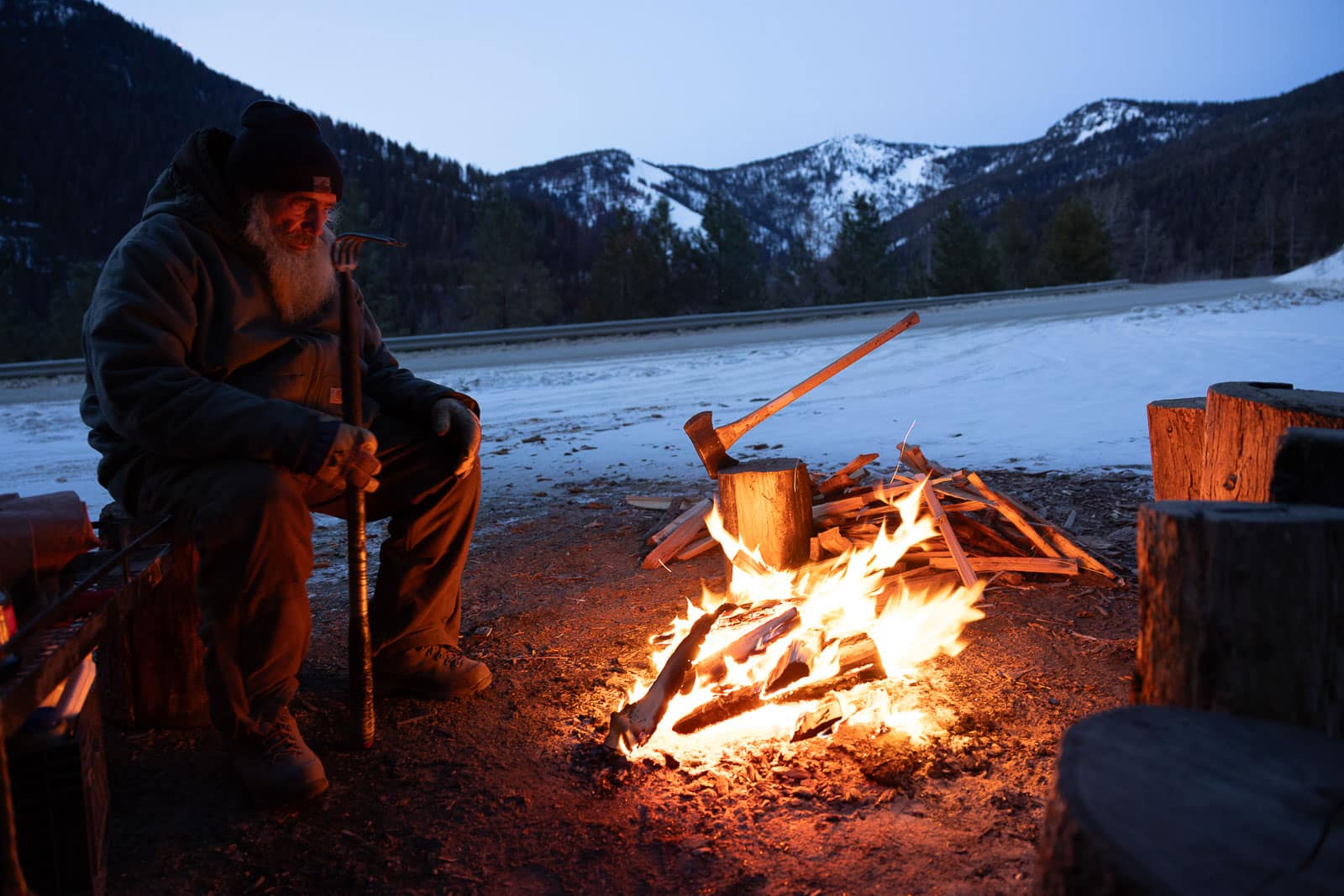
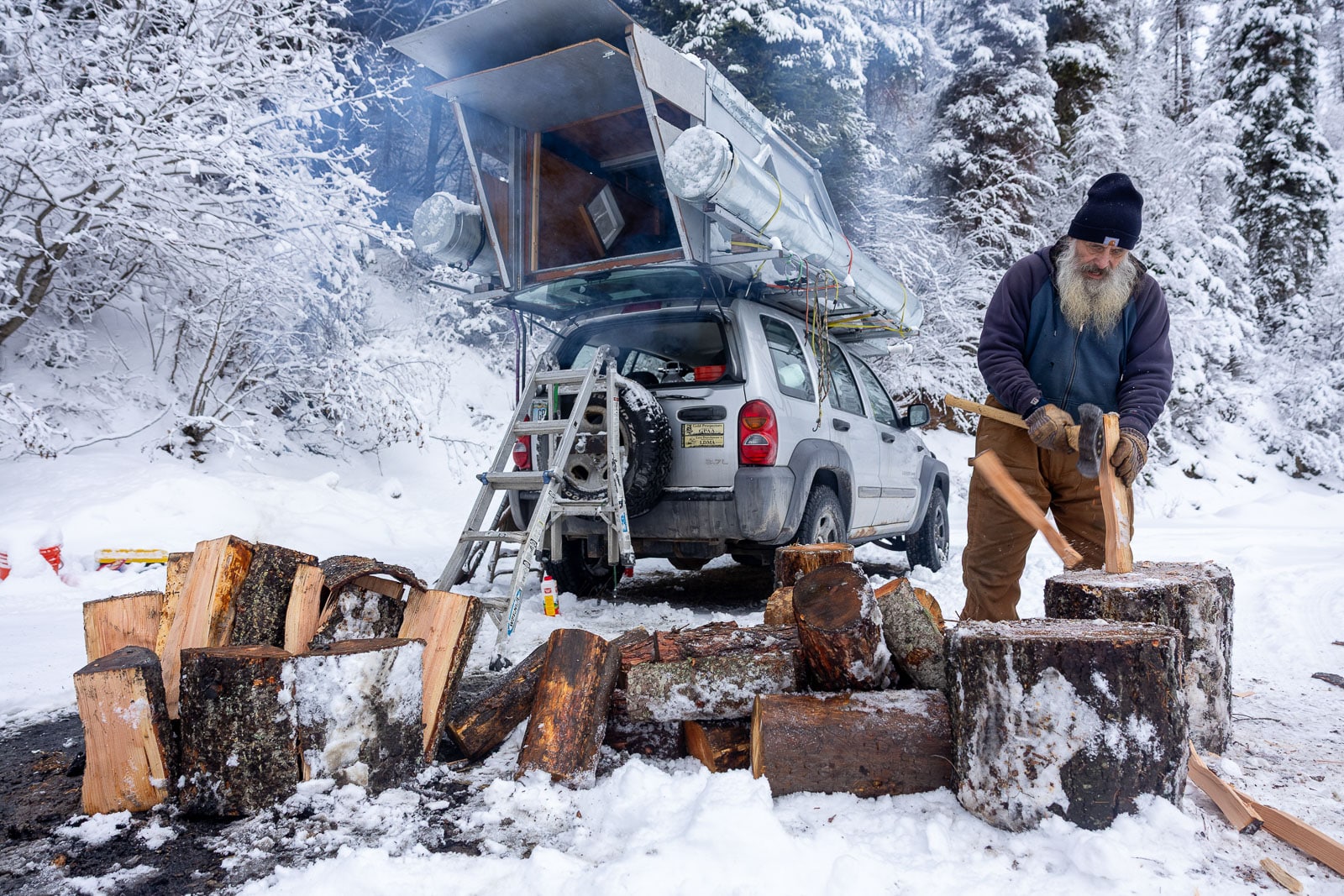
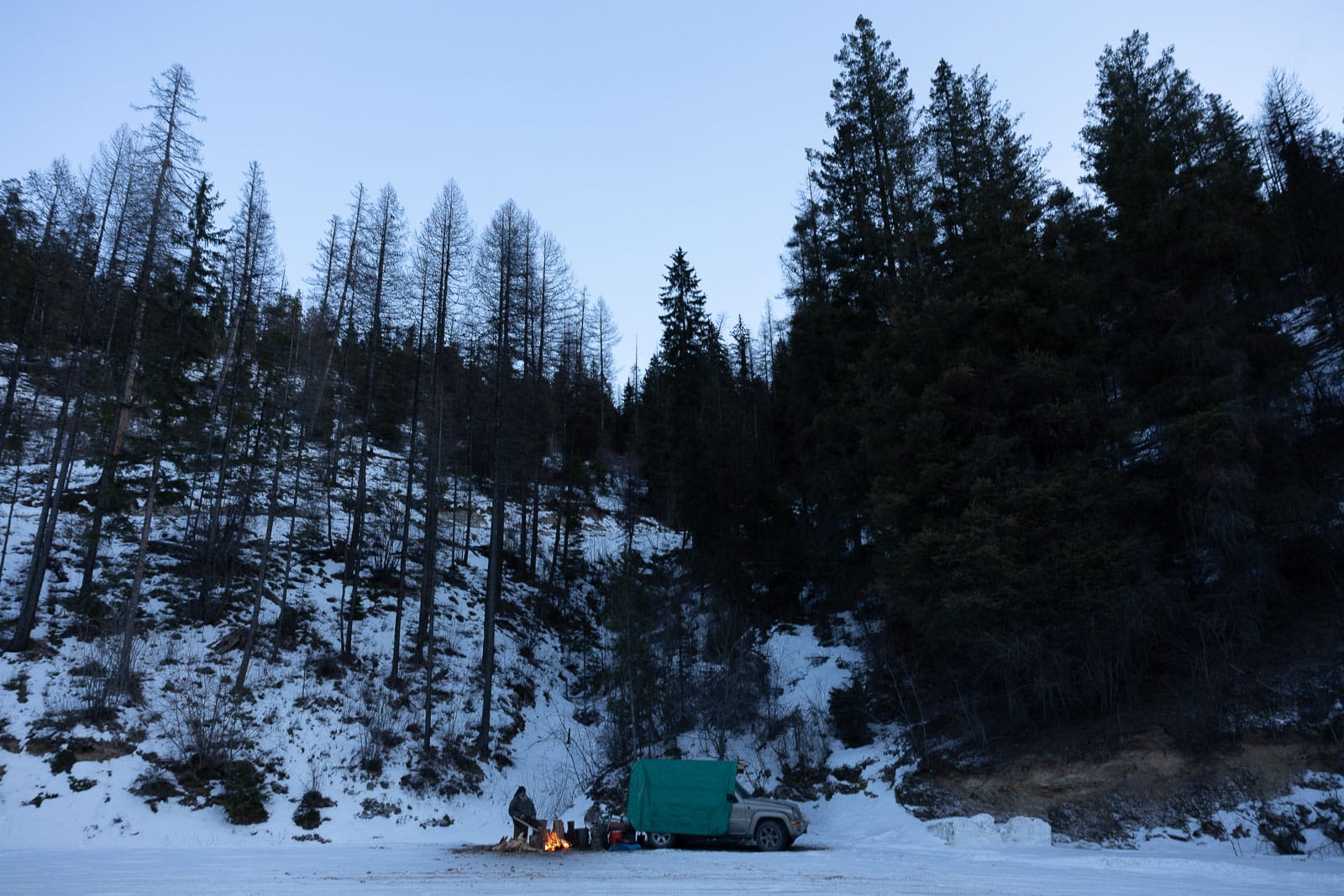
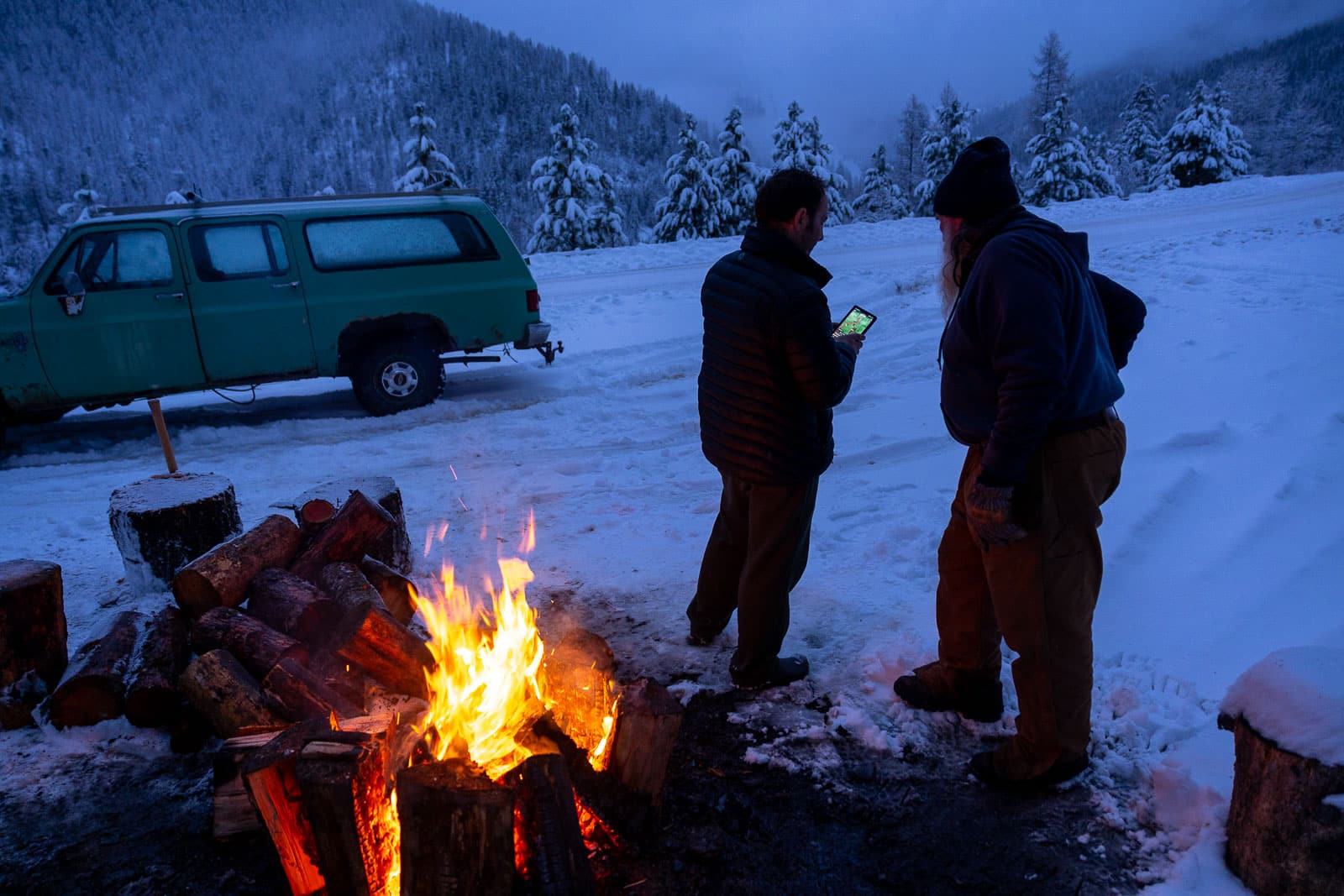
The Jeep SUV with its handbuilt rooftop camper is parked in a wide turnout a mile and a half below Montana Snowbowl ski area. The camper is flanked by two wide metal cylinders pointing forward like it’s a spaceship about to take off. The first time I see it, around Christmas, I suspect the cylinders hold a quiver of skis. Nice basecamp, I think. Someone’s ready to shred powder. But the next time I drive by I notice there’s a stout man with a long grey beard tending a campfire.
For a week, I see him by the fire, surrounded by a large pile of wood, half rounds, half split, snow melted in an arc around him. Skiers on the chairlift, in the bar and in the lodge’s locker room have started wondering who he is, too. Finally, in early January, curiosity got the better of me. I have to stop.
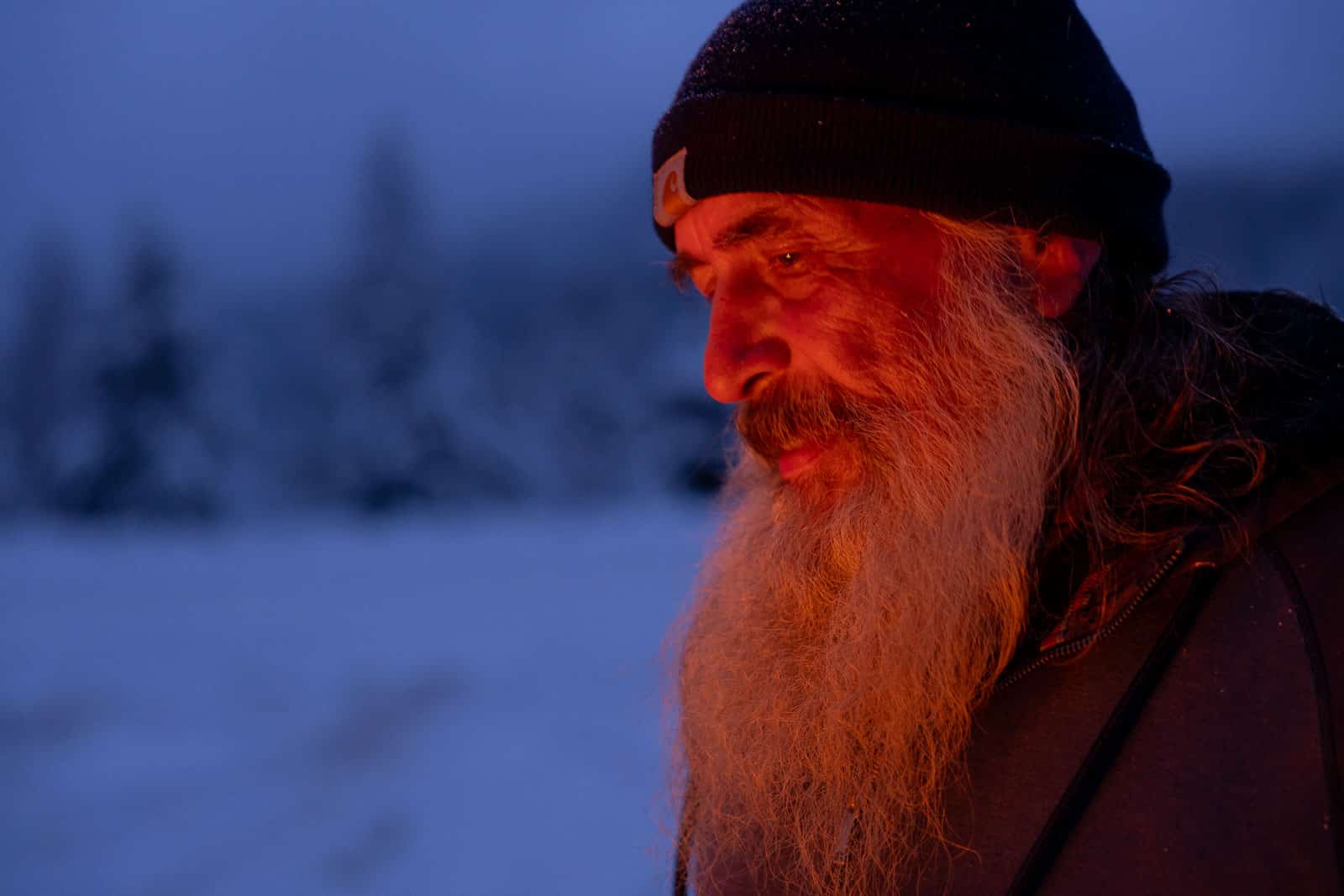
His name is Arthur Paul Kaske, a 75-year-old homeless veteran. Decked in a thick hoodie and lined Carhartt pants, Arthur wields a double-sided axe with ease. He splits large rounds into smaller pieces and jokes, “I’ve made fires my whole life. This is easy for me.”
Most days he keeps warm by burning wood people donate to him. But nights can be tough. The camper, which he made himself, is better suited for summer camping — there’s too much condensation in cold weather. So, most nights he crawls into the front seat of the Jeep and sleeps there — or tries — turning the heater on and off to stay warm.
Arthur finishes splitting wood, wedges the axe into a log and drops into a folding chair by the fire. He’s an easy storyteller — a raconteur. But when the firelight catches his eyes, you get the sense he isn’t giving everything away.
Arthur has been living out of his rig in the mountains since October 2025 when he was evicted from his rental in St. Regis. He says he was wrongfully evicted and he’s biding his time on the hill, trying to sort out his appeal — along with some other legal matters — before he makes his next move. But it’s been complicated.
Arthur has lived in Missoula on and off since 1978. “I initially learned about Snowbowl, just bombing around on my motorcycle,” he says. “I knew the road was here, and I figured that I’d come up here and take a look at it to see if there was some way that I could hang out here. I needed to make myself comfortable. And so, this happened to be a matter of convenience.”
He seems suited to another era when being industrious and self-reliant meant facing the elements with nothing but your own hands and wits.
He has another Jeep SUV in storage, and he’s building a rooftop camper for it, too. When the heat stopped working in the Jeep with the finished camper, he had to switch to the other Jeep while he repaired the heater himself. This location suits him. It’s close to town and to his storage unit, but it’s still in the hills — and the hills are where he finds solitude.
But it’s a precarious kind of solitude. This turnout isn’t public land. It’s private property whose owners early on gave Arthur some latitude — as well as a little water and food — but made clear the arrangement has limits. Yet Arthur is still here. He’s occasionally moved between turnouts along the road, crossing onto different patches of private land and Forest Service land, as circumstances have demanded, like when he’s gotten plowed in. Camping on Forest Service land is limited to 14 days. He’s trying to move his post office box from St. Regis to Missoula, but the post office won’t give him one in Missoula because he doesn’t have an address there. Or anywhere.
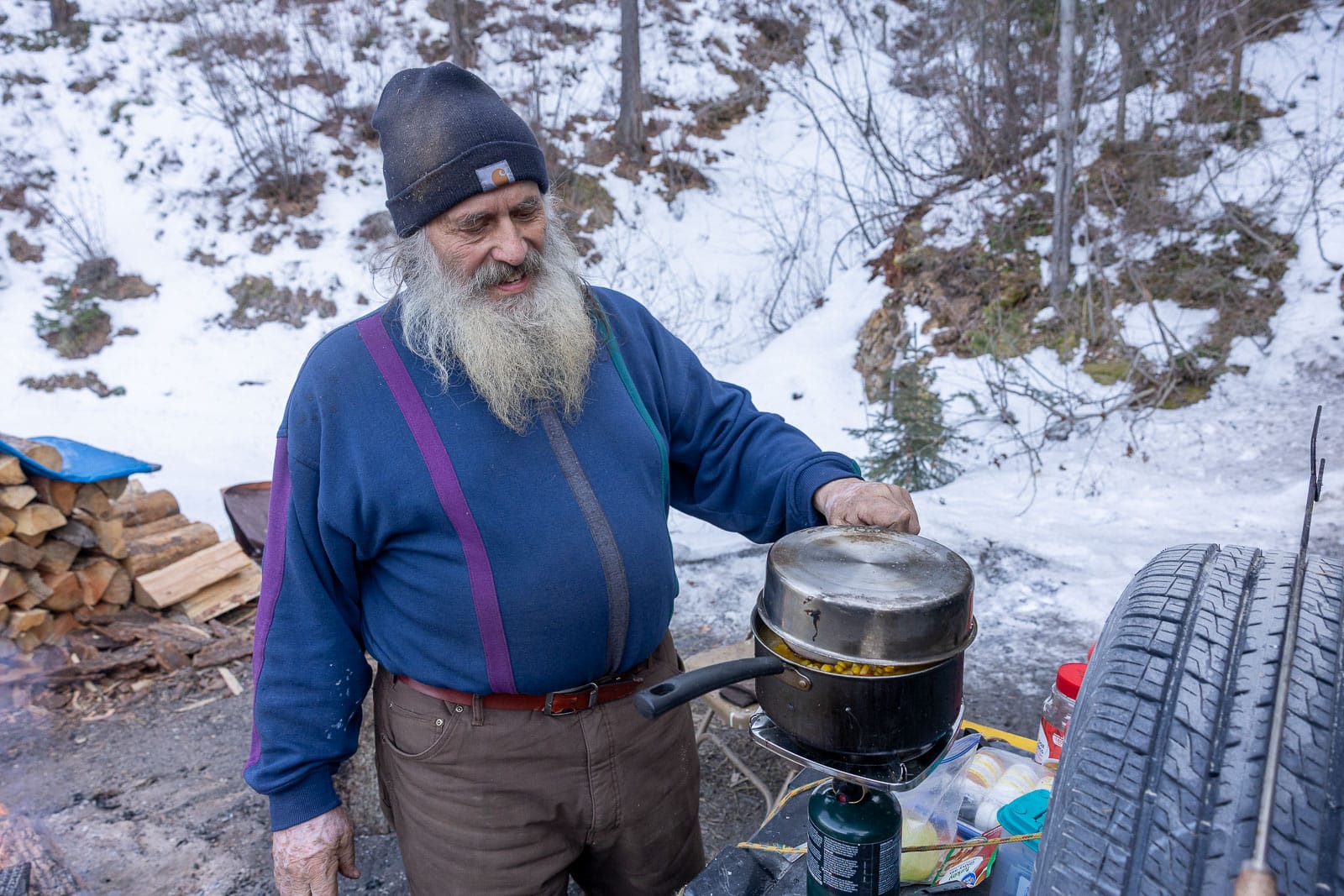
One afternoon Arthur stirs a pot of boiling potatoes and carrots over a small one burner propane camp stove. The cargo carrier on the back bumper of his Jeep serves as a makeshift kitchen and catchall for camping essentials: fire starter, camp fuel, tarp, a Ziplock bag of medicine, two jugs of drinking water, instant coffee, and a mug someone gave him — Bigfoot stamped with the U.S. Forest Service emblem that reads “Sasquatch Department.”
He adds corn and turkey into the pot, hoping the stew will last a few days. “I eat when I’m hungry and I sleep when I’m tired,” he says. And, for Arthur, that usually means eating one meal a day.
He grew up with six sisters and four brothers in eastern South Dakota and there is one thing he remembers fondly: the farming.
“Three feet of black topsoil,” he says. “The best dirt that you could ever grow stuff in, and we grew a thousand pounds of potatoes every year.”
He smiles and says they didn’t go to the store. They went to the garden. To this day he still loves dirt.
Arthur graduated high school during the Vietnam War and ghosts from that time still haunt him. But it wasn’t the war that wreaked havoc.
He had a wife and a child. In 1970, after their child died of sudden infant death syndrome, Arthur received a hardship deferment from the draft. A year later, anxious about getting drafted, he joined the Air Force.
“I decided the Air Force was the place for me to go,” he says. “Less chance of me getting killed.”
With the Air Force, Arthur spent time in Texas, Alaska, Montana and North Dakota. It was October 1974. Arthur, still working in the Air Force, was getting ready to go hunting when he got the news: His pregnant wife had been killed by a drunk driver in a car accident near Groton, South Dakota — the area where they both grew up.
“I just needed some privacy — and a decent set of circumstances where I could, you know, be somebody. I don’t have to have my emotions always tied up in knots.”
“I’m like, what in the hell just happened?” Arthur chokes up and pauses before continuing. “I’m 24 years old. And I don’t know what to think of the world.”
Arthur was left to raise their other child, a 2-year-old son named Nathan, who would end up disowning him later in life. He says he was stumbling through life looking for answers. He looked for answers at the bottom of whiskey bottles but didn’t find any there. Eventually he crawled out of the bottle.
“There were difficult times,” Arthur says. “I mean, the first 10 years after my wife died was a nightmare. Absolute nightmare.”
The fire crackles and he rakes the coals along the edges back into the flames. “Everybody on this planet struggles with something,” he adds. “Whether sooner or later … we’re all gonna suffer radically. I mean, seriously. In life, [there’s] just no way around it.”
One evening, by the firelight, he strokes his beard and looks up toward the twilight sky. He seems suited to another era when being industrious and self-reliant meant facing the elements with nothing but your own hands and wits. Maybe on board Ernest Shackleton’s Endurance or, better yet, traversing the treacherous 33-mile Chilkoot Trail from Alaska to the Yukon during the Klondike Gold Rush.
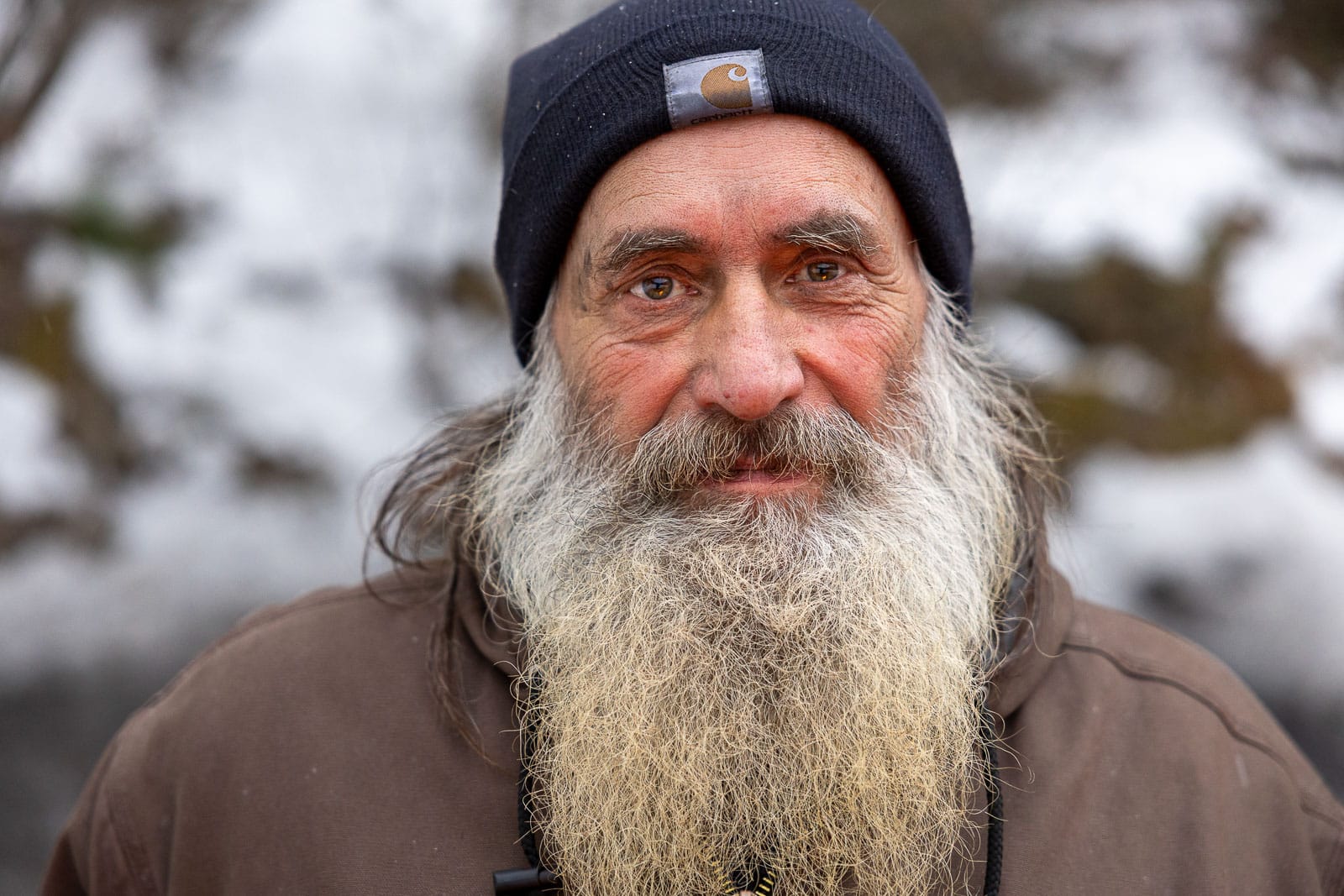
I ask how long he’s had his beard and he says it’s only been two years. I joke that it looks like he’s had it forever. “It makes you look like a prospector from the 1800s,” I say. His eyes open wide. He tells me he got into prospecting while serving time in the Montana State Prison. He’d been charged with criminal drug possession and then when he fled to New York, charged with bail jumping. But for the last three years he was behind bars, he read everything he could on how to get into prospecting.
When he got out in 2009, he joined the Gold Prospectors Association of America to get access to maps and other resources. He points to the GPAA sticker on his Jeep. He had no background in prospecting, no real-world experience, but it sounded like something he would like because he could do it by himself and it got him into the woods. And it opened a new world — of hope, anticipation and reward.
“I just needed some privacy,” he says. “And a decent set of circumstances where I could, you know, be somebody. I don’t have to have my emotions always tied up in knots.”
His prospecting extended to metal detecting for old coins. Once, while sweeping the grass around the Oval at the University of Montana, he turned up a 1986 class ring — buried there, he later learned, since a student set it down to play frisbee some 25 years earlier and never found it again.
“As a high school student, I thought art was for sissies. That was my thought. And it stayed with me: I don’t do art. Even though my name is Art.”
The four-pronged rake he uses to flip the fire’s logs is a rock rake he uses to dig for gems and minerals. He clutches the handle with his scarred hands and a smile sweeps across his face.
“Yeah, gold fever. Oh, yeah, I’m hooked. I’m in,” Arthur says, laughing. “Yep. Yep. It’s the best disease I’ve ever experienced: Gold fever. Yeah, the first time you see it in your pan, you don’t ever forget.”
His prospecting addiction isn’t that different from my addiction to powder skiing. We share a laugh about that. To each their own.
He recalls the places he’s prospected and talks about a prospecting route he’d like to follow one day that would take him through Oregon, California, Arkansas, South Dakota and Montana.
Prospecting helps him achieve what he calls “equilibrium.”
Throughout the weeks I’ve been visiting him, the temperatures warm. Though he doesn’t love the traffic on the road, there’s a rhythm to the flow of morning and afternoon skiers.
“Most people leave me alone,” Arthur says. “They just wave most of the time … and there’s a few of those that stop in and chat.”
A few in the local ski community have taken more interest in his situation and offer help. One rider gave him bison meat and some company. Another dropped off cinnamon rolls. A resident at the bottom of the hill brought Arthur a few truckloads of extra wood and some downed trees he needed to burn. Arthur was happy to help and has been burning that wood for two weeks.
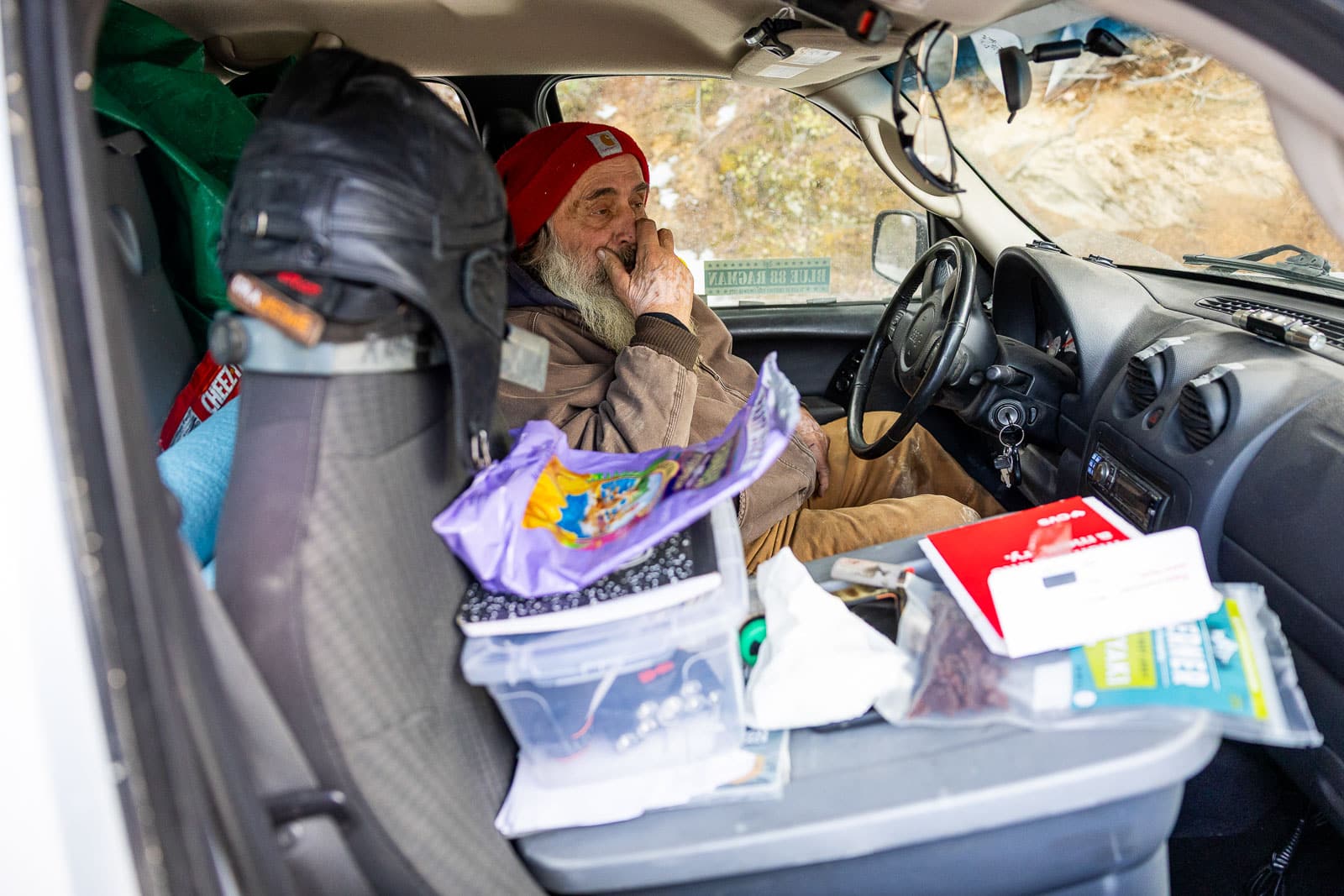
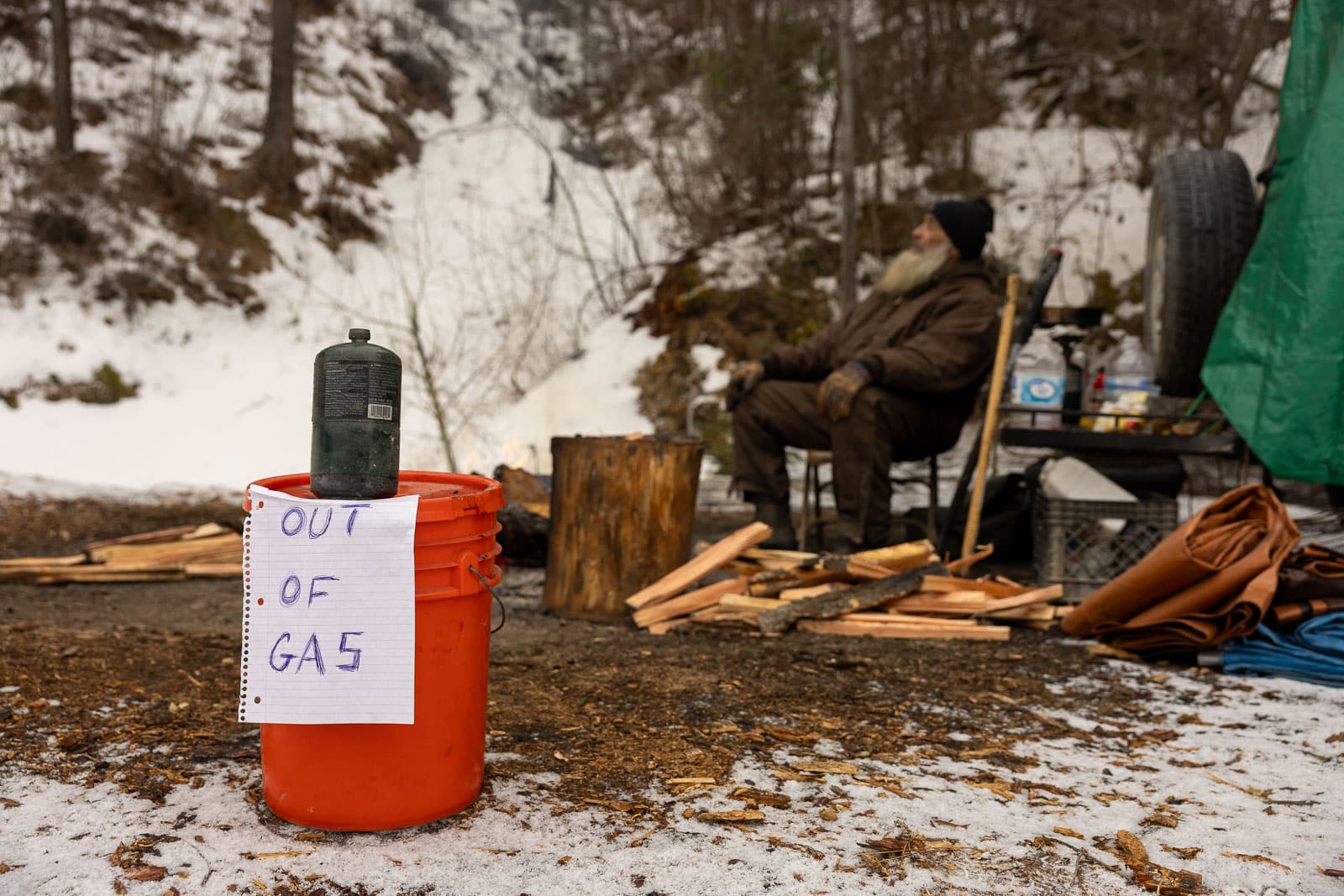
But now it’s late January the supply begins to dwindle, and he starts burning less wood, rationing the flames. The gas in his rig nears empty from using the heater each night. He keeps the fire going right up until bedtime. He’s got to make it to Friday when his disability check arrives in his account. Then he can head to town to do laundry, take a shower and resupply food for the next stint. He used to work trail crew in the Selway-Bitterroot, so he knows the rhythm of a hitch.
The other night he had to burn denatured gas inside his car to warm it up before bed. In the morning, he placed an “out of gas” sign on an orange bucket under a Coleman fuel canister.
Curt and Patty Spurzem stop by after a morning of skiing. They offer him a little cash and ask about his situation. They pass him a Hope Rescue Mission business card and tell him about a few other services that could help him find a place to live. Shortly after they leave, another driver slows and rolls his window down. “Art, everything OK?” He asks. “I’ll bring you some pizza tomorrow.”
I ask what his GRIZART license plate means. He chuckles and rewinds me to the 1980s. He had transferred from a community college in South Dakota to the University of Montana. He was taking lots of general classes, and he somehow found art, which was a surprise
“As a high school student, I thought art was for sissies,” Arthur muses. “That was my thought. And it stayed with me: I don’t do art. Even though my name is Art.”
Looking through the variety of classes, something struck him about beginning ceramics, and he signed up for a class with Rudy Autio.
“I came to art, and I came to the clay,” Arthur says. “I’m a farmer. I like the dirt. And so there, too, it was like, OK, let’s try this.”
By this time, Autio was a legend. Given the nickname “The Matisse of Ceramics,” he was considered one of the most innovative ceramicists of his generation. He was a foundational figure at the Archie Bray in Helena where ceramicists from all over the world came to work and he had started the ceramics program at UM in 1952, influencing ceramic students for a couple decades since then as a teacher.

Early on in the class, Arthur remembers that Autio placed a huge mound of clay on the table and said, “Here’s the clay, there’s the [pottery] wheels. Have at it.”
“I just took some clay and prepped it,” Arthur says. “I sat down on that wheel for the first time, and I put that clay on that wheel. And as soon as I did that, I said, ‘I like this.’ And I never stopped, from that point on.”
In the mid-1980s, Arthur dropped out of UM. But then, he returned to the program a few decades later, finishing in 2013 with a degree in fine arts at the age of 62.
He can talk for hours about the glazes, the types of clay, the way the mountains inspired his colors and the thrill he got from experimenting with texture and structure using sawdust and other materials.
“I loved it so much,” he says. “I still do.”
Arthur pulls a folder from his Jeep. Inside is the eviction paperwork from the court. He believes it was a retaliatory eviction because he complained about the living conditions of the rental property. His appeal was rejected because he’s representing himself and there was an electronic filing issue. But getting paperwork sent through the mail isn’t easy for him. Now he’s filing a new appeal. He doesn’t want the eviction to ruin his ability to rent in the future. Frankly, he says, he’s ready to leave homelessness behind.
“I’d love to go put a down payment on a house,” Arthur says. “It’s been a pipe dream for years now for me. I’m just going to keep going until I finally succeed, or I die trying.”
Arthur rakes the coals together again, stoking the fire. The act is primal. The heat is survival. He says sitting by the fire brings him equilibrium. Like prospecting does. Like ceramics does, too.
This year he has diamonds glittering in his eyes. He would really like to drive to Arkansas for warmer weather. When he got there, he’d go to Crater of Diamonds State Park, the only place in the United States where the public can mine for diamonds and keep their finds. He dreams of finding a large diamond — like the one a family found there last September. Something that would fuel him. Keep the ember burning.
When he’s not dreaming of diamonds, he dreams of a tiny home in Northwest Montana with a small garden and an art studio — a home base so he can prospect for gold in the summer and throw clay on the wheel in the winter.
But the dreams will have to wait for now. As winter turns to spring, he plans to move his camp to Libby — his time on the hill winding down by choice and by circumstance — where he can start scouting for summer prospecting spots while he awaits his appeal.
I hop in my truck and start it. Art waves, calling out his usual goodbye: “Happy trails.”
“Happy trails, Art,” I answer.