In 1989, a discovery was made on the grounds of Rattlesnake School. Construction crews had been excavating the area in Missoula’s upper Rattlesnake neighborhood to build an addition to the middle school (now an elementary school). According to a Missoulian article at the time, a neighborhood resident, Chlo Murdock, and her 9-year-old daughter were walking on a trail through the school grounds when the daughter reportedly said, “Look, Mommy. A human skull.”
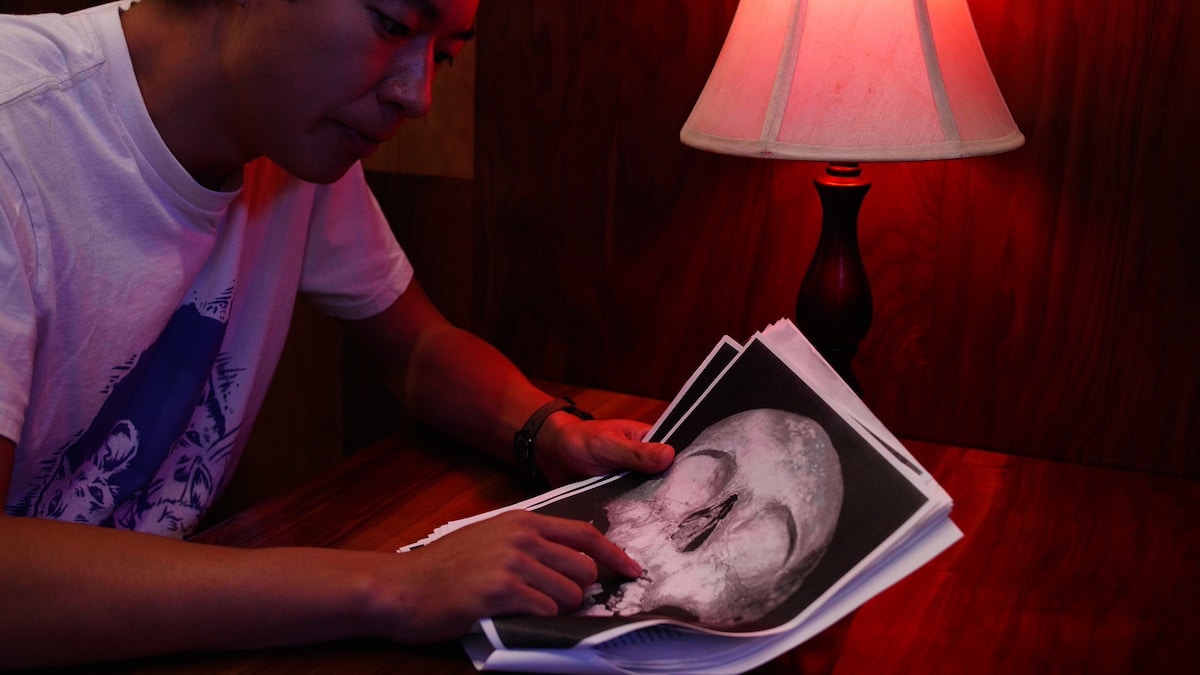
Throughout the summer, as construction continued, the Missoulian reported that bones and splinters of wooden coffins were unearthed, along with about 20 skulls, “some with teeth and long hairs still visible.” These remains, the newspaper reported, were believed to belong to residents of Missoula’s Poor Farm and Pest House, as well as to Chinese people who were not allowed internment at Missoula’s city cemetery.

The thing is, this “discovery” wasn’t new. Human remains had also been found there when Rattlesnake School’s original building had gone up around 1960, just after the Poor Farm was sold by the county.
A new documentary called The Bodies Beneath Us explores the story of two gravesites: the Rattlesnake School grounds, including Pineview Park, and another gravesite in the lower Rattlesnake, long obscured under a stretch of residential neighborhood at the base of Mount Jumbo.
The film, directed by Max Cumming and produced by UM history graduate Dylan Yonce and political activist Paul Kim, provides a peek into the history of these sites through interviews with local historians. But it also prods at the issue of how these unmarked sites keep getting lost in Missoula’s collective memory. They wanted to know: When it comes to our dead, who do we remember, who do we forget—and why?
When it comes to our dead, who do we remember, who do we forget—and why?
The Bodies Beneath Us is also personal. Yonce grew up in the Rattlesnake and her parents and grandparents also resided there. Her parents had attended Rattlesnake School before the annex went up, and by the time Yonce entered Rattlesnake, a monument to the people buried there had been erected. But still, there was very little understanding in the Missoula community about the gravesite.
“I always knew that there were bones underneath that school, but I didn’t really know how they came to be there,” Yonce told The Pulp in a recent interview. “The memorial at the school—I don’t know if you’ve seen it—it’s an arch with this artistic rendition of faces on it. I remember playing on that in elementary school, but that was sort of the extent to which I understood it.”
Kim got a degree in geography at University College of London and spent some of that time writing about contemporary politics in Montana. They were involved in political campaigns, but when they graduated and moved to Missoula, Kim became drawn to the state’s political and cultural history, where they learned about influential Montana historians such as K. Ross Toole.
“And I realized that there was a ton about Montana’s politics that I didn’t know, and that taking elections discourse as my main way of understanding the state was actually pretty superficial,” Kim says. “I learned about histories of settlement in Montana, which were pretty eye-opening to me. But I also learned about alternative racial histories, like that of the Chinese in Montana, that blew my mind.”
Yonce, Kim and Cumming were roommates in Missoula when they decided to work on the documentary. Cumming, a filmmaker, had been looking for a documentary subject, and it became clear that Yonce’s interest in the history of the Rattlesnake and Kim’s interest in Chinese history and burial could align into one project.
The documentary is informed by several sources. The filmmakers interview Bonnie Flanagan, a local historian who wrote about the Poor Farm, and history professor Leif Fredrickson (full disclosure: my brother), who heads UM’s Public History Program. The doc also relied heavily on Mark Johnson’s 2002 book “Middle Kingdom Under the Big Sky” that mined primary documents left by Chinese pioneers (which had to be translated into English for the first time) and serves as a window into the challenges faced by the Chinese community in Montana.
The Bodies Beneath Us also uses research from UM archaeology professor Kelly Dixon, who wrote a paper called “Verily, the Road was Built with Chinamen’s Bones.” The paper’s title comes from an excerpt in an 1880 story from the Helena Independent Record that describes how the railroad built from Spokane to Helena was marked by faint protrusion of graves of buried Chinese workers. Kim read the paper and recalls being struck, in particular, by Dixon’s mention of forgotten Chinese cemeteries across Montana, including the one at the foot of Mount Jumbo, in Missoula.
“She also included that when people are doing landscaping, or excavation, that bones sort of emerge through the ground.” Kim says. “I’d been living in Montana for about four years at that point, studying its politics and culture, and nobody had really told me anything like that. I started thinking, ‘Well, if this is something that happened, surely there should be some sort of larger public conversation and reckoning about this.’ And so that was kind of the very early inception of what came to be The Bodies Beneath Us.”
Though neither of them had originally planned to be in front of the camera, The Bodies Beneath Us ends up following both Yonce and Kim in their personal journeys to dig into the story of the gravesites. Kim, who is much newer to Missoula, is Asian-American and was interested in the cultural marginalization aspect of the history, and in using the film to get proper recognition through the city for Missoula’s Chinese burial grounds.
As a history graduate, Yonce takes an archival approach to talking about the horrifying history of the Poor Farm and Pest House. But her personal connection to the Rattlesnake and that particular gravesite allows for a more personal take. For instance, Yonce’s grandfather, Steve Smith, who had been a Missoulian reporter and local historian, wrote a book called Pineview, about the hospital that went up after the Poor Farm and Pest House. Interviews with Smith (who passed away during the filming of the doc) provide an informative addition to the historical narrative, but they also tell the story of Yonce’s connection to her grandfather and their shared love of history.
“My grandfather was super excited that we were doing this project,” Yonce says. “He was probably the most curious person that I’ve ever met. And so, of course, to have one of his grandchildren be invested in the practice of history and want to follow along in his footsteps and trace narratives that he was interested in, I think was really meaningful to him. It also just meant that we got to spend a lot more time together towards the end of his life, which, aside from the documentary, we spent some time reading dime novels, going to mass, going to 4Bs—all kinds of things. And so we got really close in the last year or so of our relationship.”
It also gave her a chance to ask him other questions about growing up and living in Missoula that weren’t related to the film. That helped her create an oral history that is meaningful not only to her but her whole family.
“Even though I’m a historian and do a lot of archival work, I’m very interested in investing in oral history,” Yonce says. “I’m not sure without this documentary project that I would have necessarily gotten all my ducks in a row to do something like that with him before [he passed away]. So that was something that became really important to me.”
More than that, because Yonce spent her childhood on the land where the bodies are buried, she’s able to bring in her own reflections and a certain amount of poetry to the narrative that an outsider could not pull off. “People do not see that the ground carries more than just life,” she says in a voiceover in the beginning of the film. “People do not know that it holds death as well. People do not know that over 1,000 of our neighbors are so close to us, just under the soil, sometimes just a scanty few feet down.”
“I think in the end, when you put these two narratives together, you see two very different approaches to memorializing history,” Kim says. “But you also see the similarities between the two approaches and between the two unmarked graves. That’s what we’re trying to go for in the end.”
The Bodies Beneath Us is a reminder that historical record—unchecked—will often omit the stories of the most marginalized people.
Like the story of Missoula’s Black Church on the Westside of town, The Bodies Beneath Us is a reminder that historical record—unchecked—will often omit the stories of the most marginalized people. When these pieces of lost history emerge, they can be surprising and fascinating, but they can also unearth criticism about those who hold power and strike a nerve as the community reckons with its past.
Kim says that making the film was an exercise in how to talk to a community about its own history. They knew the film needed to be fair and rigorous, Kim says, but it also needed to invite conversation.
“What happened at the Poor Farm was pretty gruesome and what happened during Chinese exclusion—pretty gruesome,” Kim says. “But we needed to talk about it in a way that people would be receptive and open to it.”
Yonce says that she has complicated feelings about her family’s history in the Rattlesnake, but that it was important to her that the film, in the end, communicate a deep love for her community. Making the film gave her new insight into the community that had raised her.
“For many reasons, the topic of buried history in the Rattlesnake had never come up in conversation,” she says. “But I got to learn all these really cool things about community members who I’ve known my entire life. That was really rewarding to see how the community came together to help us make this film, because it would have been impossible to do without them.”
As for who this film is really for, Yonce and Kim both say that, while the film is likely to fascinate anyone interested in history, it is first and foremost meant as an offering to the locals who are still in so many ways connected to the bodies beneath Missoula.
In late April of this year, when The Bodies Beneath Us premiered at the Covellite Theatre in Butte, Kim says all three of them felt nervous about how the film would be received. Afterward, they were relieved to get warm applause. And then, a woman approached them. She said she grew up in the Rattlesnake area and lived there her whole life, and that her mother was involved in the memorialization of the gravesite at Rattlesnake School.
“Her mom was Chlo Murdock,” Kim says. “And she was the 9-year-old girl from the newspaper article who discovered the skull.”
“The more people you talk to the more you realize that this isn’t some sort of esoteric history,” Kim adds. “Because it’s extremely personal to people in a way that talking about [politics] almost isn’t. What we learned is, in the Rattlesnake, when you start talking about local history, you’re really just one degree of separation away from it all the time.”
The Bodies Beneath Us continues to screen at the Roxy Wed., June 19, and Thu., June 20, at 5:15 PM, 6:30 PM and 7:45 PM, nightly.