Sometimes you don’t consciously notice a town’s architecture, it just lives inside you. When you’re young and bored — maybe especially without access to smartphones — there isn’t much to look at but the built spaces around you. You can absorb a place by osmosis just by jogging down cracked sidewalks on warm summer nights.
Growing up in Missoula, I absorbed the architecture by scraping my knees on the pavement and following irrigation ditches through quiet neighborhoods. By walking to the UC Center just to buy Now and Laters and looking up at the clock tower when the low bonging of the bell echoed across the campus. And by kicking gravel at the stoops of gorgeous old brick apartments while imagining my future self standing inside its high-ceilinged living room looking out through the bay window at the rest of the world.
Sloped rooftops, cornices, ranch-style balconies, neon signs hanging precariously in alleys — all of it crept in through my periphery to form the landscape of my restless coming of age. You live long enough in a place and it claims you like that: shaping your desires and keeping a ledger — for better or worse — of every stupid, magnificent, brave and embarrassing thing you ever did.
As a teenager, I’d walk to the Crystal Theater, where Gild Brewing is now, and watch films — slowburn arthouse, foreign and classic films — with settings in Parisian cafés and Andalusian courtyards and characters who threw dinner parties in London flats or wrote plays in the East Village. Those historic brick apartments I saw here in Missoula had the same romantic appeal. They weren’t even bougie places, just places with enough poetry to their structure you could imagine your most contented self inside them.
It wasn’t until years later, after living in Chicago and San Francisco and then moving back to Missoula, that I stopped passively absorbing the architecture that shaped me and started deliberately learning about its history — in particular, about Missoula’s most famous architect, A.J. Gibson.

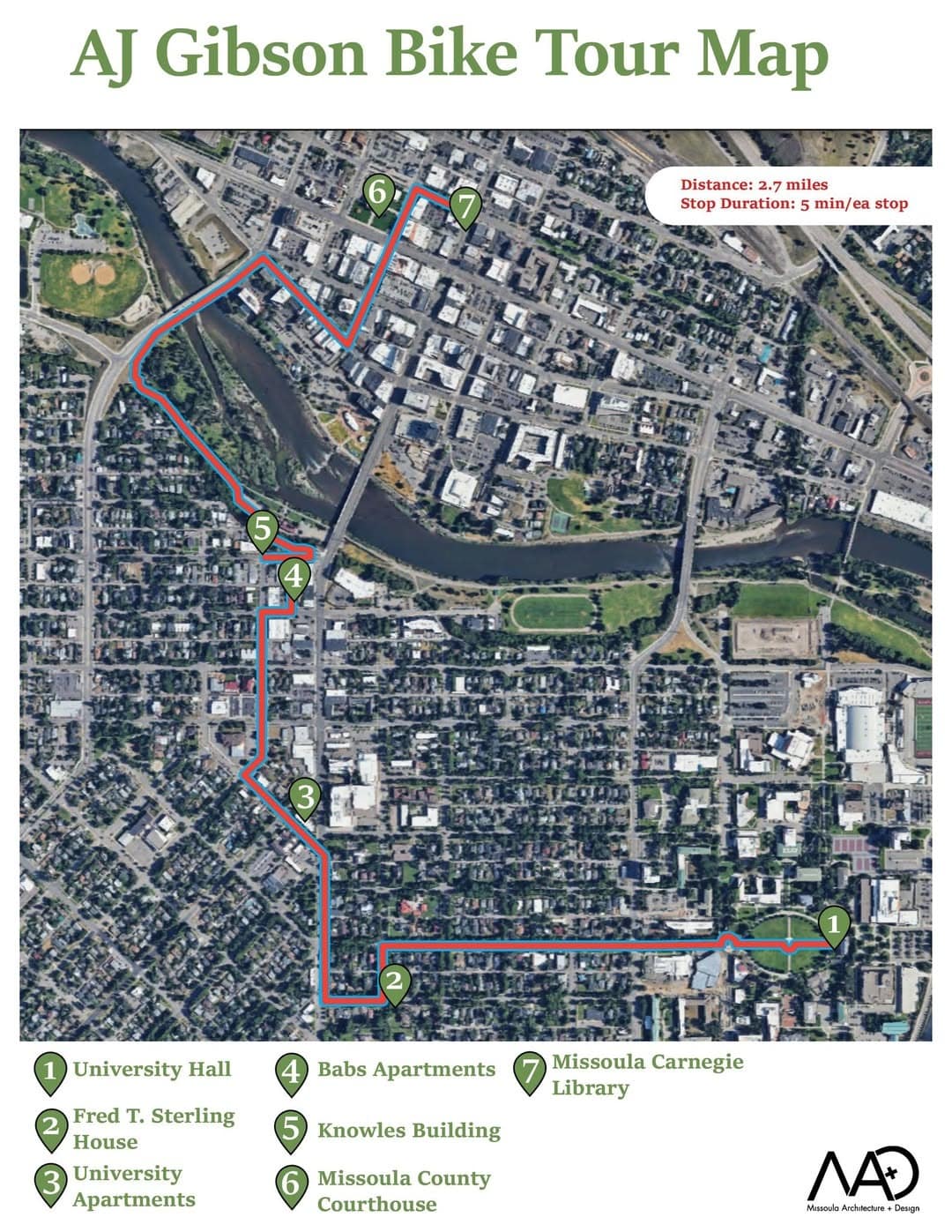
You, on the other hand, don’t need to take the same route since you have the opportunity to go on the A.J. Gibson Historic Architecture Tour, a guided bike ride co-hosted by Missoula Architecture + Design and Free Cycles that traces the city’s history through the buildings and neighborhoods Gibson designed and influenced.
Gibson wasn’t formally trained in architecture, by the way. He was a carpenter who learned how to be an architect on the job while working in Butte before moving to Missoula in 1887.
Over the years he ended up designing public, residential, and commercial buildings across the valley, from modest bungalows to Queen Anne-style follies to Spanish mission-style dwellings with arched colonnades and twisted, barley-sugar columns.
I’m no architecture expert, but Hipólito Rafael Chacón, the director of the Montana Museum of Art and Culture and a professor of art history and criticism at UM, once told me that Gibson was a “revivalist” in that his architecture echoed the styles of previous architects. But Gibson also stayed on top of architectural trends, Chacón noted, while also being deeply pragmatic about the people who would occupy his spaces.
Many of those brick apartment buildings I love are his. They reflect a Missoula that was expanding rapidly at the turn of the 20th century — much like it is now. Some are elegant multifamily dwellings and others are smaller dwellings built for university faculty and staff. You can see similar styles in Chicago, like the stacked, two-family brick residences called the “two-flat,” built in the same era as affordable but handsome immigrant housing, and which were, in turn, a nod to the Georgian and Victorian row houses of Britain and the masonry walk-ups of continental Europe. The idea was simple but pretty radical: density could be dignified. Working people could live in close quarters without giving up pride of place.
Which is what Gibson believed, too. He thought sunlight, good craftsmanship and design should be for everyone. I found that out about him after I eventually, as a full-grown adult, moved into one of the brick Gibson-era beauties I had coveted my whole damn life. It has built-in shelves and wood floors bathed in prismatic sunlight from the leaded-glass window. It also has ceilings that crack from water damage and weird DIY wiring from years of being carelessly maintained by cheap landlords. And I do love it, but its history as an elegant example of craftsmanship scaled for middle class affordability feels ironic now — I can barely afford it.
I don’t know much more about Gibson’s architectural philosophy, but my curiosity led me down some rabbit holes to see what other people have said about how architecture affects our lives. Architectural critic Ada Louise Huxtable has written beautifully about how everyday architecture shapes our identity and moral values. Urban historian Lewis Mumford saw architecture and urban design as “the container of civilization.” Design theorist Christopher Alexander argued that design patterns — a street corner, a stairwell, a row of apartments — can nurture community, connection, and belonging.
I wonder if you’ll notice those sentiments in Gibson’s designs — or at least the ones that he had creative say over. It’ll be a fascinating three-mile ride from the Oval on UM’s campus to the Missoula Art Museum, with seven historic stops each with a story of design, community and local heritage. Bring your own bike.
The A.J. Gibson Historic Architecture Tour is Wed., Sept. 3, from 5:30 PM to 7 PM starting at the University of Montana Oval and ending at Missoula Art Museum. More info.