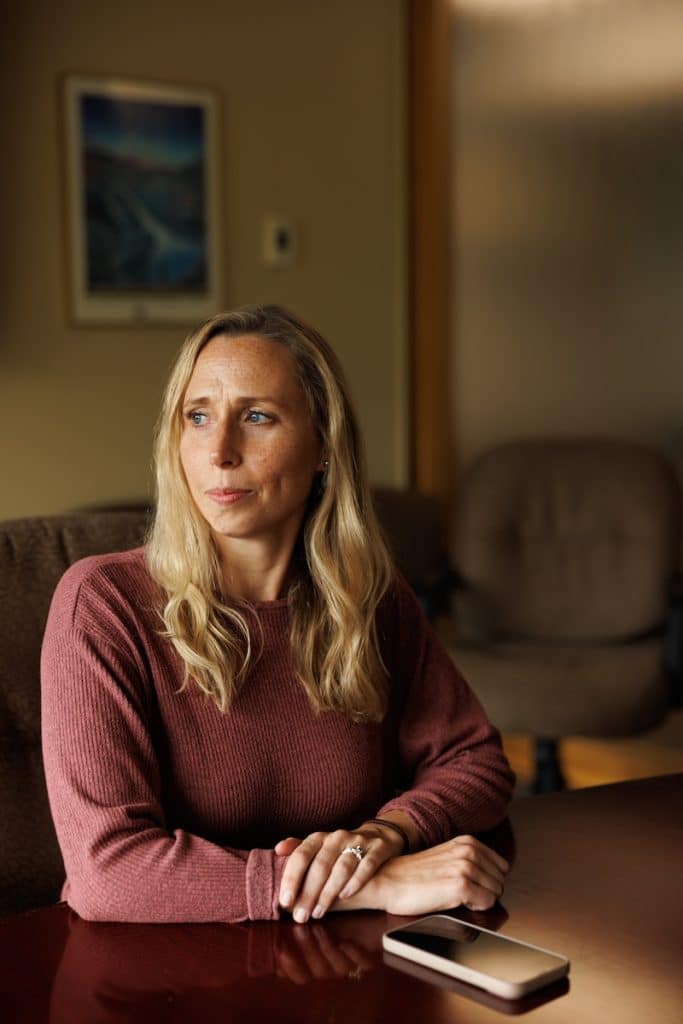
Allison Franz knows how hard it can be to get through to the public. As the communications manager for Missoula County, she’s tasked with packaging and relaying important information to the media and directly to the public about the county’s operations.
But that’s a tough job in today’s highly fractured media environment. We probably don’t need to tell you this, reading this article online, but the methods of this exchange have changed dramatically over the years. No longer are reporters the “gatekeepers” on the information highway. Especially at the local level, traditional outlets have shrunk or disappeared, new ones have come and gone, and people are just as likely to get information about their city (and air their grievances) on Facebook and Reddit as they are from the local newspaper, if not more so.
So we have to adapt. Franz, similarly, is leading the county’s communication office through a sometimes fraught digital age, engaging with the public through newsletters, press releases, podcasts, and, of course, memes.


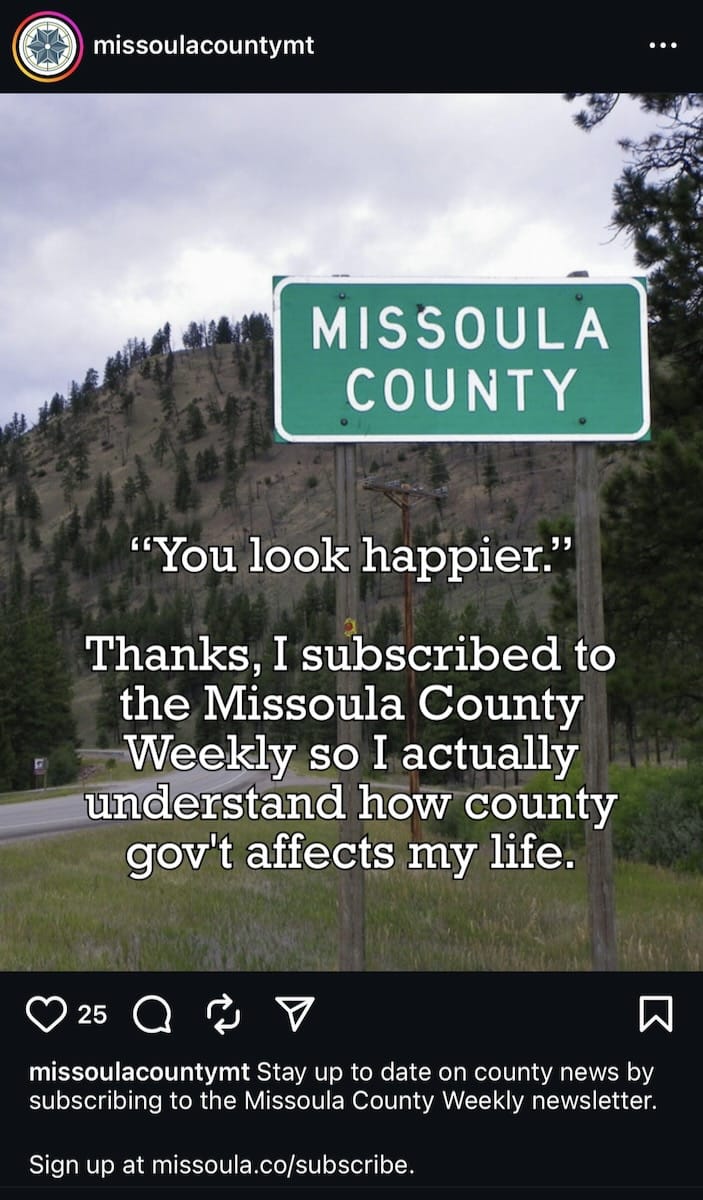


A sampling of recent Missoula County Instagram posts.
Why is this interesting? Missoulians are faced every day with big changes. And even the most hyper-local issue can be hugely animating when people are anxious about housing, jobs, the general chaos of life. How we make decisions, how we feel about what’s happening in our lives, our regard for our political leadership — these questions are all informed by the media, and it’s harder than ever to parse the signal from the noise.
We talked with Franz, who comes from the world of newspapers, about how government communications has evolved — from working with traditional press to launching the county’s own information hub, the Missoula County Voice, and weekly newsletter, to battling persistent misconceptions about what local government actually does. We also think it’s useful to simply know more about your government’s employees.
This conversation has been edited for clarity and length.
The Pulp: So, for those who may not know what your job is — who are you? What do you do?
Allison Franz: I’m the communications manager for Missoula County, overseeing the communications division. We’re based in the county commissioners’ office, but we help county-wide with any sort of communications needs — public works, elections, the planning department.
I’m a proud graduate of the University of Montana journalism school. I got a job at the Great Falls Tribune after graduation, and did two separate stints there, as a copy editor and designer and then as the digital editor.
“There’s sometimes a fallacy where it’s like, if we just give people the accurate information, they will understand and just be good with it. And that’s just not true.”
The Pulp: What was that transition like, going from newsroom to government?
AF: I really do like this role, I do think this is one of the more journalism-adjacent PR jobs. There’s a lot of internal reporting, if you will. I might get a media inquiry and not really know where to start, or they don’t know where to start. And journalism basics are really helpful in presenting information to the public — the inverted pyramid and what not.
[This is how journalists traditionally organize information in a story, with the meatiest, most important information at the top — hence, inverted pyramid.]
The Pulp: How have you seen the media environment change?
[The Tribune, for example, once one of the largest and most esteemed newsrooms in the state, is down to a single full-time reporter. Missoula lost the Independent, and the Missoulian has been beset by layoffs over the years as well, though we think our news ecosystem punches above its weight, with our work, that of the Montana Free Press, the Missoula Current, and the legacy outlets like the Missoulian, KPAX and others!]
AF: I do feel we are pretty lucky here in Missoula. Most communities this size don’t have that, and our relationship with media is still really important. We’re still doing news releases, we still rely on them for meeting coverage, all of that.
Really the difference is, back in the day, you could send a press release out, it’d get picked up by the local news, people had the information. People did watch out for their local paper, they did watch their local news. Now, the environment is so much more fractured. It’s hard. You can reach people on social media, you can see that, but it’s really difficult to know if people are absorbing the information. We do notice if we send out a news release and it gets picked up by our local outlets, there is a tangible outcome with that, for sure. We’ll get more applications for something.
The Pulp: How are you seeing that in the context of Missoulians’ frustrations and anxieties with their government today, with new development or what have you?
AF: A big thing is, there’s sometimes a fallacy where it’s like, if we just give people the accurate information, they will understand and just be good with it. And that’s just not true. So much of it is listening, validating people’s concerns. Change is hard. Of course, this is something you’re gonna be frustrated about.
We have this whole myth-busters series on social media. One of the biggest ones is just what kind of government Missoula County is. We don’t necessarily have all this authority the way the city of Missoula would. We can’t just enact a certain ordinance. Just general confusion about who does what. The example we always use is banning fireworks. We cannot ban fireworks on private property like cities can because the legislature has not specifically granted us that authority.
[This is because Missoula County is a “general powers” government. Other myths that the county has attempted to bust include “Missoula County controls traffic and construction on US Highway 93” and “Missoula County can directly influence whether an Olive Garden, Trader Joe’s or other business comes here.”]
The Pulp: Can you talk a little bit about Missoula County Voice in that context?
AF: The city of Missoula had their Engage Missoula platform. It was just a matter of knowing we needed a platform like that in this day and age. You can’t necessarily expect people to dig through an agenda and something like that. You need to meet people where they’re at. Give them the information up front. So when they hear about a development coming near them, they have accurate information.
The Pulp: Anything else you’d like to add?
AF: I do just want to say, the county is able to maintain consistent communication and a consistent presence on a lot of these different channels because leadership has recognized the importance of communication. I know that is not a priority for a lot of local governments.
[Hey, city of Missoula — maybe this is a sign to give that abandoned Instagram account some TLC?]