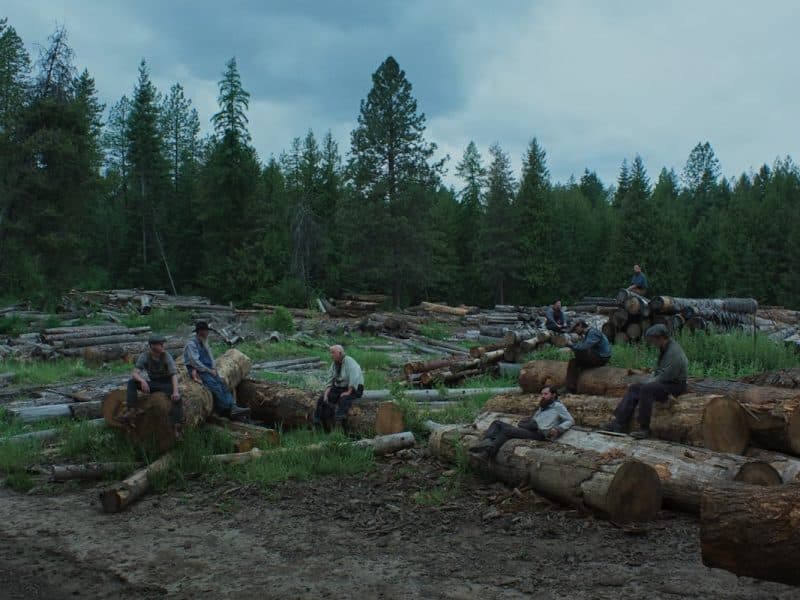
It took long-time Missoula filmmaker Andy Smetanka eight years to make his film A Place (Sort Of), which he launched as a Kickstarter project. Early on, he promised it would be a love letter to the town and involve, in part, footage he had taken with his Super 8 camera. The final result is an oddly compelling two-hour “mosaic,” as Smetanka calls it, made from his personal film diaries, clips from Hollywood films linked to Missoula, but also archival footage he found made by past Missoulians that dates back 100 years ago. It’s organized by season, but takes audiences on a nonlinear, dreamlike ride through Missoula’s past, guided by a slew of Missoula-famous narrators (actor Howard Kingston, Montana Public Radio Host Annie Garde, poet Sheryl Noethe, for instance).
Some footage—like from the Blackfoot Boogie or Aber Day Kegger—captures iconic traditions that have since faded away. Other footage captures people socializing: 1990s barbecues, 1970s bar footage of Missoula literary giants sipping whiskey, students–now long buried in the earth–socializing on the University of Montana Oval. The effect is haunting. What we do today in Missoula now—Lunch at Caras Park, summer river floats, meeting up at Charlie Bs, family gatherings on porches and in backyards—has been done in some way for generations, by people like us. Change is inevitable. Life is fleeting. Missoula is somehow simultaneously special and ordinary. And all those truths can be both painful and invigorating. Since the beginning of the pandemic, Missoula has seen a huge influx of people, for better or worse, and in that context, A Place (Sort Of) captures some of the anxiety and grief of locals, while also celebrating the persistence of community. Which also seems like hope.
A Place (Sort Of) screens at the Roxy Wednesday Oct. 18 and Thursday Oct. 19, at 7 PM, followed by a Q&A with Smetanka.
In advance of the film’s next two screenings at the Roxy, we talked with Smetanka about the most daunting part of making the film and discussed how a movie focused on Missoula’s past can help Missoulians understand the city’s present.
Andy, I know you have a lot to say about this film you made, outside of what audiences will get from seeing it. That made me curious: What question would you ask yourself in a Q&A?
Yeah, I like that idea. I guess one of the questions I might ask is why the film took so long. With the narration, it was terrifying to sign off on the last word—on what the narrators would actually read out loud and what would end up in the film. The permanence of that and the idea of committing to having someone come in and read that writing was just terrifying. It’s by far the hardest piece of writing I’ve ever done. I was trying to get it right and doing rewrites and changing things right up until the very last day of the very last recording. Why it took so long was just terror of adding the narration.
Did you know that it was going to be hard to make this film or was it the kind of thing where it became crushingly harder as you worked on it?
Well, some parts of the movie came really easy. But some were not. For example, to enumerate what I think are particular Missoula traits or eccentricities—you know, where I had to volunteer an opinion as opposed to just history or mild prose—those took me a long time to get right or to feel like I was willing to send them out. And then, in the process of recording the narration, there’s nothing like hearing your own words come out of someone else’s mouth to realize that they ring kind of false, or sound like a cliché. Even after I’d recorded material, I was cutting … But, I mean, I put a lot of thought into it, and I knew it was going to be difficult, just because I tend to sweat the narration process.
The work that I do most of the time is really solitary, whether it’s editing or animation, it’s really lonely, private work. And then suddenly when the process cracks open and all these other people are invited in to help out, it can be a bit daunting.
It’s daunting image-wise and content-wise. I didn’t fit everything in that I wanted to, but I knew that was going to happen.
A Place (Sort Of) captures a “good old days” sentiment at times, but it seems to also be a critique of it too. It explores nostalgia without being it. I wondered how much you thought about that idea in terms of all the people moving to Missoula more recently, who don’t have much context for this place.
I did think a lot about it. Part of it was, there were wild fluctuations in tone. I would think that I had the narration just right, and then I would put it down and come back two weeks later, and it just seemed wrong. And sometimes it was because I was feeling a little bit down on Missoula, or wondering about my role in it. And then there were other times where I wanted to figure out a way to satisfy people like me and you, who have lived here for ages … and who do feel these weird changes in the air, but maybe can’t quite put our finger on it. I wanted to figure out a way that I could satisfy the sense that Missoula’s changing and that it’s scary for those of us old-schoolers. But also, at the same time, not alienate or point fingers at people who just want to move to a nice place. I didn’t want to turn it into this big us-and-them. And I didn’t want to fall prey to the same kind of rhetoric that always gets handed to you, like, “Oh, you should have been here [back in the day].” Or even worse, “Go back to where you came from and try to make it nicer there.”
I do think that Missoulians resent people who can—I know I do—come swanning in with all the money that they need to set themselves up exactly the way they want without having to pay their dues. People who can work from home and just decide to plug into the fantasy life that they’ve seen for a bohemian mountain town—I hate that fucking phrase—that bohemian life that looks so appealing, but without really having done much to contribute to it. Or arguably not doing much to contribute to it in the future.
I think it’s totally natural to feel like the best days are behind you. And it’s really hard to grow old in a college town that always kind of stays young. You question if you’re a creative person. You question your relevance. You sometimes feel like people are looking over your shoulder at the more exciting thing that’s coming up behind you.
So I think it’s understandable to resent people who just kind of come flying in. But, you know, everyone who wasn’t born here did that at some point, so we have to learn. It puts Missoulians in a weird bind because we’re sort of friendly and outgoing and welcoming people, but we don’t mean that to be construed as a fervent wish that everybody and their dog should move here all at once, you know?
It does seem like the film is screening at a crucial time for Missoula. In a way, it serves to stake a claim about who we have been and who we are in this moment, even if Missoula continues changing.
I quite agree with you. And I sort of think of this movie as my Noah’s Ark of Missoula up until this point. You know, the evidence is there [in the footage]. And it’s like I sneaked a really personal movie about myself into this greater picture of Missoula. I wanted this to be the repository of all these things that I think are great about it and these questions and funny bits of history and, above all, these great tunes all in one place. But it’s not meant to alienate. I want it to be celebratory and inclusive. But also be kind of a sop to people who I think of as my peers, who have been here for decades, and who feel like the rug’s kind of being pulled out from under them.
What you’re saying though about this being an important time, I felt that. I love that The Pulp is starting up and that this movie is starting up and that those kind of almost happened on the same day. I wondered earlier in the year if this movie coming to the public was going to feel like some sort of sad outpost of nostalgia, but really it seems to be part of this greater moment of lots of really cool things happening in Missoula. There just seems to be this eruption of homegrown local culture right now that I’m psyched to be part of.
I have to admit I was a little worried there was going to be too much footage of Jay’s Upstairs and backyard parties from the 1990s—stuff I might find interesting but other people might not because they weren’t there. But I realized, watching the really old footage from the early 1900s, you don’t need to know the people to find them interesting and relatable.
Yes. And to tell that fun is being had. And to see these kinds of things where they’re most at home. And porches in backyards. I think so too. I think you’re right. You don’t have to know these people. Also, you see that people have been doing it for generations, you know? Being outside, just enjoying themselves. I think if it would have been all my footage, it would have been [too insider]. And if it would have been all everybody else’s footage, then it would have been maybe dry in a different way, or just sort of lackluster. But mixing the two together [makes it work].
The film is rich with found footage. Can you give me an example of some footage you were particularly delighted to find, that blew your mind?
In my research and in researching history and also trying to find footage, I was delighted if I found something that was kind of uncomfortable. Something that you wouldn’t really think, “Oh, that sounds like Missoulians, then and now.” Like, [footage of Missoulians] almost killing an elephant. And [footage of] a blackface show… I knew that that was going to feel uncomfortable. And the context is a bit unclear as to why it’s there. I had one read of it. And then somebody else had a completely different read of it. So you don’t really know why. And those things that are kind of ambiguous but sort of unsettling, I took special delight in finding those.
I appreciated that complex—if unsettling—aspect, too. It seemed more truthful. I know that you look at things complexly, but wasn’t sure how much of a glowing love letter the film might be.
There’s a kind of tone I really don’t like. I’ll be honest here and say that I don’t really like reading my fellow Missoulians introducing Missoula to a wider world. You know what I mean? It always makes me really uncomfortable partly because I’m like, “Shhh, don’t tell everybody!” Can’t we kind of try to unring this bell a little bit? It’s so easy to fall into cliche, and it’s easy to fall into this kind of chamber of commerce language when you’re writing about something that you really love.
I’ve done it once or twice. I had to write a little rock report on Missoula for Spin magazine 25 years ago and, honestly, it felt kind of gross then and it felt kind of gross when I saw their edits. And it kind of felt gross when it came out. I just knew that it wasn’t something that I really wanted to be part of. I’d rather write strictly for Missoulians who understand the complexities of living here, instead of throwing more logs on the fire of why people should live here. And that’s not to take away from anyone else’s accomplishments, or to question their motives for doing it.
I’m just saying I’m not comfortable writing that kind of stuff. And I don’t really like reading it. At the same time, you know, I have kind of a lot to say about Missoula, and I chose my own outlet for it. I won’t say it chose me, but it seemed to arrive here, where I do more of my communicating through images than I do through writing.
After so long, how does it feel to be done with this project?
Amazing. Absolutely, positively amazing. I mean, it was quite a summer. I was gone for three weeks and I left when the movie was … I wouldn’t even say almost done. I came back and I had three weeks to finish everything. I knew I could make it, barring any unforeseen catastrophe.
And I did barely make it, with a couple days to spare. But, I was just so worried. I mean, it was all building up to that first public showing with [this final version]. Having pulled off that little feat at the Wilma, anything else is just gravy. And now I feel relieved and like there’s so many other things I can get to now and just so many other fun projects starting up. It’s like having a clean slate.
What are your hopes for A Place (Sort Of)?
It sounds pretty self important, but hopefully it gives people something to aspire to. Or some kind of example of how to contribute to local culture. I feel like if I did that and didn’t alienate newcomers, then that was good enough. But like I said a couple times, it really is [for] people who are right at the center of the Venn diagram— people who love the [soundtrack], people who know me and can kind of get some other resonances out of seeing all of these people on screen. A lot of my friends won’t need to be told that it’s for them, they’ll just get it. But hopefully it’s got enough universal appeal that if you’re trying to kill a couple hours at a hotel in Bangkok, and you’re scrolling through Netflix, you’ll give it a try. If this movie can keep you with some kind of universal appeal, or if it allows you to see something of the place that you live, in your hometown, in a study of another hometown, then I think that it will totally have been worth doing.