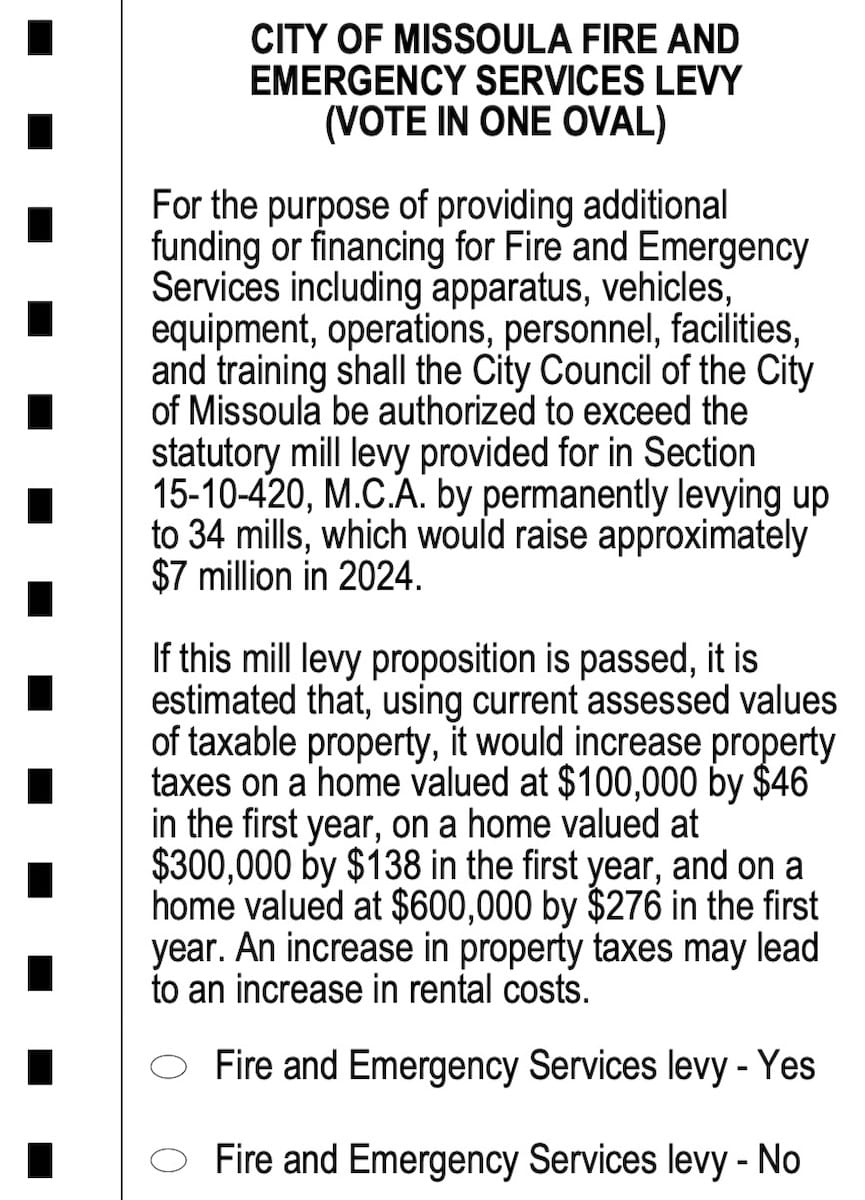
Tucked in the bottom right corner or on the back of Missoulians’ June 4 primary ballots—which were mailed on Friday to active voters registered to vote absentee—is a question with major implications for whether the Missoula Fire Department can keep pace with the city’s rapid growth. The ballot also asks voters, as it does every 10 years, whether to commission a local government review.
On Monday, dozens of residents gathered for City Club Missoula’s forum discussing the levy and its impacts on property taxes, as well as how a potential local government review would unfold.
In early March, Missoula City Council approved placing the 34-mill fire and emergency services levy on the primary ballot. The levy, which would raise $7 million in the first year, had been set to appear on last November’s ballot, but city council opted to pull it less than two months before the election due to unease around rising property taxes.
The levy would fund 20 firefighters to staff a sixth engine company, a new station, replace aging equipment and help keep wages competitive, Fire Chief Gordy Hughes told the crowd at the DoubleTree hotel. It would also provide permanent funding for the mobile support team, which responds to behavioral health-related 911 calls.
At current mill rates, the levy would cost about $46 per $100,000 of assessed value, according to the city. A home at Missoula’s 2023 median assessed value of $413,200 would pay about $190 per year, or $15.80 per month.
“That $23 a month is a piece of insurance knowing that, God forbid I have to call 911, there is a trained professional who is going to be there in time to either save my loved one or save my home.”
City Council Member Stacie Anderson said her taxes would go up $276 per year, or $23 a month.
“That $23 a month is a piece of insurance knowing that, God forbid I have to call 911, there is a trained professional who is going to be there in time to either save my loved one or save my home, which is my most valuable asset and the place that holds all of my memories,” she said.
Hughes detailed how the number of firefighters has not kept up with Missoula’s expanding population and city limits. While Missoula’s population increased about 15 percent from 2010 to 2022, the number of firefighters has remained the same since 2008, he said. And since 2008 emergency calls have nearly doubled from just shy of 6,000 to about 11,000 calls in 2023.
Simultaneous calls nearly 50 percent of the time mean engines are responding from farther away, and leaving areas uncovered by the closest stations, Hughes said.
“We are having to vacate areas to backfill, which perpetuates the problem and allows those response times to increase,” he said.
The department’s average response time is two to two and a half minutes longer than the national standard of six minutes, Hughes said. If response times increase too much, the department’s Insurance Services Office rating could worsen, meaning homeowners’ insurance premiums could go up, he added. Conversely, if the rating improves, premiums could go down.
Councilor Anderson explained that, unlike a police department, which can hire one or two officers at a time and increase patrols, adding individual firefighters doesn’t expand the system. It takes three people to run an engine, and the city needs to hire 20 for a new engine company to address the rise in calls, she said.
The levy revenue would also help ensure competitive wages for existing firefighters and new hires.
Hughes also emphasized that rising costs make keeping up with equipment replacement schedules more challenging. The cost of a fire engine has nearly doubled from $500,000 to $960,000 since 2020, he said, noting that engines are replaced every 10 years and ladder trucks, which cost about $2 million, are replaced every 20 years.
The levy would provide about $1.5 million in permanent annual funding for the mobile support team, a collaboration between the Missoula Fire Department and Partnership Health Center. The team, which started responding to calls in late 2020, has sourced its funding from grants and federal pandemic relief money that’s dried up.
“That unit is showing some great successes out in our community by providing an alternative for folks aside from going to the emergency room or to jail,” Hughes said. “We’re diverting folks to proper resources and providing wrap-around services to these individuals in our community who have no other place to go other than those two other options.”

If the levy fails, it’s unclear how the city will fund the mobile support team, Anderson said.
Fire and police departments account for 60 percent of the city’s general fund, leaving little wiggle room to find another $7 million, Anderson said.
“We are already spending a significant [amount] and we are not meeting the needs in our community,” she said.
In response to an audience question of why tax revenue from new growth can’t cover these costs, Anderson said growth doesn’t automatically translate to ongoing revenue required to cover expanded fire and emergency services. New development is often assessed a one-time impact fee, she said, but the city needs sustained revenue to pay for the additional firefighters year after year.
“Growth does not pay for itself in Montana,” Anderson said.
Under Montana’s tax system, cities can only increase property taxes by half the rate of inflation averaged over three years, she explained, limiting how much the general fund can increase and necessitating the levy.
In Missoula County and across the state, the recent spike in residential property values means that homeowners are bearing significantly more of the property tax burden—and industrial property owners significantly less.
It’s difficult to predict how long the levy will fill the funding gap, as Missoula is likely to keep growing, Hughes said, but by the time a seventh station is needed, it would likely be funded differently, possibly by increasing impact fees to hire people over time to staff a new engine company. Right now, the department is so far behind it needs to hire multiple people at once, Hughes said.
“As the city, our number one goal is to provide public safety,” Anderson said. “It’s unfortunate we’re now at the point we’re having to ask voters [for money], but we don’t have any other options.”
Passing muster?
All Missoula voters—not just those in city limits—will see a ballot issue on whether to review their local government on the ballot.
The option of a citizen-driven review of city and county government was included when Montana drafted and ratified a new state Constitution in 1972. Geoff Badenoch, a board member for the League of Women Voters of Montana, explained that voters consider whether to commission a review of their local government every 10 years.
“They recognized that things change, times change, needs of communities change, and they figured why not let the people decide if they need to think about their government again and consider other ways of doing it,” Badenoch said of the Montana Constitutional Convention.
“This is an exercise about governance; it’s not meant to be political.”
Missoula voters within the city limits opposed a review 10 years ago. In 2004, Badenoch said, city voters approved a review but the study commission provided a divided report and citizens opposed implementing its recommendations. In 1994, city voters approved a review, which led to the city adopting a charter form of government in 1996, according to Badenoch, who served on the study commission at the time.
The ballot language includes the amount of money the county or city would spend on a review and the number of citizens that would make up the study commission. Missoula County and the city both would spend up to $200,000, or about a half mill, for a study by a seven-member commission.
If approved, registered voters could file to run for the commission and be elected in the November general election. Local elected officials are ineligible.
Starting in 2025, the commission would study the existing form and powers of local government to determine what’s working, what’s not, whether people are fairly represented, whether services are provided effectively, among other considerations, Badenoch said.
“I want to emphasize this is an exercise about governance; it’s not meant to be political,” he said. “If you have a bone to pick with the city council, if you don’t like the commissioners, if you don’t like the mayor, vote them out of office. This is how we decide to govern ourselves—we the people.”
The study commission would hold public hearings and compare alternative forms of government, Badenoch said. It would create recommendations for voters to consider by the 2026 general election, and if the commission recommends changes, it needs to include a transition plan.
Badenoch declined to give his opinion on the most efficient form of government and said it’s up to the voters to choose.
Over the last 50 years, more communities have adopted charters, Badenoch said. State statute includes several forms of local government and outlines how they must be organized. A charter form allows self-governance, or, as Badenoch described it, “You do whatever you want as long as the state doesn’t say you can’t.” He said the list of things the state says local government can’t do is growing longer.
The League of Women Voters is working to educate people on the local government review because most voters are likely unfamiliar with it, Badenoch said.
“This a highly democratic process, it’s meant to keep the peoples’ hands on the reins of government,” Badenoch said of the review. “It’s meant to be thoughtful. It’s not meant to be contentious. It’s not meant to create fights. It’s meant to have people think about themselves as citizens and how they want to govern.”