The idea for her new script, Can’t Drink Salt Water, came to Kendra Mylnechuk Potter during the Covid-19 lockdown. The Missoula-based Lummi playwright and actor remembers her kids were playing in the yard and she was teaching a Savasana yoga class on Zoom. And, in the middle of teaching the class, she had a dream, though she wasn’t asleep.
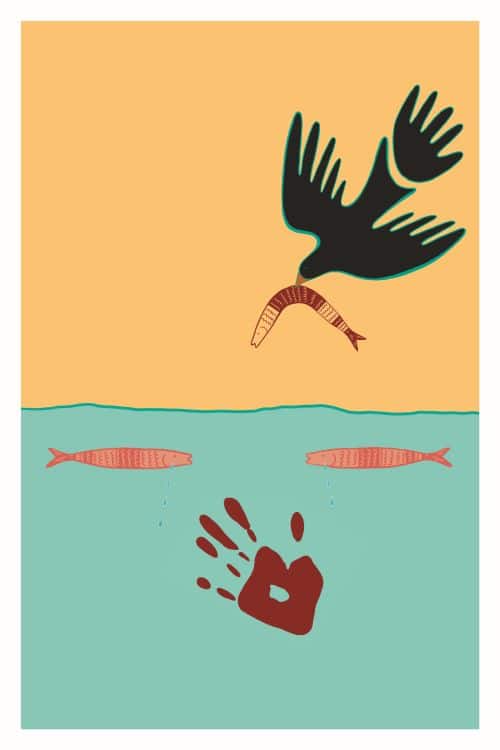
“It was this very clear image of a young woman in a watery place,” Potter recalls. “She was alive underwater, being visited by Salmon Woman, who is in one of the Lummi creation stories. This character of Salmon Woman—and my understanding of her is that she is a divine mother figure—she is speaking to this young woman and bringing her home. Not home to her earthly home, but home to the place we all come from.
“And I knew also in this vision that this young woman was missing—that there were people who were dry who were looking for her, and that they would not find her. And I knew it was a play. And I got so sad, because I was like, ‘I do not want to write this. I don’t want to go there. I don’t want to think about this stuff in any way that would require inhabiting these characters.’ But I knew that’s what it was, and I felt kind of tasked.”
But still, she resisted. After the class was over, she moved on and shut it out. But that same day, when she opened her email, there was the Montana Repertory Theatre’s newsletter sitting in her inbox announcing a commission for an Indigenous playwright.
“And I was like, ‘Oh no. Shoot. Shoot!’” she says. “And I filled out the proposal, and then I prayed that I wouldn’t get it.”
But she did, of course. Over the next year and half, as plans for the commission came together, the story haunted her as she worked to get it on the page. The resulting script—Can’t Drink Salt Water—follows a mother’s relentless search for her missing daughter and the journey of a young woman newly arrived at Bethel House, a fictional evangelical shelter located in Missoula for victims of sex trafficking. It explores three distinct spaces: the shelter and its well-meaning white Christians, the space of the grieving mother trying to cope while navigating the missing persons system, and the underwater world.
This Sunday, November 19, Potter hosts a staged reading presented by Montana Repertory Theatre, but don’t expect it to feel like a mere rehearsal. The funded project has allowed Potter to fly in director Pirronne Yousefzadeh from Minneaoplis and several Indigenous actors from across the country to read the roles, including Elva Guerra from the hit television series, Reservation Dogs and Jennifer Bobiwash (Anishinaabekwe), a member of Mississauga First Nation and a playwright and dramaturg in her own right. The script will also get an intensive workshop over the course of five days, before the Sunday reading, made possible by a grant Potter received from the Roy Cockrum Foundation.
“There is a lot of creative potential in a full production,” Potter says. “But there’s also a lot of space for the imagination in a reading.”
Many Missoulians will recognize Potter from some spectacular staged readers, as well as local theater productions and as co-founder of the theater company MT+NY Collaborative. She was also the subject of a documentary called Daughter of Lost Bird that screened at the Big Sky Documentary Film Festival last year. The documentary, directed by Blackfeet/Salish filmmaker Brooke Pepion Swaney, follows Potter, as she seeks to find connection with her Native identity and culture. She meets her birth mother and discovers, over the course of eight years, her ties to the Lummi Nation—a Native American tribe located in the coastal region of what is now Washington state, near Bellingham. It explores her personal context and opens a door into the horrific history of assimilation and genocide, and of boarding schools and brings it back to recent threats to the Native American adoption law. But as an adoptee of a loving non-Native family, the exploration is not just about finding answers; it’s about sitting in the complex intersection where uncertainty meets enlightenment, and where deep grief and trauma becomes a path to community and empowerment.

The Salmon Woman creation story was the first creation story Potter became familiar with after connecting back to her Lummi identity. In the story, Salmon Woman gives her salmon children to the people so that they can survive.
“And in one version,” Potter says, “there’s a child who’s like, ‘Salmon again? I’m so tired of salmon.’ And she overhears it and gets really offended and angry, and she sings a song, and all of her salmon children come back to life, and they flop and roll back to the bay, and she takes them away. Then Raven shows up and he finds her again in the ocean. He begs her to come back. She says, ‘I’ll come back, but I’m only coming back once a year, and you have to treat me with respect, and you have to be grateful, and you have to show your gratitude.’”
When Potter heard the Salmon Woman story for the first time, something clicked for her. It seemed to relate to what was happening with the epidemic of missing and murdered Indigenous women, and also seemed connected to the #MeToo movement.
“I was thinking about the way that the dominant culture does not value women and the unique gifts that female bodies have,” she says. “And that if a body is not in service to economic growth, it is disposable.”
During the summer, Potter went up to the Flathead Reservation in Arlee, marching along Highway 93 with other Indigenous people to urge action after recent deaths and raise awareness around systemic MMIW issues. She also attended a march in Missoula. Both of the marches were led, in part, by Carissa Heavy Runner, the mother of 22-year-old Mika Westwolf, who was killed in a hit-and-run on the highway. Heavy Runner spoke at both marches, and the impact her voice had on Potter compelled her to ask Heavy Runner to speak after the Can’t Drink Salt Water reading.
“I realized, when she was speaking, how much of the dialogue was like the mother in my script,” Potter says. “There were just enough parallels. I was really scared when I first started writing the script to call any family who actually had missing or murdered relatives because I didn’t want to exploit their stories. I didn’t want them to feel in any way like I was asking them to share their story so that I could, like, riff off of it. But now that the script has been written, and using the platform that I’ve been given, I thought I could invite relatives to come and participate, to talk about the themes in this script and how they relate directly to citizens of our community. And my hope is that this is going to be effective.”
Potter’s script was influenced by other real-world events. She recalls the actions of a mother during the Ulvade, Texas, school shooting in May 2022. The police were trying to keep parents from entering the school.
“And there was one mom who was like, ‘Fuck that!’ and went around the back and jumped the fence,” Potter says. “And she just walked into the school from the back, got her kids, and left. And I remember that it was like, ‘Whoa!’ I was thinking, ‘What would I do?’ I think that I would become an animal. After the shooting, that was when the haunting of this script got louder and louder, where I really had to, for my own mental health, find an outlet for processing that lack of support for mothers … so that’s all in there.”
Potter realized recently that Can’t Drink Salt Water had similar themes to her first playwriting endeavor, The Buffalo Play, which she co-wrote with her theater company creative partner, Ciara Griffin. The Buffalo Play took place in a jail cell outside Yellowstone National Park, where an East Coast social justice worker awaits her arraignment. She has been accused of “calfnapping” a baby bison. The social worker’s intentions were good, but her ignorant actions resulted in the death of a baby bison. Inside the jail cell, she finds herself with the dead baby bison, the grieving bison mother, and a local rancher. The play is about a lot of things: a white person reckoning with her worldview, the media, and maternal grief. The characters are complex, and the story is both humorous and heartbreaking, and weaves in storytelling common across many Native cultures that shows the role of bison as inextricably linked to people.
To survey her projects, it’s easy to come to the conclusion that you can almost always count on Potter for a raw-but-tender approach in her work and a firm-but-thoughtful engagement with her audiences. Last summer, she workshopped the Can’t Drink Salt Water script with a non-Native audience. She asked them if they related to any of the characters in the story and, if so, who? Many of the women in the audience who were mothers said they related to the mother and the pain of what it might be like for their child to go missing. (No one related to the white characters). But one man wondered about an audience’s ability to relate specifically to a Native woman character within the issue of human trafficking. “Is this a play about human trafficking or is it a play about Native trafficking?” he asked.
Potter recalls how off-guard this question caught her. She explained that Native women are murdered at a rate 10 times that of other ethnicities in the U.S. and that 40 percent of the sex trafficking population is Native, even though Native Americans make up 2.9 percent of the total population. And so, she explained, that disproportionate number means that when you talk about human sex trafficking, that discussion should involve Native women.
“But later in the night,” Potter says, “I was thinking about it, in bed—like you do—and I was thinking, ‘Native people are human.’
“What I learned in that conversation is that, for the dominant population in Montana—being white—that they are “of color” before they’re a person. And that feels like part of why MMIP has persisted in the way it has. The gentleman who asked the question, he didn’t know the statistics. He didn’t mean anything cruel by it. He wasn’t trying to be offensive. He was being earnest in his question. I feel like that conversation really led me to understand better the tall order that I’m asking the script to do.”
So that the play does not need to carry the burden of the statistics, the lobby at the PARTV building will feature Native artists and educational tabling, so that people can get some context before they experience the reading as an immersive narrative. Potter says she hopes the lobby’s art and education will also help make the event a “celebration of Native excellence” alongside and maybe as a counterbalance to some of the heavy issues the reading will explore. Heavy, but with humor, Potter notes. And with tools that serve both Native and non-Native audiences.
“I didn’t want to stir something up and then leave an audience, you know, stirred. And undirected,” she says. “I also didn’t want a non-Native audience to experience this story and then go home patting themselves on the back. I want to arm them with some actionable steps and ways that they can engage with the new information they’ve found. And, for a Native audience—if we manage to get one, because, to the best of my knowledge, the Montana Repertory Theater has not really had any kind of substantial Native audience, because they have not told Native stories—I wanted to figure out how to unpack and encourage and tell these stories without re-traumatizing the people who already know what’s happening.”
“I’m still wrapping my head around how to talk about it in a way that will not just make people think, ‘Oh, I don’t want to spend a Sunday there,’” she adds. “The world is hard right now. Hearing a hard story on top of it is also hard. But it’s such an important issue.”
The Can’t Drink Salt Water staged reading takes place Sun., Nov. 19, at 4 p.m., at the Montana Theater in UM’s PARTV, followed by a conversation with the playwright and director, and appearance by Carissa Heavy Runner. Pay what you can, suggested $5 – $50.