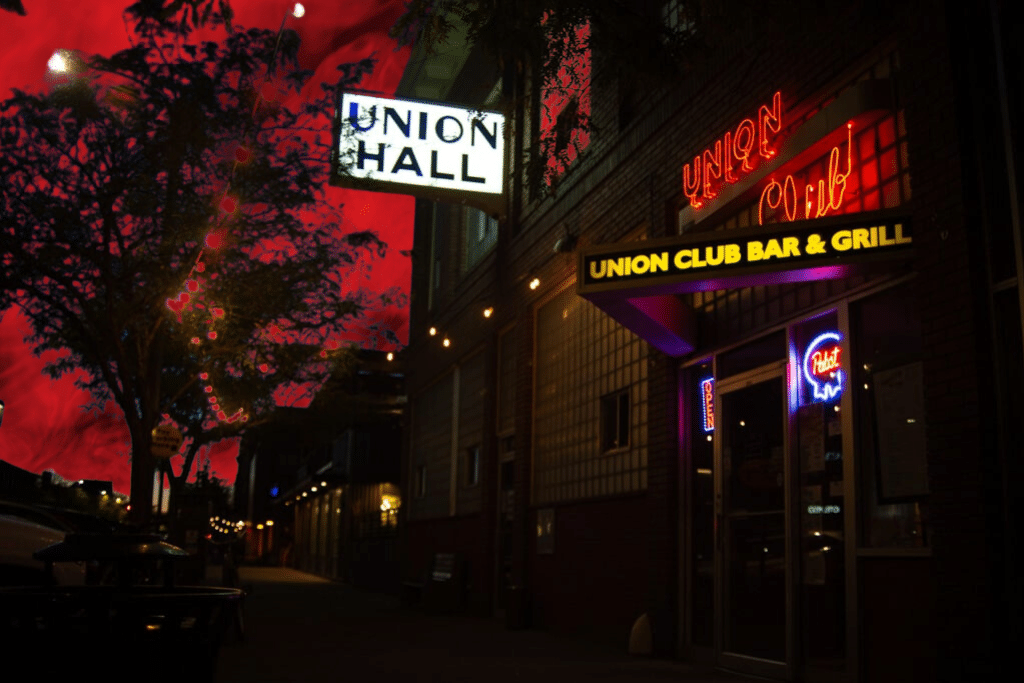
To spend a few short hours at the Missoula Democrats’ election-night watch party in the Union Club Tuesday was to sit in suspended animation in a blue dot inside of a slightly larger blue dot inside of a red expanse.
The mood was ebullient and boozy, if, with the benefit of hindsight, a little deluded. (By the time I got there, just after polls closed, the Associated Press had already called the state’s gubernatorial election for Republican incumbent Greg Gianforte).
TV reporters prepared for their stand-ups. Suits intermingled with jean jackets. Out-of-town staffers and consultants enticed to Montana by an unprecedented influx of campaign cash plotted their next moves, whatever the results held. Like any good Montana political event, the room smelled of Skoal and stale beer. The sea of bodies made it nigh impossible for me to get a drink. Campaign signs plastered the walls. While TVs on the walls slowly dispensed election results, most people were rapt in conversation.
Outside, the end of a political era approached.
Republican presidential candidates have won Montana since 1992, and in that election, Democratic Bill Clinton’s victory wouldn’t have been possible without Ross Perot’s 26 percent performance. Before that, the last Democrat to carry Montana was Lyndon B. Johnson, who won all states but six against Barry Goldwater in 1964. The state nonetheless maintained an independent streak: voters ratified a progressive constitution by a hair in 1972 and have regularly elected Democratic governors, including two two-termers from 2004 to 2020.
In 2018, they also elected Democratic U.S. Sen. Jon Tester to his third term.
Two years later, Republicans swept Montana’s executive branch and further established a commanding majority in the state Legislature that only grew more in 2022. Tester stood as the only Democrat in Montana with a statewide constituency.
Since that red wave in 2020, Montana Democrats have been trapped in a cycle of reevaluation and recrimination while their sphere of influence receded to the state’s few comparatively urban areas and remaining union strongholds. (That said, the party’s infamous — at least in political circles — failures in Cascade County in recent elections show that even the party’s hold on those constituencies is unstable.)
This cycle has produced a cast of candidates that, at least in statewide or federal races, campaign quite similarly. You put on your denim and you shoot guns in TV ads and curse and drink and you dodge if anyone asks if you’re proud to be a Democrat. You might even get a little racist. While you might talk about protecting abortion access or fighting the forces of gentrification, it’s easier to fall back on familiar — if vague — talk of Montana values and Jeffersonian myths.
You put on your denim and you shoot guns in TV ads and curse and drink and you dodge if anyone asks if you’re proud to be a Democrat. You might even get a little racist.
I’ve spent the better part of the last decade covering state politics both in my home of Arizona and my adopted home of Montana. As I floated around this state, reporting on Red Pill festivals, debates, county central committee meetings, state party conventions, legislative sessions and protests, I couldn’t help but harbor the feeling that the state’s politics were not going to revert to the 2010s. The Democratic Party seemed obsessed with the ghosts of its successes, or at least of a more liberal Montana: Mike Mansfield, Lee Metcalf, Democratic Govs. Brian Schweitzer and Steve Bullock, relatively moderate Republicans like Marc Racicot and Bob Brown, the delegates to the Constitutional Convention in 1972 and so on. Meanwhile, the Legislature — the body ostensibly the closest to the electorate and its whims — became about as red as could be, pushing through a barrage of tax cuts and financial deregulations, restrictions on abortion and gender-affirming healthcare. And the Republicans were putting forth literal teenagers to run for office and winning.
At the federal level this year, voters in western Montana had races for president, U.S. Senate and Montana’s first U.S. House district on their ballots. Setting aside the presidential race, a foregone conclusion, the key Democrats appealing to Montana voters were Tester, vying for a fourth term, and Monica Tranel, a Missoula-based utility attorney making her second bid for Congress.
And they played their roles well. Tester is a seven-fingered dirt farmer from Big Sandy, a true Montana son despite his 18 years in Washington, where he has earned seniority and become the chairman of the Senate subcommittee that steers defense spending. We can count on him, his campaign pledged, to defend Montana values — from the rich, from China, from change. Tranel may not be a farmer, but she grew up between Wyoming and Montana. She rowed — in the middle of the boat, she’d often remind you — in the Olympics. As an attorney, she fought those corporate pirates at NorthWestern Energy to keep utility rates affordable in the frozen north. In one campaign ad, she shoots a stand-in for a Chinese sky balloon out of the sky.
Who, with these bona fides in mind, would vote for their opponents? Tester and his allies painted his challenger, Tim Sheehy, as a dishonest, wealthy, detached out-of-stater who flip-flopped on issues like public lands transfers and peddled racist tropes about Native Americans. Sure, he’s a veteran of the Navy SEALs — though he seems to have lied about some aspects of his service, namely the genesis of a bullet wound in his arm — but Tester is a friend to veterans everywhere, the Democrats say. And what about the Republican Ryan Zinke, the incumbent in the western U.S. House district and Tranel’s opponent for the second consecutive election? As secretary of the U.S. Department of the Interior under President Donald Trump, he was dogged by numerous ethics probes. Even Trump eventually showed him the door. Even worse, he and his wife have a home in California!
As it turns out, a majority of the electorate would vote for Sheehy, Zinke and every other statewide or federal Republican on the ballot.
But that was not yet the accepted reality inside the Union.
Outside the bar, a series of temporary bollards affixed with Tranel campaign signs outlined a walkway where undergrads would usually be lining up to have their IDs checked. When Tranel arrived, music played and she danced down the concrete carpet with a small number of supporters.
As the evening wound on, enough results had come in nationwide to paint an unsettling picture for the Democrats. But the pervading belief in the room was that the complete electoral picture wouldn’t be clear for a while, an impression even I was under.
Denise Juneau, a Democrat and former state superintendent of public instruction (another office that Democrats lost in 2016 and have been unable to reclaim), took the Union stage to stump for her party.
Tester, she assured the crowd, “is gonna win the Senate seat tonight, or maybe tomorrow, or maybe Thursday.” And Tranel would “fight like hell to save this state” and defeat that “asshole” — Zinke — who himself bested Juneau in a House race in 2016.
“Don’t follow the crap on TV right now,” she told the crowd. “People are still in line all across the country.”
Tranel followed her.
She decided to put her name on the ballot again, she told her supporters, because “this is my home, and unlike my opponent, I don’t have another.”
By 10 or 10:30, the usual crowd of professional drinkers had largely replaced the politicos at the Union. Time had resumed its usual pace. Signs came down from the walls. Democrats from Kamala Harris down to Tester and Tranel looked on the ropes.
Time would soon reveal what we now know to be true: Tester made his last stand and lost. Tranel fared no better against Zinke in 2024 than she did in 2022. Other statewide Democratic candidates — Ryan Busse for governor, Missoula’s Shannon O’Brien for superintendent of schools, Ben Alke for attorney general, John Repke for state auditor — lost.
“If you have gender pronouns in your bio you are not in a position to understand middle America.”
Democrats in Montana can win. Democrats running for state legislature and county commission won in Missoula as they almost always do (Harris also easily carried Missoula County over Trump). And it’s not just western Montana. Democrats made in-roads in the GOP legislative majority all over the state, and not only in liberal enclaves — though they were certainly aided by new legislative maps. Voters resoundingly approved a constitutional amendment that protects abortion access (though in the same breath they elected Broadwater County Attorney Cory Swanson to the state Supreme Court over former magistrate court judge Jerry Lynch, who explicitly campaigned on protecting the right to choose). As was the case in several other states, ideas that historically found homes in Democratic circles outran Democratic candidates.
Some have suggested the problem for Democrats is that progressive social ideals alienate the hypothetical median voter, especially in states like Montana. Rachel Bitecofer, a national political strategist who stumped for Busse and wrote a book outlining a theory of “negative partisanship” with his campaign manager, Aaron Murphy, said on social media Wednesday that “if you have gender pronouns in your bio you are not in a position to understand middle America.”
Busse, whose campaign’s attempts at reaching all Montanans included accusing laborers working on the governor’s mansion of being illegal immigrants based seemingly only on the color of their skin, lost to Gianforte by more than 20 points. A Democrat held that office a mere four years ago.
Placing blame for the party’s losses at the feet of those who face ever-increasing state violence, then, doesn’t seem right. That’s not to say that I have some answer for the party’s woes, nor do I care to offer one. But I can’t help but feel that the party has spent the last several years counting on a group of voters — “native” Montanans, people who look conservative but vote liberal — that either doesn’t exist anymore or never did. Perhaps the problem with running against the threat of the out-of-stater is that this is nothing new. Transplants rule today’s Montana, as they do in much of the West. But, at least for the majority of post-Columbian history, haven’t they always?