This year’s Big Sky Documentary Film Festival provided its usual stunning and diverse buffet of short and long-form documentaries, some from the other side of the world. There was “Queendom,” the dark but beautiful film about a drag queen surviving in Russia. There was “Anxious in Beirut,” which felt almost like a coming-of-age tale, but set in Beirut’s violent streets where young revolutionaries teeter between unbridled hope and delirious cynicism. There was also Bicycle Island, an artful and, in many ways, comforting exploration of Cuba’s bicycle culture.
The festival has also focused on a special program called “Civics, Freedom, and Democracy: In Pursuit of a More Perfect Union,” which is a curation of old and new films that reflect our life and values in the U.S. These films are meant to prompt civic discourse—both for an audience who, like the rest of the country, has grown familiar with division, and also for documentary filmmakers whose job it is to tell stories that investigate human complexity.
The program has screened several of these films, including “…And the Pursuit of Happiness,” a 1986 film in which an immigrant filmmaker explores the immigrant experience in America, “Dark Money,” a 2016 film that examines the influence of untraceable corporate money on elections, and “State Legislature,” a 217-minute documentary that shows the day-to-day activities of the Idaho Legislature during an entire session, capturing the achievements and constraints of the democratic process. Another one, “Seat 31: Zooey Zephyr,” a short profile on the Montana state legislator expelled after defending transgender medical care, won this year’s award for best mini-doc.
This weekend, audiences can catch some of these films in-person, like “Seat 31: Zooey Zephyr” and “The Body Politic,” which is about an idealistic leader with a holistic plan to stop chronic violence in Baltimore. (Some films can be streamed as part of the virtual festival.)
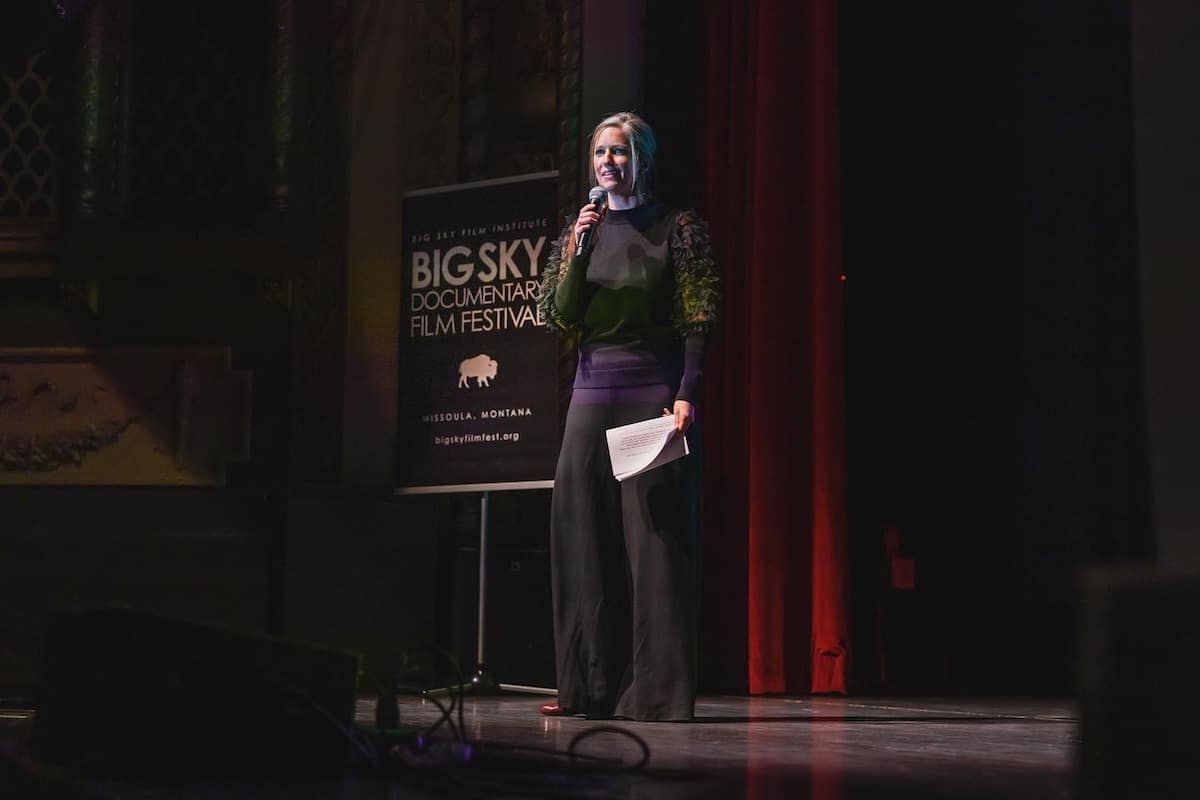
Civics, freedom and democracy all feel like apt subject matter to land on for this year—the festival’s 21st—for many reasons, not least because of the upcoming elections. It’s also a powerful finale for Rachel Gregg, the executive director of Big Sky Film Institute, who is stepping down this summer after eight years of navigating the festival’s course. During this time, Gregg has helped put the festival on the map, as internationally renowned and locally beloved, a cool-kid alternative to the bigger fests. A festival with cachet minus the pretension. Under her leadership, the Institute has grown its professional development and youth education aspects. The Doc Shop, a conference that runs during the film festival has provided exciting panels for filmmakers on industry practice and artistic philosophy. Big Sky Pitch has provided networking and funding for filmmakers who have come back after making their films to screen them full-circle at the festival. Gregg also established Big Sky as a partner in the 4th World Media Lab, supporting 48 emerging Indigenous filmmakers in this unprecedented artist fellowship. The festival has also been recognized by MovieMaker Magazine on their list of 50 Festivals Worth the Entry Fee every year she’s been at the helm.
It’s hard to imagine BSDFF without Gregg, and it will take a special leader to jump aboard and take the festival forward with the kind of vision Gregg provided.
If you talk with Gregg for any amount of time, it’s clear that she sees the Big Sky Documentary Film Festival as far more than a film festival, but a space for real impact in a time that requires thoughtful and bold storytelling. In light of her final festival year, and with a few more opportunities to see these civic engagement films, we sat down with Gregg—who, full disclosure, sits on The Pulp’s board of directors—to discuss documentary, discourse, and the power of gathering together.
The Pulp: In what ways have you seen the festival change over the years in a big-picture way and in terms of the role it plays in encouraging civic discourse?
Rachel Gregg: Well, honestly, I think the film festival has always played the same role, and how that manifests over the years [changes]. We know that the power of the festival is its gathering force. We can watch films at home, or on our phones. What’s special is that we’re coming together in one space, and it’s more than just an outing. There’s something that happens in a collective way that’s more than the sum of its parts. This year we’re calling it civic engagement. We call it that every year, but we wanted to lean more into that this year, realizing it’s a very specific moment in political history, where people are feeling very unsettled, in addition to some other very specific emotions, fears, and in such a way that it would be easy to turn aside and try not to pay attention and not to be involved. And that’s when democracy is, perhaps, at its greatest peril. I personally think that a healthy democracy requires participation. That’s where it’s exciting to have the festival play this role of bringing folks together.
What is your approach to programming the festival?
We program over 90 percent of the festival from what comes to us in the moment. We’re not going out and saying, what did Sundance play last year? What was at the Toronto Film Festival? We’re saying, “What do people want to submit to us?” Part of it is about being more democratic in our selection, but we also have a criteria for the quality of storytelling that we’re looking for, so, we only select 5 or 6 percent of what’s submitted to us. It’s exciting because it then becomes kind of a discovery process. And we’re a smaller dog in the pack. We’re not the big tentpole festivals that are really desperate for those crowd pleasers, or those biopics, or those commercial pieces about celebrities and all the shit that’s on streaming platforms. We can do weirder stuff. We’re not so big for our britches that we feel like we have to be cool or prove ourselves in some way. We’re more just like, “What’s out there?” Let’s be a venue for it and appeal to a lot more tastes, and even get really refined tastes to be interested in other things.
What is BSDFF’s identity in comparison to some other film festivals and how have you been cultivating that identity?

Our goal has really been to raise the profile of the event without letting it get away from us. What I mean by that is, we want to be respected as an institution that has strong and unique documentary programming that is distinct among the other non fiction film festivals, but also reflective of where we are in the documentary world, where there are a lot of ideas.
To get established as a film festival locally or regionally, it helped to have a brand of programming. We know people are going to show up for adventure films, mountain sports, or fishing and environmental stories. And we’re a university town, so there’s a lot of curiosity and continuing education opportunities specifically related to environmental stories, of course. There’s an appetite for Indigenous stories as well. We’ve leaned into that. There was already an existing curiosity and respect for those, but we also wanted to be really intentional about who was telling those stories, and what that means for giving voice to people who historically have not. The two things film festivals do is curate films and curate audiences. I think that second part is sometimes forgotten about.
Not all festivals have an education or professional development component. Tell us about why those are important to BSDFF.
My favorite thing to hear from filmmakers after they leave Big Sky is that it re-inspired them to want to keep doing the work. Because it’s a tough career, right? A lot of these projects are projects that they did with blood, sweat, and tears. And maybe it takes years. And then what is it all worth? Obviously, coming and sharing your stuff with audiences reinvigorates you. But it’s also about giving people a toolkit and connections. This is a relationship industry. To be able to meet people is huge. So we try and really create a space at Big Sky that’s super accessible. It’s not red ropes. It’s not pretentious. You don’t put the VIPs over here and the “Ps” over there. Everyone’s all together. It’s reflective of the tenor of our town. It’s chill, it’s laid back, it’s fun. Even the folks who come with a sense of self importance are kind of over it not long after they get here. It’s like, “Just stop taking yourself so seriously and celebrate the cool things that you do.”
Can you talk about the filmmakers’ engagement with local schools?
Probably one of the most memorable things for filmmakers when they come to Big Sky is if they do a screening in a classroom and show their films to kids. A lot of them never even thought about what it would be like to show their films to 8th graders or 10th graders or whatever. The kinds of questions kids ask and the way they experience film is so different from adult audiences. It’s a super cool experience for those filmmakers to understand the additional impact of their film—to think about that differently. But also … the kids are funny and it’s delightful.
And we have the amazing Julia [Sherman] who thinks really intentionally about how she puts all that together. They’re used to doing Q&As in a theater, even though that’s also kind of nerve wracking. But going into a classroom—you have no idea what these kids are going to say, because they’re really smart and they don’t have the filters that you probably do. And they’re more likely to express their curiosity, which is going to be really refreshing.
How does documentary, in particular, play a role in civic engagement?
Documentary has the power to give people more context and perspective—to be more curious than judgmental. We’re inundated with all of these sensations and media impressions all day long. When you go sit in the dark theater and you have to put your phone away, you become much more aware, I think, of the people around you, which is unique in a modern setting, right?
And you’re all coming at it from different experiences, but you’re all having a common experience in that moment, which makes for, perhaps, more productive outcomes. So, while we do have [international] films, we also have these curated pieces that are giving us more local, regional, and national context for thinking about how … we’ve been here before. What lessons can we learn from the past? How do we prepare ourselves? How do we give ourselves talking points as we head into a political season that feels like there are a lot of unknowns, but also a lot of knowns.
And those films are under the subcategory of “civics, freedom and democracy”?
After a lot of discussion, we decided those three words put the power in the hands of people—of voters and of citizens. Civics is how we engage with each other in a civil society. And freedom maybe has been co-opted by other ideas that actually don’t have anything to do with freedom—that actually have to do more with control. How do we take back that narrative and change it and think more about the pure definition of freedom and how that’s complicated by systems and ideas and demagogues. And then democracy, obviously, is what we’re aiming for.
When we talk about “a more perfect union,” it’s people expressing what they want from their government. We’re the ones who put the resources into government. What do we really want out of that? There’s been so much political angling to use that inundation of political rhetoric to make us not participate anymore. And when that happens, government becomes co opted by people, or circles of people, for their own personal gain. Regardless of whose side that benefits, it’s to the disadvantage of a healthy democratic society. There has to be people speaking up and participating and saying, “No.”
How are these themes incorporated into Doc Shop?
A lot of DocShop is about the future of documentary, right? If it continues to have influence. So we’re having some conversations about AI, because that’s huge in our collective narrative. So many of the conversations about AI are about if we’re going to be able to say “No” instead of giving ourselves permission to grow, and being curious about what technology can do for us. Technology has gotten to the point where we have to breathe in and not let it get so far that it’s damaging for us, collectively, in a way we could never have anticipated. I think that is kind of this interesting metaphor for the political moment, too. And that’s what we are trying to do, is give people the words and ideas and context for getting specifically, civically involved.
In politics right now, people seem to want a simple picture of the world. How does documentary push back against black and white thinking?
I’m a little bit biased because my whole reason for my work is driven by my belief in the form. What documentary does is, it slows things down. We’re so used to three-second videos—little things that people are making in front of bathroom mirrors and putting out into the world. Because it gets comments and love. But it’s not necessarily reflective of reality, whereas documentary—especially longform feature films—provides more space. And when you’re going into the room and submitting yourself to that pace, it’s more attuned to the way we think. It helps with focus. And then also, in terms of good storytelling—and hopefully we’re programming films that exercise good storytelling and multiple sides of an idea—it’s nuanced. It’s meant to look harder at those gray areas and reflect the fact that life is messy and that there’s not two camps of thinking. There’s lots and lots of camps. And maybe there’s not even camps. It’s meant to hold a mirror to reality.
Obviously documentary has this incredible power to build empathy, and meet you on a human level. I worry so much that politics take humanity out of democracy. I saw this awesome quote that said: “Politics has become a politics of anger and emotion designed to insult the very nature of truth.” I love that. The nature-of-truth idea is what got me really fired up.
What is the responsibility of the filmmaker in terms of the nature of truth?
This year [with filmmakers] we’re trying to define: Where do we draw the lines and where are we betraying our audiences? Where do we open ourselves up more to new ideas and technologies and formats that better reflect what modern experience is?
Trust with the audience is really important. You’re definitely leaning on people’s emotions. If you’re making a good documentary, you get an emotional reaction from people. But not in such a way that it makes you go behave badly, but in such a way that it makes you a more curious human who feels empathy for other people. It changes the way you go through the world—and hopefully that’s in a positive way.