On Super Bowl Sunday, hours before the Grammy-showered Kendrick Lamar took the field to proclaim his singular dominance of the genre before 128 million viewers, western Montana’s preeminent rapper was holding court in the front row at the Roxy Theater, knuckles deep in a silver bowl of popcorn.
Shadow Devereaux, a rap artist from the Flathead Reservation who will perform at the Red Ants Pants Festival this summer, kept one eye on the aisle, where an audience of musicians and creators was trickling in and walking up to pay their respects. In his trademark oversized hoodie and flat-brim cap, Devereaux bumped fists rather than shake hands. His fingers were greasy.
It was a private event, invitees only, and the feature presentation was about to start: a documentary on Montana hip hop. Devereaux, AKA Foreshadow, was one of its stars. He wouldn’t put it that way; it was a group effort, a collaboration. But the idea behind the documentary was his, anyway, his and Colter Olmstead’s.
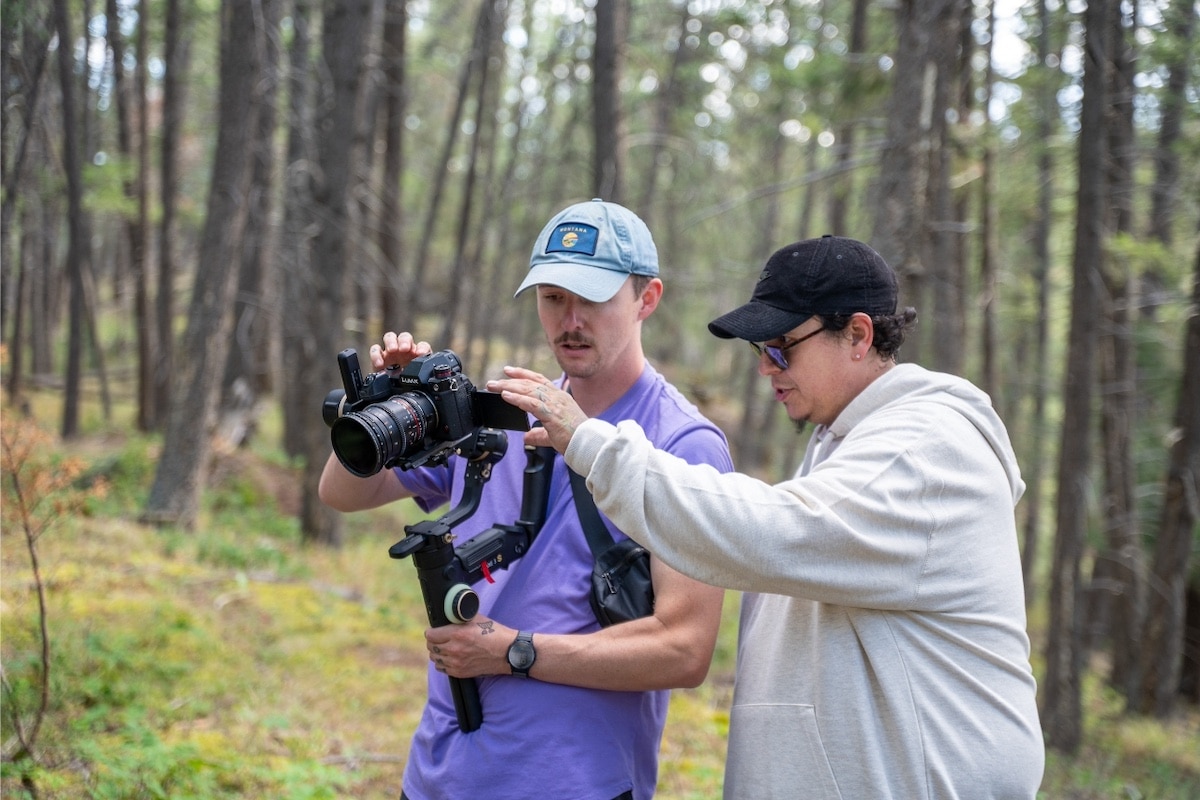
Olmstead stood nearby, mustachioed and slight. Originally from Helena, Olmstead has found success as a sound designer and filmmaker. He shot the drone footage for Bring Them Home, the bison documentary narrated by Lily Gladstone. Olmstead works commercial gigs for big companies, but his real passion is community filmmaking, especially music videos of Montana’s hip-hop scene. He’s been working with Deveraux for more than 10 years, helping film and promote the state’s small but passionate group of rappers. Together they co-founded Missoula’s Area 41 Collective, a community audio and visual studio on the Northside.
The idea for the film came in 2020, when Olmstead and Devereaux were driving up to the Flathead Reservation to make a music video that would eventually win Deveraux a Native American Music Award. It was hard for individual hip hop artists in Montana to get much traction, especially when performing opportunities dried up during Covid. What if, they wondered out loud, they brought everyone together for a summer vacation home on Flathead Lake, to record a collaborative album that would show the world the strength of the Big Sky rap scene? The idea stuck, and in 2023 they booked a VRBO on their savings and their faith, and sent out the invitations.
What happened next is the subject of the 23-minute documentary, Last of the Nobodies. Olmstead and Devereaux have been on the road recently, promoting the film on the festival circuit. First the film played in the Couch Film Festival in Toronto, where it won Best Short Documentary. Later, at the Chandler International Film Festival in California, the film was a finalist in the Best Short Documentary category. Olmstead and Devereaux have submitted it to more than 50 other film festivals, which will likely take them through early fall. They’re screening a Montana premiere this month, accompanied by a series of screenings around the state.
What if, they wondered out loud, they brought everyone together for a summer vacation home on Flathead Lake, to record a collaborative album that would show the world the strength of the Big Sky rap scene?
The film unfurls the familiar — a Flathead Lake house in late August — alongside the novel: a diverse group of two dozen rappers gathering there to produce music most people associate with cities like Los Angeles, New York and Atlanta. With candid close-ups, the film invites viewers into the house, stepping over the cords taped to the floor, and into the artists’ long days spent mixing beats on laptops and turntables, writing lyrics on their phones, and rapping into microphones in makeshift studios inside bedroom closets.
“It kinda just turned into a little rap camp,” Olmstead recalled.
Over 10 days, the artists collaborated to create more than 60 original songs. They plowed through Costco-sized bags of Hi-Chews, frozen burger patties and hot dogs. They clustered around mics to sing group hooks. They shared beats and meals. Devereaux made everyone Indian tacos.
In the film, an artist named Fish Bwoi (Jaia Kattelus) pauses to take in all the creative activity around him. “It’s like having really cool neighbors,” he says.
Unlike in other hip-hop markets, where individual artists compete for recognition, collaboration rules the day in Montana. “It’s the we versus me mentality,” Olmstead said. It’s a paradigm shift for a genre that can emphasize individual egos, diss tracks and beefs. But in a state so large and spread out, Deveraux says, working together is the only way for hip hop to get recognized.
No Montana hip-hop artist has enjoyed a fast-track to fame and fortune. “You’re taking the stairs,” says Josh Edwards, AKA Eddwords, a Kalispell-based artist and producer whose lyrical quotes make him the film’s unofficial narrator. If you’re creating hip hop in Montana, Eddwords says, it’s a passion. You’re probably working several jobs, saving money for studio time, and making music late into the night. “You’re kinda fuckin’ crazy,” he says. “You’ve gotta be.”
After 10 days in the lake house, Olmstead and Deveraux left with hours of footage and dozens of tracks. They spent the next year paring them down and mastering them into an album that dropped last September. Later they finished editing the film, with help from a $10,000 grant from the Big Sky Film Office. From the beginning, it was a labor of love.
“Coordinating 25 hip hop artists is probably the most difficult thing I’ve done in my life,” Olmstead told the crowd at the Roxy last month. “I don’t recommend it.”

That said, he and Devereaux are already fundraising for a Last of the Nobodies Vol. 2. This time they’re hoping to get 40 artists together, rap camp style, for another collaborative album.
“We’re taking the stairs,” Olmstead said, echoing Eddwords. “We’re going to have to take the slow route, no matter what.”
The film culminates with footage from an album release show at the Top Hat last fall. The artists wore matching gold and black jerseys, emblazoned with LOTN on the front and 406 on the back. In one of the film’s final scenes, Eddwords hypes up the group backstage. “If you ever doubted yourself,” he tells this unlikely group of rappers, “there’s a reason you’re in this room.”
“We’re taking the stairs. We’re going to have to take the slow route, no matter what.”
What follows is a sweaty, satisfying catharsis as the rappers take the stage before a cheering crowd with their hands in the air.
“Montana really has no hip-hop culture,” Devereaux says at one point in the film. But watching this group of rappers onstage at the Top Hat, pouring their hearts into their microphones in the film’s crescendo, it’s clear that these artists are making one.
As the film finished at the Roxy, the room erupted in applause. Many of those in attendance were artists in the film, and for them it brought back a wash of good memories.
“It made me realize how much of a love family it is,” said Zak James, a rap artist from Helena who wrote “Damn Thang,” one of the tracks on the album. “It felt right. We had a community come together and make something beautiful. You could feel the energy. A lot of times the world is lonely. Art is lonely. It was nice having a lot of people on stage getting funky, getting down.”
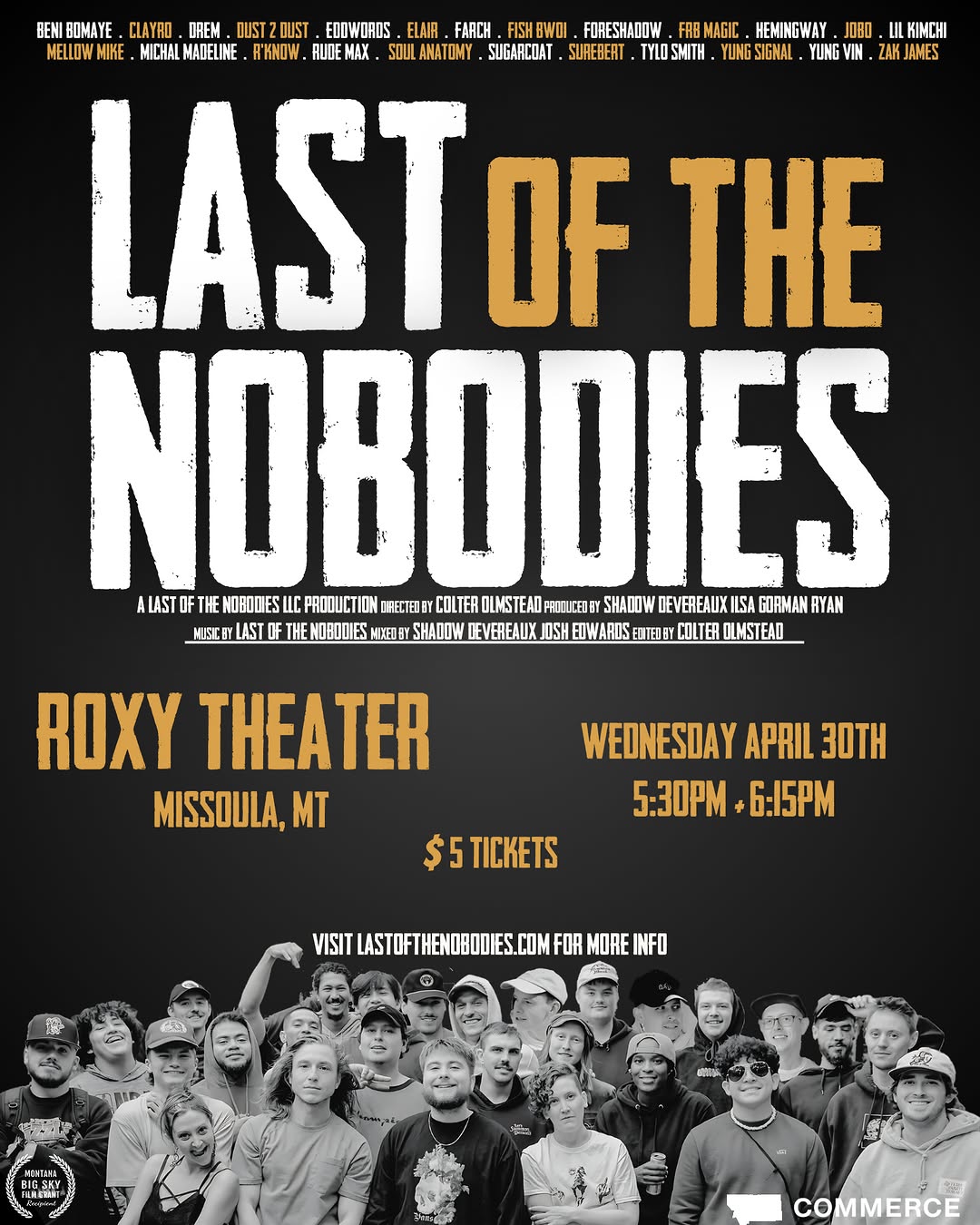
Last of the Nobodies screens at the Roxy Theater on Wed., April 30, at 5:30 PM and 6:15 PM. $5. More info & tickets.