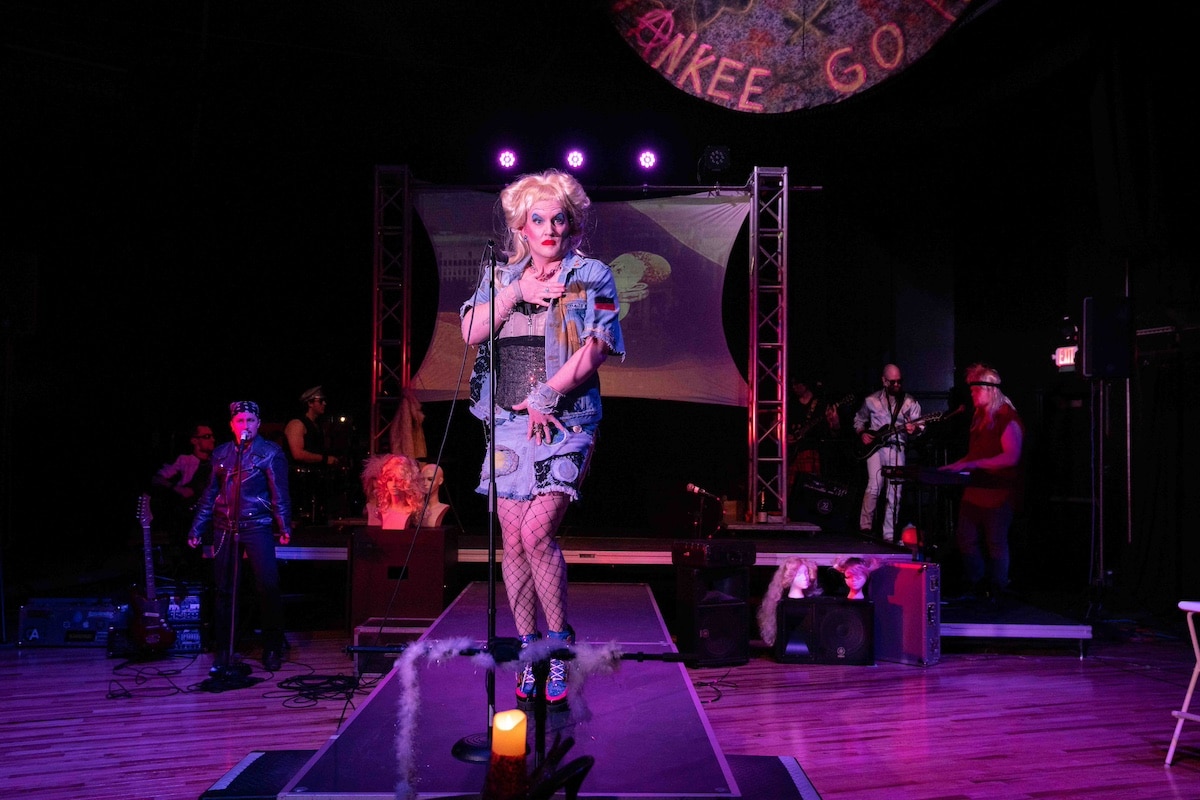
The fun of seeing “Hedwig and the Angry Inch” on stage is that it doesn’t feel like a play in the traditional fourth-wall sense. The concept of “Hedwig” is that you—the audience—are watching genderqueer rock singer Hedwig Robinson perform her musical act with her band, the Angry Inch, and her husband, Yitzhak. She and the band are on tour and, on this particular night, they are playing inside a ramshackle venue. Hedwig’s ex-lover, Tommy Gnosis (a much bigger star), performs in a larger venue nearby. Hedwig, a German immigrant refugee from East Berlin, is using this particular evening to tell us, the audience, her life story in between her musical numbers. She’s a woman who has had it. She’s ready to unleash the truth—about Tommy and everything else—with all the bitter, sordid details. And the audience is along for the ride.
Westside Theater’s production of “Hedwig and the Angry Inch,” directed by Joe Martinez (who recently directed MCT’s “Rent”), is an incredibly satisfying experience in all the ways it should be. I’ve heard great things about the Neil Patrick Harris version on Broadway, but “Hedwig” is inherently scrappier, more intimate and more immersive in a place like the Westside Theater, which is housed in old industrial buildings on the edge of the train tracks in Missoula’s Westside neighborhood. Inside the theater are round tables with black tablecloths and candle-style lights, where you can sit cozily with your friends, sipping beers and eating gummy bears (you’ll see). It’s an intimate space, but with a high ceiling (where aerial silk artists have been known to practice their skills) and a balcony overlook that give the theater an asymmetrical depth.
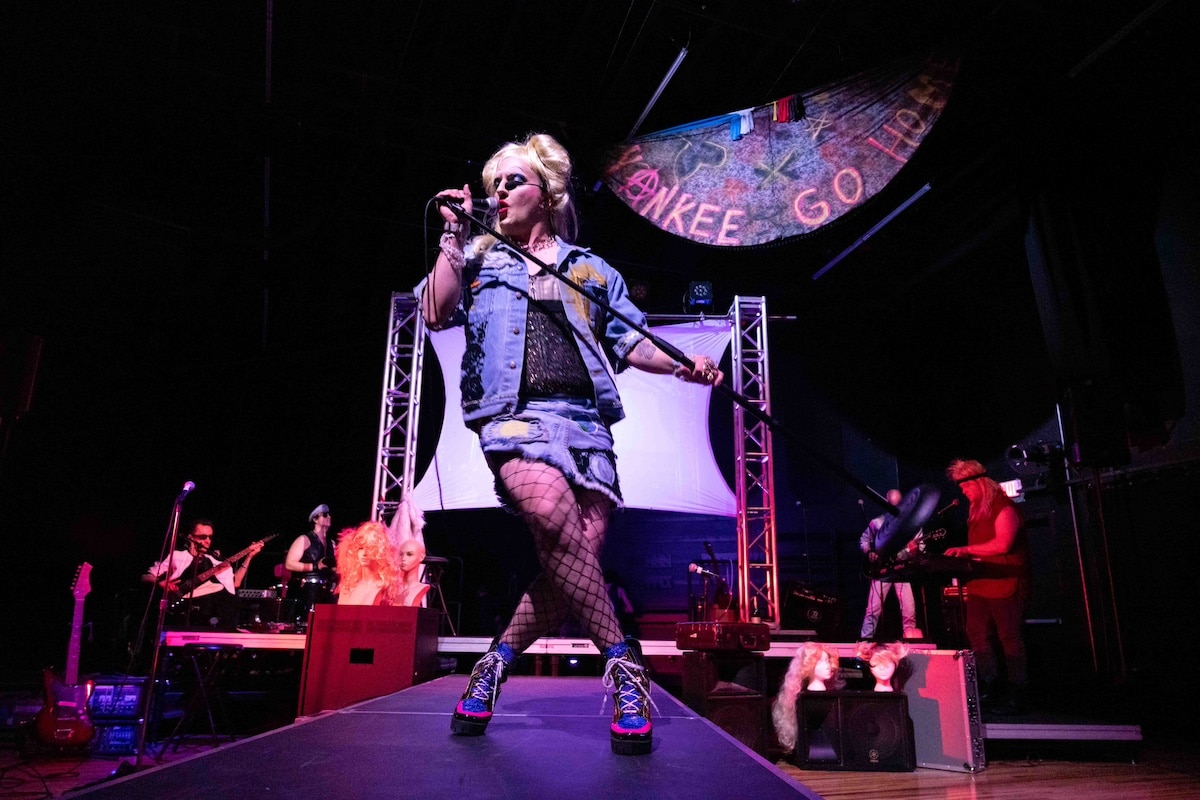
“Hedwig and the Angry Inch” is not the type of production we get to see often in Missoula. The Roxy Theatre shows the film version on a regular basis—maybe once a year—because it’s a beloved cult classic. But the film is far different from the live production. In the film, Hedwig’s story plays out on and off the stage, with real characters we meet. In the staged version, Hedwig tells us her story in monologue form. Pulling off the role of Hedwig is a feat, a theatrical marathon. It requires someone who can almost single-handedly command an audience for 90 minutes straight, no intermission. They have to spend that 90 minutes belting out glam rock songs, strutting and shimmying, all while unfolding a story of pain, love, heartbreak, anger, and triumph, with perfectly timed quips to make the audience laugh. And for the Westside Theater’s production of “Hedwig,” that person is Daniel Crary.
You may recognize Crary from last October’s “Rocky Horror Show” at the Wilma, when he played Eddie and Dr. Scott (“Great Scott!”). Though he has a long history of acting—MCT touring shows as a kid growing up in Billings, regional theater on various stages across the country, off-Broadway shows in New York—he’s never done anything like Hedwig.
“It’s a ruckus, wild concert,” Crary says. “It feels like a show: 11 songs interspersed with some monologue and storytelling. If anyone has enjoyed going to Word Dog events or ‘Tell Us Something,’ it’s like that. Or it’s like seeing a show at the Union Club cut with an episode of The Moth. That’s the vibe. I find it to be a really messy and fraught show. It’s not a cleancut morality play. It’s not a Shakespearean epic and it’s not a typical musical comedy. It’s very bare bones. It’s got a real punk rock vibe to it.”

“Hedwig” was created by John Cameron Mitchell, who based it on a woman he knew in East Berlin. He was an army brat, she was a war bride. Mitchell took some of her wild stories and combined them with parts of his own life experience as a queer man. He and musician Stephen Trask built the show by workshopping it at drag bars, birthday parties and at New York rock clubs like Squeezebox, opening for various acts including Debbie Harry and Joey Ramone. In the early workshops, Hedwig sang covers—Television’s “See No Evil” and David Bowie’s “Boys Keep Swinging”—but eventually Trask composed the songs that make up the current show.
In the script, Mitchell and Trask encourage productions to preserve the improvisational flow by ad-libbing when appropriate and changing lines to fit location. In the Westside Theater’s production, Hedwig is performing at the Westside Theater and Tommy Gnosis is ripping it up at Washington-Grizzly Stadium. Crary disappears into the role. His Hedwig wades into the audience, flirting and confessing and raging, but also acknowledging an audience member’s sneeze without missing a beat (bless you) and dropping Missoula cultural references like breadcrumbs. And he nails the rock songs with punk-rock snarl and power-ballad flair.
Hedwigs are often played with a full-on German accent, but Crary plays with different voices.
“I interpreted Hedwig as being a little bit of a mimic,” he says. “Having some phrases that are fully Americanized, and some phrases that are highly accented. I think any kid who grows up with a lot of media consumption as their primary best friend ends up with sort of an eclectic personality like that.”
There are other elements that provide a rich experience for this show, which was produced by Westside’s Kelly Bouma. The Angry Inch, Hedwig’s band, is played by some excellent musical performers. Video projection on a screen behind Hedwig and Yitzhak was created by Mike Steinberg of the Roxy. It serves as another element of texture and immersion, adding energy and helping to sculpt the rise and fall of emotions, but without being too on the nose.
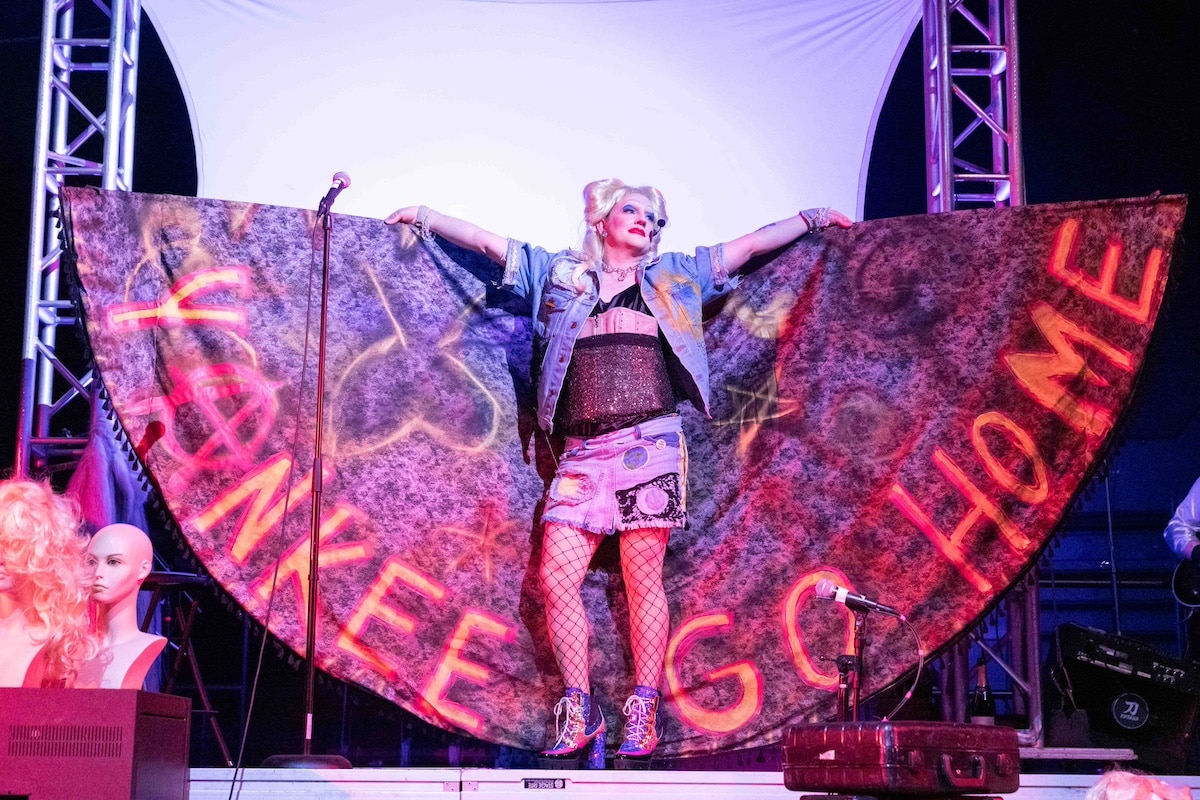
Key to the performance is the drama that plays out between Hedwig and Yitzhak. We learn that Yitzhak was once a drag queen, but Hedwig doesn’t like the competition and abuses him throughout the play. Nevertheless, Yitzhak sings along with Hedwig and helps her with her costume changes, putting up with Hedwig’s abuse, while quietly garnering the empathy of the audience. In Westside’s show, Kaegan Finn plays Yitzhak with tenderness and fury.
In the film and in many productions, Yitzhak is played by a woman who presents masculine, but Finn is a trans man who is exploring the role from that lens. Missoula audiences may recognize Finn from Montana Rep’s “Buckle Up,” where plays were performed inside cars around downtown. Finn’s piece was called “Cap’s Last Tape,” which was a monologue in which the character is experiencing loss in an apocalyptic time. Finn says before transitioning, it was harder to approach their characters as a whole self, but “Cap’s Last Tape” was a role that opened up possibilities for letting go of a gendered self and, instead, expressing an authentic self.
“When I think about how I acted before, it was always like I regarded myself as a sum of parts that just happen to join together rather than as the organic element we’re meant to be,” Finn says. “‘Cap’s Last Tape’ really helped me feel comfortable nuancing the type of acting that I’m doing.”
In “Hedwig and the Angry Inch,” authentic self is key, and Yitzhak and Hedwig’s interactions unlock a lot about the nature of power, dreams, repression, and oppression through the dynamic of their relationship.
“There’s so much to explore in this piece,” Finn says. “Like, what happens in relationship dynamics when we stick to only one thing in terms or power. There’s the phrase about when someone’s the gardener and someone’s the flower. This is about finding a way for us to all be tender to each other so we all are flourishing as a whole, right? And what a challenge that is when two people have the same medium in which they communicate.”

Hedwig’s transformation on stage, which we are meant to loosely parallel with the collapse of the Berlin Wall, is an anti-hero’s journey. Hedwig is complicated. She makes questionable choices. She is full of trauma, which she sometimes weaponizes. In bringing her to life, Crary does an amazing job of walking that vital line, making sure the audience experiences all her facets without losing empathy.
“They came up with this bizarre, spiteful, hopeful, fucked up character,” Crary says. “She’s just both a mess and kind of beautifully vulnerable by the end of the piece. What I’ve really enjoyed about it is the sort of liberating factor of the wiping away of facades, the dropping of masks.”
Crary’s literal stripping of facades—layers of clothing, wigs, shoes—looks physically exhausting, and speaks to the real art of drag. The production at Westside Theater is happening at a time when Missoula has a more vibrant drag scene than ever—and Crary is quick to note how playing this role is different from being a true drag queen.
“My work in Hedwig is the result of a lot of people helping me with makeup and with costumes,” he says. “I am not a drag queen. A drag queen is deeply involved in the creation of their own look and has willed that character into being. I’m taking on somebody else’s character with a team, with an artistic staff.”
Hedwig is a flawed character with an uneasy storyline. She’s not trans—her botched reassignment surgery was forced on her. She is referred to as “a gender of one” though she would probably be called gender-queer these days. She’s a messy anti-hero who won’t be defined, but is unquestionably relatable on a human level.
She also marks a particular moment in time for queer culture as almost exclusively counterculture. And yet, she’s still relevant now, at a time when queer representation is finding a foothold in mainstream Hollywood even as queer culture still experiences legislative backlash.
“Being punished for your existence is definitely a theme within the show,” Crary says. “But in terms of the broader cultural conversation around drag—both with drag bans and just recognizing drag for the art that it is—drag’s in a very interesting and unique place right now. And Hedwig has a place in that conversation.”
“Hedwig and the Angry Inch” shows for the last time at Westside Theater Sun., Feb. 18, at 7:30 PM. Sold out online, but some tickets will be available for purchase at the door.