
Third in a four-part series, “Community for Profit.”
Part 1: “Care on hold”
Part 2: “The selling of Community”
Part 4: “Community’s next chapter“
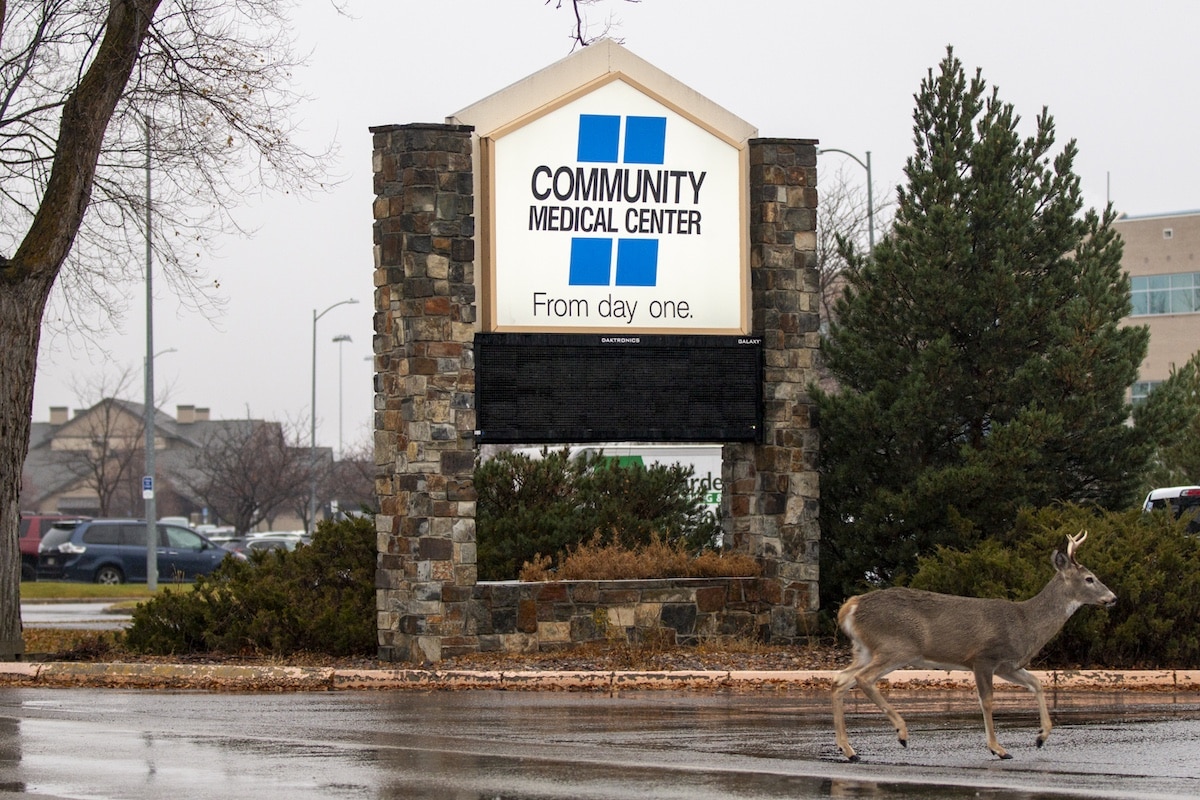
Mementos from the peak of the pandemic still sit on the nursing station countertops at Community Medical Center in Missoula. “Not all heroes wear capes, some wear scrubs” is scripted on the little figurines.
After those dark times, caregivers thought things would improve at their workplace.
“We thought things were looking up,” a nurse said in early 2024. “We’ve consistently seen the other way around.”
More than 20 current and former employees who worked at the hospital or for its physician group clinics in the years since the start of the pandemic detailed concerns for the way local administrators and Lifepoint Health, the Tennessee-based for-profit chain that co-owns Community, have run the hospital and clinics. The majority of them worked in adult-care units at the hospital. In interviews over several months, sources report leadership decisions they claim made it harder to give good care to patients in those units in the years after the pandemic’s peak. More than a dozen sources who worked with adult patients at the hospital said they felt profit-driven motives were part of the problem.
One of them is Lea Bossler, who worked as a health unit coordinator for about a year and a half and all of 2022 for both the Neonatal Intensive Care Unit, or NICU, and the Medical-Surgical unit, or Med-Surg, which cares for adults recovering from surgeries or otherwise admitted for overnight stays.
“We thought things were looking up. We’ve consistently seen the other way around.”
Before she was an employee, Bossler was a patient, as was her daughter, Maesyn.
Maesyn was born preterm at Community in January of 2021 at 25 weeks of gestation. It was a high-risk pregnancy, for both the mother and daughter, and Maesyn stayed in Community’s NICU until she died four months later.
“Everyone that worked with me was above and beyond amazing,” Bossler said, remembering the care she and her daughter received.
When Bossler was drawn back to Community in September 2021, it was for the job. In theory, the position, which paid $16 an hour, was similar to an office secretary who would be in charge of paperwork, answering the phone and scheduling. But she said part of her job at the NICU was watching the heart monitors of critical babies at night. And Med-Surg, she said, was the Wild West.
She said she watched as both the nurses and the patient care technicians on Med-Surg would be cut to the bare minimum, again and again, only to have the inevitable: more admits coming up from the emergency room in the evening, stretching the staff remaining on the adult floor thin.
“Why not have that extra person stay?” she said.
“If it had been unusual for these staffing situations to happen, I would lean on the side of it was COVID times, post-pandemic, the beginning of the housing crisis in Missoula, healthcare’s challenges — I would lean on all those things that give more grace to hospital management. But since it was so consistent the whole time I was there, it seemed a lot more by design to be as short-staffed as possible as much as possible,” Bossler added. Other sources who worked at CMC shared similar accounts.
By the end of her time at Community, Bossler’s take was that morale was in the gutter.

“There would be this quiet doom feeling that would come over our unit. Or everyone was talking about how exhausted they were, how pissed off they were. How much they questioned even being in healthcare anymore,” she said. “You’re there because you care, and for them to run out of energy to care was heartbreaking.”
Four things happened in quick succession at Missoula’s Community Medical Center: a change of ownership in 2018, a global pandemic in 2020, the release of an article in the Missoulian detailing issues on the hospital’s adult care floors in early 2024 and some significant changes at the hospital following that article. The Pulp has looked into this sequence of events and allegations from workers at the hospital, as well as spoken with some providers from CMC’s primary care clinics who reported positive and negative experiences. Those sources who remain anonymous declined attaching their names, either because they were not authorized to speak about their time at Community or because they fear it could damage future career opportunities. Community is one of two hospitals in Missoula, and many noted how small the healthcare community is.
CMC administrators in a December interview detailed recent efforts to improve adult care staffing issues — which include hiring at least 27 registered nurses in 2024, a new nurses’ contract that increases base wages by 37.5 percent over three years, and various pay increases for key nursing positions — and insisted that a high level of care comes first at CMC and Lifepoint Health.
“Quality is extremely important to us,” said CMC’s new CEO, Greg Cook. “We can’t have quality if we don’t have staff. There’s nothing we gain from cutting staff to a point where we can’t take care of patients appropriately. … We are never going to put patients in danger. If we have a gap, we’ll fill it.”
CMC has declined response on many of the specific claims made by employees and former employees after numerous attempts for comment. Where The Pulp has received comments, they are included. Spokesperson Megan Condra has three times cordially told The Pulp that CMC would no longer comment. The first time was on Feb. 27, 2024, when Condra wrote in an email, “We have chosen to not answer additional questions as we have already provided answers and contributed a great deal of time responding to your previous requests.”
The Pulp reinitiated the interview process with CMC in October, and Condra responded to some questions by email and sat for an interview with The Pulp on Dec. 6, along with Cook and Holly Nagel, the chief nursing officer.
“Everyone was talking about how exhausted they were, how pissed off they were. How much they questioned even being in healthcare anymore. You’re there because you care, and for them to run out of energy to care was heartbreaking.”
CMC declined further comment about additional details shared on Dec. 12 and Jan. 6. “We have spent a great deal of time and resources in researching and sharing responses with you over the past year and much of what you are asking … stems from operational decisions made years ago. For those reasons, we have shared all we can for this story,” Condra wrote this month.
In the Dec. 6 interview, Condra said there have been issues at the hospital, but said CMC leadership has acted on those issues.
“It’s not perfect. There are things, especially going into corporate culture, that have to be standardized … and it doesn’t always go smoothly,” she said. “But what I’ve been impressed by is, let’s have workgroups, let’s figure it out. We’re committed to making it work. So hopefully what you’ve found in asking these questions is that there have been a lot of issues, but staff bring them up, we have our (employee) survey, we learn about them so that we have the opportunity to fix them and continue to grow,” she said.
“There’s always going to be something that we’re not doing as well as we should,” Cook added, “but the important thing is we know where our weaknesses are, we focus on them and we try to improve. That’s my expectation of everyone in our organization.”
Gayle Collins, who worked the hospital’s front desk for 18 years and left during the pandemic, pointed out that some people were horrible to healthcare workers during the pandemic. The burnout was incredible, and entire departments turned over. This left massive holes in experience and launched a hiring spree to net just about anyone to fill the gaps, she said.
Replacing the experienced people lost will take years, she added.
“I think some of it is a learning curve weaving through the pandemic,” she said. “I wonder how many of us would still be working our shifts had it not occurred.”
The pandemic happened after CMC had become part of the for-profit chain of hospitals run by Lifepoint, which is owned by the private equity company Apollo Global Management’s investor funds. Apollo’s network of about 220 hospitals is the largest collection of private equity-owned for-profit hospitals in the nation, according to the nonprofit watchdog Private Equity Stakeholder Project. In Missoula, CMC is also co-owned by Billings Clinic. Missoula’s other hospital, St. Patrick, is one of 51 hospitals operated by the nonprofit, faith-based Providence network.
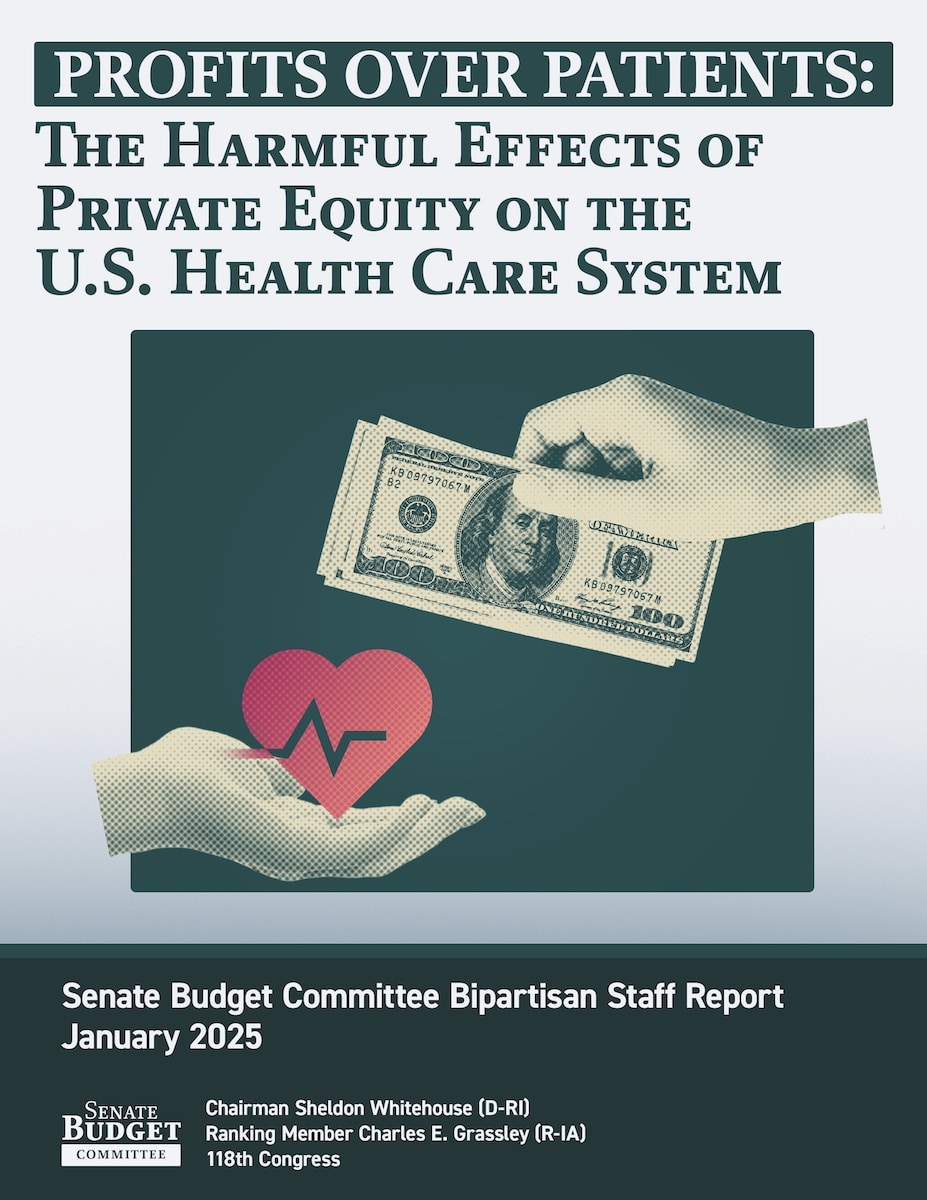
Both Lifepoint Health and Apollo Global Management are subjects of two U.S. Senate investigations. One from the budget committee, which released its findings Jan. 7, and named Community Medical Center and sexual assault allegations against a contracted doctor, Tyler Hurst, who worked in the ER there. The other is led by the Senate’s Homeland Security and Governmental Affairs Committee, which is ongoing. The investigations are digging into ways private equity-owned hospitals affect patient care.
When available, comments from Lifepoint’s spokesperson, Emily Serck, are included in this series. Numerous attempts to receive comments from Apollo were unsuccessful.
In Missoula, Lifepoint has made major capital investments at CMC since the pandemic.
In 2023, the hospital built a new $13.5 million emergency department and opened a new $17.9 million cardiology center earlier this month.
The hospital donated land near its campus for a new education building for the Mark and Robyn Jones College of Nursing, affiliated with Montana State University, in a move toward a long-term solution to the nursing shortage. MSU broke ground in April, and the facility will allow increased enrollment on its Missoula campus and feature large practical labs and simulation suites. Currently, MSU rents space from the University of Montana and the move to the new CMC campus building is slated for fall of 2026, said CMC’s chief nursing officer, Holly Nagel.
“We are fortunate to say their Missoula campus is going on our campus,” Nagel told The Pulp.
Current and former CMC staff interviewed for this story recognized the need for those improvements, and multiple sources said CMC’s renowned NICU, mother-baby and pediatric units have been staffed sufficiently.
Yet a dozen employees who worked in CMC’s adult units in 2022 and 2023 say what was happening on their floors tells a different story. They shared accounts of working with a bare-bones staff, and they attribute patient care issues to leadership’s failure to listen to nursing staff’s numerous calls for changes. They’ve come forward in internal meetings and reports and, anonymously, to journalists. Those unnamed by The Pulp outline incidents supported by others who described similar accounts.
One former caregiver called the millions being spent on a new heart center while adult care floors struggled “shifting money to the places that make money.”
“They want better out-patient services, which are the big money-makers,” the caregiver said.

As a result of their work experience, a dozen current or former employees who worked with adult patients in 2022 and 2023 said they built up a mistrust of Lifepoint and CMC’s former administration.
“We need this hospital. And we need it to be good. We have an amazing NICU, mother-baby units,” a nurse said in early 2024. “We need a place like this in the adult world.”
“And it’s profoundly sad,” the nurse continued. “You don’t want to watch this happen. There are amazing things here. You don’t want the community to feel like they can’t come here and get good care.”
This is the story of adult care challenges before they started to get better.
Overloaded techs on Med-Surg floors
Three former techs and multiple other sources at CMC said, against their expectations, the workload got worse on the adult-care floors after the pandemic.
“You drown from the time you come in until the time you go home,” a tech said of working at CMC in 2022 and 2023.
Patient care technicians and certified nursing assistants, both referred to as techs, are responsible for patients’ basic care — including taking vitals, feeding, repositioning patients who are immobile, washing and completing oral hygiene. At CMC, reporting shows techs on Med-Surg took 16 patients by day and 18 at night until changes in 2024.
Even 16 patients were too many, three former CMC techs said, but reported they sometimes exceeded that ratio, even caring for more than 20 patients in 2022 and 2023 when they were short-staffed. All three called that unsafe.
“There are times where I had 22 patients to myself, which is just so crazy unsafe,” a tech said.
“You drown from the time you come in until the time you go home.”
While there is not a national standard for patient-to-tech ratios in hospitals, a tech who left CMC to work at St. Pat’s in 2023 reported dayshift techs at St. Pat’s were typically responsible for six to 10 Med-Surg patients, sometimes 12, and very rarely more. The overall workload was “drastically better” at St. Pat’s, the tech said.
The former CMC techs described the challenges of 12-hour day shifts when they were short-staffed on Med-Surg.
Many of their patients can’t walk by themselves.
“A lot of times these are people who need at least one, sometimes two people to assist them to the bathroom. Sometimes there are patients that can’t get out of bed at all, so it takes two, three people to change them in bed,” a tech said. “Your body is so worn out. You’re lucky if you get a decent lunch break. You’re just inhaling what you can as you go.”
Some patients with low blood sugars are supposed to be checked every 15 minutes to ensure they reach stable levels. Or a patient might have high blood pressure or another condition needing attention, techs said.
“But it’s taking us three hours to go through the whole unit, and we don’t know that until we get to them. That can be scary,” the tech continued.

Multiple sources reported delays turning patients in bed to avoid skin breakdown, pressure ulcers and other complications, and said patients who shouldn’t be walking alone may become impatient and risk a fall.
“For the patients, it’s so unfair,” a second tech said.
“They would be telling me, ‘I don’t have time to feed these patients. These patients aren’t getting anything to eat,’” a nurse said.
“Oftentimes patients would soil themselves,” the nurse added. “I wouldn’t pee. I wouldn’t have a lunch break to try to do these things the patients deserve. But at times it was absolutely impossible.”
Multiple sources said that consistently brushing patients’ teeth for safe oral hygiene and regular showers for long-term patients were not possible when techs had so many patients.
The worst part, employees said, was coming into work knowing they wouldn’t be able to care for their patients the way they deserve.
“You can’t slice up your pie that thin. It’s physically impossible,” a third tech said. “It was just unsafe.”
CMC has taken steps to address some of the issues. Last year, the ratio of patients to techs on the Med-Surg floor was reduced to 12-1.
While CMC has not responded to The Pulp’s requests regarding allegations that tech staffing was at times unsafe in the past, CMC nursing supervisor Holly Nagel acknowledged the previous ratio was much higher, and called the reduction in patient load an important improvement.
“That was a huge positive in terms of recruitment and retention. Not only getting them here, but keeping them here. People want to be in an environment that feels like something they want to work in. People want to do a good job. They want to provide good care. Giving them the ability to do that through a smaller group of patients to care for is one way that we’ve done that,” she said.
“People want to do a good job. They want to provide good care. Giving them the ability to do that through a smaller group of patients to care for is one way that we’ve done that.”
The Pulp was sent staffing matrixes for both St. Patrick Hospital and Community, current as of early 2024, before CMC made those changes. The matrixes confirm what sources at CMC and St. Pat’s reported — that the standard day-shift maximum for CMC techs was 16 patients, while it was 12 at St. Pat’s. Again, CMC employees say that number was sometimes exceeded in the past.
Ratios of techs to patients vary greatly across hospitals. Nursing ratios get most of the attention in both studies and proposed legislation addressing staffing levels.
State legislation to limit how many patients a tech can safely care for is primarily aimed at nursing homes, rather than acute-care hospitals.
An exception is Oregon, where at another Lifepoint hospital, Willamette Valley Medical Center, nurses have spoken out about Lifepoint in the past. The state in 2023 passed a law to restrict CNA/tech ratios to no more than seven patients by day and 11 patients by night in hospitals.
Staffing for blood draws and transports
A job duty multiple techs and nurses discussed at length involved blood draws, or phlebotomy. Drawing blood for tests fell to techs at CMC, but not at St. Pat’s. CMC techs also transported patients around the hospital, which is not always a part of the job in other hospitals and can take away time for other tasks. The use of designated phlebotomists and transporter personnel on adult care units had been cut before the pandemic, but after CMC became a for-profit hospital.
Dean French was the company’s first permanent CEO after the 2015 shift from nonprofit to for-profit. He left in late 2020.
A former Community nurse remembered things working better under him. French was actively involved on the floors, was a doctor and had a rapport with staff, the nurse said. French was known to remember employees’ names and their family members’ names, which the nurse and other sources said they appreciated.
However, his administration transitioned away from using designated phlebotomists on adult-care units and cut transporter personnel, sources said.

French transitioned to training techs to do phlebotomy around the time CMC became a Lifepoint Health hospital, according to employees.
CMC spokesperson Condra said the phlebotomy decision happened locally and was not a Lifepoint policy. French didn’t respond to requests for comment. Messages were left on his office phone and sent via LinkedIn.
Condra said that when CMC decided to add the responsibility of phlebotomy to tech jobs, the hospital was having trouble hiring phlebotomists due to a nationwide shortage. No phlebotomists were fired, she said.
“We were trying to hire phlebotomists and none were applying,” Condra said.
The former nurse said that the move appeared to be a response to recruiting challenges, and an effort to cut costs, and didn’t remember phlebotomists being fired. French had prior experience using the model, the former nurse said, and David Lechner, the chief medical officer at the time, said the same.
Lechner said he believed part of the reason for the change was resilience — teaching the skill to techs meant the hospital would be better prepared for shortages. Lechner also remembered the decision wasn’t popular.
Techs have been trained since before the pandemic to do blood draws in on-the-job sessions that last a few hours, multiple sources confirmed. Of note: Montana does not require specific phlebotomy certification. Only four states do.
At first, things ran more smoothly, the former nurse said, in part because of French’s leadership, and because there were still backup phlebotomists available in the lab to help on patient floors. Multiple sources said the training was more thorough before the pandemic.
Techs and other employees noted that their wages were not increased for taking on phlebotomy.
The big issue, the three techs and multiple other employees said, is that phlebotomy took time away from other duties. Sources reported techs at night taking blood for more than two hours for morning labs. During the day, there are generally fewer draws to do.
A caregiver with experience at hospitals across the country said the lack of designated phlebotomists for adult care draws was the biggest shock in coming to CMC. The source stressed the disruption to workflow caused by having nurses and techs take on lab draws, as several other sources have. Having designated phlebotomists do lab draws is safer all-around and much more the norm, even in hospitals smaller than CMC where the employee had worked, the source said.
Providence St. Patrick, sources confirmed, uses designated phlebotomists for the majority of medical-surgical patient lab draws.
The Pulp also looked into phlebotomy policies at the two nearby hospitals closest to Community in size, in terms of patient discharges: St. James Healthcare in Butte, which is owned by large not-for-profit chain Intermountain Healthcare, and community-owned St. Peter’s Health in Helena. St. James is considerably smaller, with 67 beds, around 650 employees and 2,700 discharges in 2023. St. Peter’s is considerably larger, with 116 beds, around 1,800 employees and 5,800 annual discharges. CMC has 151 beds, around 1,000 employees and 3,900 discharges.
At St. James, phlebotomists do the majority of medical-surgical lab draws; nurses do some, and techs don’t do draws, according to Malorie Miller, a current nurse there. The same is true for St. Peter’s Health, according to spokesperson Jacquelyn Tescher.
In 2024, CMC hired one part-time phlebotomist to assist with peak-hour draws, but the hospital was not actively hiring additional phlebotomists as of December, Nagel said.
“We’ve redistributed workloads to be appropriate for [techs] to take on the task, and given them a support phlebotomist during the peak times,” she said, describing the significant drop in patient ratios in 2024.
That one position has been helpful, a nurse said.
“That just goes to show how desperate we have been for any kind of help,” the nurse added.
Dean French’s administration also cut dedicated transporter personnel from the CMC lineup, multiple sources confirmed. This left nurses and techs to take on the role of moving patients around the hospital for procedures, x-rays and MRIs.
“That just goes to show how desperate we have been for any kind of help.”
Combined with getting a patient ready, trips to distant reaches of the hospital and back are 20 minutes minimum, multiple sources confirmed, and a tech noted that taking a patient to the curb and waiting for them to be picked up to go to a nursing home could turn into a 40-minute ordeal.
Again, patient transport is a service St. Pat’s has and CMC does not, sources confirmed. Multiple sources at CMC also said they felt that not having transport personnel is not as unusual at hospitals as having techs do lab draws. St. James in Butte does not use designated transporter personnel to move patients around the Med-Surg unit for procedures and radiology, according to Miller, the nurse there. St. Peter’s in Helena does use designated transporters, according to Tescher.
Several sources said not having transporter personnel was nonetheless impactful at CMC.
“It’s a huge waste of time. We’re not being utilized on the floor as we should be. The transporters were the behind-the-scenes people, so we could get all these patients down [for procedures like x-rays], not only in a timely manner, but a safe manner,” a long-time former employee said.
Nursing challenges on Med-Surg
Med-Surg nurses, meanwhile, are responsible for running detailed assessments on patients, caring for wounds and other injuries, and dispensing medication — a huge part of the job.
At CMC, multiple sources described Med-Surg nurses being run ragged while helping understaffed techs keep up with basic care, blood draws and transports.
Nursing staff’s to-do list also frequently included cleaning rooms and laundry because housekeeping also ran short-staffed post-pandemic; more than a dozen sources confirmed this.
The above challenges were in full swing, and morale was at rock bottom, several sources said, when nurses were told their patient load on Med-Surg floors would increase. A source said that adding more tech help was part of the discussion, but when leadership proposed giving day-shift Med-Surg nurses six patients per shift instead of five in winter of last year, nurses fought back, the union got involved, and the idea was quashed.
Very few states have laws setting maximum nursing-patient ratios. California and Oregon set a 5-1 limit for Med-Surg, both day and night (in Oregon, it becomes 4-1 in 2026). In Montana, the Montana Nurses Association brought a house bill in 2023 that would have done the same, but it was tabled in committee. They intend to bring another this session, Robin Haux, labor program director for the MNA, told The Pulp.
A 2021 study of hospitals in Illinois led by University of Pennsylvania researcher Karen Lasater found the average Med-Surg staffing to be 5.4 patients per nurse, comparable to CMC’s ratio. The study also found that two-thirds of nurses surveyed in the study who were assigned six or more patients assessed that workload as unsafe, and found significant impacts to 30-day patient mortality with each patient added to a nurse’s load.
Two CMC employees from earlier days reacted to the proposed 6-1 ratio for daytime nurses.
“That is crazy,” said Bob Hendryx, a former intensive care unit pharmacist at CMC. “That is just bat-shit crazy.”
“That’s insane,” said Mary Windecker, a former vice president at CMC. She ran productivity measures for the hospital until she left in 2015. “You just didn’t find that level of staffing anywhere that provided quality healthcare.”
Multiple nurses called the proposal an example of the drastic disconnect between administrators and the actual work on the floors at the time.
The Pulp requested comment from CMC on this proposal and these claims, and did not receive a response.
A public airing
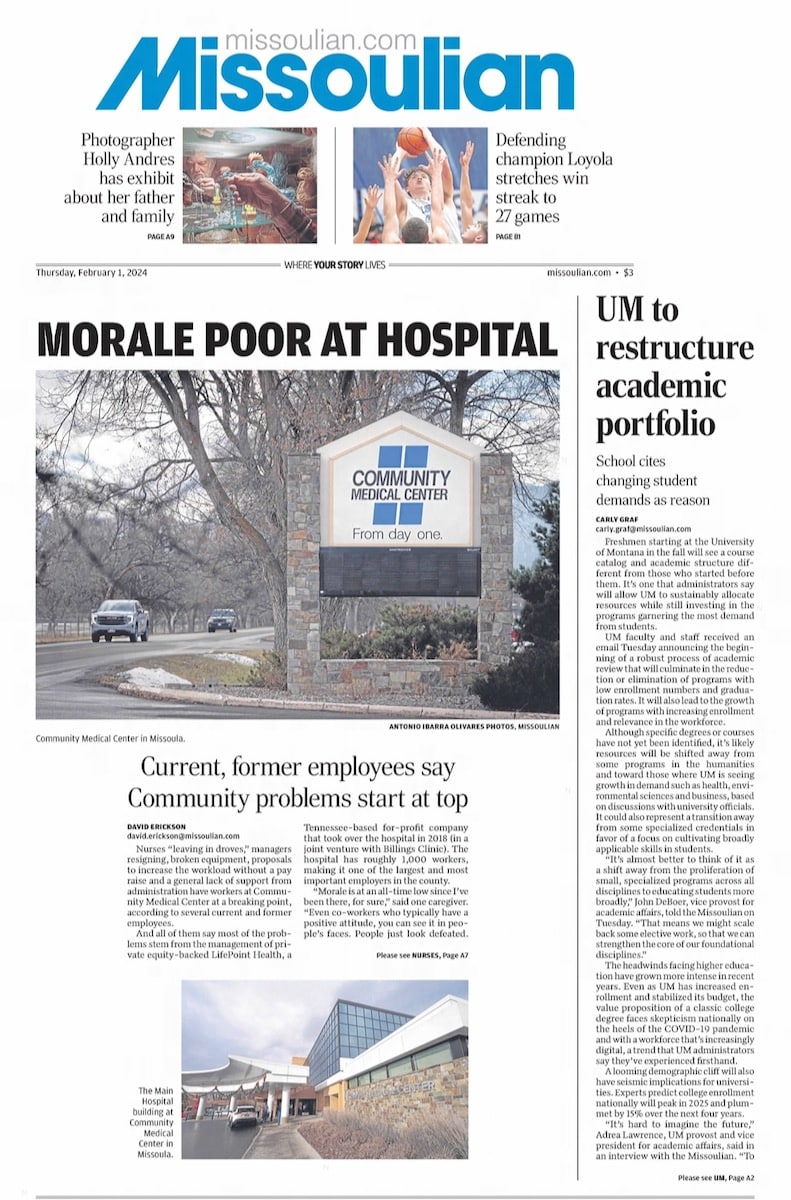
In February of last year and in the aftermath of the proposed increase to nursing workloads, David Erickson of the Missoulian reported a story headlined, “‘Dysfunctional:’ Workers describe poor morale, high turnover at Missoula hospital.” The six current or former medical staff in that piece, too, were anonymous. No sources in this series said they contributed to the Missoulian article, which sparked a unique moment at the hospital in recent years. Internal complaints became public.
After it published, Community’s board chair Don Malerk, a retired human resources manager for DirecTV and AT&T, submitted a letter to the editor in the paper, calling the article “sensational.”
Bob Gomes, the hospital’s CEO at the time, said the same in an email to employees.
Both men brought up CMC’s “A” Hospital Safety Grade from the Leapfrog Group for fall of 2023.
This past spring, the hospital’s safety grade was downgraded to “B” but it again improved to “A” in the fall. The Leapfrog Group is one of several systems that rate hospitals. Centers for Medicare and Medicaid Services (CMS) is another and gives hospitals overall ratings out of five stars. CMC has a 3-star rating. St. Patrick’s Hospital currently has a 5-star rating, but after mostly “A” ratings in recent years, St. Pat’s scored a “C” grade from the Leapfrog Group last fall.
Gomes, the CEO at Community from 2021 until this past July, resigned and took a job at Harney District Hospital, which serves a rural population in Burns, Oregon. The Pulp contacted Gomes by phone and email, and he didn’t respond to a request for comment. CMC recently hired a new CEO, Greg Cook, who started on Nov. 25. Cook joined CMC from another Lifepoint facility, Castleview Hospital in Price, Utah.
After the article in the Missoulian, Gomes wrote to employees: “We know that the opinions of a few are not representative of the great care our team delivers every day. I share this disappointment and regret the distraction this piece has caused.”
One nurse took issue with “the opinions of a few.” “When, really, it is the way everyone feels,” the nurse said. “If the head of the hospital just acknowledges that there’s a problem and that we’re working on it, I think people would feel a lot better, but ignoring that this is a huge issue is a problem.”
After Gomes appeared to write off the Missoulian article, Lifepoint nonetheless flew in its chief nursing officer for the Northwest region. The official heard employees’ concerns at a meeting on Feb. 21, 2024. CMC unit directors were in attendance, as was then-interim chief nursing officer Sandra Leggett. Gomes was not.
“If the head of the hospital just acknowledges that there’s a problem and that we’re working on it, I think people would feel a lot better, but ignoring that this is a huge issue is a problem.”
Sources with knowledge of the meeting reported the following to The Pulp:
Nurses at the meeting spoke out.
“We made it abundantly clear that we were very disappointed in the response,” a former nurse said of Gomes’ email. “We called it gaslighting and called it for what it is.”
Nurses and other workers aired concerns about staffing and the outsourced transfer center that replaced in-house employees who arranged transport of patients to and from other hospitals (the subject of Part 1 of this series). At a different meeting, employees also discussed medical equipment woes with the Lifepoint official.
Good news was on offer: Employees were told about a cost-of-living assessment and the potential for higher wages. Nurses did receive a big wage increase, but not until after a new contract was ratified following union negotiations this past September.
They heard about capital requests going in and medical equipment being ordered, including a number of portable items like oxygen monitors, compression devices to keep blood flowing in patients’ legs to prevent clots, and other machines to monitor vital signs.
The goal was to eventually have those things in every room instead of having to consistently sanitize and move them between rooms, employees said. Sources said that equipment started arriving in the spring.
The requests added up to “a lot of really basic stuff that we’ve been asking for forever,” a former CMC nurse said. Another source shared a similar statement.
They were also told the ratio of patients for Med-Surg techs would be reduced to 12-1.
CMC’s Condra verified that the equipment was replaced and the tech ratio was reduced. Other sources confirmed this.
Several sources said they believed it took the Missoulian article for changes to be made. The tech staffing issue was brought to the direct attention of leadership multiple times in the past, sources said, adding that they regularly put the concern in their employee surveys.
“Our staffing concerns have been brought up more times than I can count,” a tech said.
“Our staffing concerns have been brought up more times than I can count.”
Two sources confirmed a meeting was held online and in person with Lifepoint officials and CMC administration around summer of 2023, during which the tech ratio and other staffing concerns were brought to attention.
Sources said they spoke out about risk of infections, patients not being fed on time, concern about fall risk, and general worries about not being able to provide the best care.
“And it was basically just empty platitudes. Nothing happened,” a nurse said.
The Pulp requested CMC comment regarding the two meetings and these claims, and did not receive a response.
No cushion
“We never have any cushion — ever,” a nurse said, describing post-pandemic staffing on the adult units.
Several sources who worked at CMC in 2022 and 2023 said CMC had the tendency to accept as many patients as possible, to the point the hospital didn’t always have the staff in place to give the standard of care they felt patients deserved.
One specific example multiple sources point to concerns charge nurses in the Intensive Care Unit. An ICU charge nurse is supposed to be the hospital’s last line of defense — the rapid response nurse — should any adult patient become critical in the hospital. They don’t take their own patients so they can assist the other nurses and be prepared for emergencies, multiple employees confirmed.
But due to admits and a shortage of Med-Surg nursing staff, Med-Surg patients were routinely pushed into the ICU, and sometimes the ICU charge nurses did have to take patients themselves, multiple sources reported. Frantic efforts to bring in more nursing help in order to avoid this situation was a weekly occurrence during times of high patient admits in 2023, a former nurse said. A charge nurse from the emergency department could also fill the rapid-response role, but the former nurse said oftentimes the emergency department was just too busy to take on the added responsibility.

“The ICU charge nurse was the only back-up, and certainly the only back-up with the education required to intervene in a critical situation. When these staffing situations would arise, we would just barely get by and hope that no other emergencies would come up, because we didn’t have the bandwidth to care for them while still providing safe care for the rest of our patients,” the former nurse said.
One caregiver who worked at the hospital post-pandemic, and was in a position to observe rapid-response when on shift, said they never personally observed a delayed rapid response. Another source noted that the hospital has many units from which it can pull staff to fill gaps, but said this practice causes employee dissatisfaction linked to unknown expectations from day to day.
“It’s never a good situation, and I feel like the administration just doesn’t understand that,” the source said of ICU charge nurses taking patients.
Multiple nurses noted that the hospital rarely went on divert in 2022 and 2023, despite being frequently short-staffed. A hospital’s administrators may opt for that status to alert emergency services and other facilities that they prefer not to accept more patients.
“When these staffing situations would arise, we would just barely get by and hope that no other emergencies would come up.”
Legally, however, an ER always has to accept patients who show up at the door, Condra and Nagel pointed out.
For patients transferred in from other hospitals, it was sometimes an administrator on call, including the former chief operating officer or the chief financial officer, making the admit decisions, multiple sources said.
“I’ve seen on-call administrators make those calls against the recommendation of the charge nurse for the unit,” said Lea Bossler, the former health unit coordinator at CMC who worked partially on Med-Surg.
Multiple other sources said the same.
“When we say we can’t take another patient, it’s not because we don’t get it. It’s because we actually safely can’t take another patient,” the former nurse said.
“There have been times when we are saying we need to go on divert, and they will not,” another nurse said.
Hospitals nationwide try to avoid going on divert, multiple sources said.
“There is a distinct difference between not going on divert because the larger community needs your help and everyone is overwhelmed, like what happened during the pandemic, and not going on divert because you’re not willing to admit staffing limitations,” a former nurse said, adding: “When you accept additional patients from other facilities when your staff is already functioning at max-capacity, you are risking patient safety and creating an environment where patients are at a higher risk for harm.”
There was some improvement in patient flow with the addition of a waitlist in 2023 — where a check-in may be done with the receiving department managers and nurses before patients are accepted — but the process was still frequently fallible at the end of 2023, the former nurse and other sources said.
CMC did not offer comment related to these allegations.
St. Patrick Hospital uses a “stat” nurse, whose job is to be available to respond to all critical situations occurring in the hospital, the former nurse said, adding that this would help prepare CMC for the unexpected. Nurses have been asking for a stat nurse at CMC for a few years, only to be told that the hospital is not big enough to need one, multiple sources confirmed.
A nurse at CMC said a stat nurse would be useful on many levels. “They can be that backup, they can put in IVs, they can be a resource for all these new nurses. It’s not like there aren’t things to do.”
Related
Community named in Senate investigation’s report
A report released Jan. 7 by a U.S. Senate committee investigating the practices of private equity-owned hospitals and prompted by a sexual assault investigation in Iowa names Community Medical Center in Missoula.
Read more
Multiple sources said they felt the hospital sometimes had no contingency for people calling off work in 2022 and 2023. One or two call-offs could mean not meeting set staffing levels with personnel best suited for a unit, they said. Sources added that the hospital accepted patients without planning ahead to the night shift or weekend.
“We’re told by administration that if we have room now, we have to take the patient,” the former nurse said of working at CMC in 2023.
“That’s when you get in trouble,” said another caregiver who worked at the hospital then. “When you’re already kind of a skeleton crew, especially on weekends, and you also don’t have charge nurses with experience covering the Med-Surg unit, you kind of have chaos.”
The Missoulian reported about 66 nurses and 36 technicians had quit the Med-Surg floor at Community over the three years leading up to its Feb. 1, 2024 article. Megan Condra told The Pulp the voluntary registered-nurse turnover was 17 percent in 2023, the lowest it had been in three years.
Multiple employees and CMC administrators said efforts have been made to rebuild Med-Surg staff, a subject of the fourth story in this series.
Losing managers
Multiple nurses said that adult care managers had to be on-call at all hours post-pandemic. They’d get burned out and leave. They said good managers spoke up to make things safer.
“Impossible” was the word chosen by multiple nurses to describe the workload expected from nursing directors at CMC.
In 2023, the ICU director and Med-Surg director quit, sources said. Three different people have been in the chief nursing officer position over the last three years. Two more interim ICU managers have come and gone since late 2023, according to a source with knowledge of the situation. CMC didn’t offer comment on the current management situation.
“I truly believe that a community hospital is necessary, and we keep straying farther from that concept. The parade of interim Lifepoint administrators, directors … supports the feeling that there is little commitment to our community,” the source said.
Multiple nurses stressed the importance of having a strong, consistent manager in place. ICU care is especially complex: Patients’ medication drips need to be consistently modified, and every day, the demand is different. Experience is paramount, and the manager aids nurses in complex situations, they said.
“I truly believe that a community hospital is necessary, and we keep straying farther from that concept. The parade of interim Lifepoint administrators, directors … supports the feeling that there is little commitment to our community.”
Several sources described managers being overworked across the hospital.
Bob Hendryx, a long-time ICU pharmacist at Community, retired in 2021. He said the issue isn’t new. After the hospital went for-profit, he saw his manager lose IT help and other assistance, only to work unsustainable hours.
“They ride them like Seabiscuit until they burn out,” Hendryx said.
Some go to St. Patrick Hospital. That’s where Hendryx’s manager ended up, as well as a popular director of CMC’s ICU.
A former out-patient therapist and a former accounting employee, Danielle Ford, both reported having great managers, but didn’t feel their managers had control to improve wages or working conditions for their employees.
CMC saw a slew of upper management changes last year as well. In addition to losing CEO Gomes, Jim Gillhouse, the facility’s chief operating officer, stopped working at the facility on March 5. A replacement was promoted from within. Sandra Leggett joined CMC in fall 2023 as the interim CNO, and became chief operating officer in May. Holly Nagel, who had worked at CMC for six years in various positions, became CNO that month. Cook started as CEO in November.
Primary care
Multiple nursing staff interviewed claimed that CMC’s post-pandemic problems extended beyond the hospital. The Pulp interviewed primary care providers from CMC’s Community Physician Group’s clinics who reported both positive and negative experiences.
Charity Johnson, a doctor of osteopathic medicine, administered family medicine at the CPG clinic in Stevensville from 2022 to 2024. Johnson was ecstatic about her experience. She said she only left due to a family emergency.
“I have nothing but positive things to say about the company. It was a good experience for me,” she said.
Johnson said leadership was supportive, she had the resources she needed, and that she routinely saw patients for 20 to 30 minutes.
“Plenty of time to do phone calls, do paperwork and take your time with patients. It was extremely manageable,” she said.
“I have nothing but positive things to say about the company. It was a good experience for me.”
She described a very positive working environment and said she’s still in touch with her colleagues.
“Down in Stevensville we didn’t hear much gossip. We just went to work, took care of the patients and went home,” she said.
Another local primary care provider who formerly worked for CPG reported a slew of provider departures from the three primary care clinics over a two-year period starting in 2021, while the pandemic was still in full swing.
In what amounted to almost wholesale turnover at two of the clinics, 13 providers left to work either for other local organizations — the Veterans Affairs clinic, Partnership Health Center or Western Montana Clinic — started private practices in town or left to work out-of-state, the provider said.
Most stayed local, according to the provider.
The provider estimated that those who left averaged more than 1,000 patients each, and said that due to insurance rules — like how much Medicare and Medicaid would cover — or because some providers went to the VA or out-of-state, a significant number of patients didn’t have the option to follow their doctors.

“I felt like decisions being made at the senior leadership level were too heavily driven by profit and by people who really didn’t know me or our community,” the provider said. “Lifepoint headquarters are in Brentwood, Tennessee, and more and more, I felt that distance. I tried to speak up about my concerns for my work environment, employee happiness, patient needs, and I did not feel heard.”
Lifepoint continued to say that primary care was a priority for the hospital, the provider said, but didn’t make a real effort to invest in the providers or the clinics at the time.
Another former provider with Community Physicians Group confirmed departures of doctors from the clinics over the past few years, and ultimately quit due to what the provider felt was an unsustainable patient load.
The provider reported routinely having only 10 minutes to see patients during the pandemic.
“Family practice is very complicated. You’re dealing with acute problems and also chronic problems, and I don’t feel you can do that well in 10 minutes,” the provider said. “Medicine is already difficult, and when you have a lot of pressure to see a boatload of patients in a day, it’s tricky to keep that trajectory going without getting burned out.”
A 2023 study published in the Journal of the American Medical Association found the median duration of a visit with a primary care physician was 18.9 minutes during 2017, the year studied.
The departures also affected hospital employees, multiple nurses said, as primary care is more affordable through the Community Physician Group. One CMC nurse reported their family losing five doctors in a three-year period.
Megan Maurer, a former NICU charge nurse who left CMC in 2023, said she was concerned about the departures.
“If primary care isn’t their focus, it just kind of gave me the ick about the company in general. You don’t care enough about primary care? That should be number one — out-patient so they don’t end up in-patient,” she said.
CMC spokesperson Condra noted that the physician group hired seven new primary care providers in Missoula and Stevensville in 2023. Neither CMC or Lifepoint offered comment on the physician departures or other specific allegations.
“Lifepoint headquarters are in Brentwood, Tennessee, and more and more, I felt that distance. I tried to speak up about my concerns for my work environment, employee happiness, patient needs, and I did not feel heard.”
Julie Larkin was a psychiatric nurse practitioner for Community Physicians Group’s three-partner psychiatric practice for seven years. She described a more positive experience.
“They were a good employer to me. I think they tried. I think some of these circumstances were pretty wild for a few years,” she said, speaking of the pandemic.
Larkin started her own practice in April, a long-time dream.
During the pandemic, ancillary staff and managers left, as well as two of her partners, leaving her to try to absorb their clients. She said she felt the pandemic was in large part to blame, as many with ancillary healthcare jobs left to take on less stressful jobs for similar pay.
The workload increased as time passed, but that wasn’t unique to CMC, she said.
“The model of corporate medicine in general right now is shifting a lot of burden onto providers,” she said. “They push productivity rather than quality of life for the people who work for them.”
David Lechner was president of CMC’s physician group from 2011 to 2019. He said he and his colleagues built programs to increase patient access to care.
“We were one of the first groups in Montana to put integrated behavioral health together,” he said, adding that the group embedded maternal mental health into CMC’s perinatology practice – which is care for at-risk fetuses and complicated pregnancies. He said the group also collaborated with the University of Montana social work department and brought in programs to screen for suicide.
Lechner was also the hospital’s chief medical officer after 2013. He left CMC in 2019 after Lifepoint came on because he said he felt the company’s business model didn’t include having a physician in a leadership position. He was not fired, but suspected he would be.
He said most of his team — office managers and directors at the physician group — left CMC after Lifepoint took over. He said he was aware of several providers who departed to start private practices or to work elsewhere in Missoula, but didn’t comment on their motivations.
Lechner said his perception was that Lifepoint had a different management style — he had built a provider group that had been integrated into CMC, whereas he felt Lifepoint was supportive of providers leaving to start independent practices but continuing to work with Community. Multiple providers who left started their own practices on the CMC campus, he said.
Lifepoint also took over management of CMC and the physician group right before the pandemic, Lechner noted.
“COVID was a radical variable for everybody. And I don’t think anywhere in the United States people feel secure in what they’re doing in healthcare. It’s a different management company under Lifepoint leaders than it was before, but it’s also a different world,” he said.
Problems in perspective
The push to do more with less in adult care units is a national trend, multiple sources said.
“This isn’t unique to Lifepoint. This is a national problem. This is what happens when we have a healthcare system that profits off of sick people versus getting sick people better. So until our nation takes drastic steps to change that, profits will always be placed before patient care,” a CMC nurse said.
A 2022 national survey led by the National Council of the State Boards of Nursing includes responses from 29,472 registered nurses and 24,061 licensed practical nurses across 45 states. It found 62 percent reported an increase in their workload during the pandemic. Those sampled reported feeling emotionally drained (50.8 percent), used up (56.4 percent), fatigued (49.7 percent), burned out (45.1 percent), or at the end of their rope (29.4 percent) “a few times a week” or “every day.”
Emily Serck, vice president of communications at Lifepoint, acknowledged the tough post-pandemic spot most hospitals had to navigate.

“Our company experienced significant financial impact due to the COVID-19 pandemic resulting from government restrictions on elective procedures, shelter-in-place initiatives and the increased costs associated with delivering high-quality COVID-19 care,” she wrote in an email to The Pulp.
Condra added: “Nurse recruitment and retention are industry-wide challenges.”
The national challenges resonate locally, but sources also say they don’t excuse issues in their workplace.
“It’s easy to say this is nationwide. It doesn’t matter if it’s nationwide — it’s your community hospital. It’s where you go to get care,” a caregiver said.
An employee who worked through the transition from CMC as a nonprofit to its post-pandemic for-profit struggles described a sharp change.
“Morale was so much better. It was actually a fun place to go to work. There would be stressful days, as happens in a hospital, but it wasn’t like you just dreaded to get up in the morning and see what was about to hit you in the face. You never felt that,” the long-time former employee said.
Employees insist CMC has amazing personnel — from housekeepers to doctors — and sources say they have stayed at the hospital because they love working with their fellow caregivers and patients.
“Most people who work there are very good at their job. They’re there for the right reason. They’re ethical. They’re there to take care of the community. … It’s really sad to see that spirit crushed for money,” a nurse said in early 2024.
Several sources said post-pandemic turnover and staffing issues have affected CMC’s reputation.
“Missoula is not that big, and the healthcare community is pretty small, so the word is getting around pretty quickly: Don’t go to Community because you’re going to be overworked and understaffed. And it just adds to the problem,” an employee said in early 2024.
In addition to the issues described in this story, the hospital also outsourced its security, patient scheduling and billing since CMC became for-profit, multiple sources said. Employees reported significant turnover in the human resources department and in the unit that repairs broken technology, as well as a noticeable decline in the quality of food in the cafeteria.
“Missoula is not that big, and the healthcare community is pretty small, so the word is getting around pretty quickly: Don’t go to Community because you’re going to be overworked and understaffed. And it just adds to the problem.”
To multiple sources, little things felt big — including not getting the usual $50 gift card as a holiday bonus in 2023 and the hospital failing to arrange a hot meal on Thanksgiving for night staff in 2022, forcing them to rummage for snacks. Several sources said their health insurance has gotten worse since Lifepoint took over, as well.
Several employees said they dreaded coming to work in the years following the worst of the pandemic, and described seeing employees in tears. Multiple employees emerged with a firm conviction as to the root cause.
Running a hospital to maximize profit is fundamentally incompatible with the mission of health care, a former nurse said. “That doesn’t make sense to me, and I think it causes exactly what we’re seeing here at Community Medical Center.”
But Geri Unbehend, a veteran ER nurse, is optimistic for the future at CMC. In an interview this past fall, she said turnover has been consistent since the pandemic, but things are looking up now that nurses received a big raise and there are reports nurse recruitment has started to pick up.
“I work with a fantastic group of people, and I can say that is probably what has kept me coming to work every day. Have they changed things at Community Medical Center? Absolutely. Are they going to change again? One-hundred percent,” Unbehend said.
This series was made possible by supporters of this nonprofit Missoula news organization. You can help The Pulp produce more in-depth local journalism by becoming a member for as little as $5/month.