
Missoula County Public Schools is taking stock of 14 non-school properties it owns throughout the valley. From empty lots in the South Hills to leased and vacant buildings scattered across town, each site represents a particular blend of benefits, costs and potential. And as district leaders prepare to examine each one in the face of tight budgets and declining enrollment, one property on the list, the PEAS Farm on Duncan Drive, has become a kind of outlier in the process: a deeply embedded hands-on learning space and community food hub that many see as too valuable — socially and politically — to lose.
By Feb. 23, a team of consultants reviewing all 14 properties is slated to release a final proposal for the MCPS Board of Trustees and the public, outlining recommendations for each site’s future. The recommendations come after nearly a year of guided tours, public surveys, property assessments and listening sessions designed to gauge costs and benefits of improving, retaining or selling each space.
As MCPS weighs the future of these properties, the review highlights a tension that spreadsheets alone can’t get at. In addition to costs and mission alignment, the district is confronting the reality that some of these sites serve as long-standing public spaces shaped by years of use and community investment.
Words like “review” and “alternative” tend to stir a strong, justifiable dose of Missoula-style scrutiny when they involve the future of a treasured space such as the PEAS Farm. That’s why consultants and district officials have been stressing in public meetings that the goal for the PEAS Farm is not redevelopment — it’s to preserve the farm’s existing agricultural and educational role, even if ownership ultimately changes.
“I don’t feel panicked about any of this,” said Garden City Harvest Executive Director Jean Zosel, whose organization runs the PEAS Farm in partnership with the University of Montana’s Environmental Studies program. “I’m confident in the value we’re providing to the community and that, for the most part, MCPS has a really strong sense of that.”
“I’m confident in the value we’re providing to the community and that, for the most part, MCPS has a really strong sense of that.”
The same level of clarity doesn’t apply to every non-school property MCPS currently owns. Over the years, questions about the deferred maintenance of a particular building or debates about the suitability of a certain vacant plot for a future school have routinely popped up. What makes this process different, said Superintendent Micah Hill, is to ground the conversation in real numbers rather than speculation and provide a formalized evaluation system for community stakeholders.
In early 2025, the district tapped Missoula-based WGM Group to do just that, pulling together appraisals, site visits and a full inventory of 14 properties, from a vacant lot on Rimel Road to the old brick-and-stone administrative building just off the Hip Strip. The goal, Hill said, is to answer a prudent but uncomfortable question: Which properties are contributing to the district’s central mission of educating kids and which ones are pulling resources away from it.
“It’s a balance of being good stewards of the resources that we have, and keeping in mind that our core purpose for Missoula County Public Schools is to educate kids,” Hill said.

The timing of the review isn’t accidental. The complexity of public education funding and enrollment trends have thrust MCPS and other Montana school districts into one existential financial dilemma after another. The Montana Legislature did finally approve significant funding increases for schools last session — largely targeted at improving dismal starting teacher wages statewide, but Hill stressed those gains are incremental and heavily dependent on enrollment numbers. Like scores of other districts, MCPS is still reeling from recent deficits, budget cuts and a multi-year student decline that’s projected to continue. Trustees even took the step in late 2025 of joining a lawsuit against the state arguing that Montana’s school funding system falls short of its constitutional mission — the third such challenge in four decades.
With money already tight, holding on to properties that aren’t actively used to teach kids comes with a price tag of its own — more than $10 million over the next decade, according to WGM Group’s financial estimates.
The complexity of public education funding and enrollment trends have thrust MCPS and other Montana school districts into one existential financial dilemma after another.
Only a handful of the 14 properties actually contributed to that estimate. Unlike the PEAS Farm, which is managed entirely by partner organizations, some sites require ongoing grounds work and pricey remediation by MCPS even when they’re leased or vacant. Cold Springs, for example, was recently shut down due to imminent structural concerns, forcing several child care businesses that were leasing space in the building to find a new home and leaving district leaders to decide whether fixing the sagging roof was worth the cost.
The former Prescott elementary school in the lower Rattlesnake has sparked the most pointed public pushback of any of the 14 properties during the review process, with neighbors calling on MCPS to renovate — or at least retain — the aging building. Prescott has been sitting empty and in disrepair since its previous tenant, the Missoula International School, moved out in 2018. Facilities staff have attempted to explain that fixing leaks and broken windows is already costing MCPS thousands of dollars, and that it would take more than $1 million to make the building safe and usable again.
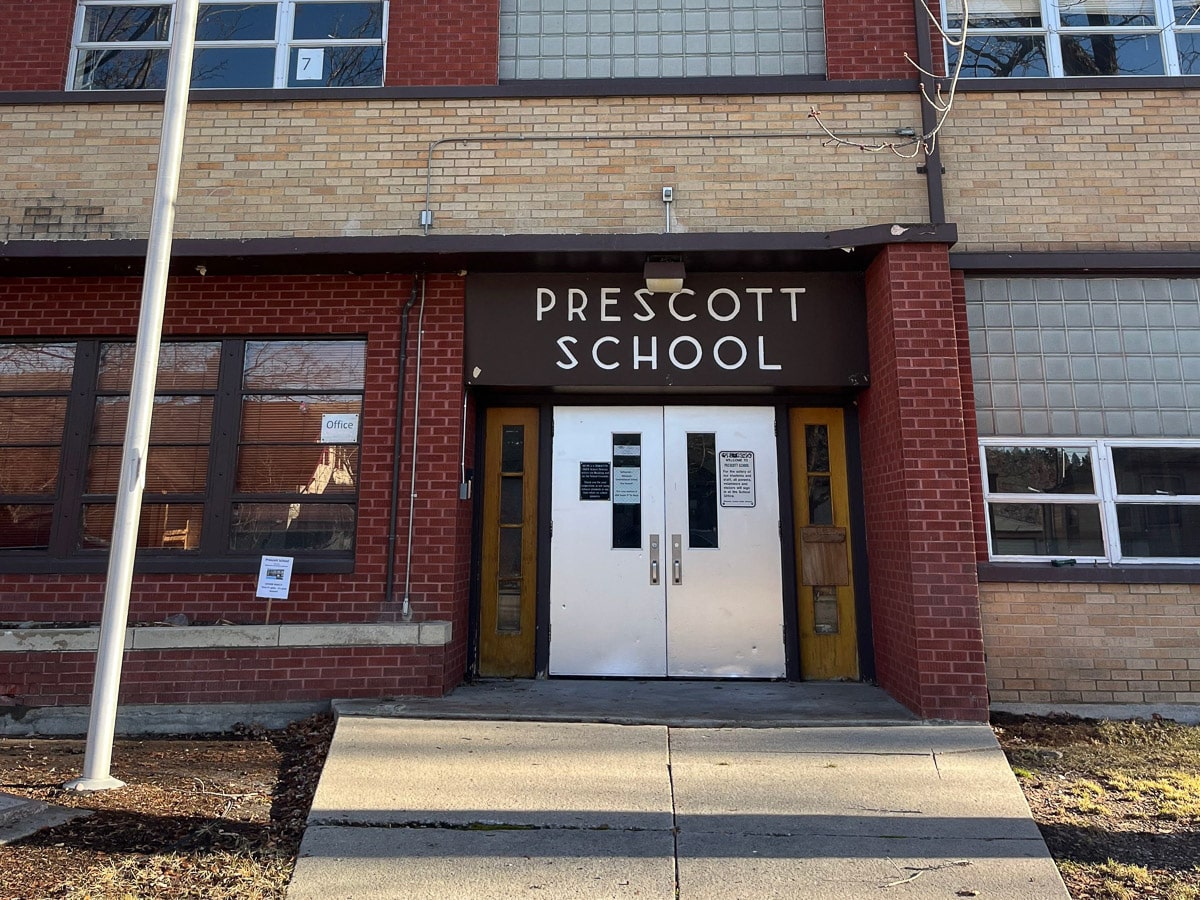

For neighbors, though, Prescott is more than just an empty building. Opened in 1893, the school sits at the base of Mount Jumbo, anchoring the lower Rattlesnake neighborhood shaped by generations of working- and middle-class families. Its grounds double as open space, with a longtime sledding hill, an all-purpose field, a playground and access to one of the trailheads leading up to the “L.” Letting go of the property could ease the district’s financial burden and create opportunities for new uses, from housing to expanded public space. But any shift would come with tradeoffs that look different depending on who you ask — illustrating that MCPS’s decisions are not just about holding or selling land, but about navigating change in places that matter to many people in different ways.
Emergency repairs and upkeep at unused buildings like Prescott are paid for with a mix of state dollars and non-voted local levies — money that, Hill told The Pulp, also has to cover the physical costs of running 16 active elementary, middle and high schools.
By comparison, the situation on Duncan Drive is essentially cost neutral. Garden City Harvest operates the PEAS Farm’s 10 acres in partnership with the University of Montana’s Environmental Studies program, while Missoula Parks and Rec handles scheduling and maintenance of the three acres of adjacent soccer fields with help from a local volunteer group.
A broker opinion commissioned as part of the district’s property review estimated the 13-acre parcel’s market value as high as $4.2 million, but the existing lease gives the city right of first refusal and requires three years’ notice of termination. That lease stands as one of the most compelling examples of how deeply embedded the PEAS Farm is in the Missoula community and why supporters like Josh Slotnick, the former farm director turned county commissioner, told The Pulp they’re unflapped by the district’s review.
When the city’s prior lease came up for renewal in 2014, then-Mayor John Engen famously offered the district $1.2 million in open space funding to buy the space outright. Former MCPS Superintendent Alex Apostle declined, citing in part the property’s potential future value to the district, but the two did land on a long-term compromise: A 40-year lease at the low and politically shrewd rate of $1 per year. Engen seized the moment to plug the PEAS Farm as a lasting testament to local agriculture, community partnership and a resource for the city’s children.
“The PEAS Farm and its related programs are part of what makes Missoula a great place to live,” Engen told local news outlets at the time, “and it’s important to preserve them.”

Fast forward 20 years, and Hill emphasized that any discussion impacting the PEAS Farm and other properties is still in the early stages. Like past community leaders, he acknowledged the farm’s value to the community and its educational role. The farm doesn’t just complement MCPS’s own agricultural course offerings, it taps into their broader push to expose students to more experiential, outdoor learning spaces. At the same time, Hill said, the district is designed both operationally and financially to be just that: a public school district, not a de facto landlord. By kick-starting a conversation about possible alternatives, he argued, the property review process could well result in a more permanent, stable arrangement for everyone involved.
“Don’t rush to conclude that we’ve already decided something,” Hill said. “We’re just trying to put something in our board’s hands so that they can make calculated decisions, and any decision could be a long time off.”
Trustees, too, have stressed that no decisions have been made about any of the properties under review. For the PEAS Farm, consultants are recommending that MCPS explore a possible sale or trade with Garden City Harvest, UM and the City of Missoula, which would preserve its existing recreational and agricultural uses long-term — the very outcome Engen, who died in August 2022, sought so many years ago.
“Don’t rush to conclude that we’ve already decided something,” Hill said. “We’re just trying to put something in our board’s hands so that they can make calculated decisions, and any decision could be a long time off.”
“This is not looking at that property to sell to a developer, it’s looking at that property with the intention of exploring ownership with those entities, is that correct?” MCPS Trustee Meg Whicher, who works for the Missoula Parks and Rec department, asked project leaders during the board’s Jan. 13 meeting. “I want to go on record saying multiple times that that’s what we’re looking at right now.”
Zosel’s optimism about her organization’s future on Duncan Drive stems in part from the cooperative relationship cultivated with MCPS over the years, with Garden City Harvest helping establish and maintain gardens at area elementary schools and covering the cost of bussing roughly 2,500 students and chaperones to the PEAS Farm each year. Beyond that, Zosel said the PEAS Farm has become an important model not just for urban agriculture but for community food assistance. Of the dozen or so community gardens and neighborhood farms Garden City Harvest runs across the valley, the PEAS Farm is the biggest. Last year, the farm produced about 70,000 pounds of food, 20,000 of which went to the Missoula Food Bank to feed low-income households. Additional contributions went to partner organizations including the UM Food Pantry, Head Start, Mountain Home Missoula and the All Nations Health Center.
“What we’re trying to do through that piece of what we do is make sure that everyone in this community has access to fresh, healthy, nutrient-rich food,” Zosel said. “That’s a big part of what we do at PEAS.”
Then there are the stories Zosel hears about PEAS Farm field trips: students discovering a taste for beets or kale, or learning for the first time that food doesn’t originate in the grocery store. In the 23 years since the farm moved from a two-acre plot at Fort Missoula to the quiet creekside Rattlesnake neighborhood, Garden City Harvest has deepened its reputation in the community.
School officials appear to recognize that, and community leaders see it as a key strength in the ongoing discussions over Duncan Drive’s future. Slotnick described the PEAS Farm as “part of the established fabric of the town” and said he doubts the district would seriously consider any path that threatened it. In fact, he told The Pulp, there’s a real opportunity for the conversation to explore a more lasting guarantee than the current lease — perhaps a conservation easement similar to the one Garden City Harvest secured for its smaller farm property outside its offices a stone’s throw from the Russell Street Bridge.
“When I saw this [property review], I was not alarmed around the PEAS Farm,” Slotnick said. “I could not imagine that MCPS would want to endure the political blowback of even flirting with the idea of getting rid of the PEAS Farm. I think they’re way too smart for that, and they understand that its highest and best use is as it is right now.”