Missoula Mayor Andrea Davis has announced her intent to seek re-election in the fall.
Davis, a former affordable housing non-profit executive who was elected in 2023 to carry out the remainder of the late John Engen’s term, said she’s running on a platform of government transparency and improved affordability.
“I can’t control national inflation rates,” Davis told The Pulp in an interview last week. “But what we can do to make sure that Missoula is a livable and accessible place.”
The municipal primary election is Sept. 9, followed by the general election on Nov. 4. Mayors serve four-year terms, and like city council members, don’t face term limits — something a group of council members just tried to change to no avail.
Davis said she always planned to run for re-election after the completion of her truncated first term.
“I was really pleased that the Missoulians that voted in my election overwhelmingly voted for me,” she said. Davis received about 59 percent of the vote, beating out councilmember Mike Nugent. “That gave me the confidence to believe I’m supported.”
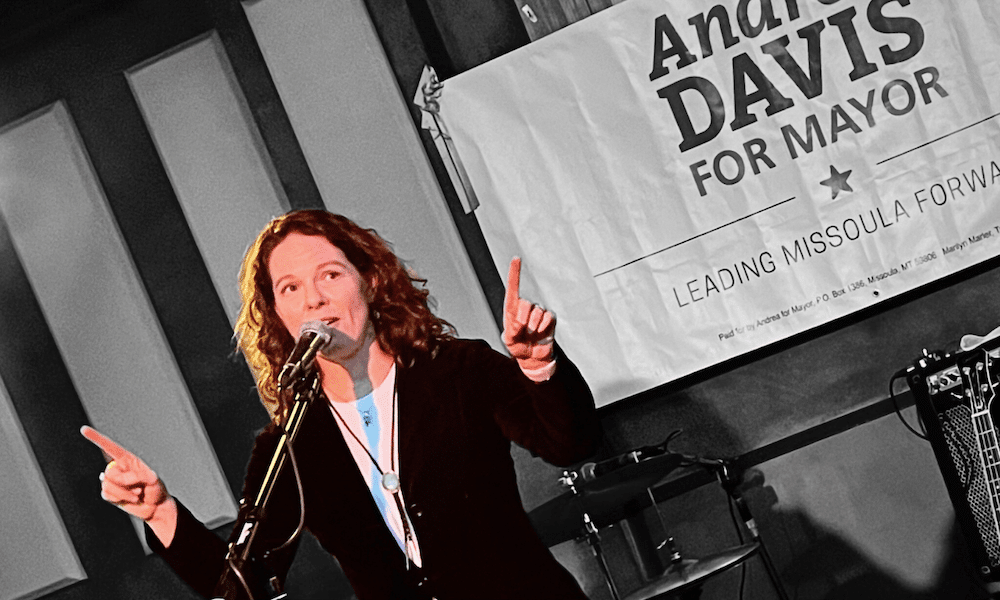
Sources of that support now include Nugent himself, who said in a press release last week that he will seek re-election to the city council and endorse Davis’ re-election bid.
“Having had the unique opportunity to campaign alongside her as a candidate and work with her as a city council member, I’ve seen firsthand her dedication, leadership, and deep commitment to our city,” Nugent said in the statement. “In her short time as mayor, Andrea has shown a willingness to tackle our city’s most pressing challenges head on, from advancing critical code reform to tackling housing affordability.”
Davis touted the development of workforce housing — the Scott Street-Ravara project, for example — land acquisitions in midtown and infrastructure upgrades as accomplishments from her first term.
As expected, that term has been defined by the collision of Missoula’s affordability crisis and a city budget constrained by state law. Davis’ first executive budget called for a 5.84 percent increase in spending. In August, shortly after her term began, the city council approved an almost 17 percent property tax hike. (Voters, it’s worth noting, had already approved more than half of the increase in the form of a fire levy.) The council also approved a one-time levy to fund the Johnson Street Shelter as part of the city’s 2023 emergency proclamation on homelessness.
“It’s hard to communicate sometimes,” Davis said. “I hear from members of the public that we have an overspending problem, but the reality is most of that is wages.”
Davis, previously the executive director of Homeward, entered office as the city was developing a policy related to so-called urban camping, a phenomenon arising from the intersection of increased homelessness and limited shelter space. The Urban Camping Working Group, led by Davis and comprising the council, business leaders, service providers and homeless Missoulians, met several times in the spring of 2024. In late June, the council passed a controversial rule restricting — though not banning — camping on city property, despite hours of public testimony mostly opposing the policy.
Criticism of the law only grew louder once it went into effect. Though this time it was property owners — especially those who live near the Johnson Street shelter — who were most vocal, calling for further restrictions on urban camping. In particular, a neighborhood group led by a former Republican state legislator began circulating a petition to ban camping in city parks. Members of the council and staff began drafting amendments to the ordinance to that effect, also instituting a potential misdemeanor criminal penalty for violators. The changes passed in December and took effect at the beginning of this year.
“I think that was a big, messy, hairy situation, but I don’t think there was any way around that,” Davis said. “There’s not a single answer that is actually going to resolve any of those issues. And I don’t mean to constantly go back to this but it’s true — we have no state support. And we have no federal vision for this.
“I’m glad we were able to create a forum through which to have a conversation,” she added. “We need a structure by which to be able to try to manage the situation.”
The city announced a new strategy to address homelessness this week. The “On Our Way Home: Missoula Community Houselessness Strategy 2025-2028” plan calls for identifying the number of shelter beds the city needs, developing permanent housing, obtaining additional funding for homeless services and increasing capacity for service providers. Development of the plan began last January, with input from service providers, non-profits, government officials, homeless people and others. The council still has to ratify it.
“We want to create more home availability and choice for people, and the code helps us get there. But it’s not the only thing — the market has to respond.”
While the city’s main shelters are hovering at or just below capacity — especially in the winter months — Davis said the solution can’t only be to increase shelter space. The Poverello Center reported exceeding its capacity by almost 30 people in late January, per the Missoulian.
“We need to look at what kind of shelter is giving us the right kind of outcomes,” Davis said. “The goal is not for people to be occupying shelters as permanent housing.”
The city has also adopted a land use plan to govern municipal growth over the next 20 years. The plan, which will be implemented, in theory, through the city’s ongoing code reform process, calls for densification and substantial infill development of multiple housing types across essentially all neighborhoods of the city.
“We want to create more home availability and choice for people,” Davis said. “And the code helps us get there. But it’s not the only thing — the market has to respond.”
Missoula, Davis acknowledged, is in the throes of profound change, as is much of the rest of the state. How different coalitions of voters and advocates respond to that change is a key dynamic in city politics. There are newcomers, old timers, the price-flexible and the priced out; business owners, remote workers, realtors, a growing number of homeless people, students, socialists, hippies-turned-NIMBYs and more. At the heart of this community is a tension between past and future.
“We really know that tension to be true,” Davis said.
She recalled a recent conversation she had with a constituent:
“I recently had a woman approach me. She moved back to Missoula after being away for 45 years. She bought a home in the neighborhood she grew up in,” Davis said. “That’s what her vision has been for 45 years. But she expressed to me her concern about the change that might come about from changing the different types of home in the neighborhood
“In the same vein, she said, ‘I want my son to be able to afford a home here,’” Davis continued. “These two truths can exist at the same time. It’s OK to feel this way. Change is here. We have a choice — we can shape it or we can let it happen to us.”
The ledger #️⃣
360
Rough number of U.S. Forest Service employees in Montana who were pink-slipped by the Trump administration as part of its sweeping reduction of the federal workforce, in particular of probationary employees, according to an NBC Montana report. “The Trump Administration’s executive actions to gut the federal workforce are not only illegal, but will also have damaging consequences for federal employees and the public services they provide,” Randy Erwin, president of the National Federation of Federal Employees, said in a press statement.
The feed 🗞️
University of Montana unenrolls 740 students for unpaid bills; majority now reinstated (Missoulian)
City houses 12 homeless veterans during 60-day sprint (Montana Free Press)
Gianforte office controls an unrestricted interest fund worth $86 million, and counting (Helena Independent Record)
Lawmakers in GOP-held Senate signal openness to continuing Medicaid expansion (Montana Free Press)
Trump orders fuel questions, concern over research funding on Montana campuses (Montana Free Press)
Abrupt federal layoffs expected to hit tribal programs (ICT)
Stunned federal workers brace for the real-world repercussions of Trump’s purges (Politico)
Inside a network of AI-generated newsletters targeting “small town America” (NiemanLab)