The Zootown Arts Community Center has removed a local band from the organization’s spring festival lineup after a community petition protested what it described as the band’s racist actions against Indigenous people.
At issue is Native cultural appropriation by a white musician who performed under the moniker “War Pony” for 12 years. Cara Schulz grew up in Cody, Wyoming, and later moved to Hamilton, Montana, where she says War Pony started as a high school nickname. She describes herself as a redneck kid from a troubled home life with a chip on her shoulder, unafraid of a fight. She captained the rugby team, and also loved singing and playing music.
After spending most of her 20s moving around, trying out different careers and living outside Montana, Schulz, now 30, moved to Missoula in the fall of 2023 and set out to pursue music as a career.
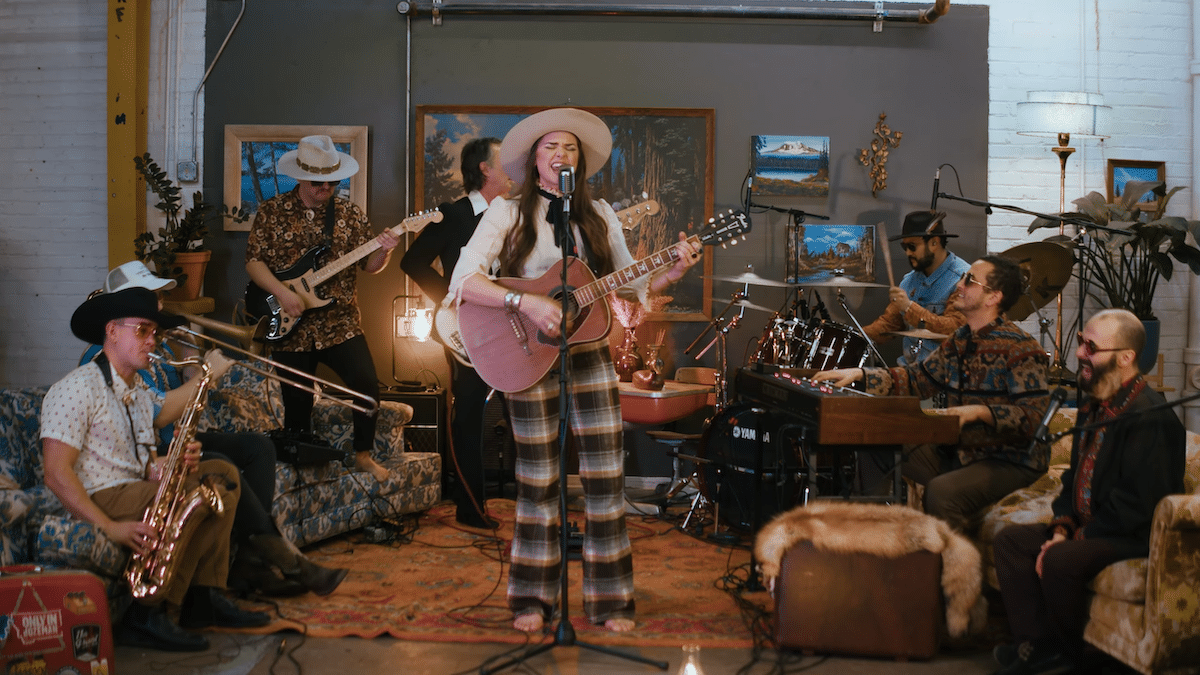
A revitalized War Pony, backed by a multi-piece band, made several high-profile local appearances over the summer of 2024, including a Free Cycles show in May and Missoula Pride in June. The publicity brought new fans — and scrutiny. Schulz has appeared in promo photos in faux-tribal face paint. Comments about the band on Missoula Reddit claim it has performed a song called “Tomahawk My Heart” and done mock war cries. Older promotional artwork depicts her and other band members riding a bizarre Indian-chief centaur and the word “poop” written on a faux-tribal emblem.
Schulz doesn’t deny any of these choices, and says it wasn’t until last summer that anyone confronted her about the War Pony concept. She now acknowledges that the old poster was “horrible and tasteless,” and says she didn’t realize the band’s aesthetic was sending harmful messages.
“Coming from Norwegian descent, I almost dress up more like Viking style,” she says. “That was more like what I thought I was doing — that is, until people made the connection that War Pony is a commonly used Native term. So I was like, ‘That’s not a good look.’”
“So that’s where it came from for me,” she continues. “But, like, 10 years ago [cultural appropriation] wasn’t a topic. Now it’s the topic and it makes me feel horrible that I did any of that.”
In July 2024, Schulz changed the group’s name to Give it to ‘Em, Florabelle!, updated her website and social media, shelved the War Pony merch in her garage and posted a video apology to her Instagram Stories. She hoped that would resolve the issue. But members of Missoula’s Indigenous community say that the change from War Pony to Florabelle did not come along with a meaningful apology or reckoning with the harms of cultural appropriation.
“This is cultural stealing. This is appropriation for profit.”
Missoula musician Dylan Running Crane says she and her Native family and friends took note of War Pony as the band started playing high-profile gigs.
“This is cultural stealing,” Running Crane says of War Pony’s name and style. “This is appropriation for profit. That’s the heinous part of that. And I see it all the time. I see people perform in headdresses, there are still people that dress up like Native people for Halloween. Most of the time I can just look and be like, ‘That person’s an asshole,’ and move on. But when it’s for profit and they’re using my culture in such a disrespectful way to line their pockets, it’s taking away from Indigenous artists. It’s taking up space where an Indigenous artist could have been.”
Schulz says ever since playing a Free Cycles show in May 2024, people started calling her out for racism — some with well-intentioned critiques, others in aggressive or hateful ways. She wishes she’d handled everything differently, including the initial apology statement. She also learned that it’s a bad look to block and delete comments.
“I’ve learned not to do that. That is not what you do. I’ve learned not to silence people and just let their comments live on the internet. They want to be heard,” she says.
The newly dubbed Florabelle played more gigs throughout the fall, including Missoula’s River City Roots Festival. In late December, the ZACC announced that Florabelle was among the bands to play its inaugural ZEST festival on March 29.
Running Crane, who’s worked for the ZACC as a Rock Camp counselor, says it felt egregious for the group to be booked by a nonprofit arts center that’s supposed to be inclusive and equitable.
She first took her concerns directly to the ZACC, and the festival’s organizing committee declined to remove Florabelle from the bill. So she launched a public petition on Sunday, Dec. 29. The petition said, in part: “This band has yet to take any accountability for their racist actions, and by platforming them, the ZACC passively endorses the anti-Native sentiment the band Florabelle has engaged in.”
Running Crane says she thought maybe 50 people would participate. But in less than a day, over 900 people signed the petition. Some commenters wrote that despite Florabelle’s name change, Schulz and the band members’ personal interactions with Natives didn’t show a meaningful change of heart.
On Monday, Dec. 30, ZACC leadership held separate in-person meetings with Running Crane and Schulz, and then posted a statement to social media saying the band would be removed from the ZEST lineup.
For the ZACC, the controversy has prompted much discussion and soul-searching during a time of transition. The ZACC has undergone several leadership changes and lost many boards and subcommittees — including a DEI committee — in the wake of the departure of longtime Executive Director Kia Liszak in early 2023.
New Executive Director Sarah Justice, who previously led the Paris Gibson Square Museum of Art in Great Falls, took the helm in mid-November.
“I want people to know that through transitions, things take time to grow and change,” Justice says. She intends for the ZACC to rebuild committees and form a new DEI advisory board.
“This was booked before any of the controversy was known on my part,” Justice says. “We realize the impact we have made on the Indigenous community by booking it and not cancelling in a time frame that seemed appropriate in the community … and we sincerely apologize for any harm.”
Justice personally hopes for some kind of in-person, mediated discussion about the issue — and less social media sniping.
Sarah Aswell, a local comedian and writer, is a ZACC board member who joined some of the in-person discussions on Dec. 30. As a queer, mixed-race, single mother, she says she feels a renewed motivation to bring more diverse voices into the arts center’s decision-making (with the knowledge of what a difficult and emotionally exhausting role that can be for a marginalized person).
Aswell commends Running Crane’s activism, even though it’s led to some uncomfortable feelings.
“I think people are allowed to be critical,” Aswell says. “Our mission says ‘art for all.’ If we’re not doing that, then I want the community to respond to that. I think the bottom line is that it was a mistake, and people make mistakes, organizations make mistakes, and now we’re trying to fix it, which I’m hopeful we can do.”
“Our mission says ‘art for all.’ If we’re not doing that, then I want the community to respond to that.”
She also hopes that Schulz and other artists called out for blunders can find a path forward and demonstrate goodwill.
“Maybe she makes a heartfelt apology and does the work of understanding the harm and then is able to create some great music,” Aswell says. “I know she’s really talented, and I wish her the best.”
Meanwhile, Schulz is determining next steps. She says she feels like a pariah and doesn’t feel safe in public in Missoula. And she’s trying to understand the harms of cultural appropriation. When asked what she thinks about the difference between cultural appreciation and cultural appropriation, she pauses.
“I think that’s really interesting. I wish I could spend more time thinking about that,” she says. “If I was trying to culturally appropriate and be racist, it’s almost like — and I’m not saying that I did this — but if I’m dressing and acting and branding myself as Native, why would it make me hate Natives? If anything, I think it makes me look like I love Native culture.”
As she grapples with these questions, Schulz says she’s working to show her commitment through actions — and to be a little more careful. She asked an attorney to vet her public social media statements, including a new apology posted to the Florabelle Instagram account on Fri., Jan. 3. She’s considering hiring a cultural consultant to show her and the band what next steps they can take. And, like Sarah Justice at the ZACC, she’s wondering if some kind of in-person community discussion would clear the air — and maybe help repair her music career.
The hardest part of this ordeal, Schulz says, is that in the days since the ZACC announcement, other venues canceled Florabelle bookings, including a Wilma gig opening for the Bozeman-based jamgrass band Kitchen Dwellers on Jan. 18 that would have been a big opportunity.
“You’ve taken my shows away, and you can’t do anything worse to me than take my shows away,” she says.
Schulz believes that Running Crane sought to have her removed from these concerts, which Running Crane flatly denies.
“I did not ask for Cara to be removed from any other bill,” Running Crane says. “I sought to protect the community center that I love, and I did that.”
Running Crane says she doesn’t want to see a local act permanently “canceled,” but hopes Schulz and her band put in meaningful work to understand the extent of Indigenous peoples’ mistreatment and marginalization in this country, and how cultural appropriation only continues that legacy.
“Anybody that’s put in that position of being asked to reassess how they compartmentalize and justify harmful behavior has two choices: One being to revert back to life before this conflict — which is comfortable, the path of least resistance — and the other is to go on an extremely uncomfortable journey of growing and learning,” Running Crane says.