Rob Domenech had been out with friends on the hot Wednesday evening in late July when a historic windstorm ripped through Missoula. Once the winds died down he drove across town, inching along darkened streets and dodging downed trees and power lines.
“I couldn’t really believe what I was seeing — the level of obstacles and destruction,” he said.
He worried he’d get trapped. “‘I’ve got to get back to my house, my home base and my dogs and just everything,’” he thought. “It was pandemonium.”
“And then, once I settled, I started thinking: ‘Oh no, the osprey.’”
Then the texts started coming in. The first said the storm’s roughly 100 mph winds had blown an osprey nest off its 45-foot-tall platform. That nest, one of the 40 or so Domenech studies as director of the Raptor View Research Institute, was home to an osprey family with three four-week-old nestlings.
His phone buzzed with texts and calls throughout the night. One of the texts he sent was to me: “This is catastrophic.”

I’d met Domenech and his colleagues at the Raptor View Research Institute — a nonprofit he founded 20 years ago — just two days before, shortly after arriving in Missoula as part of a cohort of science writing graduate students from Johns Hopkins University in town for a week-long residency. At an osprey nest above the banks of the Clark Fork west of town, we watched as Domenech climbed into a cherry picker and rose up to reach the two chicks in the nest. He and his research team efficiently banded the young birds and drew blood, which will contribute to datasets on migration patterns and mercury levels.
The banding and blood draws are part of the work they do every July before the nestlings fledge. This year, Domenech and his team were in the process of visiting a few dozen nests in the Clark Fork watershed that each held one to three chicks. That Wednesday, I’d accompanied Domenech as he tended to nests along the Blackfoot River. And later that afternoon, a perfect storm was beginning to brew in eastern Oregon and Idaho.
Around 8:30 p.m., a “wall of wind,” as the National Weather Service’s LeeAnn Allegretto described it, came from over the Clearwater Mountains to the southwest and descended on Missoula like an avalanche. NWS later identified the storm as a derecho, one that extends more than 240 miles and produces strong, straight-line winds. To their knowledge, it was the first ever derecho to hit Missoula and western Montana, Allegretto said.
Which explains why many in Missoula don’t recall ever experiencing a storm like the one that clobbered the area on July 24.

Perhaps the migrating osprey that summer in Missoula have. In any case, many of their babies that had yet to fledge didn’t stand much of a chance. The winds — equivalent to that of a Category 2 hurricane — swept at least 12 osprey nests from their platforms within the Raptor View Research Institute’s study area.
By 6 a.m. the next day, Domenech was on the road with crates and a chainsaw: The crates to gather storm-blown baby osprey, the chainsaw to help folks clear storm-fallen trees. It was the beginning of a triage that would consume Domenech and his colleagues for close to a week. Since then, they’ve recovered 17 dead ospreys, with a few more still unaccounted for, as of August 19.
“What whipped through here was something incredible.”
“In all my years I’ve never experienced anything like this,” Domenech said.
On that day after the storm, Thursday, July 25, he checked on six osprey nests between the northern Bitterroot Valley and Huson at the far western edge of the Missoula Valley, while two other Raptor View biologists, Adam Shreading and Brian Busby, visited several other nests. Domenech collected five osprey chicks, three of them dead. The two injured nestlings he took to the Wild Skies Raptor Center, a nonprofit that rehabilitates injured raptors. One of the chicks suffered a broken humerus, the upper arm bone.
“He’s alive and we got the wing wrapped,“ Domenech told me. “We’re trying to decide if we euthanize or [do] surgery.”
Surgery’s tricky. “It’s gotta be perfect,” he explained. Some raptors, like red-tailed hawks, are good at diversifying their diets. But ospreys are more limited, and precision fishing demands high-functioning wings.

That afternoon, Domenech let me ride along as he and Marilyn Trusty, an osprey enthusiast and Raptor View supporter, drove to a private property along the Clark Fork west of town that shelters an osprey nest on a platform installed more than 10 years ago. The owner, Andrea Darling, was the first to text Domenech the night before, about the three four-week-old nestlings.
We drove down Mullan Road, where the storm had knocked down nearly every electrical pole.
“What whipped through here was something incredible,” Domenech said. Huge cottonwoods lay on the ground, their root balls torn from the ground. “There was a red-tailed hawk nest up in that tree,” he said, pointing to one of the trees. “That’s down.”
As we approached Darling’s land, off Kona Ranch Road, Domenech eyed the platform by the river and pulled to a stop on the side of the road where we’d have the best view of it. Then he called Darling to tell her we were there. While we waited for her, Trusty and I passed her binoculars back and forth. The osprey parents flew circles overhead, their cries piercing.
“They’re stressed. They sense loss. I can’t anthropomorphize it to say they’re forever scarred. But they sense loss. They know something big happened.”
“Oh, mama,” Domenech said of the circling female. Traffic swooshed by. The ospreys cried. “That’s the boy. They still don’t like us here.”
“Does that force them to leave earlier then, if their chicks are killed?” Trusty asked.
“That’s a great question,” Domenech answered. “I think it can. When their nests fail, they’ll start moving around a bit. They won’t stick tight. They might hang around in the general area.”
I asked what the parents might experience when a chick dies.
“They’re stressed,” Domenech said. “They sense loss. I can’t anthropomorphize it to say they’re forever scarred. But they sense loss. They know something big happened.”
From the road we couldn’t see the nestlings. Domenech and I walked toward the platform and scanned the adjacent field. Soon he sighted the three nestlings. They were on the ground and curled around each other, as if asleep, just beyond the fence. “I ask for forgiveness, not permission,” he said, and then hopped over it.
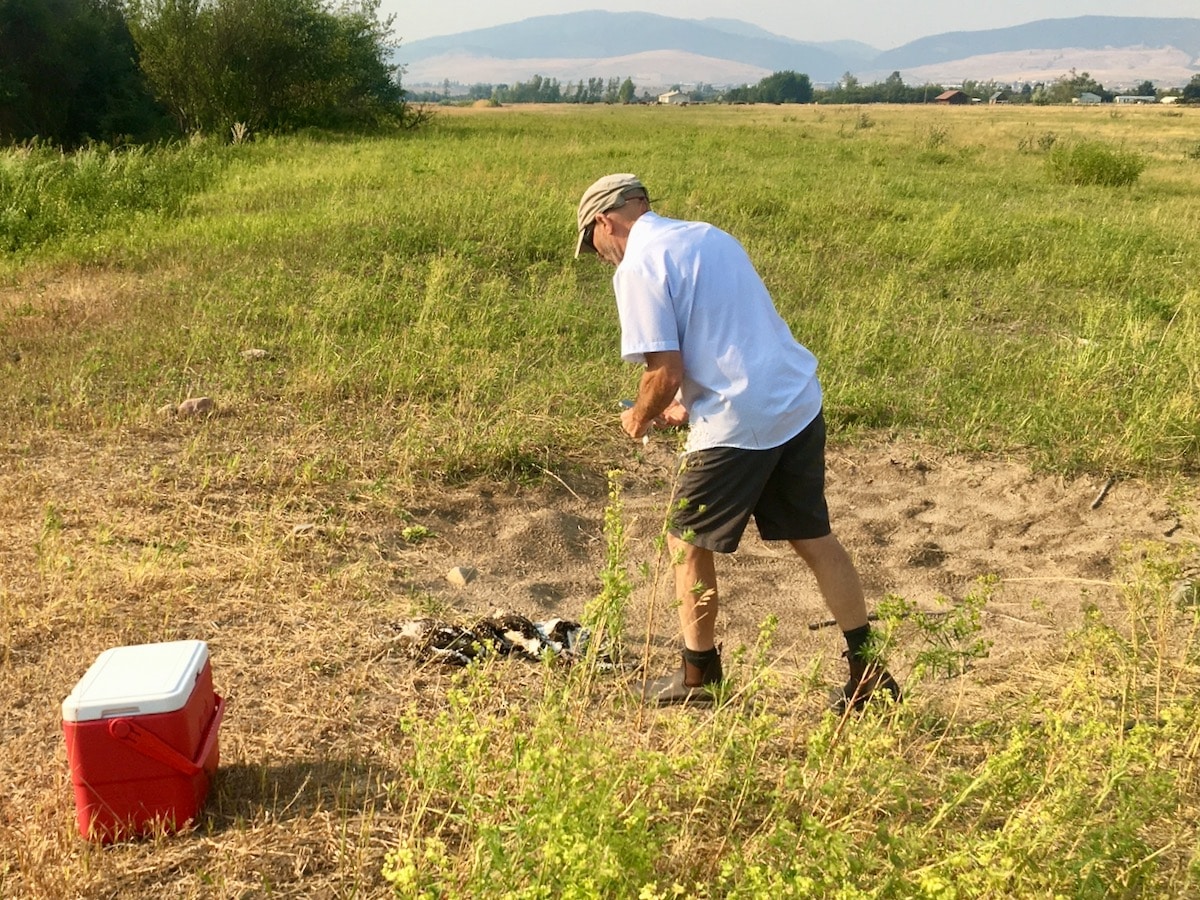
Domenech picked up one of the chicks and extended its wings. He sighed. “What a heartbreak.”
Domenech handed it to me. It had the heft of a newborn baby. I cradled its head, covered in fuzzy, gray natal down, and its feathers only half grown in.
Domenech pointed to its feet. “See how they’ve got these little, sharp spicules that aren’t really developed yet? It’s just sad. And there’s no food in there,” he said while palpating the chick’s lower neck. “It’s just an empty crop.” He continued examining and then paused. “This wing is totally busted.”
He inspected each chick and tenderly folded all three into a red cooler. Even dead, they provide valuable data.
“I hate seeing the babies like that,” he said. “They’re older than I thought they were. They had a lot of feathers [yet] to grow in here. They’re just big bodied. But they’re no more than five weeks old.”
By then, Darling had joined us. “I think they were just catapulted out,” she said. “We gauged the wind at about 120 miles per hour. The winds are different here through the canyon — typically colder, faster winds.”
Domenech had planned to band these nestlings in the next two weeks. Instead, he’d draw blood from their livers to contribute to Raptor View’s data on heavy metal concentrations.
Driving home that evening, with the dead baby ospreys in the trunk, Domenech was philosophical. “What a shame,” he said. “But they will contribute to science.”
The next day, Domenech and his team picked up one of the half dozen rescued nestlings they’d delivered to the Wild Skies Raptor Center for rehabilitation. I watched as they banded the baby. While Busby held the chick, Domenech encircled each of the chick’s ankles, a little thicker than his thumb, with a metal band, one brightly colored with large numbers to make identification easier from a distance, the other gray with small numbers per the U.S. Fish and Wildlife Service. Then Domenech carefully attached to its back a solar-powered radio transmitter resembling a tiny jetpack. Using needle-nosed pliers, he tightened the teflon straps, ensuring that the straps neither pinched it nor hampered the growth of its pectoral muscles, which need to be strong for lifting off from water. Fifteen minutes elapsed as Domemech nit-picked the fit.
Then they loaded up in trucks and headed to McClay Flat along the Bitterroot River, where one chick had survived the storm. The plan was to band and take blood from the surviving nestling, and then add the rescued baby back to its nest.
Below the nest platform, Domenech stepped into the cherry-picker basket. Holding a large fishing net in one hand, he worked the gears and slowly rose up toward the nest, where the surviving chick sat, watching. When he got close, the nestling stood up and began to raise its wings, practicing flight.
Domenech hesitated. If he netted the nestling to band it, he risked stressing it so much it’d abandon the nest. Several minutes passed as Domenech watched and considered the flexing nestling. Finally, he descended.
“It’s not worth it,” he said.

So he turned his focus to the rescued chick. On the ground, he gently placed the baby osprey in an ice-cooled Rubbermaid container, and he grabbed a small cooler tote with two fish inside. Holding both, he again ascended to the nest. He placed the rescue next to its sibling, and then offered each a rainbow trout, which he’d bought at the Good Food Store the day before. Both babies accepted the gifts. He misted them with cool water. The adult female circled overhead.
This work by Domenech and his team — collecting baby ospreys, dead or alive, gleaning data from the former and rehabbing the survivors and returning them to their nests — continued for days, from sun-up to sun-down. But not every successful return was a reunion.
Three days after the storm, after my time tagging along with Domenech was over, he texted me a photo of two chicks in a nest. “Rock Creek!!!” he wrote. One was born in that nest, the only one of three to survive the storm. The other was an orphan rescued after being blown from its nest near Bonner. The adult female had returned and began to feed them both, accepting the newfound chick as her own — and in the process, the surrogate osprey gave Domenech a gift for which there was no substitute. “I’m SO happy!!!” he wrote.