When the administration of President Donald Trump issued a far-reaching but poorly defined freeze on federal spending last week, recipients of federal dollars across the country — schools, universities, hospitals, non-profits, governments and the millions of people they serve — were thrust into a state of fear and confusion. Organizations in the Missoula area were no exception.
“It was certainly not something we were anticipating,” Missoula County Chief Administrative Officer Chris Lounsbury said in a call with reporters. About $42 million — give or take a third of the county’s budget — came from state and federal grants in 2024.
The White House Office of Management and Budget issued the memo implementing the freeze last Monday. By Tuesday evening, a federal judge adjudicating a challenge from nonprofit groups against the order blocked the freeze until Feb. 3. Several Democratic-led states also filed a challenge in court. By Wednesday, amid the lawsuits and mounting questions from press, the public and service providers, the Trump administration rescinded the memo — but not the freeze itself!, it argued in a semantic sleight of hand. By Friday, a different federal judge issued a temporary restraining order requiring the federal government to maintain funding to the almost two dozen Democratic states who challenged Trump’s order.
So are the government funds that the University of Montana, public schools, the city and county and countless other federal grantees rely on safe?
Well, when chaos is part of the point, it’s hard to predict what’ll happen in the short term, even if the funding freeze is on ice for now. But underlying it is the administration’s anti-woke belligerence that promises an extended, bitter chill.

On Jan. 20, the newly inaugurated Trump signed a flurry of executive orders implementing his hard-right nationalist agenda. Among these was an order “Ending Radical and Wasteful Government DEI Programs and Preferencing,” which directed the federal Office of Management and Budget and other agencies to terminate diversity, equity and inclusion programs and draw up a list of all employees involved in DEI and “environmental justice” work within 60 days.
On Tuesday, Jan. 28, national press reported a Jan. 27 memo from the interim director of Trump’s OMB implementing the order. The memo required federal agencies to “identify and review all federal financial assistance programs and supporting activities consistent with the President’s policies and requirements” — namely, the Jan. 20 executive orders. The memo ordered agencies to “temporarily pause all activities related to obligation or disbursement of all Federal financial assistance, and other relevant agency activities that may be implicated by the executive orders” pending completion of that review, effective 5 p.m. on the 28th.
“Financial assistance should be dedicated to advancing Administration priorities, focusing taxpayer dollars to advance a stronger and safer America, eliminating the financial burden of inflation for citizens, unleashing American energy and manufacturing, ending ‘wokeness’ and the weaponization of government, promoting efficiency in government, and Making America Healthy Again,” the memo reads. “The use of Federal resources to advance Marxist equity, transgenderism, and green new deal social engineering policies is a waste of taxpayer dollars that does not improve the day-to-day lives of those we serve.”
(To nitpick these orders for some basis in reality is largely futile, but it’s worth stating for the record that the U.S., with its for-profit healthcare system, tolerance for financial and real-estate speculation, dramatic wealth inequality, neo-imperial adventurism, etc., is as a rule not meaningfully invested in the Marxist project).
The memo clarified that the order did not apply to assistance provided directly to individuals — food stamps, for example — Medicare or social security. But that exemption still left huge chunks of federal spending in the lurch. Several states joined a lawsuit against the order. In court filings, Arizona officials said the state was locked out of $200 million as of midday Tuesday. Washington state said up to 32 percent of its budget was in jeopardy. Nonprofits nationwide said the freeze could have dramatic effects.
“From pausing research on cures for childhood cancer to halting housing and food assistance, shuttering domestic violence and homeless shelters, and closing suicide hotlines, the impact of even a short pause in funding could be devastating and cost lives,” Diane Yentel, the CEO of the National Council of Nonprofits, said in a press statement.
Montana — which, unlike the state plaintiffs in the lawsuit challenging the freeze, is governed by members of Trump’s party — did not join the suit, despite piecing together about half of the state’s biennial budget with federal funds. In a statement shared with Montana Free Press midday Tuesday, a spokesperson for Montana Gov. Greg Gianforte said the administration was “reviewing the memo.”
To nitpick these orders for some basis in reality is largely futile, but it’s worth stating for the record that the U.S. is as a rule not meaningfully invested in the Marxist project.
As reported by Montana Free Press, reproductive healthcare non-profit Bridgercare, the Montana Coalition Against Domestic and Sexual Violence and the Helena Indian Alliance, among others, were unable to access federal funds and would have to depend on reserves. In Missoula County, Lounsbury said the county would continue grant-funded work until it received clear notice that the grants were terminated, but that the freeze could jeopardize a $24 million improvement project on the Highway 200 corridor as well as funds for veteran housing and wildfire prevention efforts.
At the University of Montana, officials scrambled to reassure students and staff in a series of emails. While other universities in the country had instructed staff to halt grant-funded work, the University of Montana said employees potentially impacted by the freeze should continue their work but document any costs associated with their projects. Early Wednesday — by which point the judge had blocked the memo but before the White House rescinded it — the University said the U.S. Department of Education had since clarified that the freeze would not affect student financial aid. The university receives over $100 million in federal grants and contracts, university spokesperson Dave Kuntz told The Pulp.
In Washington, D.C., meanwhile, federal officials quietly attempted to control the fallout. NPR quoted an anonymous White House official who said that the memo should not be interpreted as a full funding freeze, and that some agencies could be expected to pause spending for as short as a day while they evaluated their programs for compliance with the executive orders.
But this did little to quell the confusion. By Wednesday afternoon, a sigh of relief: Acting OMB director Matthew Vaeth told government agencies that the memo had been rescinded.
But wait! In a social media post, White House press secretary Karoline Leavitt said Wednesday that pulling the memo did not itself rescind the federal funding freeze, and that Trump’s spending orders “remain in full force and effect, and will be rigorously implemented.”
In making this statement, Leavitt highlighted an important distinction between the executive orders Trump signed on his first day in office and the OMB memo — the latter being an instrument to implement the former, which remain in effect. She said that rescinding the memo should merely end the court case, not the freeze.
That argument didn’t hold much water before the federal judge who issued Friday’s order, which says the administration can’t “pause, freeze, impede, block, cancel, or terminate” already appropriated funds. But that order is still temporary, even if it doesn’t have a specific end date. And it only applies to the states that sued the feds — a group that doesn’t include Montana and many other GOP-led states.
This means, in other words, that further disruption in federal spending is possible, if not likely. Trump’s pick to lead OMB, Russ Vought, whose confirmation is pending before the U.S. Senate, has clearly indicated as much, telling federal lawmakers that both he and the president believe that the White House can rescind already appropriated spending without Congressional approval. This would appear to contravene the 1974 Impoundment Control Act, which the White House believes is unconstitutional.
In any case, all of these developments have left federal grantees like the University of Montana with major questions.
“We still have not received a definition of DEI from the federal government, so it is hard to identify how that might impact our work,” Kuntz, of the University of Montana, told The Pulp Friday. “For example, we receive federal funding to provide advising to Native American students and first-generation college students. We have no guidance if that is considered DEI, as that work has been going on at UM for decades.”
“We receive federal funding to provide advising to Native American students and first-generation college students. We have no guidance if that is considered DEI, as that work has been going on at UM for decades.”
What the university does know was laid out in a Jan. 27 memo from the Office of Sponsored Programs.
“Several agencies have now provided clear guidance. All have used language stating that grantees shall cease and desist all DEIA activities required of their contracts or grants,” the memo says. “This work may include but is not limited to: DEIA plan requirement, training, reporting, considerations for staffing, or any other direct or indirect contract or grant activity. This requirement does flow down to sub-awardees.”
Grant funds previously allocated for DEI programs “must remain unspent and cannot be reallocated to other budget categories,” the memo continues.
On those lines, the university is “evaluating the status of many of our federal grants in order to have a complete understanding of how an extended federal funding freeze would impact each project,” Kuntz said.
Montana Nonprofit Association Executive Director Adam Jespersen perhaps summed up the overall situation best in a statement issued Wednesday.
“We want to reiterate — even if this means that the immediate threat is finished, we believe that the administration will continue to target programs that they believe are out of step with recent Executive Orders. It is of the utmost importance that organizations evaluate funding sources for potential targeting and make plans for what to do if federal funding for any of your programs is suspended.”
TIF teetering?
Missoula is pausing its plans to annex the Roseburg Forest Products land between Scott and Reserve streets pending consideration of proposed state legislation that the city says would limit its ability to leverage the redevelopment tool known as tax-increment financing.
The city council voted 11-1 Monday evening to indefinitely halt the annexation.
City officials and representatives from Roseburg, which owns the roughly 235-acre site where it long operated a particle board plant, have been working on a tentative plan for the city to annex, rezone and redevelop the land to allow for residential and commercial use.
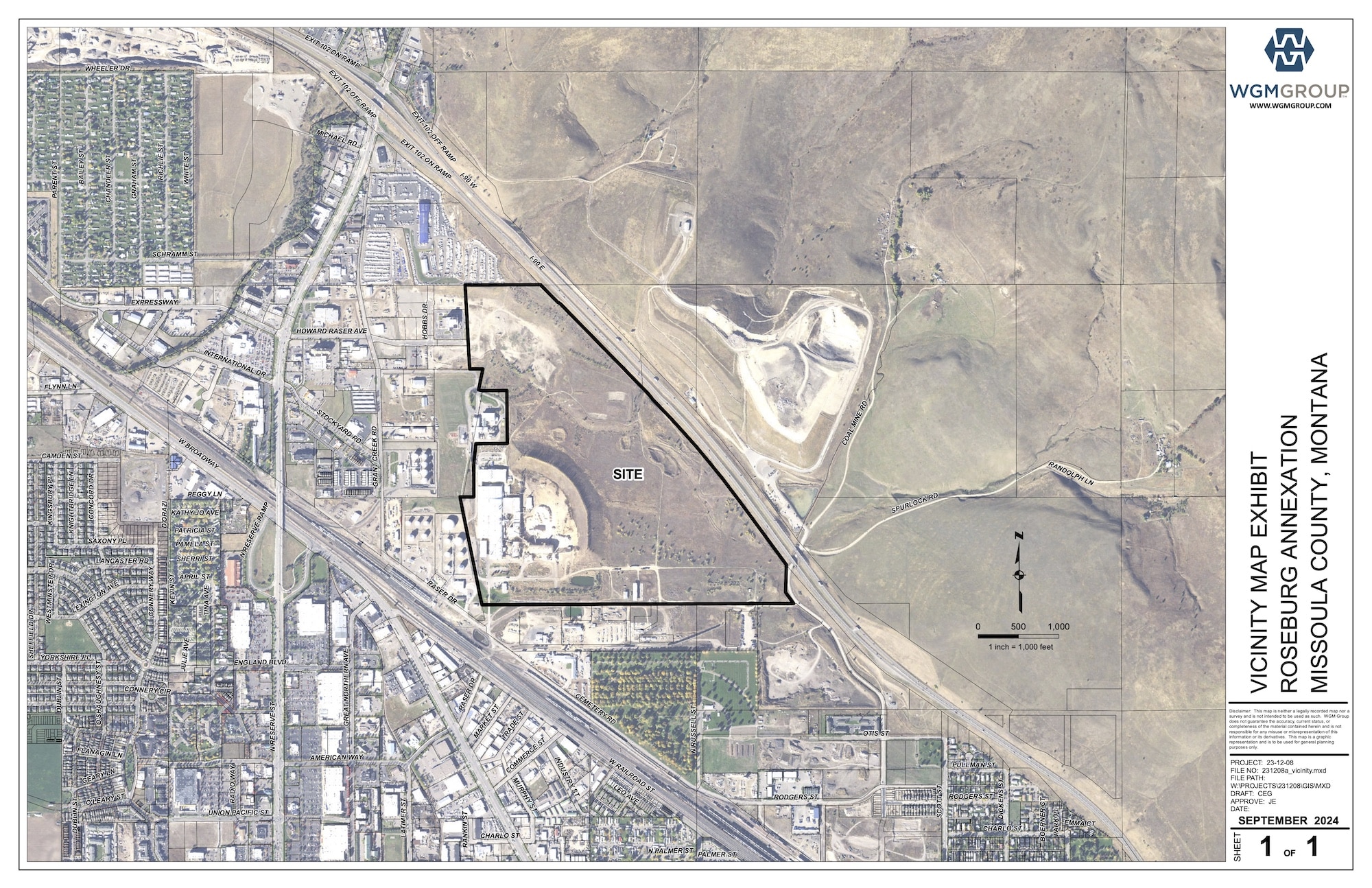
Roseburg officials have said they’re interested in joining the nearby North Reserve-Scott Street Urban Renewal District — a tax-increment financing district — to help fund the redevelopment. TIF districts allow local governments and/or redevelopment authorities to earmark potential property tax increases from improvements to blighted sites for future development of public infrastructure in the area. To put it simply, they serve as incentives for private owners to collaborate on intensive redevelopment projects with the city, which can use the tool to guide growth.
But tax-increment financing has also piqued the interest of legislators in Helena, where property tax reform is a constant topic of conversation as the state enters another year in the throes of a housing crisis. Republicans in particular have taken aim at municipal policy and spending that might increase tax rates.
That’s the genesis of Senate Bill 2, carried by Sen. Greg Hertz, R-Polson, at the behest of a legislative interim committee that drew up the basics of the proposal before session began.
The bill amends a section of law related to the amount of money a local government can add to its budget without going to the voters for approval of a new levy. To translate property law-ese to English, the statute essentially says that cities can increase their budgets by one-half the average rate of inflation for the prior 3 years or by applying the existing levy to newly taxable property — new subdivisions, newly annexed land, and so on.
TIF districts function differently. They’re not included in the newly taxable property that a city might use to fund services — the point being that the potential property tax revenue they create is instead used to help finance improvement and development in the district. When the TIF district sunsets — generally after 20-plus years — the properties within, now substantially improved and thus worth more, are added to the tax rolls, allowing the local government to use the funds to support the services that otherwise were funded through other means when the TIF properties were off the rolls.
“I think it’s safe to say that SB 2 would literally be the death knell for tax-increment financing use in the state of Montana. And it’s the only economic development tool we really have.”
Hertz told lawmakers in a committee hearing in mid-January that he supports the fundamental principles of TIF districts. But he said that one of the Legislature’s top priorities this session is property tax relief, and that in order to maintain government services in a TIF district, residents of the district will inevitably pay more in taxes to subsidize the TIF exclusion. He understands that cities want money to fund development, he said.
“But at the same time, we’ve had taxpayers that are helping subsidize TIFs for 30 years,” he said.
His bill would mean that the new property that comes online following the termination of a TIF district would be used to push down mill rates — in essence, the amount a person pays in property taxes — instead of growing the overall tax base.
“As you push down mills, peoples’ property taxes will go down,” he said.
But opponents of the legislation told lawmakers this month that despite Hertz’s assurances that he supports tax-increment financing, the change would kneecap the practice.
“If this bill passes, the TIF provision will no longer be a tool that local governments are able to use,” Jennifer Olson, the government affairs director for the Montana League of Cities and Towns, told lawmakers.
Olson acknowledged the change would reduce property taxes for individuals. But she said the savings on property taxes would be miniscule in comparison to the potential boost to the city budget provided at the end of a TIF district’s life under current law.
At city council this week, Missoula Redevelopment Agency director Ellen Buchanan raised similar concerns.
“I think it’s safe to say that SB 2 would literally be the death knell for tax-increment financing use in the state of Montana,” Buchanan said. “And it’s the only economic development tool we really have.”
If the law passes, she said, the city would be hard-pressed to amend the North Reserve-Scott Street Urban Renewal District to include the Roseburg site, and without that incentive, Roseburg would be hard-pressed to request annexation.
Hertz’s bill has not yet received a vote in committee. The city of Missoula is opposing the bill at the Legislature. Preserving TIF is one of the four primary legislative priorities the city listed at the beginning of the session.
The ledger #️⃣
$2.4M
The amended value of the city’s contract with tree-grinding company Terra Firma to process debris from last July’s historic windstorm, thanks to an additional $800,000 approved by city council last week with hundreds of trees still needing processing.
The week ahead 🗓️
- On Thursday, Feb. 6, the Missoula County Board of Commissioners will consider a $5.3 million tax- increment financing request for construction of a public water system at the Wye.
Find a list of all upcoming city meetings here and county meetings here.
The feed 🗞️
Senate Judiciary committee passes bill to require Ten Commandments in schools on party lines (Daily Montanan)
Immigration officials are arresting people in Washington and warehousing them in Idaho (Range Media)
Montana lawmakers advance bill requiring more signatures for independent, minor-party candidates to reach ballot (Montana Free Press)
Bathroom access, sports and health care: Lawmakers debate slate of transgender bills (Helena Independent Record)
Gianforte, joined by Grover Norquist, touts hefty income tax cut proposal (Montana Free Press)
What we found in the Legislature’s ‘junque’ drawer (Montana Free Press)
Law of the landowner? (Flathead Beacon)
Academic restructure: UM to keep humanities, social sciences separate from education (Missoulian)
UM lands $500,000 grant for Democracy Studies (UM News Service)
The climate fight endures (High Country News)