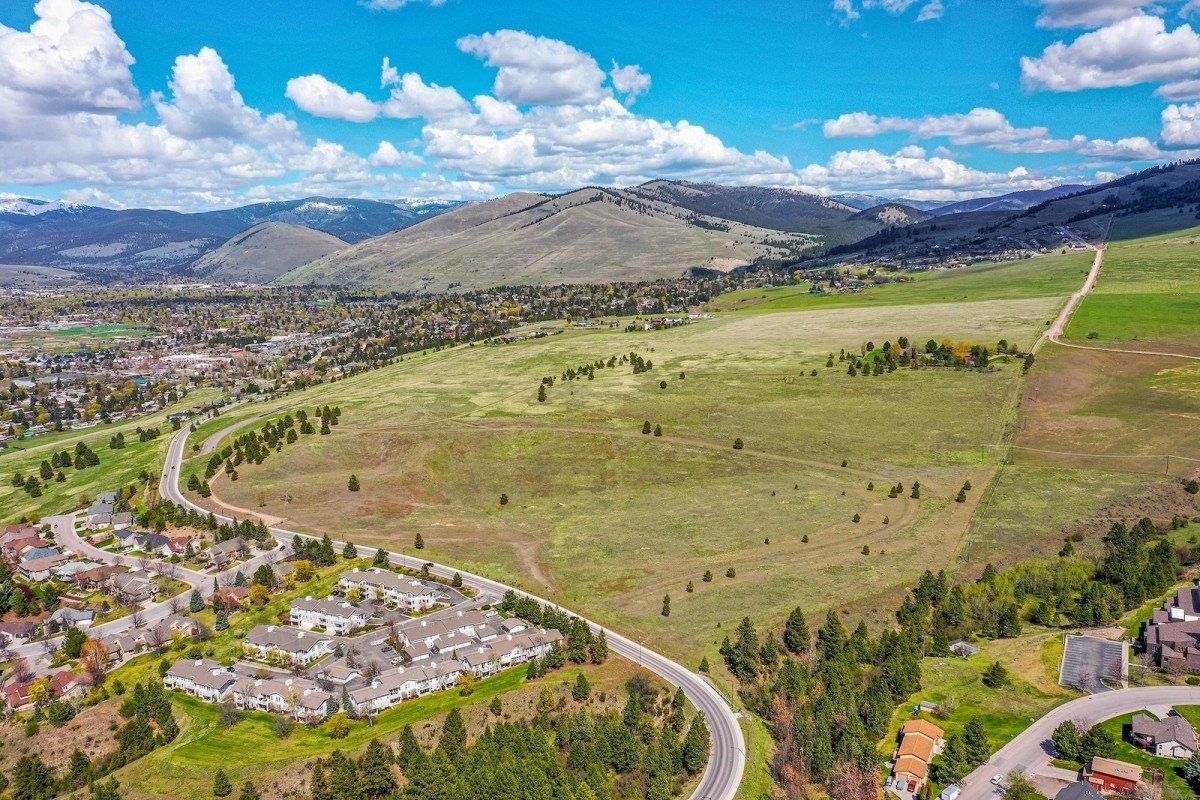
The Missoula City Council Monday evening approved a preliminary application for a large, multiphase subdivision in the South Hills, a development that could add 450 dwelling units to the city’s starved housing inventory over roughly 20 years.
The Wildroot development, platted for the Moose Can Gully neighborhood, will add hundreds of apartments, townhomes and single-family units to what was once one of the Missoula’s largest undeveloped tracts. The first phase of development — an apartment complex — is already underway, with the first round of residents moving in this month.
The city approved the preliminary plat application, annexation and rezoning petitions and several variances on a series of 10-1 and 9-2 votes Monday following debate among the council and public on familiar lines. In short: What role should new development play in addressing Missoula’s housing crisis, and at what cost?
Kiely Wilson, the principal and cofounder of the property’s developer, Pando Holdings, is clearly attuned to the city’s pervading anxiety. In his presentation to the city, he expressed lifelong love for Montana despite his Denver roots and said the development would help the city’s housing crunch.
“Our goal with this project is not just to develop real estate but to create a neighborhood that will be an asset for the area and that aligns with the goals and objectives of this city,” he told the council. “I’m proud the work we do will help with local housing attainability.”
But the homes in the Wildroot development itself will not be affordable, at least not in any strict legal sense. The project isn’t subsidized to ensure affordability, and all of the units will be available at market rates. For the already-built apartments, that means a 482-square-foot studio for $1,485 a month.

Pressed by councilmember Kristen Jordan about the lack of permanently affordable units, Wilson expressed a belief common among those who favor market-oriented solutions to high housing prices.
“This is a tough one to answer straight up,” he said. “The more housing that gets built, it releases more affordable housing down the line.”
Some members of the community who testified about the project voiced skepticism of this concept. How could a tony development governed by a homeowners association in the hills do anything to contribute to housing affordability?
“It really makes it hard for me to tell all my friends who have been driven out of here over the years how this is going to help,” said Nick Van Hole, who lives near the development.
But these concerns were also dressed in the anxieties of longtime residents generally afraid of change and development. Van Hole and others expressed worry over traffic, sidewalks and other issues as much as they did over affordability.
One community member who isn’t opposed — at least anymore — is John Rimel, a member of the Rimel family, which owns adjacent land and maintains a stretch of Rimel Road connected to the subdivision. The city and developer earned the family’s support by inserting a condition of approval that the portion of the road the family maintains will be blocked to public access.
“I’d like to reiterate my thanks to staff and to the developer for hopefully working out a solution to this issue,” Rimel said.
Ultimately, the council approved the development without much issue. The two no votes on the plat approval came from Jordan and councilmember Daniel Carlino.
Jordan implored developers to invest in affordable housing and work with the city and other government stakeholders on improving affordability.
If the city loses its remaining attainable housing through a proliferation of market-rate construction, she said, Missoula is “going to change, and it won’t be that fun town, but you will have already built your development and the checks will be cashed.”
But the city has to use whatever tools it has, said Mayor Andrea Davis, who ran on a pro-housing platform.
“I would continue to stress the importance for us to maintain as many tools as we possibly can, to make sure we can effect any level of affordability … going forward,” she said.
The philosophy of construction
Mayor Andrea Davis was among the panelists at a discussion at the University of Montana last week that examined one of the key questions underlying the city’s approval of the development: Can Montana build its way out of a housing crisis?
The panel was part of Montana Free Press’s inaugural Free Press Fest, and Davis was joined by Jacob Kuntz, the director of Helena’s Habitat for Humanity, and state Sen. Forrest Mandeville, R-Columbus, who carried the GOP’s zoning reform package in the Montana Legislature last year.

Mandeville’s legislation embodies one major philosophy in the current Montana housing debate: The best way to make housing cheaper is to make it easier to build. The bills enable construction of accessory dwelling units, allow for the construction of duplexes by right, allows for some residential development in commercial areas and directs fast-growing municipalities to retool their approach to zoning to allow for more construction more quickly. In his eyes, the spider’s web of repeat regulatory hearings and public comment — to name a few steps along the way to build housing — are impediments to sustainable growth.
“There are wide swaths of our communities in Montana that made it really, really hard or illegal to build certain types of housing,” he said.
But the market, as Davis pointed out, can take a while to respond to these changes. And it won’t immediately help anyone experiencing houselessness or on the verge of eviction.
“It’s not gonna turn the switch tomorrow,” she said.
Land banking and revolving loan funds hold possibilities for providing legally affordable housing, but the more the state invests in housing, the greater the political criticism, especially from the right. The state has a housing trust fund, but its funding is minimal, and the city’s equivalent fund is in its infancy.
The lack of available public funding for cheap housing is ironic, Kuntz said, given that homeownership itself is hugely subsidized.
“One of the largest receivers of federal subsidy is the homeowner in the form of the mortgage interest tax deduction,” he said. “The American Dream was a marketing campaign put together by bankers to sell the fixed rate mortgage.”
Ultimately, all panelists — admittedly, to varying degrees — presented construction as a solution to the housing crisis. But, especially for Davis and Kuntz, it can’t be the only solution.
“If we only say that it’s supply that will answer this question, I think we fall short,” she said. “We need housing policy that helps folks be able to get homeownership and rentals.”
The ledger #️⃣
4.2%
The year-over-year property tax increase included in the budget passed by the Missoula County Commission last week. The growth of the county’s taxable value did not meet expectations, the county said.
The week ahead 🗓️
- The city’s Housing, Redevelopment, and Community Programs Committee meets Wednesday, Sept. 11, at 3:10 p.m. The committee will take up a motion to authorize the mayor to sign an interlocal agreement with the county for emergency funding at the Johnson Street Temporary Emergency Shelter, among other issues.
- The Missoula County Commission meets Thursday, Sept. 12, at 2 p.m.
The feed 🗞️
Council takes up expansive Wildroot development (The Pulp)
Missoula County approves 4.2% property tax increase (Montana Free Press)
City Club: Missoula must find ‘tradeoffs’ to make housing more affordable (Missoulian)
Correction: An earlier version of this story incorrectly stated that Mayor Andrea Davis had voted in support of the Wildroot development on Sept. 9. Mayor Davis did not vote. In general, the Missoula mayor votes only when the City Council vote results in a tie.