The Co-Lab for Civic Imagination is, at its core, an experiment in what’s possible. It’s built on the idea that art isn’t just about reflection — it’s about creation. What if, instead of merely reacting to crises, communities had the space and resources to imagine something better? What if they could take those ideas and make them real?
That’s the driving force behind the Co-Lab, an initiative housed at the University of Montana but designed to work far beyond it. More of a movement than a place, it brings together artists, students, faculty, and local experts to tackle pressing social issues through collaboration. It’s about using the arts not just to tell stories, but to shape the future in tangible ways.
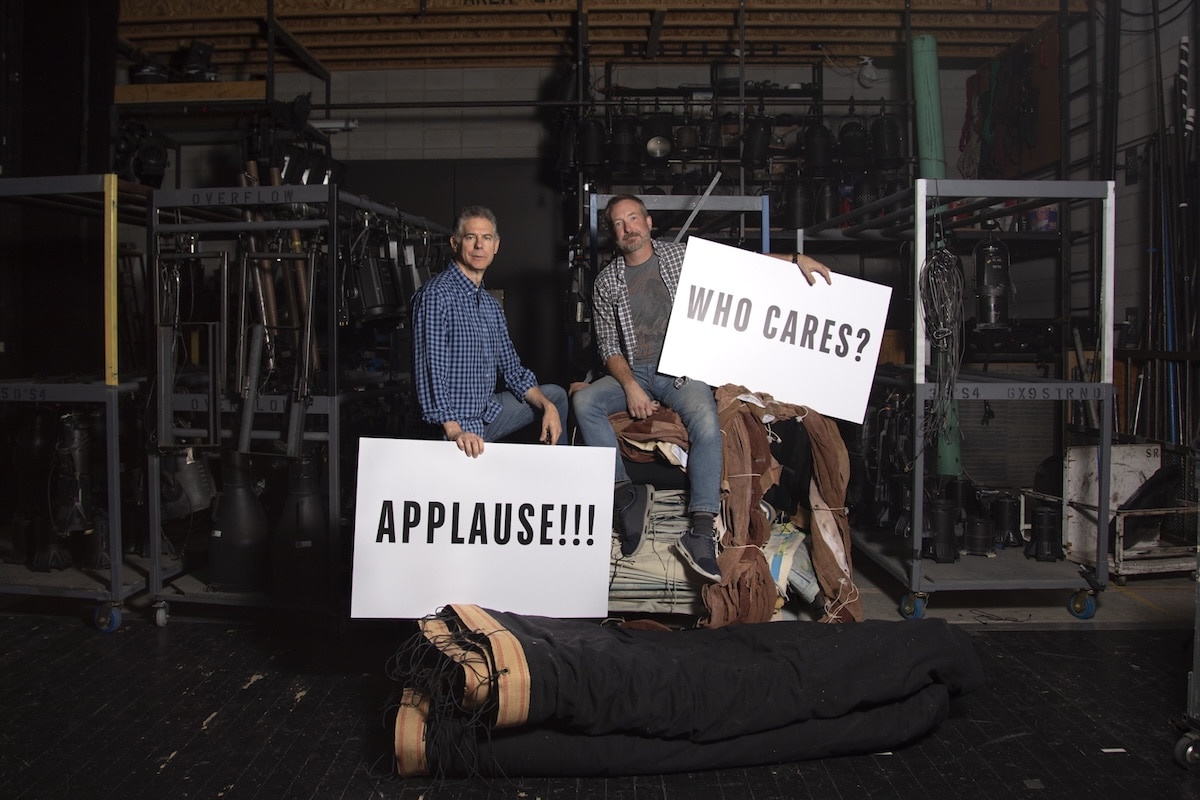
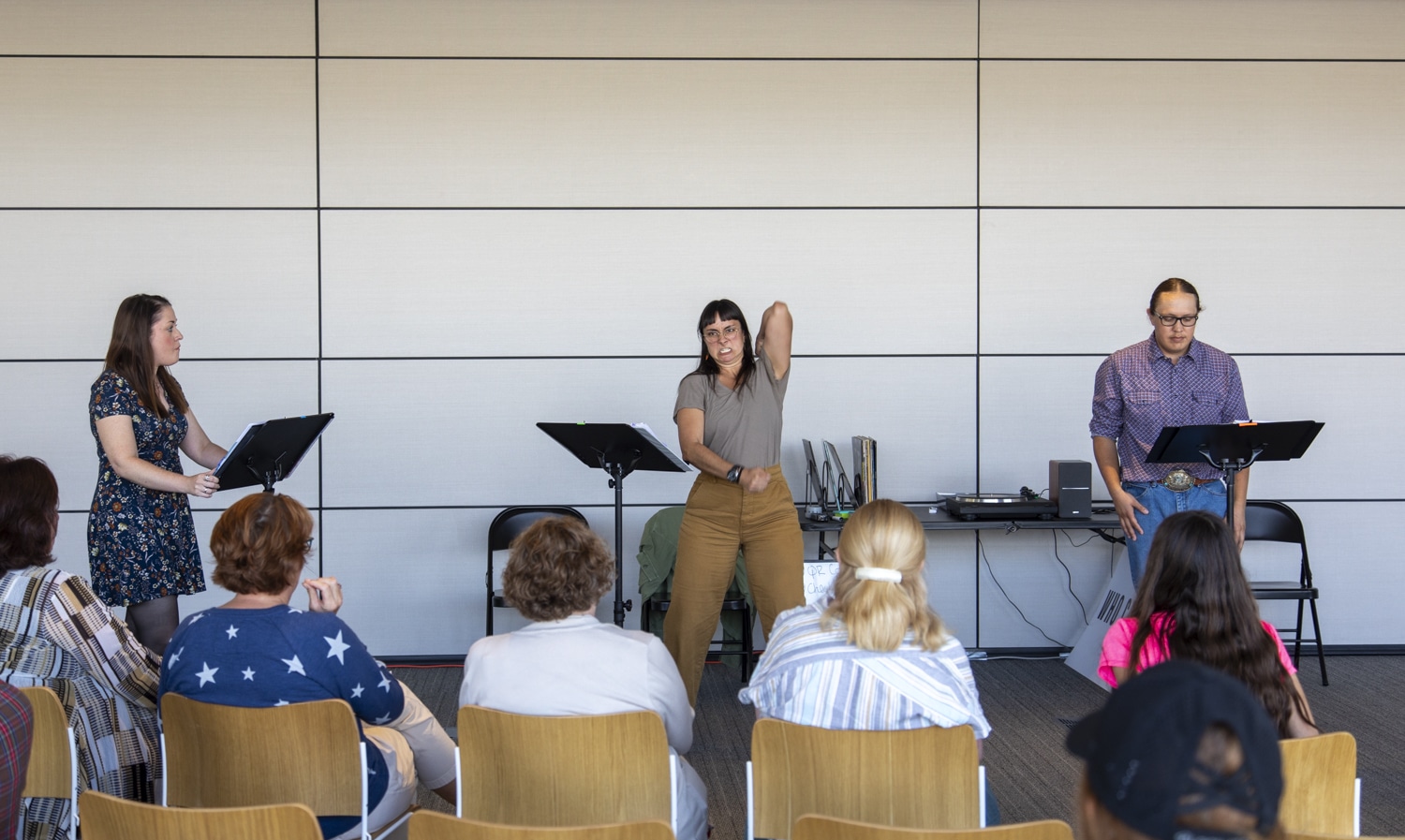
Its most ambitious project so far, State of Mind, is a statewide tour created in partnership with Montana Repertory Theatre, UM’s long-standing professional theater company-in-residence. Led by Michael Rohd of the Co-Lab and Montana Rep’s artistic director Michael Legg, State of Mind is more than a play. It’s a roving conversation, a chance for communities to reimagine what mental health care and community support could look like. The project was launched last September with a public performance at the Missoula Public Library, and has toured to several towns since then including, among others, Conrad, Great Falls, Glasgow and Butte. It will continue touring through 2025 until the end of May 2026.
In each town, the show unfolds as a dynamic, interactive experience. Five professional actors rotate through three roles each night, but a big part of the magic happens in the workshops that precede the performance. These workshops — held separately for local high school students, educators, and healthcare workers — are where the real stories and voices of each community are brought to the table. These insights shape the evening’s performance, which means the material stays relevant, fluid, and rooted in the lived experiences of each place.
“How do we support our community’s mental health, not just through professional providers, but through building communities of care? And what does that look like?”
Rohd, who moved to Missoula to help establish the Co-Lab in 2022, views this partnership with Montana Rep as a perfect example of how the arts can be a catalyst for civic engagement. And Montana Rep, under Legg’s direction, has always been game for the unconventional — their productions have been almost exclusively innovative, site-based theater projects.
The statistics are stark: 35 percent of Montanans report symptoms of depression and anxiety, and access to care is often limited in rural communities. The project is actively engaging communities to imagine how they could better support each other, even in uncertain times. By framing mental health and community care not as a burden or as a bare minimum, but as something every community deserves, the Co-Lab’s work is crafting an alternative vision — a vision where access to care, support, and resources is a shared, non-partisan priority.
At each stop, the goal is to make local mental health resources more visible, break down stigmas, and strengthen networks of care by listening to each community’s unique needs and building from there. That process is essential, because, as Rohd puts it, mental health isn’t a linear journey, and the project embraces that reality, encouraging conversations that evolve with each town.
In advance of State of Mind‘s next stops — including in Kalispell and Polson on April 7 and 9, respectively — The Pulp caught up with Michael Rohd to discuss the innovative partnership with Montana Rep, why the arts are a perfect fit for tackling community challenges, and how the tour is about starting with a practical approach — listening, strategizing, and empowering people to take the first step by simply talking.

The Pulp: Can you give me a little more background on the work of the Co-Lab for Civic Imagination?
Michael Rohd: The Co-Lab is based on the work that artists do — and can do — when they collaborate outside of the arts field, but work in other sectors like housing, public health, transit, local government, issues around racial justice and community development. It’s based on my work for the past 30 years, working in different parts of the U.S., where I’ve helped artists collaborate in all these different spaces, not just producing their art, but looking at how their art can make contributions to other areas of community life. So, the Co-lab is now here, and I’m doing that work, collaborating with the city of Missoula and Parks and Rec, for instance, on some of their strategic planning work. We had a commission last year called the Civic Imagination Commission, where we funded artists around Montana who were doing civic imagination projects of their own. And State of Mind is our largest project these first couple of years.
How did the collaboration between the Co-Lab and Montana Rep come about?
I’ve been a theater maker my whole life — theater company, working in theaters around the country. The Co-Lab isn’t only theater. It’s different disciplines. But when I’m doing a project, it’s a theater project, because I’m a theater maker. When I got here and started the Co-lab, I got to meet my colleagues at the Rep, Michael [Legg] and Marie [Fahlgren], and we started talking about our similar interests in looking at how theater can function in community, not just as entertainment, but also as this positive contributor to stuff happening in the community, so we decided to collaborate.
What are the elements of the State of Mind project?
The project is about the behavioral health situation in Montana, which, like many states, is in crisis. There are not enough service providers, we have high levels of really challenging mental health issues, and it’s an underfunded landscape. What we’ve been learning as we listen to people around Montana talk about this crisis is that a lot of people wish we were just talking about mental health more — just making it OK to talk about it. One of the things the project does is it tackles stigmas and it tries to help people understand what the local resources are that might not be so visible to them. It invites people to think about, “How do we support our community’s mental health, not just through professional providers, but through building communities of care? And what does that look like?” So the play is performance. But it’s also a conversation.

Can you articulate why it might be effective to see these issues through an arts angle?
Here’s why I think artists are really meaningful and provide a different sort of contribution to all kinds of community issues and outcomes. Artists work in three main areas that are useful. They collaborate — and collaboration is something we need when we’re trying to solve big challenges. Artists are also really experienced at problem solving and coming up with new solutions — new ways of thinking — and that’s something we need. And artists are really experienced with public engagement — with listening and then reflecting and expressing back [what they heard].
For audiences, it seems like receiving information about mental health issues in the form of a lecture or academic talk is such a different experience than, say, watching a performance that might make you feel emotionally connected to it.
Yeah, I think that’s true. I think there’s something about the story sharing and the empathy that builds. But I think in addition to the production of empathy during the show, we invite people to imagine together. There’s me, the artist, making something to make you feel — and that can be useful. But that’s not enough, right? I’m actually not interested in art that just makes you feel something and then says, “Thank you.” I’m interested in imagining — in that space where we’re feeling and connecting — how our community deals with this challenge. How do we imagine what we hope things look like five years from now? How do we imagine the way to get from here to there? How do we imagine what care looks like in our schools when we find that challenging? So I think you’re right. There’s that empathy and that sort of story connection, but then artists can also help actually imagine possibilities.
I’m actually not interested in art that just makes you feel something and then says, “Thank you.” I’m interested in imagining — in that space where we’re feeling and connecting — how our community deals with this challenge. How do we imagine what we hope things look like five years from now?
I can totally relate to that with journalism. The discussion in the journalism world right now is that you can’t just write about problems all the time and leave it at that. You have to engage with the community and cover solutions.
Yes, of course. And who do you listen to? As a journalist, normally, it was maybe three experts. But what about the people with lived experience? How do we bring their ideas into the problem-solving conversation, which is also what we’re trying to do here by going out to all these places.
Yeah, imagining what we want our communities to look like is really important.
Right. And then, how do we get there? What are some steps? What might we do?
There was some research done that showed that people are more likely to read the news if they get to read about people or communities trying to solve problems. It helps readers envision the world they want, rather than feel defeated — and therefore less likely to actively participate in their community’s problem-solving.
Yes, I mean, I think that was really interesting during the pandemic, because some of the most successful news offerings that appeared online were people telling stories of hope. And ideally you want stories of hope to invite people into participating, in trying to make hopeful things happen. How does hope invite you towards contributing and creating more hope? Co-creating hope. Our poster for this project says we’re trying to tackle mental health challenges in Montana by making it OK to talk about mental health in Montana, because that’s really the first step we have to destigmatize the conversation. You can’t imagine something together unless you can talk about that thing together. So we’re trying to do both those things in this art space.
How did you end up working at this intersection of theater and community building?
I’ve been sort of in both spaces — producing theater, but also looking at theater as this kind of community asset — for a long time. I was a theater maker in Washington, D.C., in the early ’90s, and I started working with a group of men and women who were living with HIV and or AIDS and who were unhoused. And this was 1991 when that was super taboo. You couldn’t say the word “HIV” in a D.C. public school without being suspended as a teacher or suspended as a student. I started accidentally working with these men and women at a shelter who were living with the virus, and we started making theater together. And they asked me if we could take the theater we were making together, not to put it on as a production, but to go into youth spaces and have conversations about HIV in the city, since HIV was the number one killer of 15 to 21 year olds in D.C. So they were like, “Can we find youth spaces to do theater workshops about this?” I was acting at night in theater theater, and then suddenly doing this. And I was enjoying theater theater, but this other thing was way more interesting and felt way more connected to the place where I was living and made me feel very alive as an artist and as a citizen. From that point, I started trying to figure out how I keep engaging around community concerns with people who have lived experience. How I explore theater as a way to have public conversation and public problem solving — not just as a way to have production and entertainment. And I love production and entertainment, but this felt really important as well.
So, back then the taboo issue was HIV. What are some examples of things now that you feel like people are having the hardest time talking about?
I think, certainly, mental and behavioral health. And I think we’re really challenged right now to talk across partisan divides — not even about a particular issue. We can name all the issues that are hard for people to talk about, right? But I think one of the big challenges is, how do we just talk to people who believe different things from us, right? I think that’s a huge challenge that affects how we govern, that affects how our schools function, that affects how our neighborhoods feel, our lived experiences day to day. You can bubble yourself off from everybody who thinks differently than you, but you can’t really deal with community challenges that way.
Artists all over the country are a part of the bridge-work people attempt to do. This project, I would not describe as a bridge partisan project. But hopefully we’re bringing people in with lots of different values and lived experiences, and then having a conversation about something we can agree on. We all might have different perspectives on how to make our communities healthy. That’s OK. But we probably all want our communities to be healthy, right? So the hope is, by making that a thing we’re talking about on this project — and not an issue — we’re able to bring lots of folks together to be in a dialogue about imagining how we can be healthy together.
What else do you want people to know about this project?
It’s a no-cost project. It’s free. When we go out to communities around the state, nobody has to pay for it. We’ve been fundraising so we can take it for free everywhere. And that’s important, because health equity is important, and we don’t want to only go to places that can afford the show.
Issue-based arts projects can sometimes be tricky, because if you’re trying to push your art into the framework of a cause, it’s easy to lose the complexity good art produces and, instead, end up with something heavy-handed. How do you avoid that?
It’s a great question, because I would say the show is not didactic, except about one thing. It is didactic about the fact that we believe that everyone deserves care. And we believe that it’s important to talk about mental health. So it’s didactic about those things.
Yeah, and I guess that aspect should be clear, right?
It’s got to be clear. I think the text at the beginning of the show is something like: “Montana is having a behavioral health crisis. Theater is not going to fix it, but we believe that traveling around the state and talking about theater is a step towards a healthier mental health landscape for all of us.” I think that’s the beginning — the very first lines of the show. And then after that, it’s a bunch of different pieces. The show is structured like an album, not a play. There are 14 tracks, and there’s a side A and a side B, and the audience chooses the order of side A and then the order of side B. Because mental health is not a linear journey for people. So we wanted the show to be something that the audience and the actors are basically putting together, together.