Native Americans’ across Montana and the country could not have guessed that within the first week of Donald Trump’s inauguration, their citizenship would be drawn into question.
Within days of taking office, in his rush to tackle what he called an “invasion” of immigrants, Trump signed an executive order declaring that the long-established right of birthright citizenship — guaranteed by the 14th Amendment — did not include children born to immigrants in the United States who lack permanent legal status. The order, itself, sparked immediate outrage, leading to multiple lawsuits and court injunctions, which activists and courts said violated the 14th Amendment. (District courts in the states of Washington, Maryland and, just this week, New Hampshire, have since halted enforcement of Trump’s executive order. Judges in both courts declared the order blatantly unconstitutional.)
But it was during the first of these lawsuits, on Jan. 23 — when Washington state attorneys filed a lawsuit in Seattle seeking to block Trump’s order — that the issue of Native American birthright citizenship came into play.
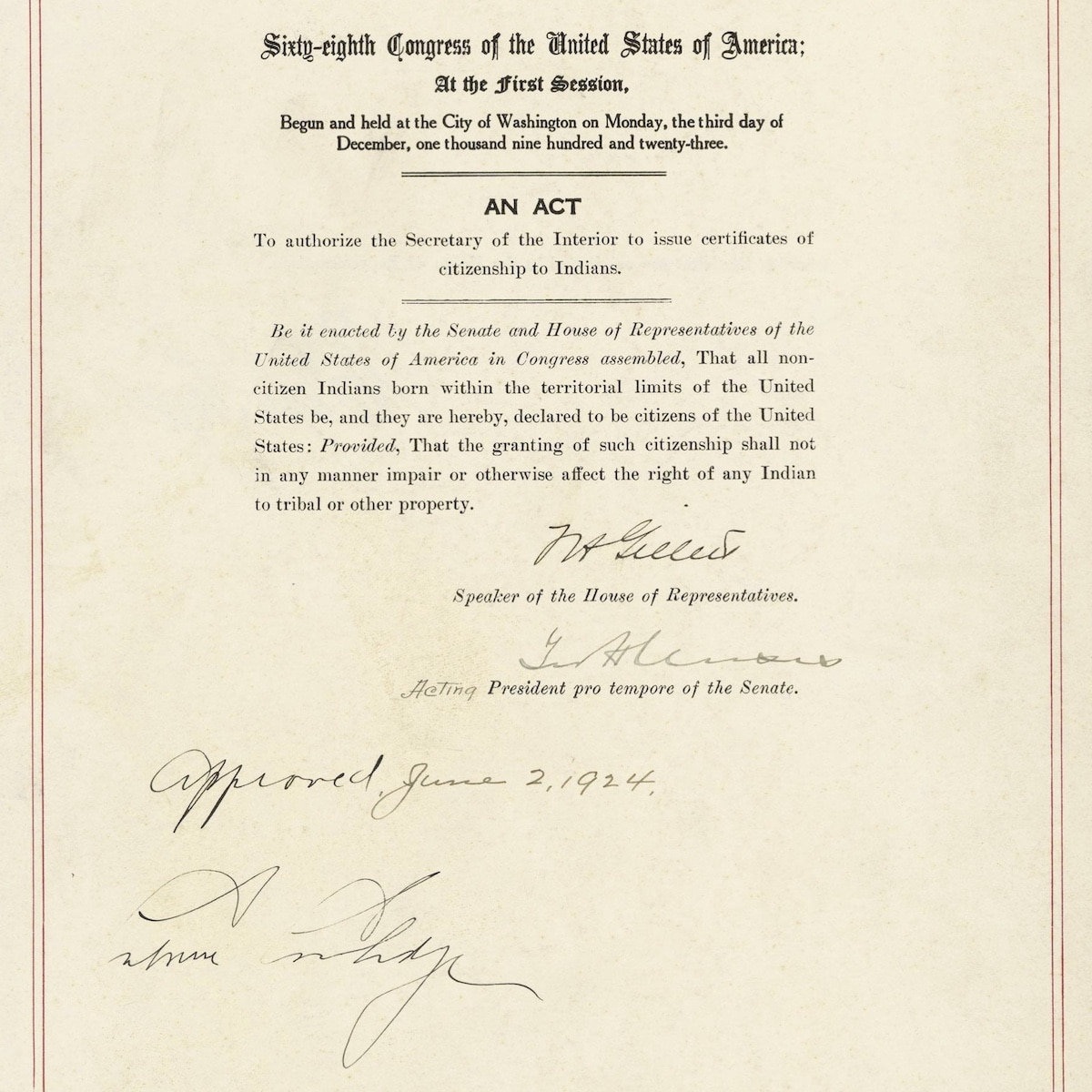
In defending Trump’s order, the Department of Justice relied on an 1884 Supreme Court case, Elk v. Wilkins, to argue that the 14th Amendment does not inherently grant birthright citizenship. In that case, the court ruled that Winnebago tribal member John Elk was not a U.S. citizen at birth because he was born on a reservation and therefore not subject to U.S. jurisdiction at the time. Although the 1924 Indian Citizenship Act overrides the case’s core legal conclusion by granting U.S. citizenship to all Native Americans, the DOJ incorporated the case into its legal reasoning to exclude children of undocumented immigrants from the 14th Amendment’s protections.
Their argument: that Native American birthright citizenship is not inherently built into the 14th Amendment and, therefore, undocumented immigrants do not have birthright citizenship, either. In one part of that brief, leaning on the verdict in Elk v. Wilkins, the DOJ stated:
The DOJ’s argument: that Native American birthright citizenship is not inherently built into the 14th Amendment and, therefore, undocumented immigrants do not have birthright citizenship, either.
“The United States’ connection with the children of illegal aliens and temporary visitors is weaker than its connection with members of Indian tribes. If the latter link is insufficient for birthright citizenship, the former certainly is.”
But in their initial argument, the DOJ failed to clarify that the Indian Citizenship Act affirmed Native American birthright citizenship. And this lack of clarity, along with the very act of invoking a case that questioned Native birthright, quickly led to some misleading headlines in the media and fueled confusion, anger and panic within Native American communities across the country.
“There’s some language that is quoted in the [initial DOJ] brief that gives the impression the [Trump administration] doesn’t think Indian people are entitled to birthright citizenship, right?” said Matthew Fletcher, a law professor at the University of Michigan and expert on federal Indian law. “And that gives you a sense of like, this is something you have to pay attention to.”
Fears of deportation
In addition, the DOJ’s legal argument landed just as Native American tribal members were fearing — and some reporting — being caught up in Trump’s aggressive immigration crackdown.
On Jan. 23, just three days after Trump took office, the president of the Mescalero Apache Tribe in New Mexico, Thora Walsh-Padilla, issued a statement trying to calm fears that tribal members were getting caught up in immigration raids. Wash-Padilla also stated that the tribe was working to ensure that its members’ rights would be protected.
“Last night and throughout the day today,” the statement read, “I received multiple calls from concerned Mescalero Apache Tribal Members in relation to rumors of incidents involving Tribal Members and U.S. Immigration and Customs Enforcement (ICE) agents.”
The statement pointed out that there had been only one confirmed incident of an ICE agent asking a tribal member for identification and then leaving when a driver’s license and tribal ID were presented.
Nevertheless, the statement advised members to “be aware of your surroundings, let family members/friends know where you are, and keep identification with you at all times. If possible, then carry multiple forms of identification (driver’s license, state-issued identification card, Tribal identification card, Certificate of Indian Blood, etc.).”
That caution, as well as efforts to quell fears driven by rumors that Native Americans were at risk of being deported for lack of citizenship, were quickly replicated on reservations across Montana and elsewhere.
The legal history of Native American citizenship is complex. However, it is widely accepted that the Indian Citizenship Act of 1924 forever put the issue to rest, stating that all Native Americans born in the U.S. are “declared to be citizens.” That act was later codified in the Immigration and Nationality Act of 1952. Legal scholars argue that citing Elk v. Wilkins to challenge birthright citizenship for children of undocumented immigrants is a political, not legal, argument. They contend that the Trump administration’s attempt to end birthright citizenship would overturn more than a century of precedent, during which marginalized groups have fought hard-won battles to secure their rights under the 14th Amendment.
During the hearing, after which he signed a nationwide preliminary injunction stopping Trump’s order from taking effect, U.S. District Judge John Coughenour out of Seattle gave his opinion on Trump’s order.
“The Constitution is not something with which the government may pIay policy games,” Coughenour stated. “If the government wants to change the exceptional American grant of birthright citizenship, it needs to amend the Constitution itself. That is how our constitution works, and that’s how the rule of law works. Because the president’s order attempts to circumscribe this process, it is clearly unconstitutional.”
Since its initial defense of Trump’s order in Washington state’s case, the DOJ has attempted to assure Native American communities that the order will not impact them legally. At the same time, to win its argument against children of undocumented immigrants having birthright citizenship, the DOJ is choosing to use Native American birthright citizenship as an analogy — relying on old acts, such as the Civil Rights Act of 1866 (because it did not include Native Americans) and old Supreme Court cases, such as the Elk v. Wilkins case.
Headlines and rumors
The absence of an acknowledgement of Native American citizenship in the DOJ’s first defense on Jan. 22 clearly helped fuel rumors circulating online.
Among the news headlines that caught attention in Montana was this one from Salon on Jan. 23: “‘Excluding Indians’: Trump admin questions Native Americans’ birthright citizenship in court.”
The Fort Peck Tribal Law Enforcement posted on Facebook the next day:
“The Justice Department’s arguments included questions about whether Native Americans born in the United States have birthright citizenship if they aren’t ‘subject to the jurisdiction’ of the U.S. — such as if they live on sovereign tribal land. However, the arguments are based on 19th-century legal provisions that precede the Indian Citizenship Act. … An executive order cannot change Congressional laws.”
Native Americans born in the U.S. are U.S. citizens—ICE does not have the authority to detain or deport them for immigration violations. A 2025 Executive Order has sparked debate on citizenship, but Native citizenship remains protected under federal law. Know your rights: narf.org/citizenship-…
— Native American Rights Fund (@nativerights.bsky.social) February 6, 2025 at 1:31 PM
[image or embed]
The controversy became intense enough that Montana Sens. Steve Daines Tim Sheehy posted on X and Facebook, respectively, on Jan. 25, stating that rumors of Native Americans being “targeted for deportation” were not true.
The Crow Tribe Legislative Branch posted on Facebook two days later:
“None of our Crow tribal members should live in fear of being arrested or deported by federal immigration agents. Social media may be abuzz with scary stories right now, but our longstanding rights to our homeland, and our citizenship, have been consistently recognized and upheld by the United States since it entered into its first Treaty with our tribe, in 1825.”
The tribal legislature’s Facebook post also warned members to view “everything on social media with a critical eye.”
Similar notices followed from other leaders of Montana tribes.
Jeffrey Stiffarm, president of the Fort Belknap Indian Community Council, shared with us the notice he sent out on Jan. 25, which read:
“In light of current events it seems that there are reports being circulated that the Trump Administration is targeting tribes located in Montana for deportation. I have been advised directly by Senator Daines that there is NO such plan in place; the rumors are unfounded and there is no need to panic. Please advise others that this is not the case.”
Anger persists
While the threat of deportation was a rumor, the long history of distrust of the American government plus the chaos caused by Trump’s many executive orders continued to produce unease within Native American communities.
“You know,” Stiffarm said, “I don’t know how to explain how this guy is, man. It’s — I knew it was going to be like this, but not this bad and not this fast. … He doesn’t understand our treaties or our people.”
Two days after sending out his notice attempting to quell panic, Stiffarm still expressed anger in an interview at even the rumor that citizenship or deportation could be an issue for tribal members.
“Where is [Trump] going to deport us to?” he said. “A different state? A different town? A different reservation, because we were here before anybody.”
Stiffarm also said he and other Fort Belknap leaders have been telling tribal members to “be vigilant and carry their travel IDs so they are not mistaken as Mexicans and grabbed and taken down to the southern border.”
“I knew it was going to be like this, but not this bad and not this fast. … He doesn’t understand our treaties or our people.”
Fletcher, the University of Michigan professor, also did not want to simply shrug off the legal arguments made by the Justice Department regarding the long-established rule that kids born on U.S. soil are citizens.
“I think it’s a bit overblown,” Fletcher said of the reactions on social media and elsewhere. “I’m much more concerned about the extent to which the government is willing to defend indefensible positions.”
Fletcher is a member of the Grand Traverse Band of Ottawa and Chippewa Indians located in northwest Michigan. He is also an editor and writer of a blog on “American Indian law and policy” called Turtle Talk, where he wrote about the department’s arguments.
The DOJ’s reference to old arguments that a Native American’s “first loyalty, supposedly, is to a tribal nation,” he said, “are not arguments that are going to get very far, and I don’t think the government is intending to make that argument. But what they are doing is really gross.”
He said those arguments echoed the same arguments made in the pre-Civil War Supreme Court case of Dred Scott that declared enslaved people were not citizens of the U.S.
“They’re picking up Dred Scott, trying to re-establish racial hierarchies in the text of the Constitution,” he said. “It’s an argument that’s unacceptable, and it’s rooted in sort of this weird reality that Trump has six judges on the Supreme Court that have … a pretty significant history of reversing hugely important precedents.”
Fletcher also worried that the administration’s attempts to stop federal funding over diversity, equity and inclusion (DEI) policies could also affect Native American communities.
Do DEI efforts include “all Indian law?” he said. “I mean, we don’t know, right? I don’t think it does. And I think the moment that you pay attention … is when some tribe has announced, ‘Look, we tried to draw some money down, and they said no.’”
‘Don’t back down’
As the DOJ continues to use Elk v. Wilkins in its argument to defend Trump’s order, the unintended consequences of this argument could continue to lead to anger and fear among Native American tribal members, just as it had when the argument was first made, especially since the case may make it to the country’s highest court.
Three weeks ago, according to USA Today, Trump said he believes the case will end up there.
“I just think we’ll end up winning in court, in the Supreme Court,” he’s reported to have said. “I think we’re going to win that case.”
Fletcher cautioned that when it comes to the new administration’s assertions, it’s important to remember that everything is “in a complete state of flux” and “chaos.”
Parents living on the Northern Ute reservation are coaching their children to memorize their tribal ID numbers in case they are stopped by immigration officers. Many say they are scared to leave reservation lands — and even their homes.
— The Salt Lake Tribune (@sltrib.com) February 12, 2025 at 8:00 PM
[image or embed]
He said the clearest threat from the administration for Native Americans at the moment is getting caught up in the promised “unprecedented” level of immigration arrests.
Those enforcement actions led to more complaints in late January. Newsweek reported on Jan. 29 that “nine congressional Democrats sent a letter … to President Donald Trump urging him to direct ICE agents to ‘stop harassing’ Native Americans.”
“It’s a really important time to be vigilant,” Fletcher said. But when it comes to executive orders around citizenship, federal funding and other issues, he added, it’s “worth just waiting” and paying attention to what actually happens in the first 100 days of Trump’s presidency.
“And then maybe you’ll get a sense of what’s going on,” he said.
Stiffarm said he and other Native American leaders in the country are trying to “gather steam to fight together,” whatever comes out of Washington.
His message to tribal members?
“Don’t back down. Stand tall. Don’t be afraid, because that’s what [Trump] wants. He thrives on fear. He thrives on being a bully. Don’t be afraid of him, and don’t act afraid of him. Stand tall and face the day.”