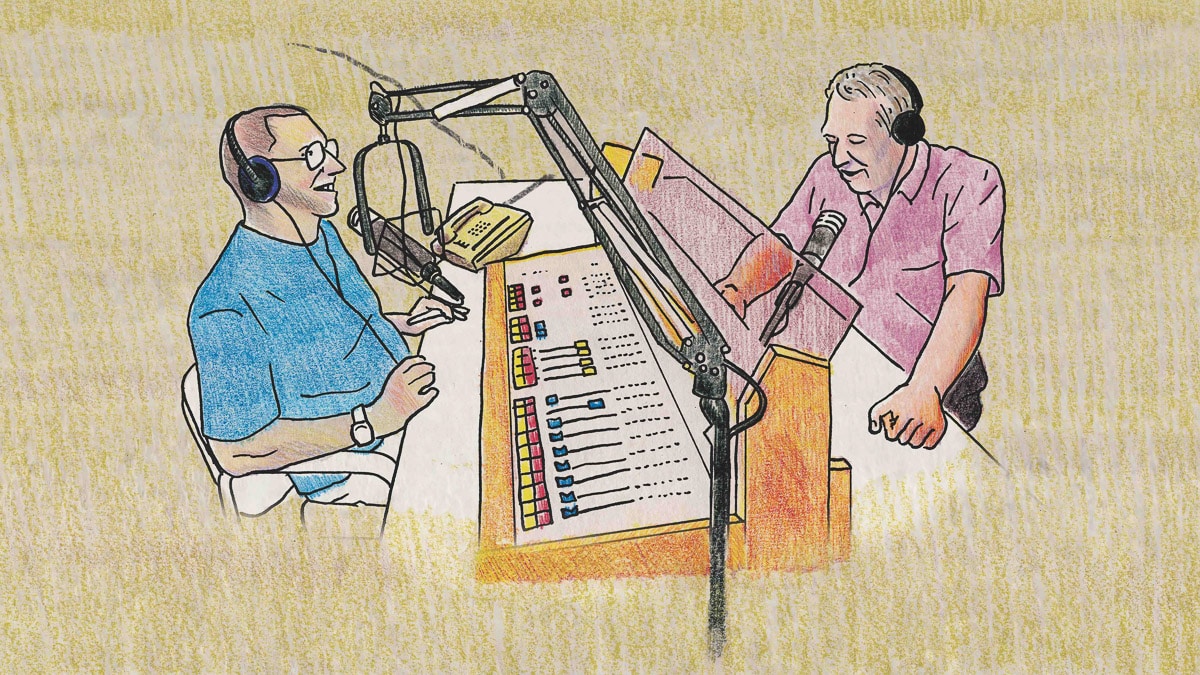
Marvin Granger intones at the beginning of his son’s delightful film about a call-in radio show, “We welcome your views and those of your neighbors on any subject that’s on your mind and can be discussed in public.” What an idea! How fresh and free-wheeling!
It feels so quaint and hopeful, this concept of expecting and encouraging people to come on the air and just talk about whatever — politics, even — and to do it with humor and civility. And for 10 years, from 1997 to 2007, that’s what happened on “Your Opinion, Please!” broadcast once a week to roughly the eastern half of Montana via KEMC-Yellowstone Public Radio on the campus of MSU-Billings.
Marshall Granger’s 14-minute film, selected for this year’s Montana Film Festival to air before David Lynch’s quietest feature, The Straight Story, is also called Your Opinion, Please (no exclamation point). And it has a simple concept. He took many hours recorded from that live program co-hosted by his father, then the general manager of YPR, and Ken Siebert, the current GM there, and cut up the best bits. Then he paired those bits with beautiful, honest images and sounds of central and eastern Montana. And, while simple, the overall effect is so thoughtful and moving. There’s an arc to it. There’s poetry.
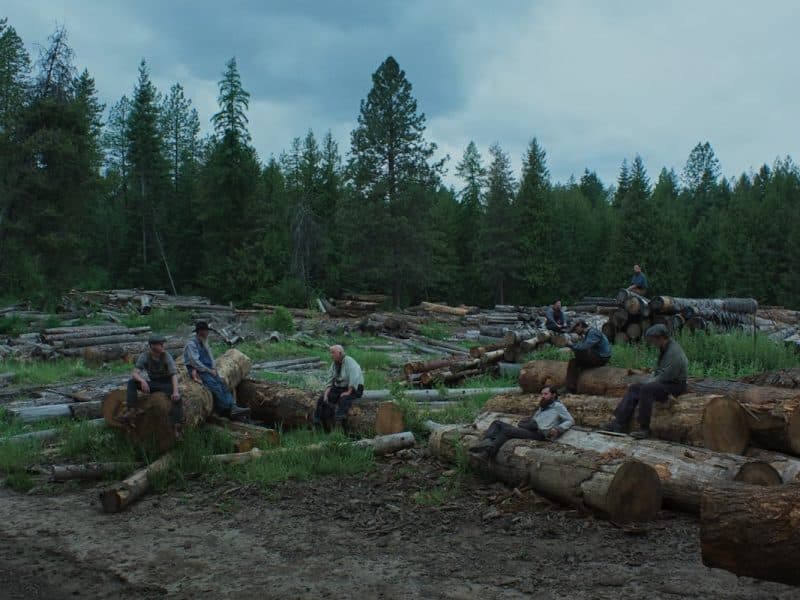
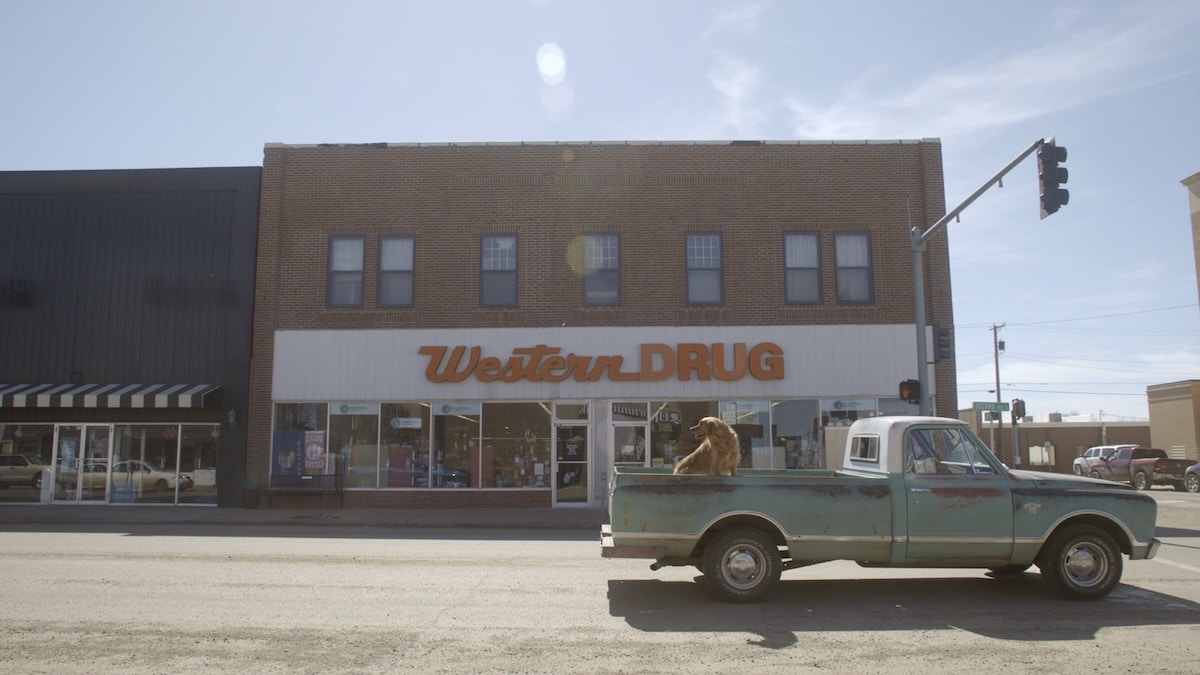
It’s also very Montana, the Montana of another era — Max Baucus makes an appearance as someone still in the Senate — while also showing us the Montana that hasn’t changed all that much, as long as we get over griping about the Yellowstoneification of our state and just look around. There’s a handsome dog in the back of a pickup rolling past a main-street Western Drug. There’s an old grain elevator giving way to a gurgling stream in the foreground, with familiar, snow-dusted hills in the back.
It’s also not *just* Montana in the way people are just people who want to say things and communicate with each other. Marvin Granger is the glue that holds it all together with his humor, engagement and fabulous timing. There’s a joke in there about Napoleon’s pants that comes at just the right moment — revealing Marshall Granger, who directed and edited the film, understands timing, too. Marshall’s brother, Lorin Granger, was also a big part of Your Opinion, Please. He shot it alongside Marshall over a few weeks in spring 2024 and is listed as director of photography. Filmmaker Alana Waksman, who also worked at the Roxy and is Marshall’s partner, is a co-producer on the film.

Your Opinion, Please debuted at 2024’s Big Sky Documentary Film Festival and has made the rounds at a few other fests. Recently, it was picked up by PBS to air as part of its POV series in November, a coveted slot for documentary filmmakers.
Pairing it with The Straight Story, about a man traveling on a tractor, strikes me as a brilliant move, with the two films evoking similar feelings of hope in humanity. Catch them on opening night of the fest at the Roxy Theater, Thursday, Oct. 23, at 7 p.m., and on the last day, Sunday, Oct. 26, at 2.
The Pulp had questions for Marshall Granger, 33, who grew up in Billings, graduated from the University of Montana, worked for years at the Roxy, moved to Los Angeles and has been involved in dozens of films along the way. This one’s special, though.
The Pulp: Where does this film fit in your body of work?
Marshall Granger: As a director, I’ve been making short films in one way or another basically since I was a teenager. I created a lot of work between my years as a film studies student at UM and my time working at the Roxy — all of which I would classify (like most young filmmakers) as trying to emulate the films I loved. I took a step away from trying to write or direct anything and really focused on editing. For me, Your Opinion, Please marks the first piece that is wholly and organically of my own style and voice and, by far, the thing I feel most proud of.
What was the day or the moment when you knew you’d make this film?
The idea for this came in fits and starts. When I lived in Missoula, I would go to Big Sky Doc Fest every year, see some inspiring, innovative short film and always leave with the same notion that I need to get out of my own way and just make something. I had made doc shorts in the past, mostly standard portrait-of-an-interesting-person kinds of films. But Big Sky has always inspired new approaches, partially because of their fantastic international programming. I remembered that I had this collection of recordings from my father’s show, and every year between probably 2018 and 2022, I thought more and more about how to make a film out of it. I think it ultimately took moving away from Montana and gaining that sense of nostalgia and longing around my home state to really drive me to make this.
What’s something specific you absolutely love about it, still?
The tone of this piece was something I really believed in for years and also was kind of the hardest to explain to anyone. I really wanted to avoid the impulse for conventional moves like interviewing the people involved. I wanted this film to be an experience of the show itself, to kind of overcome the viewer’s senses like a warm blanket. Listening to these shows always gave me a sense of comfort, but also a sense of loss for another time. So I guess I love that the film gives me that feeling, and from what I’ve gathered, others have processed it that way too.
“I wanted this film to be an experience of the show itself, to kind of overcome the viewer’s senses like a warm blanket.”
This radio show had so much trust that everyone involved would be civil. What’s your sense after listening to all the hours that didn’t show up in the film about how that was managed and encouraged?
It’s a huge, kind-of unbelievable trust in the listeners. There was someone picking up the phone and placing them on hold, but no one was actually screening any of these calls and there was no delay in the broadcast. Some people called with emotions running high about issues, or even frustration directed at NPR or the show itself. But Marvin and Ken were always there to listen. My dad’s particularly unique skill is his ability to really disarm with humor — crucially never at the listener’s expense. The atmosphere was always inviting. And I think it makes a huge difference to express an opinion and be met, not with an automatic counter argument, but with a follow-up question. What is it about this issue that makes you feel that way? Can you say a bit more about what you mean here?
What do you think an invitation to people to just generally talk about their opinions in Montana or elsewhere would yield now? Have we changed?
I wonder about this a lot. To a degree, I think this kind of program could exist because political division is so high and polls suggest that Americans are more concerned about that than the actual issues dividing us. So maybe there would be a welcome place for it.

But the reality is that our outlets for expressing opinions are largely social media platforms, which did not exist during this show. On “Your Opinion, Please!” you can pretty easily decipher who has been reading the fringe blogs of the early internet. There was a more stable sense of fact and reality — and I say that knowing we are talking about the era of Enron, 9/11 and weapons of mass destruction.
There’s a string of episodes where callers are talking about Michael Moore’s film Fahrenheit 9/11 — agreeing with it, disagreeing with it, or, because it’s Montana and pre-streaming, asking where the nearest town is they can go see it. I think about that a lot because, whether you aligned with it or not, that film was able to be a central talking point in America. Now, every individual is interfacing with their own custom pocket Michael Moore in the form of their algorithm. If no one is even referencing the same reality, what is the meaning of sharing opinions?
I also think about the nature of sharing opinions in the age of social media, which ends up looking like a bunch of op-ed pieces. You see a lot of very written, dramatic posts — almost like everyone is having their own isolated Aaron Sorkin/Mr. Smith Goes to Washington speech for their small bubble of followers. On this program, the magic came in how vulnerable people were, to call in and try to express your thoughts live for who knows how many people.
Did your dad see this film? What was his reaction?
My dad was able to come to Big Sky Doc Fest for the premiere and attended both screenings. We had shown it to him privately in Billings beforehand, and it was a unique, jarring experience of hearing his own voice from 20 years ago. But seeing it with an audience, hearing them laugh with him and then having people approach him after — that was really special.
This is of a place, for sure, but how do you see this as universal? As bigger than this one call-in show on YPR and these images of Montana?
Someone approached me after a screening in Colorado and expressed how much they appreciated the film’s portrayal of rural or middle America. How so much of the time people are painted in a patronizing light or a sort of cute, folksy way. I think these voices sound familiar to a lot of people in America, and that expands its relevance beyond just Montana.
At the Montana Film Fest, your short is paired with David Lynch’s The Straight Story” in 35MM. Do you have feelings about that?
It’s no exaggeration to say the pairing is one of the highest points of my creative life. I think The Straight Story is quietly one of the greatest things Lynch ever made. (And also, equal credit goes to his editor and then-spouse Mary Sweeney, who spearheaded the project.) It’s a film about meditation and mortality. Lynch is most celebrated for going from the white picket fence and into the mud of society, or following the picturesque waterfall down to the corpse at its shore. Here, he starts in the stars and gently descends into the quiet lives of the people who look up at them.
It’s all about the poetry of listening — to yourself, to the stranger next to you or simply to the landscape. If my film echoes even an ounce of that same spirit, I’m immensely proud.
At the Montana Film Festival, Your Opinion, Please will screen before The Straight Story at the Roxy Theater on Thursday, Oct. 23 at 7 p.m. and on Sunday, Oct. 26, at 2 p.m.