
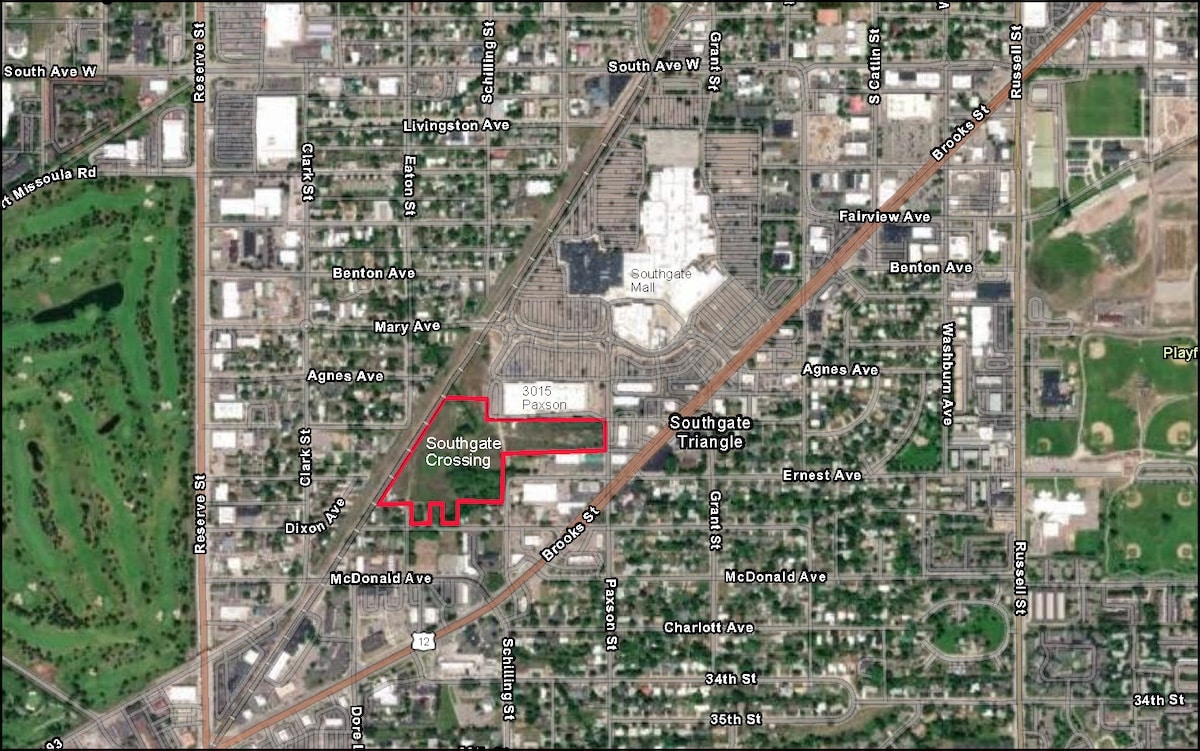
The city of Missoula and an Arizona-based homebuilder announced plans this week to transform the vacant, city-owned Southgate Crossing property in Midtown into a mixed-use residential development with “missing middle” housing and commercial space.
At full buildout, the project could bring more than two dozen homes and “a hell of a lot more” rental units to Missoula’s starved housing market, Chris Kemmerly, the CEO of developer Miramonte Homes, told the press at an event Wednesday. Beyond that, it demonstrates the city’s new approach to residential development: more private sector involvement and fewer prescriptions from city redevelopment or affordable housing officials.
In other words, while the city will be selling the Southgate land to Miramonte, it won’t be requiring, for example, a certain number of income-restricted units. And while the land falls in a redevelopment district, it’s not clear at this point whether the project will actually need or receive financial support from the Missoula Redevelopment Agency.
Kemmerly laid out an ambitious vision for the project: a central park with at least some degree of public access, connections to bike and pedestrian paths, a daycare center, and units that someone like his grandmother, a nurse, could afford. But Missoula will be employing neither carrot nor stick to manifest this vision in reality. Rather, Kemmerly says he’s bought into the vision for infill-style urban development that the city has laid out in its new land use plan and other documents.
“We hit everything that the city wanted, and it also coincides with what we want,” he said Wednesday. “You know, I’ve been at this 40 years, so I only do things that I enjoy doing. And this project for us checks all the boxes. It’s mixed use. I can hit the missing middle and maybe a little below the missing middle on the economic scale. We can do rentals, we can do housing, and we can do commercial. And at this stage of my career, that’s what gives me juice.”
Before we unpack that, let’s talk a little about how we got here.
The Southgate land, like seemingly every other piece of redevelopable land in the city, was once the site of a lumber mill. Located southwest of the Bob Ward’s store at the mall, it has sat vacant for decades despite being identified by the city as a prime redevelopment opportunity. Then, in the winter of 2024, the city purchased the 13-acre site for $5.8 million, giving city officials the ability to revive it.
“The intention from the beginning when we acquired this property was not that we sit on it,” Missoula Mayor Andrea Davis said Wednesday. “The whole idea was that we get this moving into the private sector, and eventually, folks will live, folks will play and folks will do business on this site.”
“The whole idea was that we get this moving into the private sector, and eventually, folks will live, folks will play and folks will do business on this site.”
Miramonte was one of several developers the city considered partnering with. It won out, Davis said, because of the company’s belief in the city’s development goals. — more housing and more types of it, more infill, more connectivity, more park space, and greater equity. The firm also isn’t unknown to Missoula: Miramonte developed the Amazon facility at the Wye (and another in Billings), the Missoula Loft Apartments on West Broadway, and has other local projects in the works. Kemmerly, a Midwesterner with an Arizona company, lives in Missoula, he said.
The two parties still need to swap some ink before the project can begin to take shape — namely, the city council must approve the sale of the land. Providing that happens, Kemmerly said, work can begin on the development next spring.
Sites for the more than two dozen detached single-family homes are already platted, he said, and construction on those units can begin first. But as many as 200 units could be included in the project overall, counting rentals. Miramonte will also offer some of the houses on spec, and would-be buyers could choose to add an accessory dwelling unit to their lots — another point of alignment with the city’s growth goals.
The development is also to feature a 1.5-acre park at the center of the property, which Kemmerly said would evoke towns built before the arrival of the automobile that revolved around a central park and courthouse. The city has referred to the park as a “public” park, and indeed, the city parks department says it will conduct a public engagement process to gather input on the park’s design. But it’s not actually clear if the city will own the parkland. Kemmerly said one possibility is that it will be managed by a homeowners association.

As described, the project hits a variety of city goals. In addition to the parkspace and trail connectivity, the city has high hopes for a broader redevelopment of Midtown, anchored around a mall that, despite national trends, seems to be fairly healthy. On the other side of the mall, the city is looking to develop the North MRL Triangle. First Security Bank is building a new midtown office.
“What we’ve been lacking is the housing density around [the mall] for a complete transformation as a lifestyle center,” said Melanie Brock, the director of the Missoula Midtown Association. “And to do that, having projects like this at Southgate Crossing is the final puzzle piece.”
We will get more information as the city solicits public feedback and reaches a sale and development agreement with Miramonte. But perhaps the most important question remains the trickiest to answer: How much will it actually cost to live there?
The median home sale price in Missoula is around $570,000, according to the Missoula Organization of Realtors. Most new builds aren’t selling for less than $600,000, Kemmerly said, and the goal is to offer single-family homes for “well under” that price.. The range of possible rents at the property isn’t clear, but, as the Missoulian pointed out, one-bedrooms at the company’s Missoula Lofts Apartments rent for $1,600 a month.
“I’m not doing this if I can’t make money, or I’m not gonna be in business.”
Kemmerly said the best Miramonte can do to fulfill his vision of housing the nurse looking for an affordable, comfortable place to live is to design the project with that would-be buyer in mind. (For what it’s worth: In 2022, when the state published a report on the local nursing workforce, median nurse pay in Montana was about $72,000. That salary would allow a nurse to afford a $1,600 rental without being considered rent-burdened, at least according to federal definitions, but be stretched quite thin between the down payment and mortgage on a $550,000-$600,000 home.)
“You know, I have no control on the world or the financial markets in New York,” Kemmerly said. “I don’t control interest rates. We will never see 2.5 percent [interest rates] again, but, you know, we might see 7. So it just kind of depends.”
There are a variety of local and federal tax credits and subsidies available for the development of affordable or workforce housing. Those aren’t being employed here, and that’s not an accident. Earlier this summer, the city released recommendations from a task force the mayor assembled to help decide how the city should dispose of its 45 acres of redevelopable land. The thrust: The city will focus more on getting land sold and developed and less on whether the proposed project fits each of the city’s goals for affordability, sustainability and so on. The city is still engaged in developing some affordable and workforce housing — just this month, we wrote about one such development in the Riverfront neighborhood — but will be seeking to incentivize private developers by not, as a rule, requiring them to contribute a certain number of affordable units or develop public infrastructure if they want to purchase and build on city land.
“I’m not doing this if I can’t make money, or I’m not gonna be in business,” Kemmerly said.
The city’s housing needs run the price spectrum, said Davis, who prior to becoming mayor was director of a housing non-profit that used public dollars to develop and improve affordable housing around the state. While the city will still use its affordable housing tools to add to the stock of income-restricted housing, she said, it’s also looking to add more housing at any price point, even if the price the market demands is rather lofty.
“We’ve recognized that the more parameters we put around something, often we can’t achieve that goal with the private sector developer,” she said.


