In the landscape of American letters, Walter Kirn is a genre-hopper with a scalpel: novelist, memoirist, cultural critic, podcast host, and literary insider with an outsider’s edge. His work has appeared in The Atlantic, Harper’s, The New York Times Magazine, and Time, and his curious, contrarian and often darkly funny voice has been a fixture in the upper tiers of the writing world for decades.
His 2013 memoir, “Blood Will Out,” is a twisty account of Kirn being duped by a man posing as a Rockefeller heir, who turns out to be a con-artist and murderer. It was praised for its psychological insight and willingness to turn the lens inward, even when it made him look gullible. And it’s a book that offers a glimpse of the observant and unsparing writer he is — one who is drawn to the stranger corners of American identity. (Also: In a fittingly eccentric twist, The New York Times not only reviewed the book but let Kirn interview himself about it in a third-person article titled “Alter-ego rattles author’s ego.”)
Kirn, who is based in Livingston and has lived in Montana for 30-plus years, is one of the founding editors of County Highway, a bimonthly, print-only broadsheet newspaper that aims to tell the kinds of quirky, ultra-local stories that are sprawling in form and rarely show up in coastal media. The pub, which debuted in July 2023, is a collaboration with Tablet editor David Samuels. It’s a throwback and provocation, and it’s wholly uninterested in chasing digital traffic. As Kirn told Montana Free Press just after County Highway’s launch, it was created to invert the classic New Yorker map: not to flatten the middle of the country, but to center it.
“There’s a great sense of loss in America,” he told MTFP. “Loss of tradition, loss of cohesion, loss of neighborly knowledge, loss of local knowledge, loss of vocational knowledge. There’s an inescapable theme of technology overrunning people’s lives, hollowing out a lot of the country that used to be a little bit more intact.”
County Highway is an analog escapade — a newsprint road trip through overlooked parts of America.
The result is an analog escapade — a newsprint road trip through overlooked parts of America. Its 20-some pages feature a mix of reportage, essays, editorials, interviews, and cultural oddities. One issue might pair a wheat crop report from Oklahoma with a meditation on the legacy of Buddy Guy and the future of the blues. Another might jump from an exposé on the gentrification of the California desert to a dispatch from the Miracle of America Museum in Polson. Some stories are tongue-in-cheek, such as a classifieds section with only some real listings, or a roundup of the worst summer fairs in all 50 states (including Kansas’s Carrie Nation Temperance Festival, where attendees hack open barrels of whiskey with axes before drenching themselves in ice water). Others are more sobering: a critique of Big Tech’s existential creep, or a warning about the dangers of artificial intelligence.
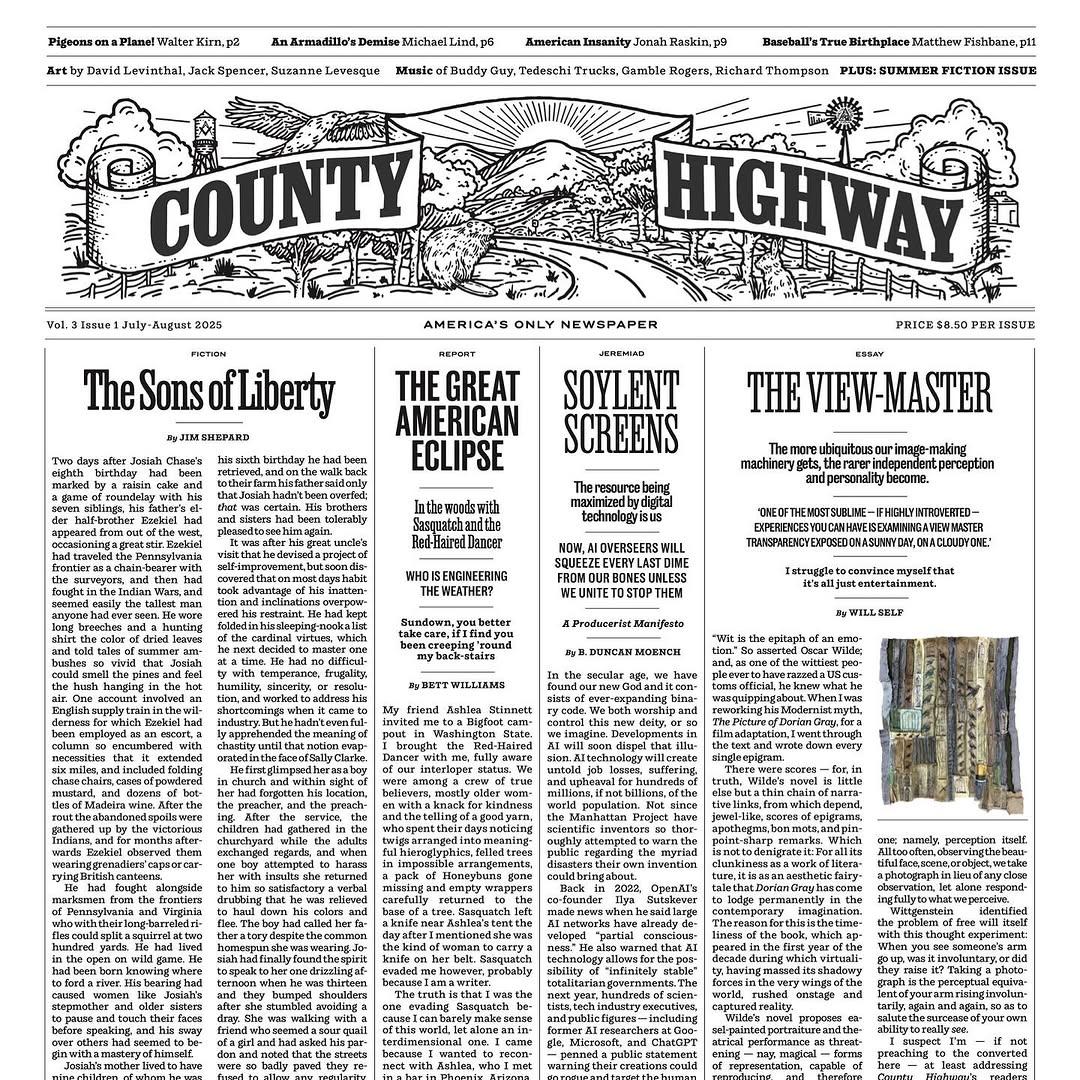
But the throughline is pretty clear: County Highway aims to spotlight small-town and rural America without fetishizing or simplifying it. The voices are diverse, the opinions uncensored, and the tone veers from elegiac to mischievous, sometimes on the same page. There’s humor, melancholy, and a clear-eyed sense of cultural drift, all held together by the idea that where there’s a stop sign, there’s a story.
This Saturday at Shakespeare & Co., Kirn will be joined by fellow County Highway contributor Amanda Fortini, who has frequently written for The New York Times Style Magazine, and has been published in The New Yorker, The Believer, California Sunday, and The Paris Review, among other publications. She writes the paper’s natural remedies column, whose titles include “Elm for Overwhelm” and “Sick of it All.” (Kirn and Fortini are also married, btw.)
They’ll bring County Highway to life in a reading and conversation talking about the joys of slowness, the value of local knowledge, and what’s left to say about America when you leave the algorithms behind. For readers not used to it, the dense blocks of small-type print may initially feel like a challenge. But that friction is the point. The paper isn’t designed to inform you faster, it’s designed to make you linger for longer — to wake up slowly over a cup of coffee and indulge in what it feels like to read for depth rather than reaction.
As Kirn told Montana Free Press, “There’s no algorithm in County Highway. It rewards a solitary experience.” That unmediated experience may be exactly what the American reader didn’t know they were missing.
Walter Kirn and Amanda Fortini will give readings and discuss the founding and future of the newspaper County Highway on Sat., Aug. 9, from 7 to 8 p.m. at Shakespeare & Co.