In a spread-out state like Montana, where drive times are long, some of the best ideas are born on the road. That’s what happened in 2020, when Colter Olmstead and Shadow Devereaux were commuting between Missoula and the Flathead Reservation to do film work for the Confederated Salish and Kootenai Tribes. A Helena native, Olmstead had spent years filming low-budget music videos for artists in Montana’s relatively unknown hip-hop scene. Devereaux, a hip-hop artist under the name Foreshadow, had grown up on the Flathead Reservation, nurturing the dream of making a living off his music.
The friends were frustrated by the way hip-hop felt stagnated in Montana. Hip-hop artists were scattered around the state, but they didn’t have much of a platform to showcase their music. They certainly didn’t have national recognition. To many who associate the state with folk and country, Montana hip hop sounded oxymoronic. When the pandemic dried up the limited chances to perform, it seemed the only opportunities to make a name in hip hop were elsewhere, out of state.
“A lot of us have gotten to the same spot where we’ve done all we could here in Montana,” Devereaux said. “There’s no big labels here that you could get a deal to, there’s no distribution companies you could sign to. It felt like we hit the ceiling and this is where we’re staying.”
Olmstead and Devereaux got to thinking. Each of them knew talented hip-hop artists from around the state who were committed to the craft despite the lack of publicity, audience or opportunity. What if, the friends wondered, they invited all of them to spend 10 days creating a collaborative album, the first recording to represent Montana hip hop?
“I remember initially thinking, ‘We’re gonna need a lot of money,’” Devereaux said. “It’s gonna take a lot of planning, and it’s gonna be a while out.”
But the idea lingered. Their work in film and music was increasingly centered around building community. If they could get everyone together, they thought, to pool their creativity, experience and resources, they might accelerate the opportunities available to Montana hip-hop artists.
Then, in January 2023, Olmstead woke up with a resolution. “I literally called Shadow at seven in the morning and said, ‘Whatever we do this year, we’re gonna make this happen.”
Olmstead found an Airbnb on Flathead Lake large enough to host a big group. He and Devereaux compiled a list of artists. They booked the dates. They made a massive Costco run. Olmstead fronted the costs himself. “I have to give it to Colter,” Devereaux said. “He made some pretty big power plays as far as the passion part of the project goes.”
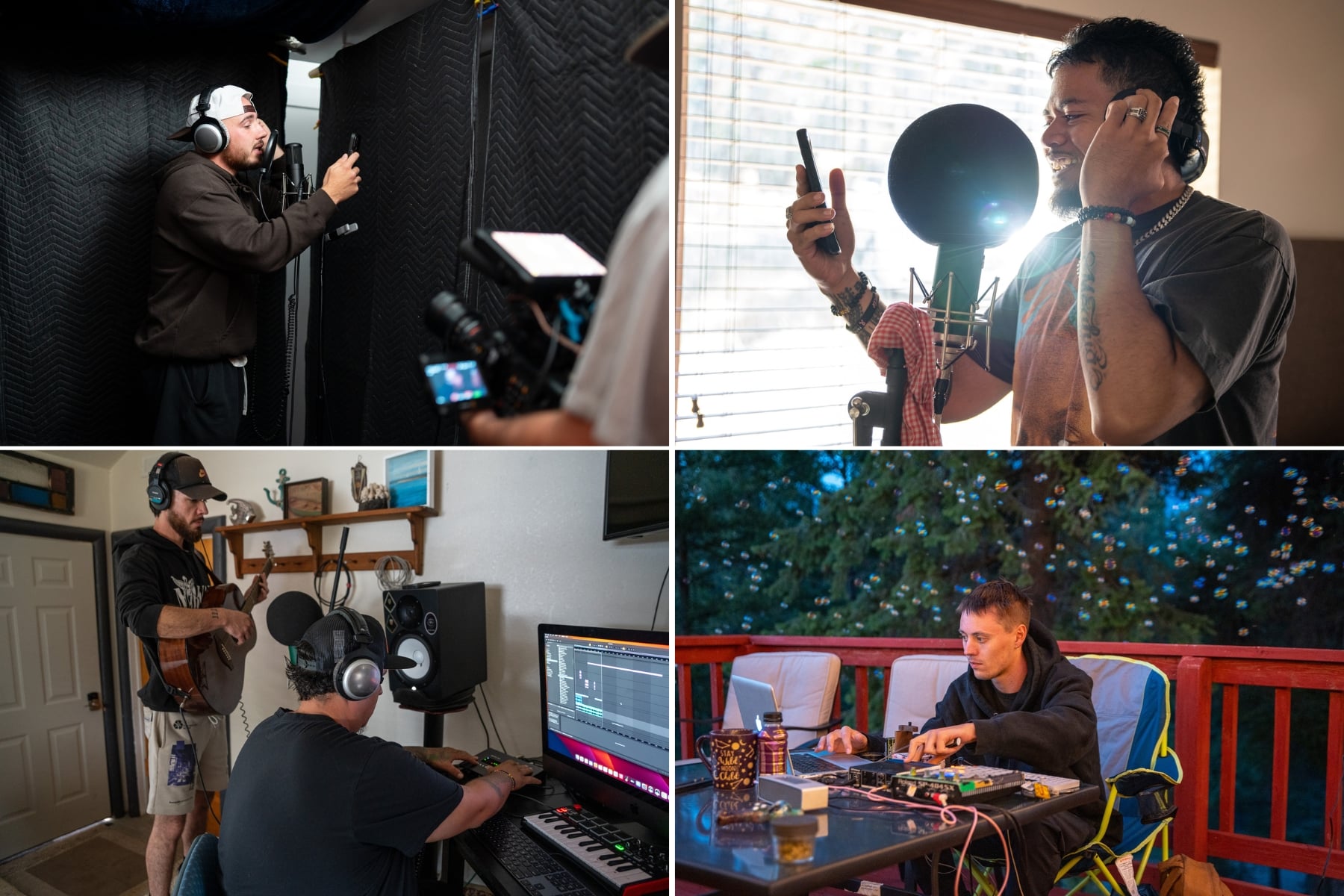
Aside from the logistics of lodging and feeding 23 artists for almost two weeks, one of the biggest foreseeable challenges was the “me mentality” of hip hop. “How are we going to get all these egotistical hip-hop guys together and tell them to leave their ego at the door and let’s make some music?” Devereaux said.
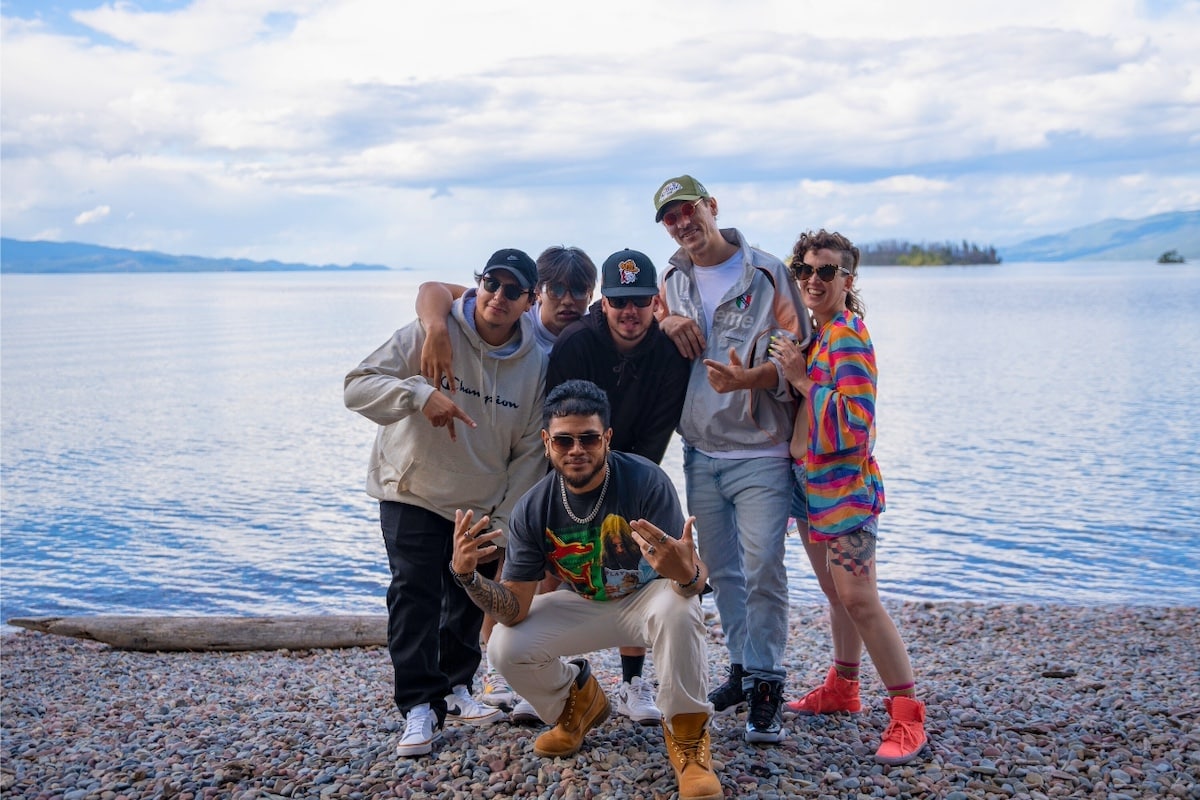
As it turns out, they needn’t have worried. Artists came from around Western Montana, many from Montana’s reservations where hip hop has flourished. When they arrived at the Flathead Lake house last summer for 10 days of collaborative creation, most didn’t even take time to settle in.
“People showed up and didn’t even put their stuff in the sleeping area,” Olmstead said. “They set it down and went to work. In the first two hours we had three songs started. After that first 48 hours, I thought, we could honestly have enough right now for an album. From then on everything was a cherry on top.”
Olmstead and Devereaux had brought enough equipment for five recording spaces, where producers tinkered with beats. “We just had piles of notebooks and pens,” Olmstead said. “Artists would come up and hear a beat and start writing to it.”
“It was just like a rap camp, man,” Devereaux said. “It was really cool.”

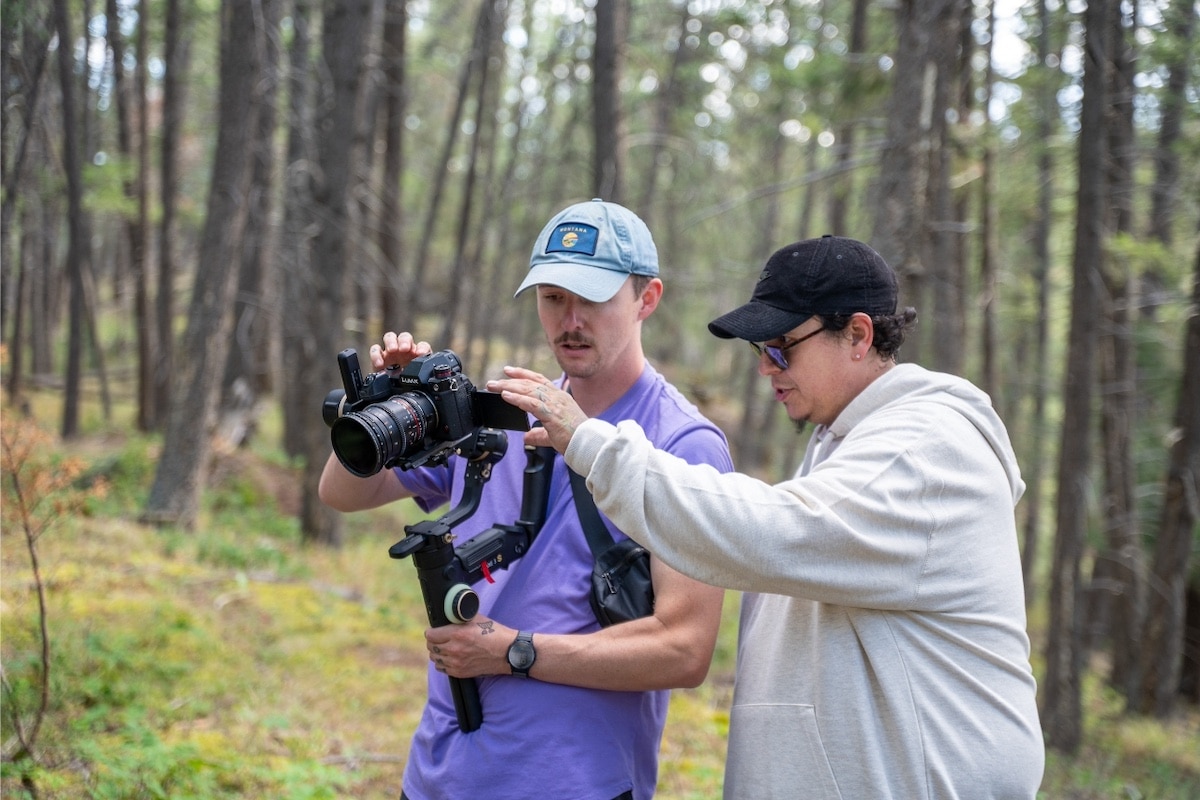
Meanwhile, Olmstead was capturing footage of the experience to turn into a feature-length documentary. The scenic location and diverse cast of characters coming together for a common goal struck Olmstead as a worthy narrative, to say nothing of the soundtrack. “I thought that story really was going to tell itself through the music,” Olmstead said. “I believe in these artists and the message they’re bringing to the music.”
Olmstead came up with Last of the Nobodies as a title for the album and documentary, a nod to Montana’s claim as the Last Best Place.
“I did some work in California and Arizona,” Olmstead said. “I told the artists I was working with there that I do hip-hop music videos in Montana. They’d say, ‘That’s the last place I’d think hip hop would be.’”
Olmstead and Devereaux knew firsthand the depth of talent in Montana’s hip-hop community. Artists here don’t have opportunities to open for big-name acts, because big rappers rarely tour in Montana. So the Last of the Nobodies project became a Montana-style workaround: When no opportunities exist, create your own. And if monetary gains are scarce, then why not invest in the unquantifiable benefits of a creative, collaborative hip-hop community?
Ultimately, it all went better than Olmstead or Devereaux could’ve imagined. “In the 10 days we made over 60 songs,” Olmstead said. “There were so many different areas to create, and also places to go walk by the lake or get away. Things were constantly getting created every day.”
The project left Devereaux with a feeling of creative kinship that’s hard to come by for a hip-hop artist in Montana. “The energy in the room when those songs were made was so electric,” he said. “I don’t know if I’ll ever be able to capture that feeling again. Sometimes those are once in a lifetime. We’re all in there just smiling and dapping each other up, singing each other’s verses. This is hip hop right here. This is why we do it.”
The music aside, just living together—cooking and cleaning—made for moments of bonding. “We kinda all just turned into roommates,” Olmstead said. While the group went through more food than anyone could have imagined, shared meals were a highlight. One night, Devereaux enlisted some help and made Indian tacos for everyone.

“We’re in the kitchen listening to some ’90s pop song, making fry bread,” he said. “That’s always gonna stay with me.”
Some artists, used to working alone, took time to warm up to the collaborative process. Two of the rappers were just 16 years old, and others were shy by nature.
“It was kinda out of my comfort zone,” said Missoula-based artist Zak James. “I’m not used to having a creative place to go in Montana. I got to pull some people into my world to make some funky pop songs. We got some hard dudes, and we were getting all boy bandy and breaking down some crazy hits.”
Kalispell-based Josh Edwards, who raps under the name Eddwords, remembered James coming through with a song (“Damn Thang”) at a key moment in the project.
“It was the fifth day, a rainy day,” Edwards said. “The energy was just lower. You’re five days in, you’ve been making music for 12 hours a day, every day. A lot of artists are just floating around. Later in the evening, James comes into the room. He’d been real quiet this whole time, and this dude just comes out of the corner and has one of the most energetic, fun songs of the whole album.”
In the months that followed those days on Flathead Lake, Olmstead, Edwards and Devereaux pared down the songs to 17 that felt complete and cohesive enough to stand together on an album. After months of mixing and mastering, the album, Last of the Nobodies, Vol. 1, drops today on all streaming services.
“It hits the head on the nail of the Montana experience,” Edwards said. “I know Montanans will relate. It has a lot of twang in it. We do have a country root here. We do have a blue-collar root here, too, and you can hear it in the music, that hustle-hard mentality.”
The album begins and ends with cerebral, spare storytelling of Farch (Jesse Frohreich), who manages to weave the environment, the economy, politics and pop culture into a few Montana-centric verses.
“I’m from where the air quality low and the property values are too high,” he raps, “past-their-prime pop stars move here to live poolside, exploit the joint but never give back two dimes.” Even political dark money and Greg Gianforte body-slamming a reporter get a mention.
Every artist has a time to shine on the album, whether it’s Elair’s saxophone-smooth voice in “406,” or the dizzying Lauryn Hill flow of Soul Anatomy, one of the project’s few female artists, in “Heavy.” “When the Night Falls,” a lush track featuring Dust2Dust and 16-year-old Lil Kimchi, begins like a Sandra Boynton book (“I like short bitches. Give me some more bitches”), before it takes a turn for the earnest and introspective: “These days I need natural healing, these days I need something to feel.”
There’s plenty of striving in these tracks, plenty of the underdog’s comeuppance, and the indignation of the overlooked. In “MPR,” Foreshadow says he’s coming for his “money, power and our respect” before he shouts out his family in a breathless verse: “Grandma told me, ‘Boy, don’t forget where you came from.’” One of the most carefree tracks on the album is “Damn Thang,” the poppy, funky track featuring Zak James that delivers party-vibe verses over a Sugar Ray-style electric guitar groove.
In the music video to “Breaking Out,” one of the first singles released, a group of artists hang out of a GMC Denali while Eddwords and Foreshadow rap verses about metamorphosis, self-creation and focusing on the future while not forgetting your past.
Close listeners will find some Montana in these songs — references to wood stoves, 4x4s, even the Mission Mountains — but not too much. Montana hip hop is shaped by diverse regional inspirations that include Midwest rappers like Tech N9ne, Ludacris and Lil Wayne from the South, and Pacific Northwest artists like Macklemore.
“Montana is a melting pot of all of these outside influences,” Devereaux said. “That’s what Montana sounds like to me.”
The Last of the Nobodies project is already creating new opportunities. Olmstead won a grant from the Montana Film Office’s Big Sky Film Grant program to fund post-production of the documentary, which he hopes to release later this year. The artists will perform a free show at The Top Hat on Sept. 13, showcasing an album that takes ownership of an outsider status, turning a pejorative into a point of pride. Because if there’s any unifying characteristic to Montana hip hop it’s that none of it has come easy. By necessity, creating hip hop here is the product of devotion, of $60 microphones and Garage Band beats, banking hours crafting rhymes after work, after school, because you can’t not. Adversity weeds out all but the most passionate.
“The people are so gritty,” Edwards said. “We’re told, ‘No,’ so goddamn much, it makes you that way if you are here. I’m proud of that. I love standing next to those guys who have got their asses kicked to get here. I’m honored to be on the same stage. The sound is grit. The sound is hard work. People will see it.”
Last of the Nobodies album release show takes place at The Top Hat Fri., September 13, at 10:15 PM. Free. 21+