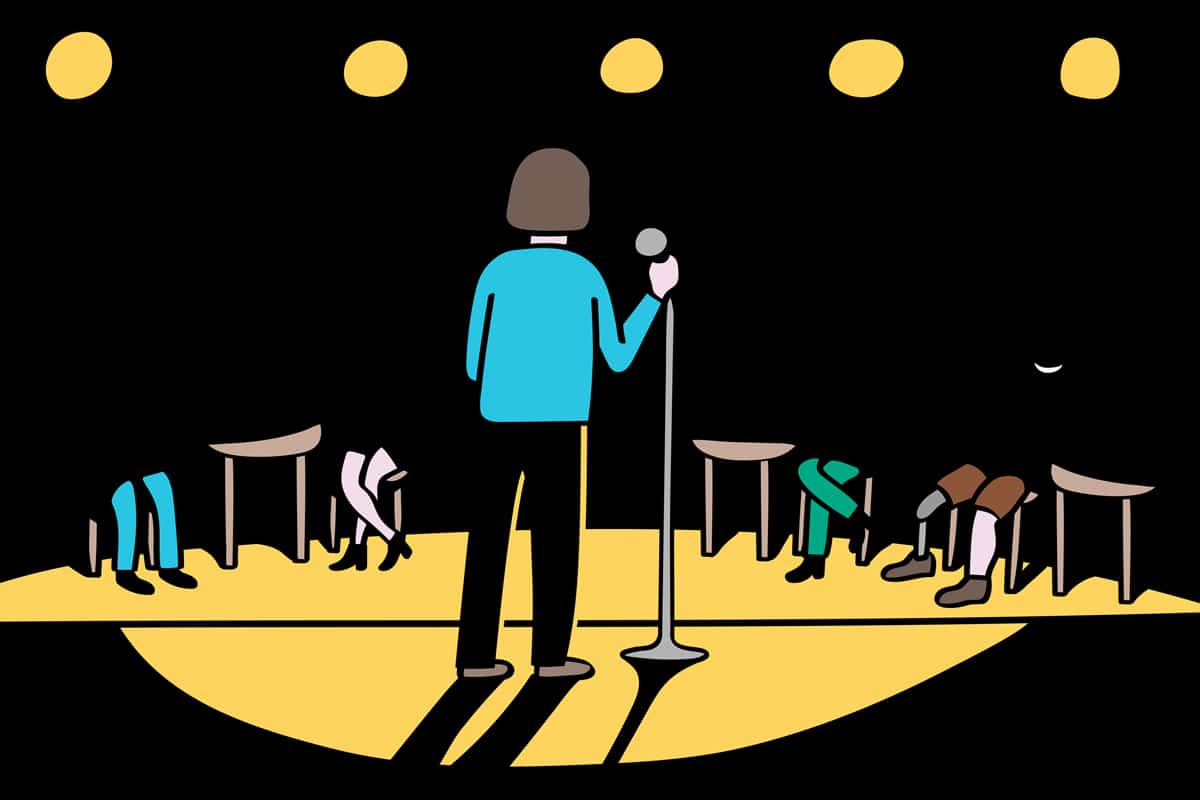
When I first started performing stand-up comedy in 2015, I had one of those learning moments — also known as bombing — at the Union Club. I’d written what I thought was a hilarious punchline about a man with a peg leg. But while on stage, right in the middle of the bit, I looked down at the audience and saw a man with a prosthetic leg sitting in the front row.
I stopped the joke right in the middle without explanation. Honestly, I had not considered that a person like the imaginary one in my joke would be in the audience, and the realization that I would get a laugh at a real person’s expense hit me hard. I had time to stop the joke, but not time to save my bit, and it did not go well. Without a punchline, the potential for laughter was replaced by blank stares and confusion.
Particularly at the Union Club, when you lose your audience, even for a single joke, they will inevitably restart their conversations, loudly, lost to you forever. They might even start a game of pool or slide a fiver into a Keno machine. But like all big bombs, there was a lesson embedded in the rubble: My one job as a comedian is to make my audience laugh — that is the singular point of the art form. And I can’t do my only job well while alienating individuals in the room.
Fast forward 10 years to this October and the first-ever Helena Comedy Festival. It featured a diverse lineup of 50 mid-level comics from around the country, including me, performing dozens of shows scattered around the city over four days.
Just a few minutes into the first show I attended, I was surprised to hear one of the comics casually drop the R-word (a slur for disabled people, if you need an extra hint). And then a few comics later, I heard it again.
To paint the full picture, we were in a brewery that serves dinner, surrounded by families eating burgers. And the audience was not pleased with what they were hearing. The laughter died down and was replaced with an uncomfortable silence that, as all comics know, is very difficult to recover from. Any trust or connection that the comics had built with the audience was broken. But in the back, a few of the other festival comedians laughed at the jokes.
The question, to me, is: Does the R-word make stand-up comedy better? I think the answer lies in the Missoula comedy scene.
There’s been a lot written about the R-word reentering the lexicon in recent years — even the president of the United States casually used it as an insult last month — and I don’t want to cover that ground again. The trend, many believe, goes hand-in-hand with the current MAGA movement’s goal to quash DEI initiatives and make marginalized people feel marginalized again. People hear everyone from Donald Trump to Elon Musk to their favorite podcaster letting the disability slur roll off their tongue, and it emboldens people and normalizes the behavior. There’s almost a ’90s nostalgia about it: Remember when we could call different kids on the bus r*tard or f*ggot and it was fine?
There’s also been a lot written about the R-word in comedy and whether it is “right” or “wrong” to say it on stage and whether the comedians who say it should be “canceled.”
Some, like stand-up Joe Rogan, are celebrating the return.
“The word ‘retarded’ is back, and it’s one of the great cultural victories that I think is spurred on, probably, by podcasts,” he said earlier this year on his podcast.
And Tony Hinchcliffe’s show “Kill Tony,” which now has episodes on Netflix, is unapologetically peppered with the R-word, alongside other punching-down insults toward basically any marginalized group you can think of.
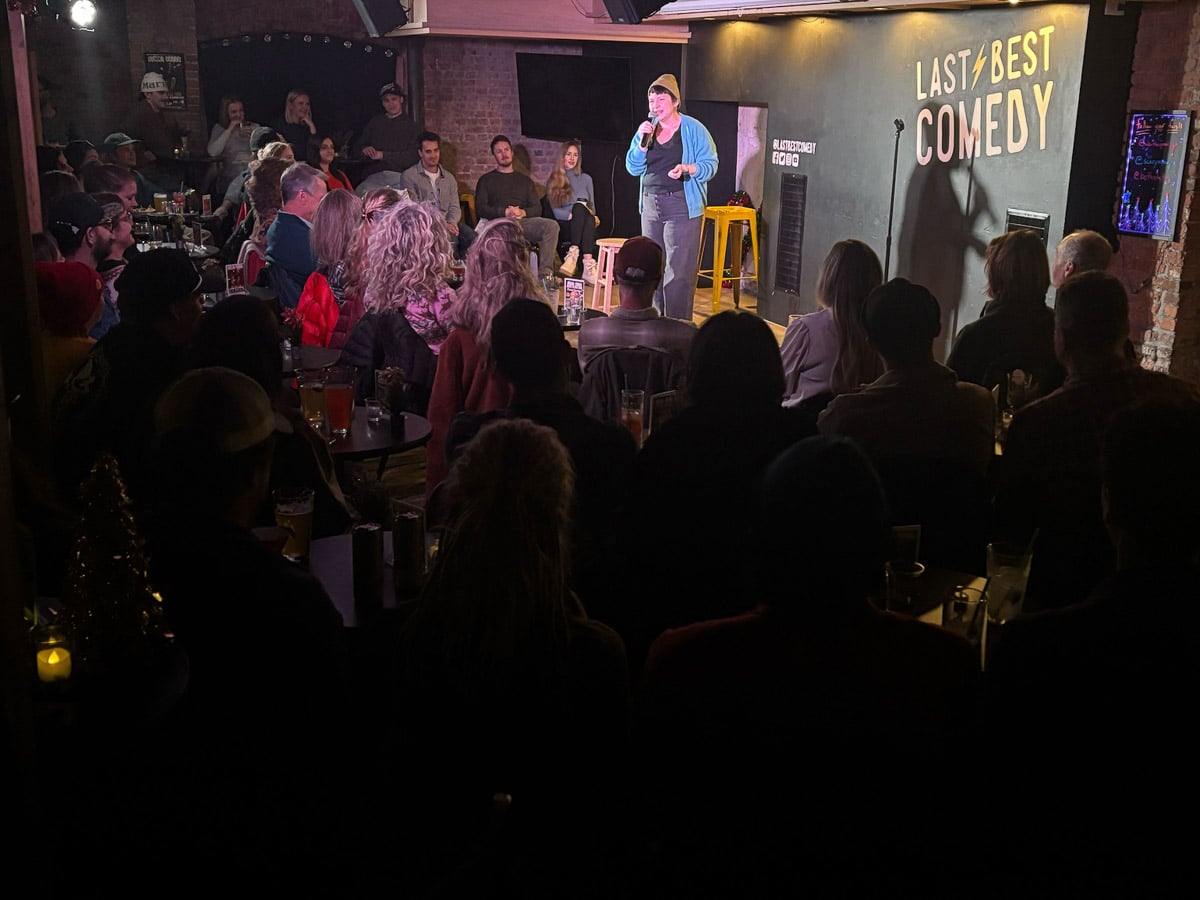
Both Rogan and Hinchcliffe celebrate the word as a symbol of free speech in comedy — latching onto the sense that comedians are the last line of defense in speaking truth and that silencing comedians in any way is a canary in the coalmine of our rights as Americans. At the same time, they insist it’s not that offensive, which raises an obvious question: Can something really be daring and edgy if it’s also totally normal and acceptable?
I’m less interested in whether it should be “allowed” on stage (whatever that means) and more interested in whether it should be used on stage. The question, to me, is: Does the R-word make stand-up comedy better?
I think the answer lies in the Missoula comedy scene — a place where, until very recently, I had never heard the R-word on stage.
Why don’t we hear it here often? The answer comes with a dose of Missoula comedy history.
When the current comedy scene began in Missoula around 15 years ago, it was spearheaded by John Howard, who started the Union Club open mic, along with Michael Beers, whose interest in comedy started at Hellgate High School.
Howard, who will unapologetically tell large stand-up audiences about his lazy eye and severe dyslexia, is the long-time coordinator of BASE, an affiliate of Summit Independent Living Center that offers all-abilities activities and social events to people of all ages in Missoula. Beers, who was also a Summit employee until he moved away last year, is a disability activist who performs nationally as part of the group Comedians With Disabilities Act.
Howard’s and Beers’ activism naturally influenced Missoula’s comedy space. People took comedy and improv classes at BASE and then showed up at Union open mics and other events, both as performers and fans. And comedians, led by Beers, were doing innovative and very funny bits about living with disabilities that educated audiences and increased awareness.
At the same time, Howard, who ran many of the shows at the time, was excellent at calling out comics who said hateful or ignorant things on stage. He wouldn’t pull the plug on them, but he’d insult them between acts or encourage the audience to speak up about what they didn’t like. You could say anything you wanted on stage, but there were pretty immediate consequences.
Beers now lives in Oklahoma City, but I called him up to ask him his thoughts about comedy and the R-word.
“It is not funny, it is not edgy, and it certainly does nothing to honor the stage they are on or the comedic ancestors that built those stages for us — names like Pryor, Carlin, Rivers and Williams,” he said. “Maya Angelou said, ‘We do the best we can until we know better and then it is upon us to do better in this spirit.’ I’d like to believe that a lot of comics using the R-word now just don’t know any better or at the very least don’t know the impact that it has on the audience. I have to believe for my own heart that most comics would take this new information and choose to do better.”
Beers hits on an important point here: People are going to make mistakes. Comics are not going to be perfect on stage all the time. We learn through bombing. We all have our peg leg joke moments. I still have them 10 years down the road. Especially during open mics, which are times of experimentation and improvisation, things can go terribly wrong even for seasoned comics with good intentions. Things can just come out wrong, or you can not have a full understanding of a topic or issue.
You could write jokes for the rest of your life without ever using a slur that doesn’t belong to you, and have an amazing career, and many, many people do.
I do believe, though, that if you put craft and the audience first, you simply don’t have to deal with questions like, “Is the R-word OK to use on stage?” Like any other slur that I can think of, the word will immediately alienate a significant portion of my audience, starting with the estimated 16 percent of people living with significant disabilities and including the loved ones of those people. Not to mention people from other marginalized groups who recognize bullying and othering when they see it.
Here’s how I think about it as a comic: There are an infinite number of jokes in the universe. There are a thousand-thousand million-million jokes floating around waiting to be written, and a lot of them are very funny. There is zero reason that you need to write a joke with the R-word in it. There’s zero reason to punch down at all. You could write jokes for the rest of your life without ever using a slur that doesn’t belong to you, and have an amazing career, and many, many people do, including basically all of the most successful ones. So why would you choose to write and perform a joke with a word in it that makes millions of people feel horrible?
The answer in many cases is just that newer comics use it because it’s an easy way to seem edgy without writing punchlines. It’s one of the only ways that they know how to make an audience laugh. But that kind of laughter is…. It’s also a good excuse — when an audience doesn’t laugh — to explain why they didn’t like the performance: They didn’t understand my art.
Freya Holland, another comedian and disability activist on the Missoula scene, also associates the word with comics who don’t know how else to get a reaction from the crowd or do actual edgy comedy.
“Comedy is about shaping your thoughts and beliefs into a cohesive joke,” Holland said. “It can be a statement about free speech, but you actually have to be saying something. Calling someone the R-word and then proceeding to tell a story about jerking off for 20 minutes doesn’t make you [Lenny] Bruce or [George] Carlin.”
And while shock comedy absolutely has a place on stage and can be used in amazing ways, just saying a slur and waiting for a reaction is not one of them. It takes no talent — literally anyone on earth could do it, and increasingly at open mics and small shows, they do.
Back in Helena, after one of the comics said the R-word on stage, I chatted with him at the bar. I didn’t chide him for what he said, but I did ask him about his word choice.
“Comics can say whatever they want,” he told me.
And it’s true. Comics can say whatever they want. And in the same way, I guess painters can paint whatever they want and sculptors can sculpt whatever they want and musicians can make whatever music they want. But if they don’t make good art that other people value, it usually doesn’t get displayed in a gallery or played at the radio station.
Comics can say whatever they want — but audiences can reject it. And I hope that Missoula audiences continue to reject comedy that demeans. We’ve escaped the R-word trend so far by virtue of our uniquely inclusive scene, and we can continue to rise above it by focusing on craft.
Stand-ups have freedom of speech and a wide open stage. We might as well write some real punchlines and do our only job: Making everybody laugh. Even the guy with the peg leg in the front row.