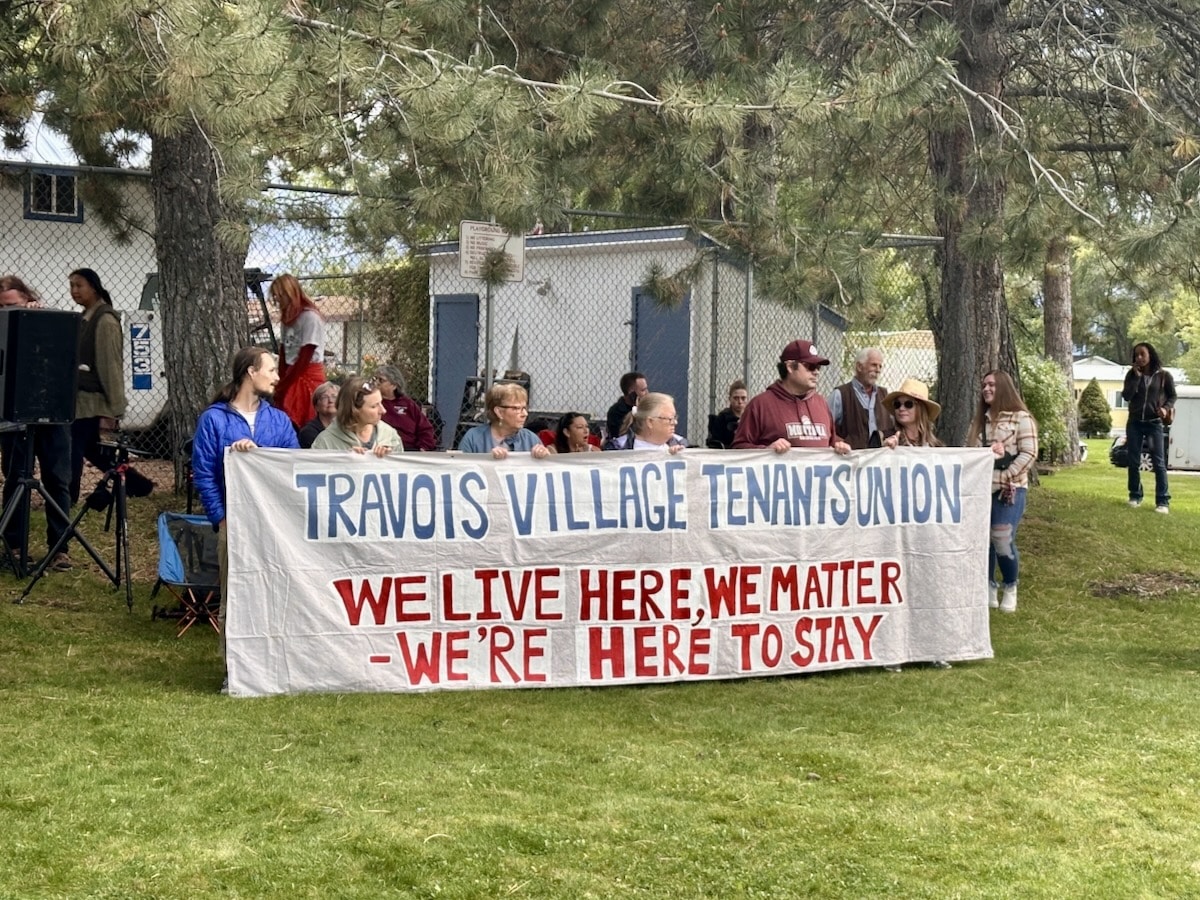
Almost 200 people living in a Westside trailer park have joined together in a tenants union, now the largest such organization in a city where the rising cost of living has spurred a growing number of renters to collective action.
Residents of the Travois Village mobile home park and organizers from the broader Missoula Tenants Union announced the formation of the local at an event last week. In between shouts of “That’s not right,” Travois Village tenants said they had been buffeted by rent increases and changing lease terms, forcing some to forgo food or medicine.
Now, they’re looking to bring the park’s Texas-based management group, Oak Wood Properties, to the bargaining table, proposing a new lease that caps rent increases and offers other protections.
“As a union, we have demands,” park resident Kathy Kelly told the crowd last week. “Our family community means everything to me, and that’s why I’m here. We cannot, and we will not, let Oak Wood kill us with their rent increases.”
More than 70 percent of the park’s residents have joined the union, a supermajority, Kelly said. There are about 280 trailers at the park.
“We cannot, and we will not, let Oak Wood kill us with their rent increases.”
Tenants in the park have been agitating against ownership for months, as chronicled in a series of stories by the Missoulian’s David Erickson. Over the summer, residents were notified their lot rents would be increasing by $150 per month on top of higher service fees and a $200 increase the year before. That meant more than $800,000 more per year for the park’s owners, despite property taxes rising by only about $14,000 in that time, Erickson reported.
Oak Wood reduced the rent increase to $50, telling residents in a letter that they had considered their feedback and conducted “an updated market analysis for the Missoula area,” per the Missoulian.
But an increase is still an increase, especially for a community that is mostly older, unable to work and living on social security payments or other fixed sources of income.
Kelly, who lives on disability payments, is one such person. She bought her house in 2005 but eventually lost her ability to work.
“We have a set amount of money we get each month, and that doesn’t increase when the rent goes up,” she said. “Many residents here are elderly, single and struggling each and every day to make ends meet. You know, a simple thing like getting a cup of coffee or getting new glasses is hard enough when you’re on a fixed income. But with the rent increase, it makes it almost impossible.”
And it’s not just the money. Tenants say they were pressured to sign month-to-month instead of annual leases, or that they received multiple different leases without understanding which was binding. On a more general level, they said they wanted more responsiveness to safety and maintenance concerns.
The lease the union proposes caps lot rents at $580 for the current annual term, caps future increases at 3 percent, and gives the tenants both the right of first refusal to any potential buyer for the park and the right to sell their homes to a buyer of their choice. The terms get at another issue facing Missoulians living in trailer parks — the surprise sale of the land underneath them.
That’s what happened to residents at the Katoonah Lodges Mobile Home Park in January when they learned park owners were selling to a different Texas-based firm with little communication about the future, as the Missoulian reported then.
Indeed, the problems facing the residents of Travois Village are not unique. Over and over again, people speaking at the launch event said the issue was not just rising rents in the park — it was that, with Missoula’s general cost of living crisis, there was nowhere else to go.
“Hundreds of other properties are facing the same conditions, the same neglect, the same unconscionable rent hikes that are pushing us out of our homes onto the street,” Jackson Sapp, an organizer with Missoula Tenants Union, said.
“I think it’s time that we, the renters — the tenants who make up 51 percent of the city — it’s time that we can organize,” he said.
“I think it’s time that we, the renters — the tenants who make up 51 percent of the city — it’s time that we can organize.”
Tenants at various properties in Missoula have been organizing for years, though the citywide tenants union organization didn’t launch until 2022, amid a nationwide upswell in tenant organizing activity. Hundreds signed up in the first year, though Travois Village perhaps marks the union’s most visible organizing success. And the effort appears to have already borne some fruit, with Oak Wood stating that it would revise leases, per NBC Montana.
Missoula Tenants Union also isn’t the only group organizing renters in the city. In the spring, Missoula Neighbors United launched, and continued work the Tenants Union had done to organize residents at Eagle Watch Estates, an affordable housing complex.
“We do whole-person organizing,” Alessandro Mitchell, one of the founders of the group Missoula Neighbors United, told The Pulp back in May. “We try to, when we deal with people, not just isolate them as tenants or workers but to get them to understand the whole ecosystem of the economy and political system that they’re embedded in.”
Eagle Watch residents have pushed for better living conditions for at least a year, and secured a meeting with representatives from the U.S. Department of Housing and Urban Development last June.
But the problems have persisted, they say. This August, residents from Eagle Watch and another affordable housing complex, the Bruce Blattner Apartments, said they were still dealing with safety and maintenance issues, absentee management, and units that did not meet accessibility requirements.
Maire Odermann moved to Eagle Watch in 2024, and said she was used to shabby affordable housing but was nonetheless shocked at the state of disrepair — drawers broken, paint scratched, window screens missing, a long-running bed bug problem, mold. But, as is often the case with neglected apartment complexes, many residents are older, disabled and living on fixed incomes.
“And on top of that, there really is nowhere else to go,” she told The Pulp. “It’s seemingly increasingly more difficult to find any housing, especially if you rely on social security. It’s scary, because you understand that you can’t allow yourself to be dehumanized, to just accept these conditions. If you accept the low bar, it just keeps getting lower.”