A week before throngs of publicly intoxicated revelers descended on uptown Butte, the four Democrats running to represent the city — and the rest of western Montana, including our own Missoula — in the U.S. House of Representatives came to the Mother Lode Theatre to make the case for their candidacy.
It wasn’t much of a debate, despite being labeled as such. The Democrats have much more in common with each other than not, even down to footwear — all wore leather boots of the work, cowboy or smokejumping variety — and any one of them faces an uphill climb to Congress. They also aren’t seasoned politicians practiced in the art of the rebuttal, so the candidates generally made positive cases for themselves rather than indictments of their opponents. Still, the Montana Democratic Party has a big problem — losing elections — and the debate gave us a chance to see how the candidates might try to address that deficiency in what is probably the closest thing to a winnable federal race the party has in Montana this cycle.
One audience question put the state of affairs bluntly: “What will you do to combat the complacency of the Democratic Party?” Answers ranged from “untying” from the national party to “putting an elbow” to Democrats who stand in the way of universal healthcare.
More than 100 people came to the debate last Tuesday. Attendees had to progress through a gauntlet of security guards with metal detectors to reach the stage — someone on social media had threatened to use the event for “target practice,” organizer Jesse Mullen said.
The Montana Democratic Party has a big problem — losing elections — and the debate gave us a chance to see how the candidates might try to address that deficiency in what is probably the closest thing to a winnable federal race the party has in Montana this cycle.
The candidates have already appeared across the district, including at a recent podcast roundtable in Flathead County, but this was the first debate of the primary. Butte also holds a special place in the mythology of the state party. As the rest of the state has shifted from purple to red, Butte remains one of the few places reminiscent of 20th Century Montana, with its heavy industry, labor unions and ornate Victorian facades, that still votes for Democrats. (Another example lies in neighboring union-heavy Deer Lodge County, which Trump came within 47 votes of winning in 2024).
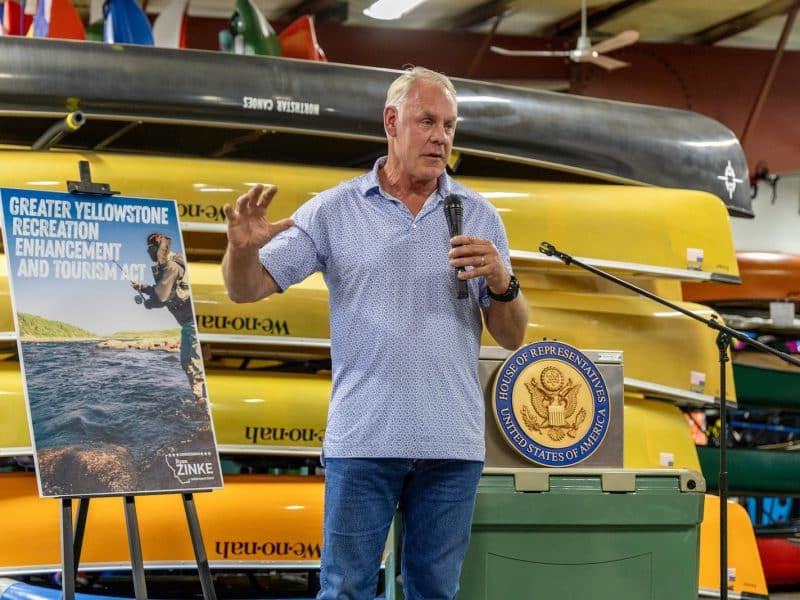
While Butte’s is perhaps a different kind of Democratic politics than one might find on the Hip Strip — as Ryan Zinke, the Republican who presently represents the district in Congress, once remarked at a campaign event I attended, Butte Democrats still “stand for the flag,” whatever that means — it is a historic stronghold for the party nonetheless. Dynastic families with Irish names and Buttian roots still populate Democratic meetings across the state.
It was easy to get a sense of that historic importance last Tuesday from the back seats of the Motherlode Theatre, a venue that, like much of Butte, is at once a little shabby and staggeringly ornate, with gold-appointed chairs beneath our rears and lush red curtains backdropping the campaigners. Each of the candidates emphasized their connections to the Richest Hill, pointing to long-ago ancestors who came to the city for work. It was Russ Cleveland, a rancher and childcare company executive who lives in St. Regis, who seemed to hold the clearest home-field advantage — he played football at Montana Tech under legendary coach Bob Green. (Butte’s pull was on full display again this week when a parade of political hopefuls came to town for St. Patrick’s Day.)
But Democratic vote shares in Butte-Silver Bow County have generally declined during each of the last several presidential cycles. In 2024, Kamala Harris took home 51 percent of the vote, down from 55 percent for Joe Biden in 2020. Hillary Clinton struggled to 52 percent in 2016, but at the same time, only 39 percent of votes went to Donald Trump, as opposed to 44 percent in 2024. Former Democratic U.S. Sen. Jon Tester easily outperformed these presidential contenders, including in his losing 2024 reelection bid, as did Democrat Monica Tranel in her two House bids in 2022 and 2024. So I wouldn’t expect the city to suddenly swing Republican — but it does seem to be getting more conservative, and not much is certain for the state Democratic party anymore.
In any case, a Democrat will need to run up the score in Butte — not to mention Missoula, Bozeman, Anaconda and the Blackfeet and Flathead reservations — to win Montana’s First Congressional District, which leans solidly but not overwhelmingly Republican, even with Zinke vacating the seat and taking incumbency out of the equation. The Democrats vying for that opportunity include Cleveland, Sam Forstag, former firearms executive and author Ryan Busse, and rancher Matt Rains. The winner of the Democratic primary will face one of several Republicans running to replace Zinke, most notably Aaron Flint, a talk show host with endorsements from Zinke and Trump; Montana Secretary of State Christi Jacobsen; and former hard-line state legislator and orthopedic surgeon Al Olszewski.
The debate was put together by Mullen, a newspaper publisher and Democratic activist who splits his time between Butte and Deer Lodge.
Mullen has a tumultuous relationship with the state Democratic Party, resigning from its executive board in 2024 because of what he said was poor transparency and management of donor funds. While running for Secretary of State later that year, he was omitted from a mailer issued by the party in an act of apparent retribution. In 2025, federal prosecutors announced wire fraud charges against one of the party’s main campaign finance consultants, Abbey Lee Cook, who pleaded guilty to three counts. Now, Mullen is a frequent presence in southwestern Montana Democratic politics and a vocal member of the party’s online commentariat. He said he was too busy running around the theater during the event to have any assessment of the candidates’ performances he could share with me.
There were other signs of fracture at the debate. When Rains, who worked as a war photographer, mentioned that he had witnessed the Rohingya genocide in Myanmar, two people in the audience shouted out, “What about the genocide in Palestine?” None of the candidates answered.
We’ve also written about the candidates previously here and here. And with that exposition out of the way, let’s get to the meat of things.
Differences of degree
The candidates found a lot to agree upon. But they each followed distinct — though often overlapping – trajectories through politics and life up to this point. Here’s how they described their differences from each other in their own words.
- Forstag, who has worked as a lobbyist, smokejumper and union organizer for federal employees, said he grew up mostly with a single mother who “picked up extra shifts at the hospital to provide for my sister and me,” and that there are few in Congress who “know what it’s like to grow up worrying that mom’s working too much.” He’s also the only labor union member in the race, and he has “spent a decade engaging in organizing and policy work in this state, getting bills passed by people in both parties.”
- Busse, who previously ran for governor in 2024, said that, for one, he has “a different barber.” (He’s bald). He’s also “vetted,” and said that when you lose a tough race like he did, “you take what you’ve learned, you take what you’ve built, you put it to work, and you go to work winning the next election.”
- Cleveland, whose candidacy is informed by his experience with the healthcare system during the illness of his late daughter, and who is refusing all PAC money, said he has “lived experience and ability to fight and speak out against injustice,” and that he’s “been proud to do that, against genocide, against ICE.” He said he’s a combination of the other candidates, pointing out that he’s a military veteran, a small business owner, an executive and a rancher. “I am a father to six kids and care about their future.”
- Rains, another veteran and rancher, said he brings a diversity of experiences, including time at war and working as a war photographer in Myanmar, where he said he put his life on the line.
On healthcare
The candidates faced questions on rural healthcare and the prospect of universal healthcare or Medicare for All.
- Rains said Trump’s Big Beautiful Bill was “an attack on our healthcare system” that threatens rural hospitals. “Where I live in Simms, I’m 45 minutes to an hour from an emergency room,” he said. “That is unacceptable if we expect the next generation … to come back and raise families in our rural towns. They need to have accessible healthcare to do that, or they’ll go find it somewhere else.”
- Busse said that, in the short term, Congress needs to reverse cuts to Medicaid. Long term, he said, “we need universal healthcare in this country.” He added that some Democrats are also “in the pocket” of the healthcare industry and have stood in the way of universal healthcare.
- Cleveland, whose daughter had leukemia, said that the first month of her treatment cost $300,000 even with insurance. “That’s disgusting. Medicare for All Plus is the only solution moving forward. That includes your eyes, your ears and your teeth, mental health and rural access.”
- Forstag, whose mother is an ICU nurse, said she would sometimes remark that we have universal healthcare — “we just don’t deliver it until you show up in an emergency room, and that is the least effective, least compassionate way for us to possibly administer healthcare.” He advocated for expanding Medicare and increasing Medicare reimbursement rates. In one of the few rebuttals of the night, Cleveland asked Forstag if he supported Medicare for All or a public option. Forstag said that his plan, which he said he discussed with Bernie Sanders, who endorsed him, is to give “every American, regardless of age, the option to buy into Medicare and [expand] the [Affordable Care Act] subsidies that Republicans let expire.” This “does not give Republicans the chance to frame us as taking away choice.”
On AI and data centers
Data centers are contentious within the Democratic Party. While many progressives, environmentalists and others are opposed to their growing presence in Montana, they maintain some support among labor unions interested in possible job growth.
- Cleveland said states need the ability to regulate data centers and should not face moratoria on new restrictions. Then, the government and populace can demand things like a guarantee that data centers pay for their own power consumption and not pass those costs onto other ratepayers. Data centers should use cooling technology that consumes a minimum amount of water, he said. And he voiced support for laws that ensure “companies like Palantir can no longer harvest our data and invade the privacy of Americans.”
- Forstag said that data centers are a symptom of the larger problem — that “we have artificial intelligence companies right now running roughshod with zero regulation.” He advocated for similar restrictions as Cleveland, and added that data centers must be built with “good union labor, because God knows they can afford it.” Additionally, he said that people should be compensated for the use of their personal data.
- Rains had a somewhat contrary view, and said the U.S. “needs to be the leading edge of that technology to stay No. 1 in the world.” He supports developing AI technology “with guardrails.” Still, he said he wants to see more research about the negative consequences of data center siting in Montana to make sure they are not a drain on the state.
- Busse said one of the main reasons data centers exist is to enable technology that “will put human labor out of work.” Secondly, he said, “most of the data centers are owned and pushed upon us by billionaires who want to further concentrate wealth at the top and take it from us.” If data centers claim that utility rates won’t increase for average consumers, that should be put in law, he added.
On housing affordability
The candidates agreed on the need for more investment in affordable housing and other programs to bring down the cost of living in western Montana.
- Forstag said the federal government needs to invest in building homes like it did after World War II. “We had an entire generation of Americans coming back from overseas ready to buy homes and build families. And you know what we did? The federal government stepped in on a bipartisan basis and invested billions of dollars in building housing. We created the low-income housing voucher program, and we got a whole other set of tools we could be investing in, and we need to start investing in right now to make sure people can afford to live in this state.”
- Rains said that “Pandora’s Box” has been opened, and the rest of the country has realized “this is a really incredible place to move to.” He said the state needs to get Wall Street out of the housing supply, and that “Montanans should own Montana homes.” He also said the state needs to add to its housing supply in both rural and urban areas, which might mean building out utility networks and making sure “our contractors don’t just cherry pick the mansions for the billionaires.”
- Busse said the federal government has the money to support housing affordability and rental assistance programs, but instead spends that money on ICE and foreign wars. “I think it’s time that we put somebody in Washington, D.C., who will push other buttons. Why don’t we have more low-income housing assistance? Why don’t we have more first-time buyer assistance? Why don’t we have a renters program? Why don’t we give occupational priority for workers who make communities go — teachers, firefighters, police officers.”
- Cleveland touted past experience working in affordable housing financing and construction. The first issue to address is wages, he said. “I would propose a 50-to-1 ratio of executive-to-frontline worker wages, to close that wage disparity and start attacking that without necessarily raising the federal minimum wage and hurting small businesses. The second would be banning corporate ownership. And I think all of this is part of a broader affordability strategy that is included in and interwoven with things that help with affordability, like universal healthcare, universal childcare and student loan reform.”
On the Democrats and Seth Bodnar’s independent run
As we wrote, the state Democratic Party’s failure to win races loomed throughout the debate. Candidates faced multiple questions on this issue — particularly about the party’s “complacency” and Tester’s decision to support an independent candidate for U.S. Senate, former University of Montana president Seth Bodnar. Tester has called the Democratic brand “poison” in the state.
- Busse said that “it’s time we elect somebody who really will go fight and put an elbow to our own party, because there is way too much intransigence there. You take universal health care, for example — we should have universal health care, were it not for health care insurance companies who essentially made sure that the Democratic Party did not come far enough along when the ACA was established.” As to the Senate race, Busse said he would support “whoever can beat the Republican” — in other words, not necessarily the Democratic candidate.
- Cleveland said “we have to untie our hands from the national party. I present myself as … a progressive independent running on the Democratic ticket. I will not be beholden to our national party, not now, not when I get there. I will do what’s best for the constituents of Montana.” He said he will support the winner of the Democratic primary in the race for U.S. Senate.
- Forstag said “we combat complacency by holding our own party accountable when they mess up.” He said we need to pass a law overturning Citizens United, but noted that previous proposals to do so haven’t received universal support among Democrats. Voters need to send people to Congress “who know what it’s like to be on the wrong end of these broken systems,” he said, “because if you do not know what it’s like to spend 80 percent of your income to keep a roof over your head or be in the grocery store and know that you’re not going to be able to fill that fridge up, even if you’re working three jobs at a time — like I was for three years here — well, you’re going to be treating those problems with a little bit less urgency than they deserve.” He didn’t directly address the question of who he would support in the Senate race.
- Rains said the state needs another Democrat like Pat Williams who “got shit done.” Montana Democrats, he said, are “what Congress needs right now.” He also avoided voicing his support for a specific candidate, but said “we need to flip this seat and get the GOP out of this race.”