Most of us were sleeping when it all began.
Thursday, Jan. 11, dawned as just another mild day in a string of mild days. At 1 p.m. it was 31 degrees in Missoula. Then, in the afternoon, the air began cooling. By 9 p.m. it was down to 4 degrees. At midnight, it was zero. Few of us may have noticed our thermostats kicking in, the furnace blowing warm air through our vents. But by sunrise on Friday, Jan. 12, it was 10 below zero, cold enough that thin veils of ice were forming on the inside of our bedroom windows.
Life continued, as life in Montana does. We got up. We sent our kids to school. (Our fourth-grader willingly wore a jacket, which meant conditions were already approaching historic.) We may have warmed our cars a little longer, or turned on the heater in our chicken coop. But otherwise, it was another day.
Still, it takes more energy to warm our houses and offices and schools and businesses in frigid weather. Where does all that energy come from? NorthWestern Energy is the state’s largest utility, serving 400,000 metered customers in Montana and 95 percent of Missoula. NorthWestern’s energy mix for Montana is about 59 percent carbon-free, in the form of wind and solar, and a collection of century-old hydroelectric dams. The utility also generates power from coal, natural gas and petroleum. At 9 a.m. on Jan. 12, the load, or energy use within NorthWestern’s footprint, was at 2,035 megawatt-hours and rising. Over that hour, the output of all these sources looked like this:
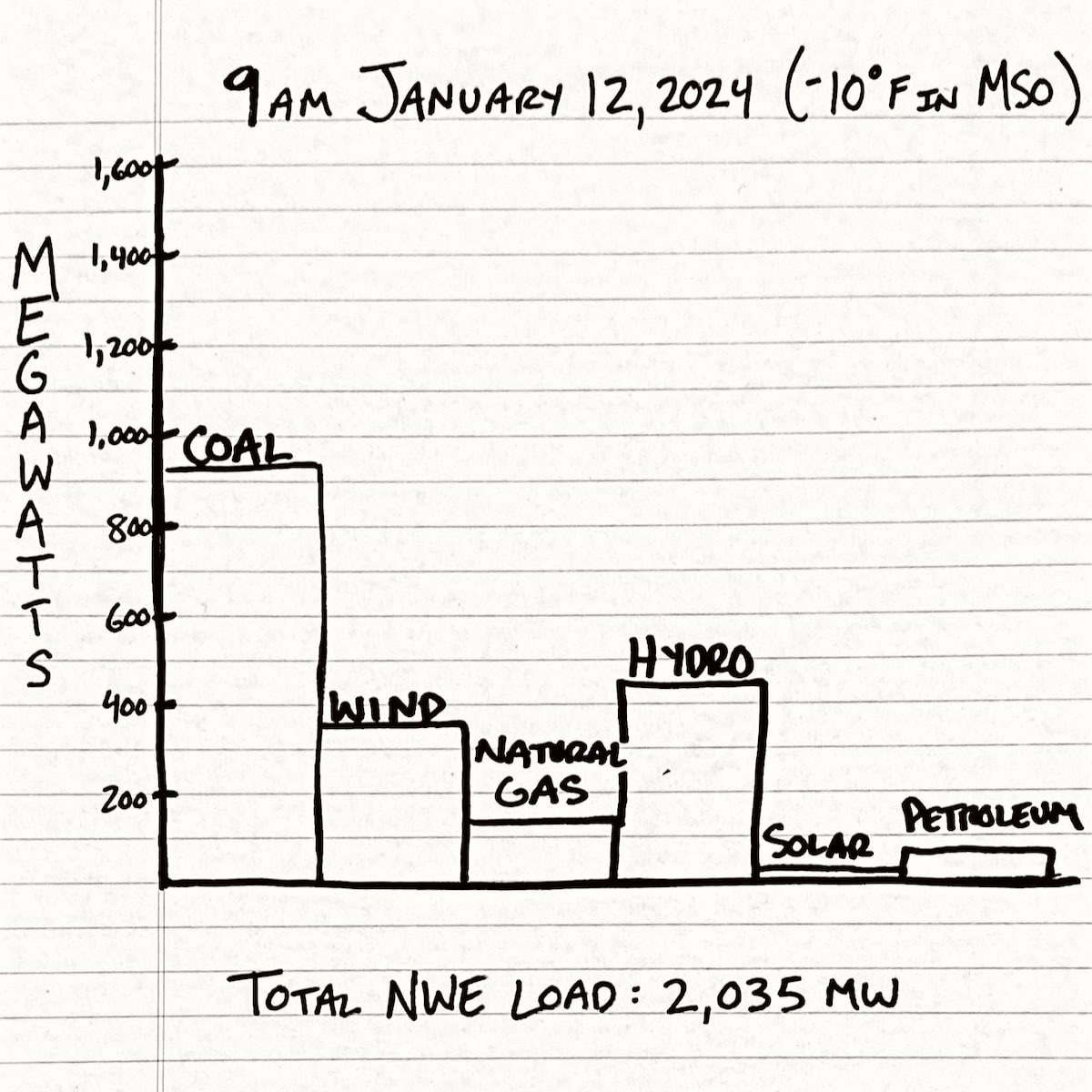
This data reflects all of the output of resources within NorthWestern Energy’s balancing area, or the footprint across which it’s responsible for balancing energy supply and demand. The numbers add up to more than the load, because some of the resources are owned by or contracted to other utilities. Still, to the people who keep an eye on these things, a few details in this data stand out. First, coal is generating 928 MW, lower than usual. That’s because on Jan. 7, Unit 4 of the Colstrip power plant went offline. This unit contributes 222 MW of electricity to NorthWestern’s mix. (Thanks to a reciprocal agreement, NorthWestern could use 111 MW from Colstrip Unit 3 while Unit 4 was offline.) NorthWestern public relations specialist Jo Dee Black said Unit 4 was taken offline to allow for the repair of leaking boiler tubes that could have damaged the plant. The repair was expedited, Black said, when the utility learned the cold front was approaching, but took longer than anticipated. The unit wasn’t operating at full power until the early morning hours of Jan. 13.
Fortunately, the wind was blowing and turbines within NorthWestern’s footprint, including some east of Great Falls, were spinning at a healthy clip and generating 367 MW. Solar was close to zero, which is fairly typical for a winter day at northern latitudes. Hydroelectricity was steady at 442 MW, unable to be ramped up in times of need because most of it is “run-of-river” hydro, which means there isn’t much water storage behind a dam to draw from. Petroleum generation was steady at 58 MW. Natural gas generation, at the Dave Gates Generating Station in Anaconda and the Basin Creek Generation Plant near Butte, was operating at 139 MW, below its combined accredited capacity of 199 MW.
This is the energy, swirled together from a multitude of sources, that was pulsing through the power lines and into our homes as the temperatures started to drop.
The weather was only getting colder. By bedtime on Friday, Jan. 12, it was 19 below zero in Missoula, cold enough that when I let our dog out as I was doing the dishes, my damp fingers stuck to the handle of our storm door. Even in our heated house that night it was pull-up-the-covers cold.
By 8 a.m. on Saturday, Jan. 13, Missoula was at 21 below zero. I took a cup of boiling water outside and threw it into the air and instantly made snow, the video of which made an impression on my family in Australia. This was the coldest temperature Missoula reached during this cold snap. Meanwhile, NorthWestern was generating as much energy as it could. At 8 a.m. on Jan. 13, generation for NorthWestern’s balancing authority looked like this:
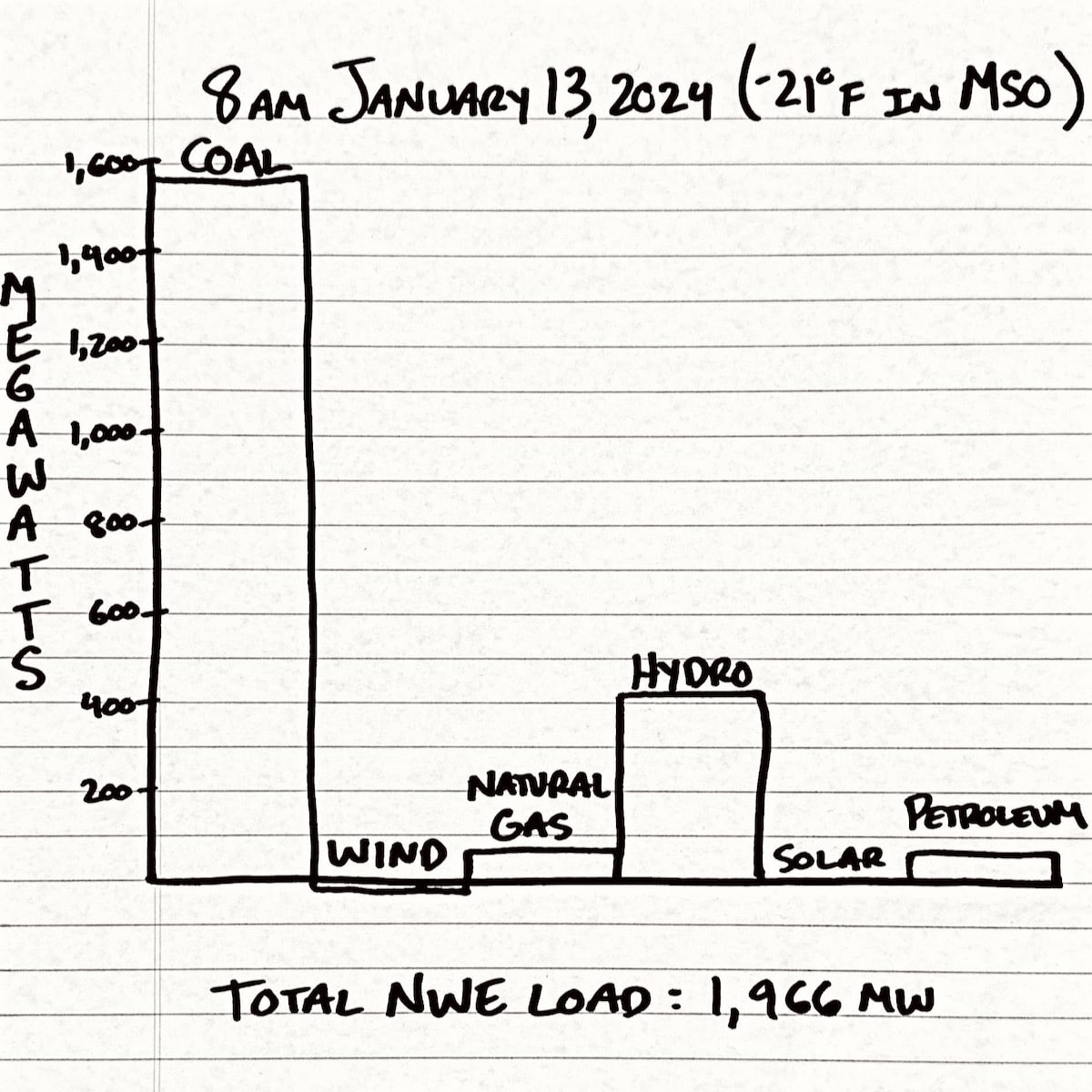
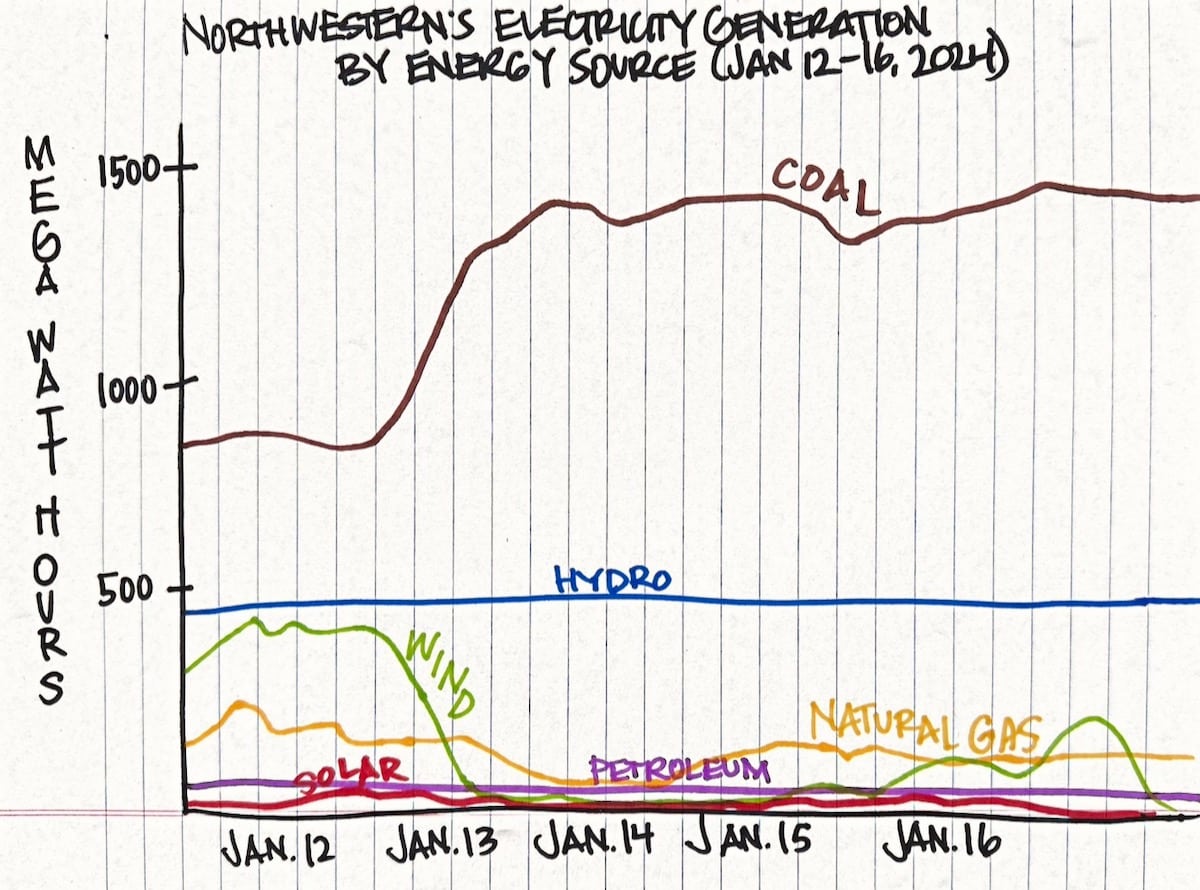
With Colstrip’s Unit 4 back online, coal had returned to its expected capacity, around 1,500 MW. Wind generation had ground to a halt, dipping to -1 MW, even, because the wind was barely blowing and the plants themselves use some energy. (Some turbines are designed to shut off at extremely low temperatures due to the risks of iced blades.) The other sources were more or less playing their predictable roles in the energy mix, except for natural gas, which was producing just 79 MW, less than half its accredited capacity, or the expected energy a resource will provide during peak demand hours in the winter or summer.
The underwhelming performance of natural gas caught the attention of Kyle Unruh, a former employee at NorthWestern Energy and now the Montana and Idaho policy manager for the nonprofit Renewable Northwest.
“Natural gas did not show up like it was planned, not even close,” Unruh says. “It’s hard to know why, because it’s not public information.”
It wasn’t an anomaly, either. In December 2022, when Montana experienced another cold snap and energy use spiked to 2,073 MW, natural gas wasn’t meeting its capacity, either. Unruh dug through public data from the U.S. Energy Information Administration for the 45 hours over these two events where load exceeded 2,000 MW and found that natural gas averaged just 73 percent of its capacity.
“Natural gas generation was as low as around 50 MW, and only as high as 187 MW,” he says. “And these are during the highest load hours of the year.”
“Natural gas did not show up like it was planned,
not even close.”
NorthWestern did not answer repeated emailed questions on the performance of natural gas generation and did not offer any data that disputes this. A recent filing with the Montana Public Service Commission acknowledged “some intermittent outages” for its two natural gas generation plants during the cold snap, but didn’t explain them. According to data within that filing, the Basin Creek natural gas plant outside Butte—a facility the utility doesn’t own but controls—was offline for 19 hours between 10 p.m. on Jan. 12 and 5 p.m. on Jan. 13. At the same time, NorthWestern’s Dave Gates Generating Station was producing well below its capacity. This information was made available after the PSC unanimously voted to review NorthWestern’s handling of the cold snap, the Colstrip repair and the energy the utility produced and purchased on the open market. NorthWestern provided this information on Feb. 20 and is scheduled to present it to the PSC on March 6.
Although the advent of fracking has driven down the cost of natural gas significantly, it’s still often the most expensive fuel for energy generation, according to the U.S. Energy Information Administration. This is confirmed by a memo from Gary Duncan, a recently retired regulatory analyst for the PSC, whose job it is to regulate utilities in the state. In 2022, Duncan found, the total cost of electricity from NorthWestern’s Dave Gates natural gas generating station was $125.05 per MWh. The cost of NorthWestern’s portion of Colstrip Unit 4 was less than half that, at $62.27 per MWh. Meanwhile, electricity from the Invenergy wind farm at Judith Gap, which NorthWestern contracts, cost just $33.25 per MWh. The cost of purchased power on the open market was highest of all, at $129.16 per MWh in 2022.
In the aftermath of this cold snap, some have pointed out that NorthWestern could have made better use of its ability to hedge, that is, purchase energy in advance at a fixed price. Others argue hedging, while ensuring a predictable price, isn’t cost-effective in the long term—the market, like the casino, always wins. This month, the Montana Consumer Counsel blasted NorthWestern’s prior use of hedging, pointing out its advanced purchases for natural gas cost $11 million more in the last year than it would have to buy the gas as needed. Because these costs are passed along to customers, Montana Consumer Counsel’s Jason Brown told the PSC, “this is really akin to gambling with someone else’s money.”
NorthWestern Energy’s preferred interpretation of this cold snap is that it needs to build more “24/7, on-demand” thermal generation facilities closer to energy users. The utility argues that record energy use, combined with the sticker shock of paying top dollar for extra energy on the market, bolsters its case for taking on another 222 MW of the Colstrip power plant in 2026, a move criticized as backwards by environmental groups. NorthWestern is acquiring that share from Avista, a Spokane-based utility that is divesting from Colstrip because Washington’s Clean Energy Transition Act requires utilities to remove coal from their portfolios by 2025.

The environmental implications of burning coal for energy are not insignificant. To generate one MWh of electricity, a coal plant must burn more than 1,000 pounds of coal, enough to fill a hot tub, contributing 2,070 pounds of carbon dioxide emissions, according to the EPA.
After 2026, NorthWestern will control 444 MW (30 percent) of the Colstrip plant. Colstrip currently has six owners, and only two of them (NorthWestern and Texas-based Talen Energy) want to keep the site running. The remaining four will abandon Colstrip by the end of 2025. NorthWestern’s CEO told the energy news site Clearing Up that the utility imagines generating power at Colstrip until 2042.
At the same time, construction is underway for the $283 million, 175-MW Yellowstone County Generating Station, a natural gas facility in Laurel that has been plagued with litigation, including a recent court brief filed by the 16 activists in the Held vs. Montana case, who argue the facility will violate their Montana constitutional rights to a clean and healthful environment.
In a press release on Jan. 17, NorthWestern claimed it could have saved $14 million on energy purchases during this last cold snap if the Yellowstone natural gas plant were operational, and $18 million if it had access to the extra unit of Colstrip. According to its recent filing with the PSC, NorthWestern was a net purchaser over 160 consecutive hours during this latest cold event, and paid $40 million for energy on the market. (The actual cost of this cold snap will be averaged out in a “true-up” process where NorthWestern balances the energy it bought and sold.)
“The best hedge against high energy market prices is owned generation resources located in Montana and dedicated to serving our Montana customers,” John Hines, a NorthWestern vice president, wrote in a Jan. 30 editorial in the Missoulian. He added that the utility is investing in the Yellowstone natural gas plant and the extra unit at Colstrip “because the on-demand generation located in Montana will improve our ability to provide reliable energy service at stable prices for our Montana customers.”
Critics point out that natural gas and coal aren’t the on-demand resources they’re promised to be. Coal piles can freeze, power plants can fail and natural gas supplies can be interrupted. What’s more, Unruh points out, investing in fossil fuel energy at this point in the climate crisis involves significant economic, environmental and social risk. Colstrip emitted almost 11 million tons of carbon dioxide in 2021. It didn’t rank among the top 10 emitting power plants in the country, as it had over the previous decade, only because units 1 and 2 shut down in 2020 as part of a settlement in a Clean Air Act lawsuit.
“There’s also regulatory risk around their emissions and carbon output,” Unruh says. “The EPA is requiring coal plants and methane plants to have certain emissions mitigation technologies that are very expensive.” Unruh worries that coal and natural gas plants could become stranded assets with improvements in renewable energy generation and storage.
Unruh isn’t the only one critiquing NorthWestern’s approach. Energy analyst and former Montana Public Service Commissioner Travis Kavulla posted on Twitter: “This is a constant theme on the utility’s part: A false dichotomy of ‘we have to own all the capacity we may ever need’ (good, wholesome), and ‘we are exposed to the import-based spot market’ (bad, scary).”
In reality, Kavulla and others point out, NorthWestern also sells energy on the spot market. It’s generally a good thing when utilities are interconnected and can buy and sell energy across long distances as needed. In the middle of the latest cold snap, for example, when prices on the Mid-Columbia—the regional trading hub—peaked at around $930 per MWh, they were just $180 per MWh on the wholesale market in Southern California, an argument for greater interconnectivity of our regional and national electric grid.
“This is a constant theme on the utility’s part: A false dichotomy of ‘we have to own all the capacity we may ever need’ (good, wholesome), and ‘we are exposed to the import-based spot market’ (bad, scary).”
Many utilities have begun investing in long-duration energy storage, which would increase the viability of renewable energy sources like wind and solar. Idaho Power is set to deploy 1 GW of battery storage across their system over the next two decades, starting with more than 320 MW by 2025. “The question around batteries,” Unruh says, “is are they cost competitive and do they have a long enough duration to cover our need. The answer to both of those is yes.”
NorthWestern recently considered a contract for the Beartooth Battery Storage Project, a 4-hour, 50-MW battery that would be the first on the NorthWestern grid. But in 2022, a Missoula judge struck down the statute that grants NorthWestern assured reimbursement for the project from its customers. What’s more, the battery would be contracted, not owned. Without a guaranteed return on a potentially risky, first-of-its-kind investment, NorthWestern bailed on the battery. Today there are no batteries in NorthWestern’s footprint.
“We’re becoming unique in that respect,” Unruh says. “Most utilities to the west of us have battery generation. Some are doing long-term batteries that can provide energy for days.”
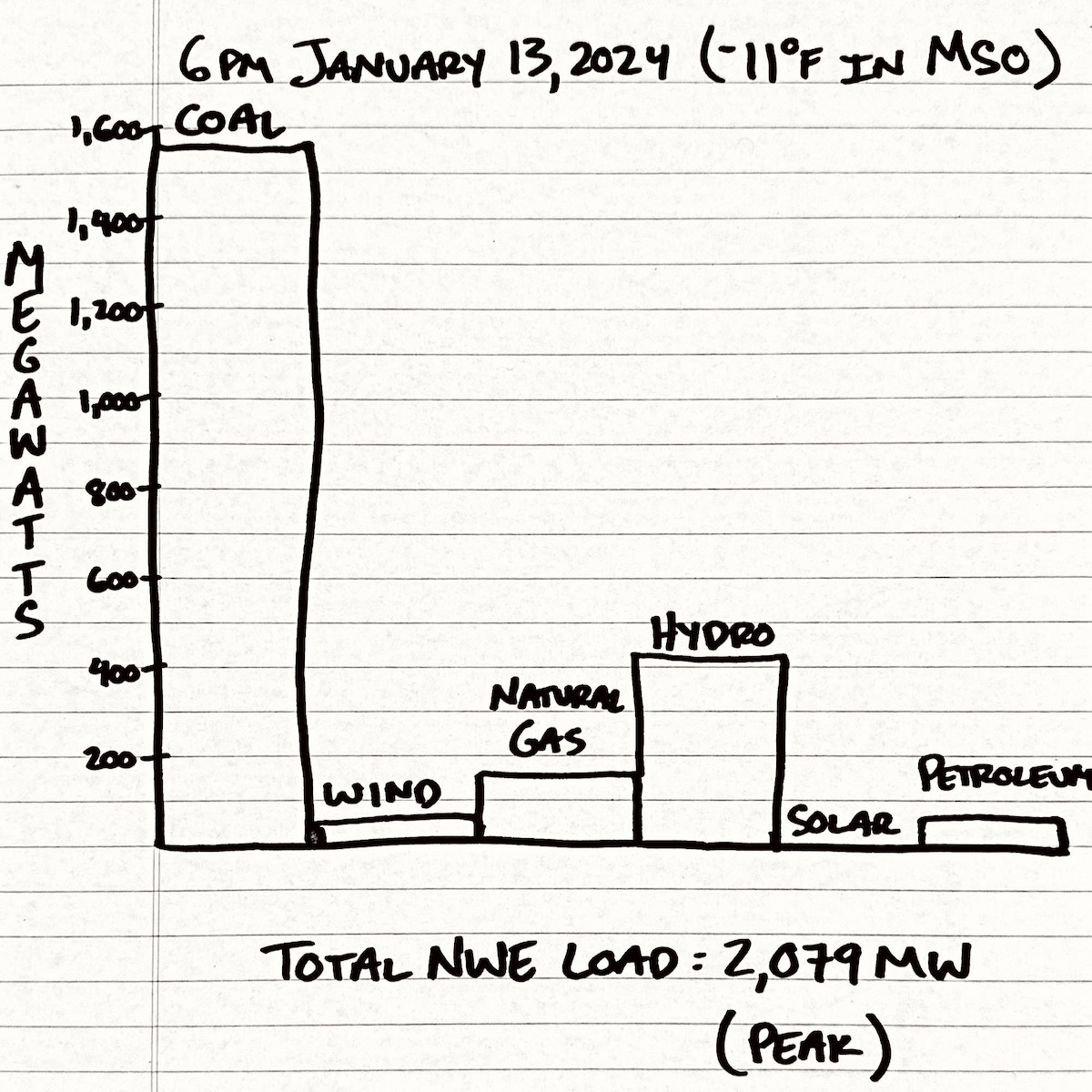
As Saturday, Jan. 13, unfolded, energy demand grew. For four hours that day the load was higher than 2,050 MW. It peaked at 6 p.m., with a record load of 2,079 MW. NorthWestern was only generating about half of this need, so it was buying the remainder on the Mid-Columbia market, where prices were spiking.
At that time, NorthWestern’s balancing authority generation looked like this:
After Jan. 13, the coldest temperatures were behind us in Missoula, but the cold snap wasn’t over. The next two days saw lows of 18 below and 16 below. For four combined evening hours on Jan. 14 and Jan. 15, energy demand topped 2,050 MWh. At noon on Jan. 16, the temperature in Missoula finally rose above zero. By dinnertime it was 7 degrees and load was at 1,921 MW and falling. By the end of January, a typical evening load was around 1,600 MW.
Two peak events in consecutive winters have offered insight into NorthWestern’s management of extreme events and the priorities that inform its future planning. Recently it made a case for more “24/7 on-demand” thermal generation at an economic outlook seminar sponsored by the Montana Bureau of Business and Economic Research. The utility argued that to match the energy output of the Yellowstone County Generation Station with alternative sources such as wind, nuclear and solar, the cost would be anywhere from 2 to 24 times greater.
“Variable generation provides energy,” says NorthWestern’s Jo Dee Black, “but would have to be significantly overbuilt to provide the same capacity as a natural gas plant.”
It’s worth explaining the bizarre economics that undergird utility companies in much of the U.S. In most businesses, revenue is generated, and then expenses are deducted to determine the profit. When you compare a company’s profit relative to its overall revenue, you get their margin of profit. It’s lemonade-stand simple.
A regulated utility doesn’t work like this. Instead, a state regulator (in our case the Montana Public Service Commission) sets what it considers an acceptable profit margin for the utility and then allows the utility to set rates to the level required to generate enough revenue to cover their capital infrastructure (power plants, poles, power lines, etc.) and also make a profit. This is why, when a utility splurges on a new power plant, it is guaranteed to turn a profit for its shareholders—even when cheaper methods of generation may be available. In other words, the utility is being run first and foremost in the interests of the shareholders, and secondarily in the interest of customers. The interests of the environment often come last of all, until public pressure spurs change, as it did in Washington, which will phase out of coal-fired electricity by 2025, and in Oregon, which will phase out of coal by 2030.
Picture the grid. The electrons silently zipping from power plants, wind farms or hydroelectric turbines, to step-up transformers, where electromagnetic induction increases voltage to blast energy over long distances through thick-cabled transmission lines. Branching and forking like a nervous system, the lines diverge to transmission substations, where voltage is reduced, and then to distribution substations, where it’s lowered again, and then to the telephone poles on the side of the road and finally to an innocuous green box on the sidewalk where a transformer reduces the voltage one final time before it is sent into the buildings in which we live, to power our coffee grinders, laptops, TVs, space heaters, furnaces, water heaters and everything else that draws a current in our increasingly electrified lives.
For something you can’t see, hear, taste, smell, or touch, electricity is best understood through metaphors. Engineers compare it to an irrigation system, a network of canals decreasing in size from the point of collection to the end users. It’s a marvel. A miracle, even.
Regulated monopolies have little incentive to take risks, and the utility seems reluctant to blaze a trail when profits remain along the path of least resistance.
“We move through this world where all of these wires are behind walls or underground,” says climate and sustainability specialist for the city of Missoula, Evora Glenn. “We just press buttons and things happen. Most of us don’t know where that power comes from in any concrete and tangible way.”
Glenn is part of the team at the city and county that is working with NorthWestern to power Missoula with 100 percent clean electricity by 2030. “We’re working with them to move forward with more renewable energy in Montana that we could specifically subscribe to,” Glenn says. “It’s one of the more straightforward approaches to making that fast, across-the-board shift.”
But as Missoula takes steps to pull the plug on fossil fuels, NorthWestern is set to increase its carbon intensity until 2035, when it says it will stop adding fossil fuel generation. It plans to be carbon net-zero by 2050. Like electricity itself, the utility tends to follow the path of least resistance. And like water in an irrigation system, our current energy realities are better understood when we look back to the junctures that have directed them.

One of those junctures was back in 2006, when NorthWestern proposed a $1 billion, 400-mile, high-voltage transmission line to carry Montana wind energy from Townsend to a substation near Twin Falls, Idaho. From that substation, energy could flow to any other Western state. At the time, demand for renewable energy was soaring as states in the Northwest and Southwest adopted renewable portfolio standards.
But public opposition to the so-called Mountain States Transmission Intertie (including a lawsuit won by Jefferson County) and changing market dynamics (including a natural gas glut), among other challenges (including impacts on sage grouse), created too much uncertainty for NorthWestern to stomach, and in 2012—after spending $24 million on permitting—it decided to kill the project.
Failed gambles like this encourage utilities charged with providing reliable, affordable energy to take a more conservative approach. The variables are many and complex. Shareholders are considered alongside customers. Future energy demand, prices, transmission, and the state and federal regulatory environment must be forecasted. The renewable energy transition is being driven by unpredictable political, economic and technological winds. In the face of these uncertainties, NorthWestern is locking in more coal power and building a new gas plant with a 30-year lifespan. Regulated monopolies have little incentive to take risks, and the utility seems reluctant to blaze a trail when profits remain along the path of least resistance.
The energy we use to endure a cold snap like January’s is rarely reliable, affordable and clean all at once. Ensuring our growing energy demands are met in the cheapest, least-polluting way requires, at least in the near term, a diversity of generation sources, and the ability to balance our ideals with our needs. It also requires public engagement.
Something that’s invisible is easily taken for granted. We flip a switch, and the lights come on. But what generated this energy? How does it reach us? What does it reveal about our values and the values of the utility to which our community is hitched? What concessions must we make for its convenience? Those are thorny, complicated questions worth asking of ourselves, our utility and the elected officials who regulate it. The cold snap may have finally ended, but the debate over how NorthWestern manages our energy is only growing more heated.