Zak James is having car trouble. That’s why, on a January morning, at 10 below zero, the 28-year-old Montana hip hop artist is on foot, walking three miles from his house to grab lunch at Jimmy Johns, and then to City Brew, to meet this reporter, and later to the YMCA to finish his community college homework while working a shift at the reception desk.
James was born in Billings and grew up in Helena, by his account a shy, scared kid from a broken home who overcame a stutter and a lisp when he discovered hip hop. He’s a grown man now, sitting at a table near the door in a black Carhartt jacket, a gray hat, and a fleece scarf, nibbling a chocolate peppermint cookie. Studs sparkle in both ears and on the side of his nose.
“A big part of it is really not giving a fuck about anything. If I’m truly going to respect the culture, I need to unabashedly be myself.”
Three months ago, onstage at the Top Hat, James was sporting an altogether different look. During a hip hop show headlined by local standouts Foreshadow and Elair, James came on in the middle of the lineup, in a black and silver disco shirt, sunglasses, shoulder-length hair, and a gleaming smile. With his longtime friend Farch (Jesse Frohreich) spinning tracks at the turntables, James energized the room, rapping over funky beats while dancing like it was 1978.
One of these songs was “Sing in the Shower,” in which James channels a feel-good, dance-like-nobody’s-watching vibe with a side of healthy financial habits. (“Every paycheck that I get / I been savin’ that shit / mo’fucker, that’s the money in the bank.”) It’s so upbeat that James manages to slip hakuna matata into the chorus.

James wrote the song in 20 minutes, while driving to the studio in Billings in 2017. “We recorded it and I was like, ‘This song is a hit,’” he says. “‘This song is going to be huge.’”
It was his first experiment with pop music, and a significant departure from his earlier work in a genre that values trash-talking toughness. While the song would eventually become his most popular, James says it didn’t get any traction in the first two years and it cost him some respect from fellow rappers.
“Everyone in the hip hop community hated it,” he says. “They said I sold out.”
Growing up, James’ mother played a lot of oldies like Bobby Day’s “Rockin’ Robin,” and genre-blending singers like Etta James. He felt pressure to be a “hard” rapper akin to what he first heard in hip hop, when he was 13 and found an Mp3 player filled with Jay-Z, 50 Cent and Nas. But James wanted to make music that honored all his influences, including the “village of women” who raised him. It’s why you can hear traces of Doja Cat in his verses, along with the playful background chirps, whoops, and hee hees of Michael Jackson, Bruno Mars, and Justin Timberlake.
“Hip hop, at the core, it’s about being really braggadocious,” James tells me. “But a big part of it is really not giving a fuck about anything. If I’m truly going to respect the culture, I need to unabashedly be myself.”
Finding an authentic voice in an urban art form is a process every rapper goes through in rural Montana. Fifty years after its birth in the Bronx, the culture and music of hip hop is, of course, global. It’s no more a surprise to find it in Montana than it is in Myanmar. But despite the niche success of Supaman, a popular artist from the Crow Nation, or OverTime, a Montana country- and rock-driven rapper who tours nationally, hip hop is not a music genre people associate with Big Sky country.
“It’s the last thing you think would happen here,” says Colter Olmstead, a Missoula-based videographer who started shooting music videos for Montana hip hop artists when he was a teenager at Capitol High in Helena (class of 2010), and continued as a film student at MSU where he graduated in 2015.

In that time, Olmstead has watched Montana hip hop grow up. It’s no longer just weekday night fare at dive bars. Now Montana rappers are getting national recognition. Hip hop is becoming more prevalent, too. Last year, outside Three Forks, the state saw its first two-day hip hop festival, Rappin The Rivers. The event will return this August.
“A lot of people still think that we ride around on horses up here. So the fact that hip hop music gets made at a high-quality level in small pockets around the state is very interesting to people.”
Olmstead says the Montana hip hop community is small, tight-knit, and supportive. “It’s more of a ‘we’ versus a ‘me’ mentality,” he says. Many Montana rappers finding their way into the scene cross paths with Olmstead, who supports the community by filming music videos—often at discount rates. The videos range from one-take freestyle sessions to the public awareness messages of Foreshadow, to the perfectly propped, plot-driven videos of Elair.
“My music, even if it’s fun, even if I’m having fun, it’s very explicit. It’s rated R. That’s because my life was rated R.”
Olmstead recently moved into a new office space on the Northside, with two recording rooms where his friend, Shadow Devereaux (Foreshadow), will run his Nu Wav recording studio. Olmstead and Devereaux are turning a big garage in the back into an audio-visual community space that they’re calling Area 41 Creative. Olmstead says he wants to make professional-grade studio resources available to local artists.
Although some people may be turned off by the vulgarity, boastfulness, and aggression of hip hop, Olmstead points to songs like Yvng Vin’s “Working Man,” Foreshadow’s “Protect Your People,” and “The Valley,” by Foreshadow and Elair to point out that Montana hip hop offers a relatable expression of life in this state.

“The stories that are being told are authentic Montanan stories,” Olmstead says. “If you’re from here, you’ll connect with a lot of those stories. You’re not gonna like every song, but if you give an album a chance, I guarantee there’s a song or two from each artist that you’ll resonate with.”
One of the strengths of Montana hip hop is that it’s passion-driven. Few artists can make a living here on their music alone and performing opportunities are even scarcer than for other musicians. The committed artists are making music after their day jobs. As one of James’ lyrics goes: “I just do it for the love / I know they gonna pay me soon.”
That underdog mentality—making music with limited resources in your off-hours in the rural West—suits the overall narrative of hip hop, and it helps keep the local scene grounded. It’s hard to be too cool for yourself when your family is watching, or sometimes even in the video, as they are in “Sun’s Out,” a tribute to summer lake days by Foreshadow and Elair.
Take a glimpse into the scene and you’ll find diverse, talented wordsmiths representing familiar experiences in high-quality videos shot in places you’ll recognize. Watch a few on YouTube and they may leave you, as they did me, with the unexpected pang of connecting with music I’ve always felt apart from, music that I’ve come to realize is being made here and made well.
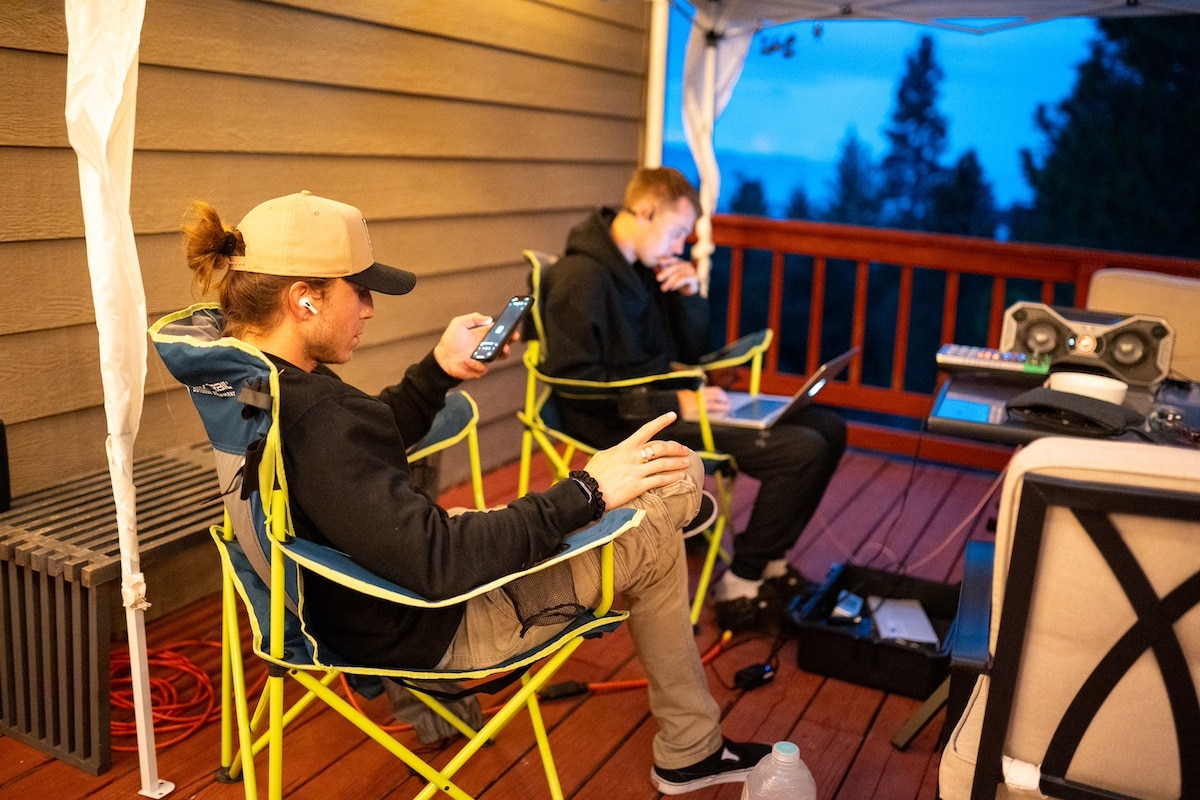
Those already on the bandwagon will be happy to know that there’s more in store. Last year, Olmstead and Devereaux brought 24 Montana rappers to an Airbnb on Flathead Lake to spend 10 days making music. The result will be a compilation album representative of Montana hip hop, and a full-length documentary called “Last of the Nobodies,” due to premiere in early summer. (Watch this space for news of an album release show around that time.)
Back in October, when Elair closed the Top Hat show, he thanked everyone for coming out. Not in that obligatory way that artists sometimes do, but in the I-can-hardly-believe-this way of someone doing what they love in front of people loving what they do.
Olmstead has known James since he was an eighth grader in Helena, a quiet kid who wrote poetry before he got into “nerdy boom-bap rap.” Since then, Olmstead has watched James find his voice and his confidence.
“He’s making music that I think he wants to listen to,” Olmstead says. “It’s very fun, very dancey, energetic, very good-vibe music.”
James’ songs can be all those things, but it’s hard to pin down his style. As he raps in one recent track: “They try to put me in a box, but homey, I won’t fit / I won’t quit / I make hits, I don’t miss.”
If James has created a happy-go-lucky, self-love aura around his music with Pharrell-style tracks like “Damn, Baby,” “Stop Writing Me Love Letters,” “Breaking My Heart,” and one of his best, “I Love Myself,” his music also reflects his share of pain. James, who is Chippewa Cree on his father’s side, grew up off the reservation in a broken household, with an absent father who had a criminal history and suffered from substance abuse and a mother who scrambled to make ends meet and eventually joined the Army National Guard and deployed to Iraq. James says he grew up on food stamps and second-hand clothes, and saw more violence and substance abuse than any child should.
“My music, even if it’s fun, even if I’m having fun, it’s very explicit,” he says. “It’s rated R. That’s because my life was rated R.”
James translated some of those hardships into goofy, self-effacing raps like “Dirty Chucks,” part of his Live From the Basement project that he released at age 20. Olmstead filmed the music video on Missoula’s Northside Pedestrian Bridge. James’ flow on that track is fast and fluid, turning hip hop bravado on its head in a pair of old Converse high tops: “I been rockin’ these dirty Chucks, and I still been getting them ladies / I got one right now, she thinks my lisp is cute, but she think my dick is huge / and I’m like, nah, girl, it’s really medium sized / she said, ‘if I’s a mile away it’d still be easy to find / okay, I can take a compliment / okay, I can keep rockin’ it.”
By that time James had already created Badmouth, a promotional LLC to sell branded apparel. In 2016, when James was 21, a friend invited him to Compton to record his first album. James called that project Fire Season, an homage to his home state.
“It’s kinda hard to make the forest cool,” he says. “Cities are cool. The streets are cool. In hip hop, no one’s really talking about the forest. I was like, how can I represent where I’m from without being corny?”
James remembers getting to L.A. and scrambling to write lyrics that would impress the West-coast rappers in the studio. “I was really afraid that they weren’t gonna like me,” he says. “I thought, ‘I need to be more hard. This needs to be more aggressive.’”
It turned out that everyone in the studio preferred the verses he wrote in Montana.
“It’s refreshing to be a part of something that’s positive,” the audio technician said in a short documentary that Olmstead made of the recording, “but it’s still dope, though, it’s dope.”
It was a valuable lesson for James to stay true to his roots. He says while it’s vital to respect the culture of hip hop, and sometimes play its boastful games, it’s equally important to know where you come from.
“You have to know that you’re not from a big city,” he says. “And generally speaking, if you’re from Montana, you’re not a gangster and you’re not selling drugs. But at the core of hip hop is struggle and pain and overcoming it.”
That something-out-of-nothing mentality has motivated James’ music and helped him grow an audience. In 2018 he released a traditional ‘90s boom-bap album, Baby Face, partly in response to the backlash he received after his poppy “Sing in the Shower.” The album includes pain-filled songs like “Broke,” which tackles themes of addiction, domestic violence, and depression and includes a riveting double-time verse. The chorus is slightly off-key—“If you feelin’ broke / that don’t mean you broken”—but that just makes the sound more raw. Someone once messaged James saying that the song saved their life.
“I’m afraid to get on stage. I’m afraid to put out music. But you can snap on a character and say, ‘I’m not this scared little kid anymore. I’m a superstar.’ It’s all stories.”
Since then, James’ voice has matured along with his sensibility. Today he plumbs greater depths of emotion on tracks like “Pretend You Hate Me,” released late last year, in which he doesn’t rap at all, but sings heart-rending lyrics about his childhood over soft piano designed to move: “I run just like my daddy / I hurt just like my mama / that broken little baby that can’t hold all the trauma.”
James says he thinks a lot about Robin Williams as an example of someone whose humor and charm masked deep depression. “Some of the funniest, most talented people you ever meet are only able to do that because they know the bottoms,” he says. Making beauty from pain inspires many of his songs. “Dancing in the rain” is an oft-repeated lyric.
In fact, James has decided that the part of him that produces funky dance tracks is another person. James calls him Jimmy Jawline. “Zak James writes rap music,” he says. “Jimmy Jawline is this funky pop superstar.”
James says channeling this alter ego helps him perform. “I’m afraid to get on stage. I’m afraid to put out music,” he says. “But you can snap on a character and say, ‘I’m not this scared little kid anymore. I’m a superstar.’ It’s all stories.”
Jimmy Jawline or not, James won’t be pigeonholed. Last year he doubled down on his rap bona fides with Fire Season Vol. 2, recorded by Foreshadow. The album has no self-deprecating lyrics, nor any funky party tracks, and seems to be making a point. A track called “Shady” features an Eminem-style ne’er-do-well narrative, while “Nothing On Me” opens with jangly keys reminiscent of Snoop Dogg. In “Iceberg Lettuce,” James raps over Rage Against The Machine-style electric guitars with an occasional Nicki Minaj quaver in his flow: “Went from Mr. nice guy straight to don’t try me / bitch, I got the hits and I’m lightin’ them up.”
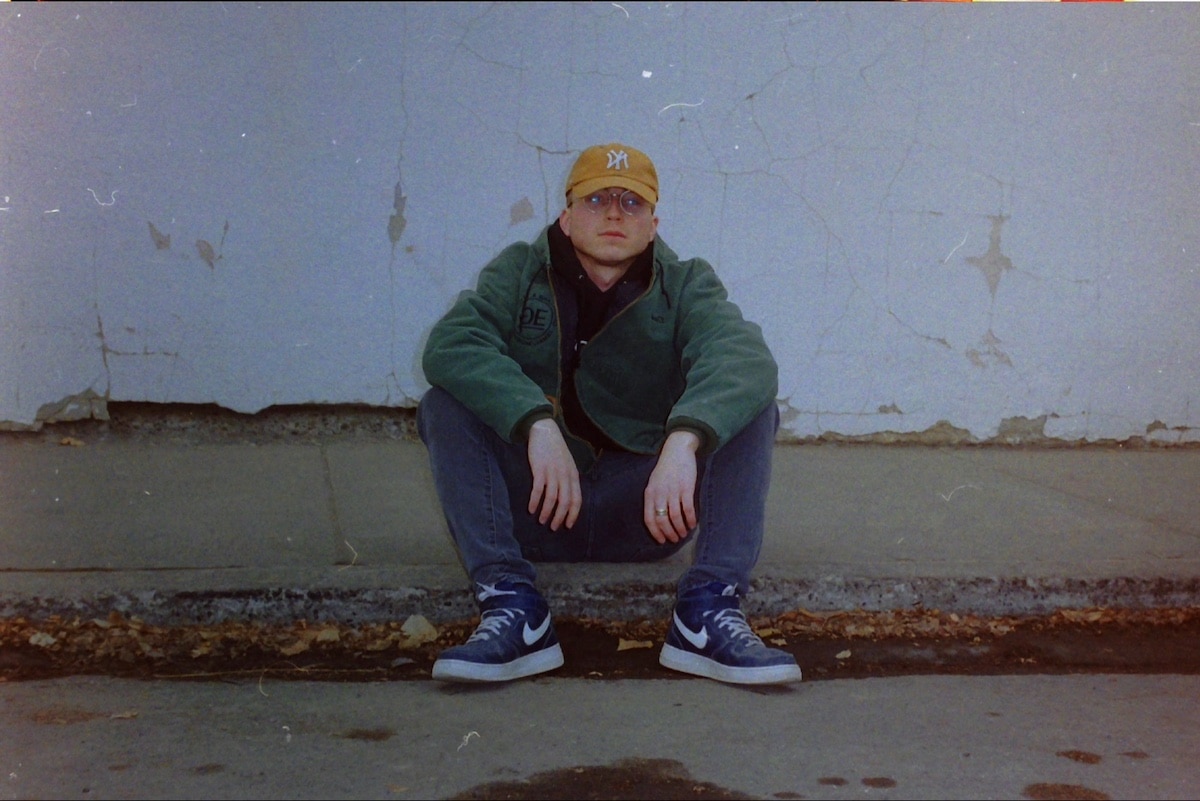
In “Bubblegum,” James lashes back at his haters: “This is for anybody sayin’ I went bubblegum / chew ‘em up, spit ‘em out, spin around, fuck ‘em up.” In “Wild Wild West, one of the album’s best songs, James’ delivery is metronomic and chip-on-the-shoulder fast. “I wrote a poem ‘bout a broken home / calling God on a stolen phone / he ain’t pick up, it’s a lonely road.”
At his table in City Brew, James says he once had dreams of becoming a rich, world-touring star. He’s less attached to all that now. Part of the sport of hip hop is projecting yourself as the best, but James has come to realize he gets to define what that means.
“You can create your own version of the top based on who you are,” he says. “I am the king in my own regards.” I’m gonna make the most successful pop hip hop funk song you’ve ever heard. You can’t do anything about it. I’m gonna hop on a track and show the most lyrical clever rhyme schemes that you can’t recreate. That’s my version of being braggadocious.”
James says he’s stopped drinking. He was in rehab in 2019 and now he’s trying to be the man he never knew in his youth—the cool, sober grown-up. It’s why he likes working at the YMCA where he can be a part of his community and build up the kids who walk through the doors. “You lookin’ fresh today, bro!”
James is taking classes at Helena College to be an EMT and, one day, an addictions counselor. For now, James, one of the shining lights of a hip hop scene that is brightening across the state, will keep making music and he’ll keep dancing—in the rain, when no one’s watching, or live on stage.
“I wouldn’t say I’m good at dancing, I just like to dance,” he admits. “You can change the world and make it a better place if you’re doing something that you love and you keep doing it.”