Andrea Davis has a hard time looking mean. Even when she’s asked to.
The Missoula mayoral hopeful went on a “candi-date” with me to Lookout Throwing Co. to chuck axes at a wooden target and talk about how she aims to lead the city.
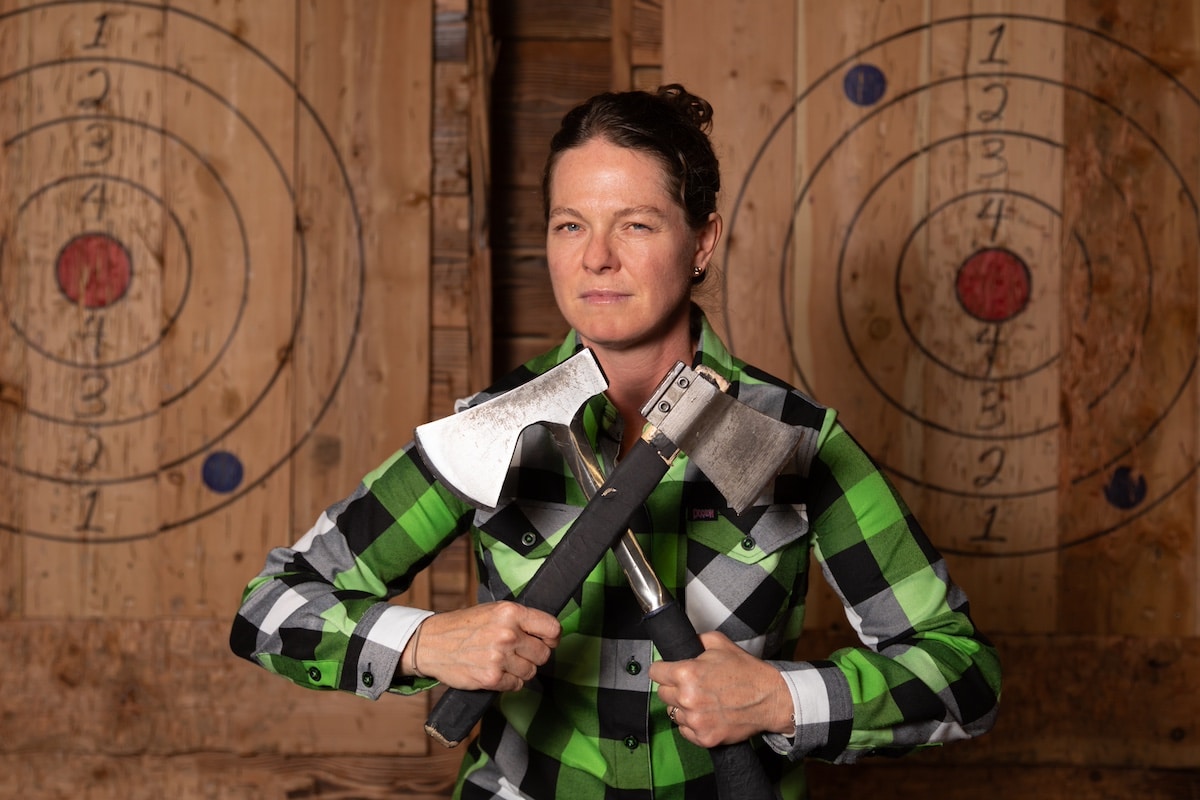
This kind of date is bound to be, well, off the wall. But it became truly funny when The Pulp’s photographer, Andy Kemmis, had Davis pose holding two crossed axes in front of her body like a super heroine from a Marvel movie. She wore a green and black plaid button-down that nailed the lumberjill theme, with jeans and black boots that could have passed for real wood-chopping footwear if you didn’t notice they had a little heel.
Kemmis gave her direction, took photos and reviewed them on his camera screen. Dissatisfied, but kinda laughing, he tried using different words to get at the same sentiment: look mad.
“I’ve been working on not being pissed all week!” Davis laughed. “You have no idea how many meditation apps I’ve gone through.”

And Davis did have a tough week. A finance complaint had been filed against her campaign, which pointed to several individuals’ in-kind donations that exceeded the $400 limit.
There’d also been a thorny dispute with her opponent, Mike Nugent, and his wife, Staci, over an Instagram post by Davis’ campaign that led Staci to claim an invasion of privacy, and then some interpreted Staci’s response as misogynistic.
And before meeting up with me, she’d spent the day at a memorial for a friend who’d recently died.
“I want to always remember what we learned today at our friend’s celebration of life: You know, when things get tough, take it light,” Davis said.
That’s not to say, she added, that she makes light of the seriousness of governance. But the sentiment does kind of capture the essence of both Davis’ campaign and her approach to the mayoral position.
Over beers at OddPitch Brewing after throwing axes, I asked her about the tenor between the two campaigns, and she replied that a small-town election means supporters of either candidate “work together, know one another, are each other’s neighbors.” Overall, she described the campaign session as “collegial” and “positive.”
“And that is absolutely my focus going forward,” she said. “I mean, that’s where I want to keep it. That’s where Missoulians want it.”
If elected to office, she wants to use that small-town dynamic to stay accessible to residents. She sees more people engaging with complex municipal issues like development, codes and taxes, and wants to keep that participation rolling, in part by rethinking how city government communicates with residents.
“Most people don’t get their news in the same way they used to,” Davis said, explaining that she’d like to expand the city’s use of social media. “We have to step out and be talking to folks.”
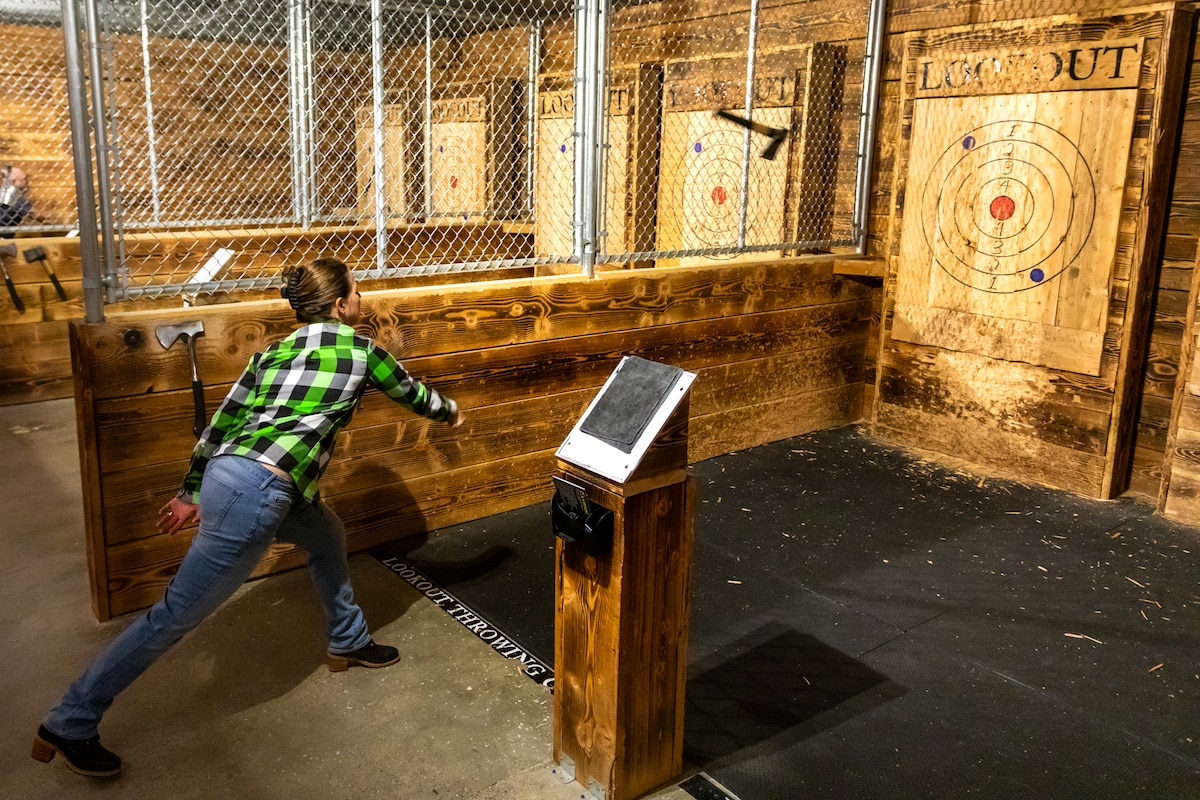
Stepping out is also a key element to a good ax throw. We were set up behind a line about 15 feet away from the targets. There were two projectile options: a longer, heavier ax for two-handed throwing and a smaller one for one-handed chucks. The instructor showed us how to lift the ax behind our heads, square our elbows, take a step forward and huck. Ideally, the ax spins only once and then—thwack!—it pierces the target with the upper part of the blade. Easy, right?
But if your angle is off—much like throwing a wine bottle at a wall in a rage room with her opponent Mike Nugent—that ax will bounce back in your direction. In fact, if it wasn’t for Davis’ quick footwork, I probably would have lopped off her feet at the ankles.
Davis, on the other hand, was consistently on the board though below the target, maybe because I was distracting her with questions.
What part of town would Davis take an ax to and rebuild? (I had to clarify that this is theoretical and, no, you’re not displacing businesses or working within a budget.)
Reserve Street, she answered, with a specific focus on pedestrians, bikes and buses.
What laws from this year’s legislative session would she put on the chopping block? House Bill 549, which authorizes the establishment of public charter schools. Davis said in the current tax environment, implementing essentially state-funded schools when public schools are struggling wouldn’t be helpful.
She’d also ax Senate Bill 105, which prevents local governments from implementing rent control, removing a potential tool as the city struggles with soaring housing costs.
Housing, of course, is Davis’ field of expertise. In addition to her work at Homeword, a nonprofit that builds affordable housing and educates homebuyers, she served as the director of planning and development for the Missoula Housing Authority for five years.
When it comes to people dealing with houselessness, Davis values allyship with other communities in the region. She serves on a 13-state advisory council for the Federal Home Loan Bank of Des Moines, and mentioned a recent discussion with the Boise mayor’s office as an example of how Missoula can trade good ideas with other communities.
Davis also pointed to Bend, Oregon’s Safe Parking Program, which allows a limited number of campers in parking lots under certain conditions, two of those being access to a bathroom and proactive case management. But, of course, Oregon and Montana’s state policies differ in such a way that solutions in Bend could be moot in Missoula.
She’s closely watching the effort on the part of dozens of cities and 20 state attorneys general to have the U.S. Supreme Court review a 2018 9th U.S. Circuit Court of Appeals decision that limits how cities can regulate camping in public places. She said the decision really put local governments in a bind.

“If you’re getting sued by local businesses and you’re getting sued by the ACLU at the same time, and you don’t have enough resources to pay for it, it literally is an impossible situation to respond to,” she said.
For renters, Davis sees possible solutions with more support at the state level, including what’s known as a property tax circuit breaker, which she said would “basically more closely align somebody’s income to the value of their home and the property tax that they pay.”
Speaking of property taxes, Davis said Missoula City Council’s decision to pull the fire levy from the ballot due to unease around rising property taxes—the measure would have generated about $7 million for fire and emergency services—highlights how the state’s overarching tax structure is increasingly problematic for city budget dynamics. She said it’s essential that the city finds a way to fund first responders and the Mobile Support Team, who she collectively described as the “silent safety” of the community.
It’s on these knotty issues that Davis speaks to her experience in forging collaborations between nonprofits, private business and the public sector—a point she’s hit consistently throughout her campaign.
Davis thinks it’s vital to form such alliances among Montana’s cities, as well.
“It’s really important for the mayor of Missoula to show up when it’s important in Helena,” she said. Or Bozeman. Or Great Falls. Or Kalispell, where Davis grew up. It’s clear to her that the Flathead Valley is affected by Missoula in many ways, notably in commerce. And she sees that interwovenness as an opportunity.
Her years of experience in working across sectors is what Davis says differentiates her from Nugent. That and what she called her “form of positive leadership.”
It came into focus when, at Lookout Throwing Co., the mayoral candidate couldn’t help but smile at the camera. Our photographer’s struggle to get Davis to “look mean” culminated in Kemmis asking her to literally growl aloud. The jury’s out, but that may have gotten the job done.