Welcome to the Go Griz Store.
The University of Montana campus bookstore has a new name, new website, and more changes are on the way now that operations have been turned over to the Follett Higher Education Group, one of the country’s biggest players in the campus bookstore game.
Barnes and Noble College, Follett’s chief competitor in the market, had operated the UM bookstore for about five years when its contract expired in June. After assessing offers from both companies, UM in July posted notice of its intent to turn the page on Barnes and Noble and go with Follett’s higher bid.
The proposed seven-year contract between UM and Follett—which would pay UM at least $500,000 annually, according to the school’s estimate based on fiscal year 2022 sales, plus a one-time $600,000 contribution towards a bookstore renovation—is now in the final stages of review, according to Jody Parrow, the UM associate director of procurement services.
“We’re not miles apart. We’re inches apart,” Parrow said. But he stressed that there are no guarantees until both parties have signed the papers.
Meanwhile, Follett has already moved in. The company hired new manager Klent Palmer, and he and bookstore staff have been stocking new Griz gear since October, just in time for the football team’s postseason run and sky-high demand for Griz apparel.
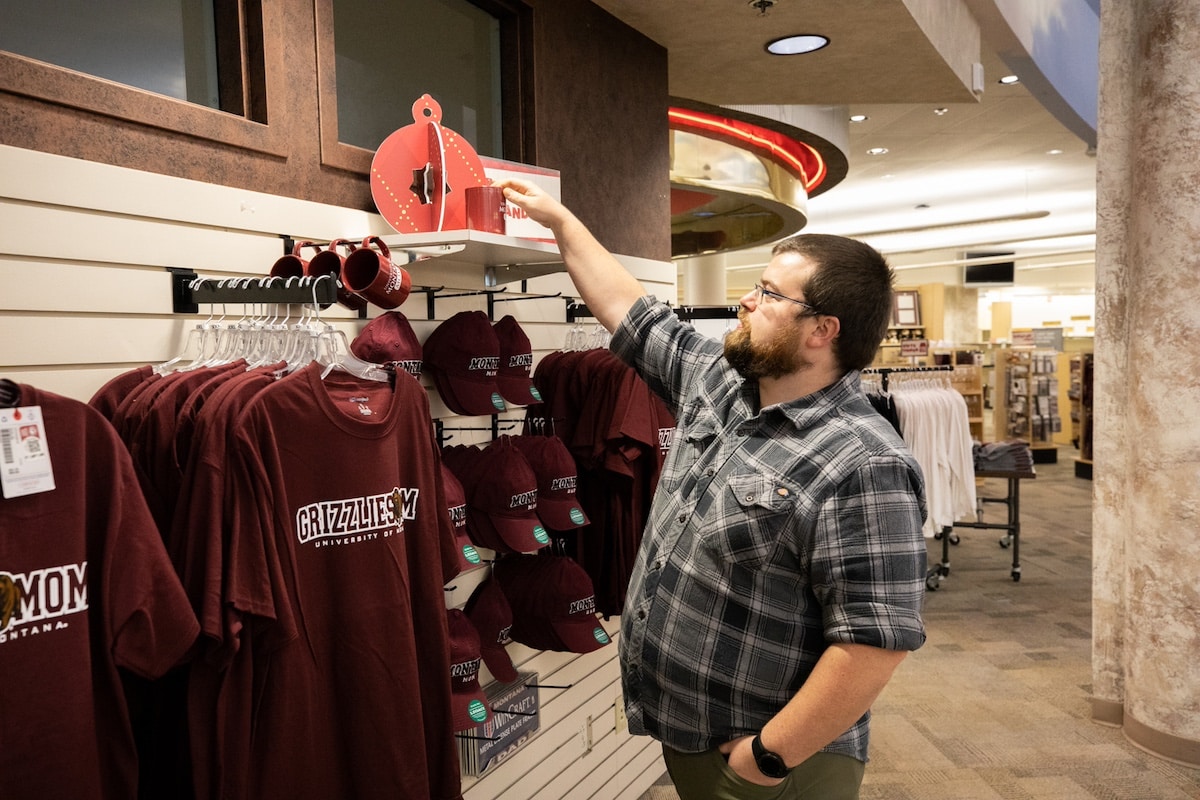
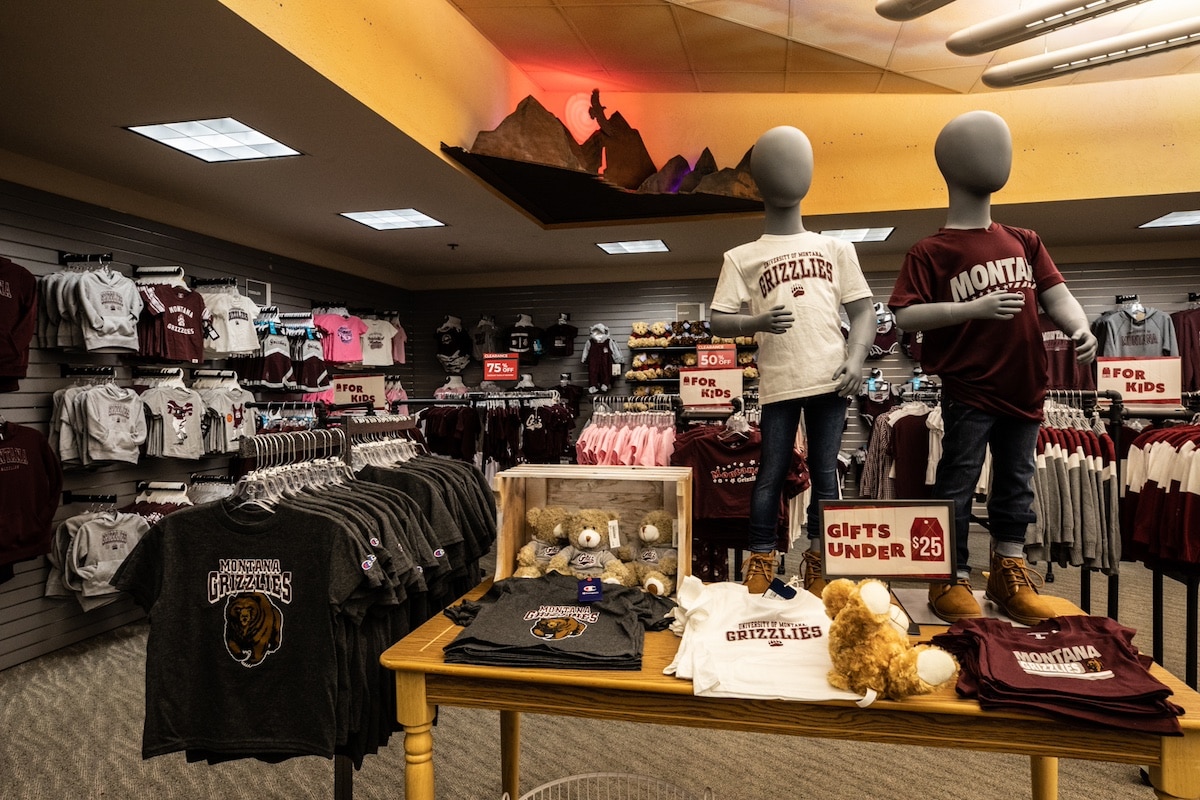
For the average Griz fan shopping for merchandise, the change of the guard means two things—discounted older stock, and new brands and gear as Follett tries to make a strong first impression.
“Let me get you into something maroon,” Palmer said with a smile in the bookstore on a recent afternoon, describing how he approaches browsing Griz faithful.
A new line of cold-weather gear has been flying off the shelves. Carhartt Griz beanies are the hot new item. During the Brawl of the Wild and playoff game days, Palmer said, sales have surged to 10 times that of an average Saturday.
For faculty and students, there are a few other things to know, with the sale of textbooks and course materials in Follett’s hands, too.
The final details won’t be known until the contract is inked, but in its winning bid for bookstore operations, Follett proposed paying $600,000 towards renovating the campus store. For general merchandise, the highest portion of store sales in recent years, Follett offered UM a 20 percent commission compared to Barnes and Noble’s 16 percent. A 20 percent commission amounts to more than $310,000 a year, based on FY2022 sales.
That was a selling point, said Stacey Eve, associate vice president for business operations and finance at UM.
“That’s where the volume really comes in,” Eve said.
However, Eve said, much of what the university makes in the short-term will have to go back into the space, both for the planned remodel and to pay rent and utilities, as the University Center, which houses the bookstore, is an auxiliary building and therefore has to be self-supporting.
“Most likely any money we get from the bookstore will probably, for the first few years, just go back into that space,” she said. “Because once you pay the rent and utilities, there’s not a lot left over.”
In its bid, Follett also offered the university 10.25 percent commission on course material sales, 7 percent on digital course materials sales, and pledged $10,000 annually towards a general scholarship and another $10,000 annually towards textbook scholarships.
The book on Follett
Illinois-based Follett runs stores on more than 1,000 campuses nationwide, providing a variety of educational services to colleges, schools and libraries. It’s also a textbook publisher and wholesaler of used textbooks. The education group’s parent company, the Follett Corp., ranked No. 215 on Forbes’ list of America’s largest private companies in 2023.

In 2022, Follett Corp. was acquired by the private investor group Jefferson River Capital LLC, which was founded by the James family (and named for the river that runs through the family’s Montana ranch, as the Wall Street Journal reported). The family’s also known for its involvement in the massive private equity firm Blackstone Inc.
Follett Higher Education Group also entered into a partnership with major sports retailer Dyehard Fan Supply this past January, furthering its college sports retail capacity.
With the highest commission percentage for general merchandise, the university stands to gain the most in that sector, but bid documents show that physical and digital course materials combined amounted to slightly more in total store sales than merch during fiscal year 2022—about $1.64 million to $1.55 million.
Follett’s bid to UM included two options for operational models, one a traditional bookstore model and the other what Follett calls “Equitable Access.” In a traditional model, the required course materials are made available at the bookstore, and a student chooses how to obtain materials and pays for them independently.
With an “Equitable Access” model, Follett would gather and deliver all required course materials campus-wide, physically or online, and the cost would be included in tuition. The company would pay UM a one-time bonus of $500,000 to implement the program, according to the bid.
A course-by-course version called “Inclusive Access” offers a similar function on a smaller scale.
In these “Access” models, a set fee is paid by all students participating.
The University of Montana, Eve said, is sticking with the traditional bookstore model as it starts its partnership with Follett, and is negotiating a contract for that model specifically.
“I want to stress we are a traditional bookstore,” Eve said, adding that the priority is making course materials affordable.
“You can get books on Amazon. You can rent. You can get e-books. You have a lot of options as a student,” Eve said.
Follett may still try to offer the university an “Access” model down the line.
On its website Follett says “Access” models reduce hassle and lower costs, and help student performance.
Nicole Allen, director of open education at SPARC, an open education advocacy non-profit, argues that such one-size-fits-all programs can end up costing students and faculty more.
“A campus needs to consider really carefully, is that actually helping them by adopting that model? Or is it better to let students bear their own costs and give them the flexibility to select courses and purchase lower cost options?” Allen said in an interview.
Often, she added, the reduced costs companies advertise are based on comparisons to new textbooks, while many students actually acquire used or free materials.
Allen also warned universities to ensure book-selling contracts fully support a university’s existing in-house Open Educational Resources (OER) program, which provides course materials and other resources to students for free. (SPARC’s website provides a library of contracts between universities and companies including Barnes and Noble and Follett, which the organization acquired by submitting records requests.)
UM’s facilitator of OER materials at Mansfield Library is digital initiatives librarian Wendy Walker, who was consulted during the bid evaluation process and contributed notes, according to Eve. Walker was out-of-office during the reporting of this story and could not be reached for comment.
Faculty, as always, will determine what materials will be required for courses, Eve said.
Plans are underway to form a campus store advisory committee, to include members of the Associated Students of the University of Montana, faculty, athletics and marketing personnel.
The committee would evaluate UM’s arrangement with Follett, weigh in on the remodel and what merchandise the store should carry, and make scholarship decisions, Eve said. She expects to move forward with a committee and remodel talks at the start of 2024.
Meanwhile, on the Go Griz Store floor, Palmer is staying busy as he aims to form a solid connection with students, faculty and fans, and looks to hire more student staff. He’s been spending company dollars to support local fundraisers on and off campus, he said, and preparing for the big push to fill the bookshelves in advance of spring semester.
“We’re really just trying to make ourselves an indispensable part of the campus community,” he said.