Halloween is the special, ominous time of year when the borders of our world are flimsy. As much as the department stores would have us believe otherwise, no amount of mass-produced plastic blow-up statues will change Halloween into Christmas. One is a holiday of birth and renewal, the other is an acknowledgment of everything in the night that goes bump. And The Shining is the perfect Halloween movie, not because it’s scary or disturbing or unforgettable—although it is all those things—but because it depicts a real horror: our own ugly, malicious, buried selves. And we recognize it when we see it.
The Shining’s back for a limited run at the Roxy. And because it is the community arthouse theater, populated with staff and volunteers who love their films, I went down there to get their experienced take on the movie. Although most other classic horror movies get a single day in October, The Shining gets a full week.
“The demand requires many screenings,” says Mike Emmons, the programming director.
“Every time, it’s a sellout,” says Solveig, the master projectionist and camp horror film festival director.
And for good reason—there’s a lot more to it than just ghosts and ghouls.
A quick plot summary in case you’re unfamiliar: struggling author Jack Torrance lands a job as the winter caretaker of the Overlook Hotel, a majestic structure deep in the wilderness above Boulder, Colorado. With his wife and young son, Wendy and Danny, Jack settles in for a long winter. But the hotel contains some sort of terrible force, and it begins to corrupt Jack, bringing new aspects of him to the surface. A sense of dread hangs over the movie as the snow piles up outside, trapping them in the hotel. Horror ensues.
The film was adapted by Stanley Kubrick in 1980 from Stephen King’s novel, and stars Jack Nicholson, Shelley Duvall, and Danny Lloyd as the Torrances. It’s not a particularly faithful adaptation (King famously disavowed it), but it is an unforgettable piece of art in its own right.
It notably opens with an overhead view of St. Mary Lake in Glacier National Park (though it’s meant to take place in Colorado), a lone car winding up the mountain road. The swooping camera plays up the contrast between the enormous landscape and the tiny car, foreshadowing the family’s isolation in the wilderness. We slowly move inside the car with the Torrances, and from there we steadily follow them up to the Overlook Hotel. Porters and staff scurry here and there, clearly packing up the hotel. We get the first tingle that something is off—if everyone is deserting this place, why are we staying?
“I love any movie where the set is a character,” says Solveig.
Entering the opulent hotel is like plunging into an oil painting: colors, patterns, rugs, fireplaces, chandeliers, elegant stairways. But, in Kubrick’s hands, what should be a Calvinist triumph of luxury over wilderness instead becomes a grandiose testament to a great and terrible force. The family begins to fray, subconsciously feeling the pressure of that force. Wendy, in particular, tries to bear up for her husband’s and son’s sakes, smiling away her worries. Jack, in contrast, grows impatient, surly, and even cruel.
The incessant and discordant soundtrack sets our teeth on edge and transforms otherwise orderly scenes of the caretaker life into creepy omens, as if the string section is channeling Wendy’s blood pressure. There’s something almost predatory in it. “The soundtrack intensifies and loosens along with the pacing,” says Ken Grinde, the operations director. The music reinforces not what we see, but what we feel.
Which is tense. In general, the camera is awfully intimate compared to other horror movies. We can’t uncouple ourselves from the immobile shot of Jack holding Danny in his lap, asking him in ponderous tones, Doesn’t he know his dad loves him more than anything? We’re pinned behind Danny’s tricycle as he tows us down spiraling, labyrinthine hallways. “It’s the carpet!” Solveig says, describing the tension’s ingredients. “Danny walking backwards through his footsteps,” Grinde adds. It’s like Kubrick started with a big block of raw tension and then compressed it until the extreme density gave rise to gravity, drawing us in inescapably.
The acting is diabolically good. Duvall as Wendy is infuriatingly helpless—a paragon of sexist female fragility. Her inability to fully open a bathroom window is ulcer-inducing. We never doubt her love and concern for Danny, or her despair when the hotel starts to work its voodoo on her husband.
As far as Nicholson’s performance goes, his slow metamorphosis is brilliant, not just for its primo psycho displays, but for those moments of lucidity when he manages to get his head above the water for a moment before the hotel sucks him back down. Jack’s peak horror comes not at the famous ax-door-Johnny scene, but earlier, from the weeping wreck we see at his desk after Wendy breaks him out of his prophetic bathtub sex nightmare. When he realizes that the hot young lady in the bathtub is in fact a rotting, festering, greedy corpse, he is revolted that he would embrace such a thing. And terrified that some deep-down piece of him does indeed lust for that grotesque and violent monster. It is a man’s brief moment of self-awareness before he once again succumbs to rage and destruction.
The Shining’s real power comes from its grounded base. Even though we’re talking about an immortal evil that consumes souls, it is, at heart, a story of a man at war with himself who abuses his family. “There’s nothing scarier than an abusive parent,” Emmons says. “The real-world horror adds a weird, twisted element.”
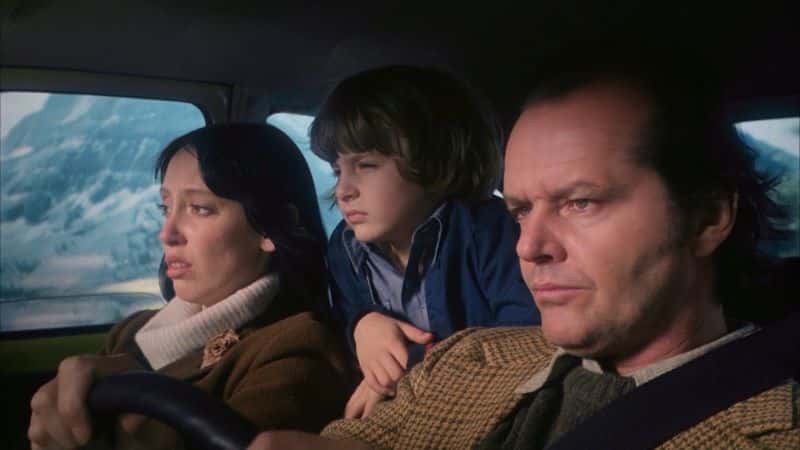
Recall the family’s conversation in the car in the first act, when they’re driving the endless mountain road up to the hotel. It’s a short scene, first a brief exchange about the Donner party and then Danny complaining that he’s hungry. Jack takes a certain unnerving relish in explaining cannibalism to his son, and uses a curt, condescending tone to tell Danny that he wouldn’t be hungry if he’d eaten breakfast. The emotional undercurrents foreshadow the family’s later tensions (kudos, Kubrick) but what’s germane here is how unremarkable the exchange is. At that moment, Jack is the impatience of the Every Man. We all can be dismissive and unnecessarily self-involved, too caught up in our superior concerns to be polite or kind. Not to suggest that it’s a skip-and-a-jump from rudeness to ax murder, but perhaps the description “meanspirited” is in some ways disturbingly literal: a part of our spirit is mean and low and callous and conniving. We don’t dwell on this for obvious reasons, but every so often an occasion like All Hallow’s Eve comes along to remind us.
Even worse, The Shining grapples with the Halloween-esque idea that evil isn’t confined to some safely-locked freezer in the basement of our minds, but exists somewhere Out There, a creature unto itself, intrigued by human suffering. The film’s deliberate pace gives us plenty of time to witness Jack’s mutation and to feel the encroaching darkness growing both in him and Room 237. Jack is not Leatherface or Freddy or Jason or any other mystical, unfathomable monster. He is a man coerced into slowly abandoning his good judgment and turning his back on his family. The hotel nurtures the soulful meanness in him until it’s all there is.
But this isn’t the story of a white knight corrupted. The meanness had an origin point somewhere inside Jack. His history with his son leads to some queasy moments, like when Wendy fumbles to explain the old injury to Danny’s arm to a doctor. There’s something buried in this family. “The blood spilling out in the hallway is a literalized metaphor,” Emmons says. “Kubrick rubs your face in it.”
And on October 31, we collectively pause to appreciate the persuasiveness of evil. We spare a thought for the possibility that malevolence exists, keen-eyed and intentional as the devil. That we may need to guard not only against the horrors that would rain down on us, but against the horrors we might commit against our fellow people.
A truly vitriolic act is exceptionally harmful because it will outlast us. At the end of the film Jack is used up, drained, frozen, consumed, but the Overlook sits comfortably on its mountain. The Shining screens at The Roxy Saturday Oct. 28, through Thursday, Nov. 2. Visit The Roxy for more info.