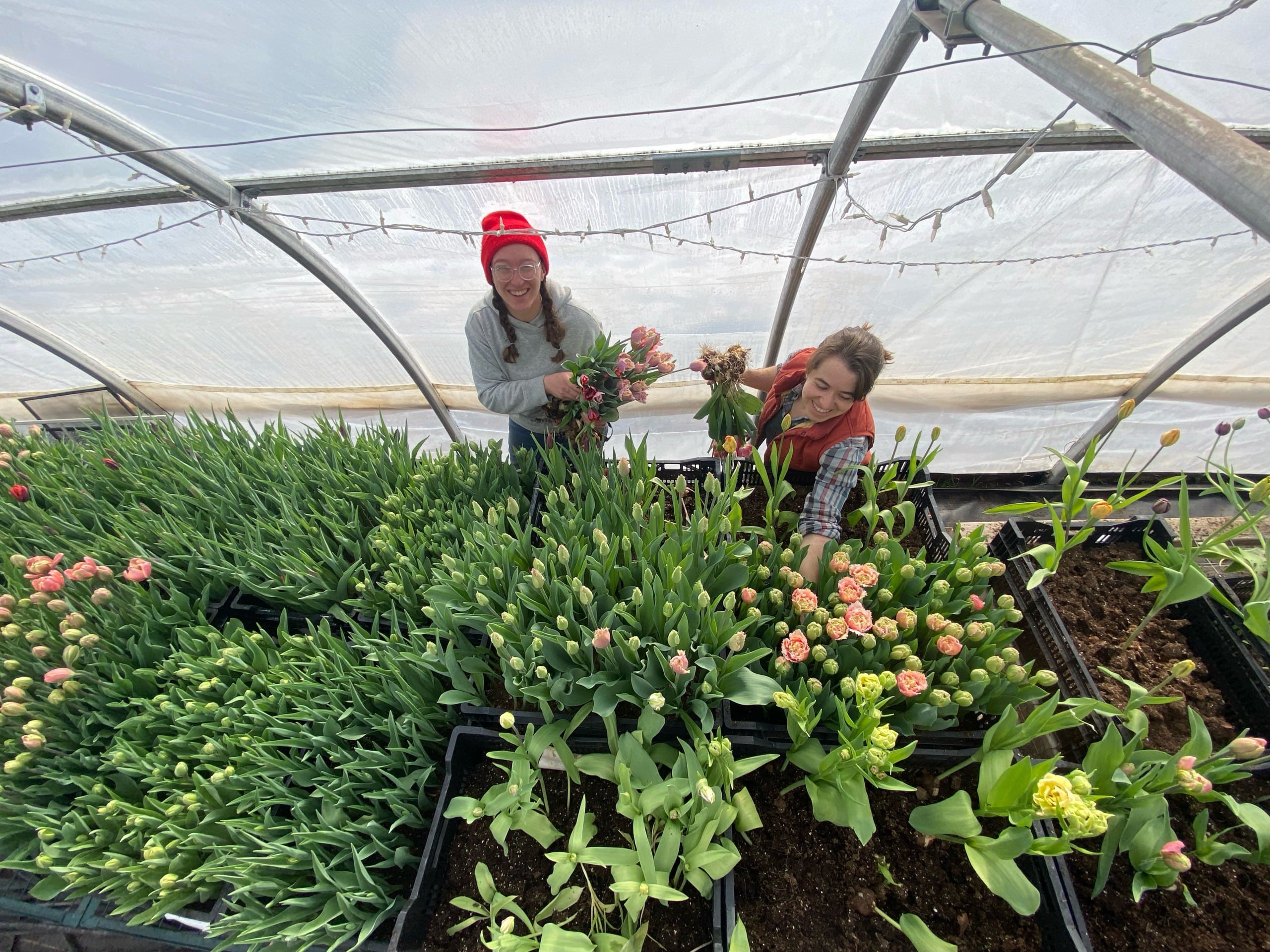
About 20 miles west of Missoula, just off Interstate 90 and hidden in a greenhouse, is a sight for sore eyes: 4,000 tulips, days away from peak bloom. As shocking as it is to see fresh Montana-grown tulips in February, these are the real deal.
These are 4,000 of the nearly 50,000 total tulips that growers Tracy Potter-Fins and Bethany Stanbery of County Rail Farm and Field Five Flowers will harvest between early February and Mother’s Day. One of the couple’s favorite varieties—of the 30 they’re growing—is the peony tulip. It’s pleasantly reminiscent of bird feathers.
Much of their Valentine’s Day supply adorns the windows of APORTA, a boutique shop on Missoula’s West Front Street, where the tulips are for sale. The farmers will be at the shop on Feb. 13 and 14 to sell arrangements and to assure buyers that, no, they’re not made of silk (a common mistake, Potter-Fins said).
But if you’re into flowers that last as long as silk ones, there are local growers who dry bouquets for that purpose. A dried bouquet, cared for properly, could theoretically last forever. These growers, too, are extra busy around Valentine’s Day.
I caught Aimee Miklovic, owner of Full Bushel Farm in Stevensville, on her delivery route up the Bitterroot Valley and to Rockin Rudy’s, where she sells dried bouquets of straw flowers, status, amaranth, snap dragons, sage, baby’s breath and more. In 2018, she started experimenting with selling bouquets of flowers she grew, dried and then arranged. Now, it’s an important part of her business.
A friend joked recently to Miklovic that she won’t need a bouquet this year because she bought one three years ago. Miklovic crunched some numbers around that feedback to determine that dried flowers are a good bang for your buck. “That’s all it costs: two pennies a day for continual joy,” she said.

Adelaide Every also sells dried flowers through her business, Farm Hand Farm. Her Valentine’s Day inventory is available at Le Petit Outre and features selections including peonies and dahlias and ferns she foraged in Thompson Falls. This coming growing season will be her sixth and she’s adding on another property to her menagerie for growing out her dried flower shop. Every sells flower shares throughout the warmer months, structured like a CSA, in which members pay up front and pick up bouquets weekly. Shares are available on her website and, Every says, also make great Valentine’s gifts.
Americans will spend about $2.6 billion on Valentine’s Day flowers this year, according to the National Retail Federation. Supporting local small businesses is a great reason to buy local flowers. Lindsay Irwin has owned the Missoula staple Bitterroot Flower Shop for 16 years and has watched buyers’ interest in locally grown flowers blossom. When she first tried supplying local flowers, customers often thought the products were too expensive. “It was kind of a flop,” she said. “Now, it’s like people are actually wondering where the flowers come from and are way more aware.”
And there are even more reasons to support local growers beyond boosting local business.
“If [you] care about the environment, if [you] care about human rights, don’t buy [imported] flowers,” Full Bushel Farm’s Miklovic said.
A majority of industrial cut flowers are grown in Colombia and Ecuador, where there are few legal protections for workers, including age limits, capped hours and safety regulations, reported on in 2012.
Worse yet, the international cut flower business uses a lot of pesticides, herbicides and other chemicals. A 2021 study reviewing pesticide use in flower production found that over 200 different compounds may be used in the industrial process, 93 of which are banned by the European Union. People who work in the industry or live nearby production areas have reported adverse health effects including poorer neurobehavioral development, reproductive disorders, congenital malformations and genotoxicity, according to the study. The overuse of pesticides also contaminates nearby air, water and soil.
And there’s the environmental impact of transporting the flowers around the world.
Local operations inherently avoid these environmental and labor pitfalls, though growing in Montana has its own challenges that need addressing. For example, it takes fuel to keep a greenhouse warm when it’s cold outside. Field Five Flowers’ tulip operation requires about one extra month of heat than their normal operations, growing seedlings for regular-season vegetable and flower production. Right now, the greenhouse is warming tulips alongside flower seedlings destined for the fields, microgreens and one rabbit that needed a temporary home.
There are no organic tulip bulbs on the market. But, as soon as those bulbs arrive at the farm, the growers instill the organic practices they use to grow all their produce.
“You can smell these flowers and know they’re not sprayed,” Potter-Fins said.
In short, you can breathe easy.

The flower half of that farm’s operation is relatively new. County Rail Farm was started in Dixon in 2011 and moved to Huson in 2016. That arm’s specialties are arugula, tomatoes and garlic, sold predominantly through the Western Montana Growers Cooperative. Stanbery joined on in 2020 and started Field Five Flowers.
Now, land use at the farm is split about half-and-half between the two operations. Over the last couple seasons, the flower business has started to pull slightly ahead in their revenue stream. Potter-Fins and Stanbery started growing tulips indoors about this time last year. But they didn’t advertise in advance because they were afraid the project would fail.
It didn’t. And now they’ve expanded it. The tulip operation provides a surge in the farmers’ winter cash flow and has enabled them to keep a worker on the payroll through the winter months, an unusual feat in the world of small farms.
Valentine’s Day might seem like the end of a rush for flower growers. But it’s more like a beginning. Each farmer is starting to seed this season’s crops—flowers and beyond.