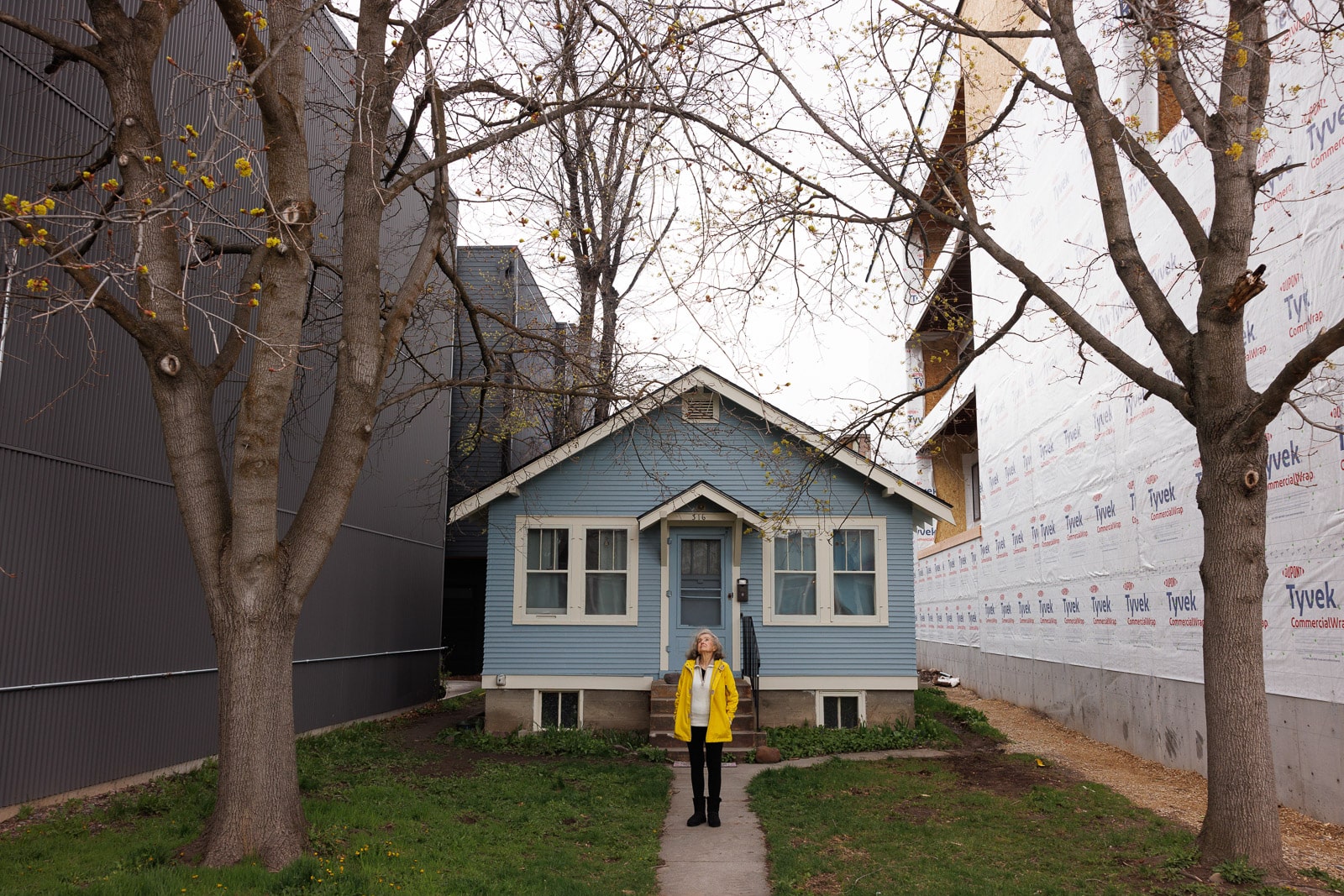
The front stoop of the little blue house on Levasseur Street gets a little more shadow these days. Ever since the tall residential buildings shouldered in on either side of it, there’s only a narrow window around midday when the sun can reach it — like a weathered paperback wedged back between two crisp hardcovers.
Since it was built, in 1921, this modest one-story craftsman has been a quiet outlier to the bustle of coffee shops, burger joints and bars just a stone’s throw away, presiding over a block-long stretch of residential tranquility interrupted now and then by a passing pedestrian on the Riverfront Trail. It joined Missoula’s downtown corridor the same year as the now-iconic Wilma Theater, and has maintained an unblinking vigil over the banks of the Clark Fork for more than a century, through the addition of levees, new bridges and riverside hotels.
It survived major downtown changes — the post-fire rebirth of the Florence Hotel, the rise of the Millennium Building, and the deconstruction of the old Missoula Mercantile. It’s endured waves of housing styles that have sprung up across the valley, from mid-century ranch-style homes in the Lewis and Clark neighborhood to the 1970s and 1980s split-level homes in the Rattlesnake and South Hills to the more recent mountain-modern estates overlooking trails and creeks.
Rarely has the past and future of Missoula been so visibly combined as on Levasseur today. A bank of sleek, stylish townhomes built several years back already assumes a commanding presence on the little blue house’s west flank. On the east, the wide balconies and first floor parking garage of the four-story Watermark Residences are under construction and already taking shape. The Watermark, a project of Missoula developer Mark Edgell, will add 23 new one- and two-bedroom luxury condo units to the city’s supply-starved housing market as early as this fall.
“If nothing else, I want people to see the little blue house and know that Levasseur Street has a history, a memory — no matter if dreams of wealth cast it in shadow.”
Speaking with The Pulp this spring, Edgell said he sees the Watermark as blending easy access to downtown amenities with warm and scenic living space — in other words, a more urban lifestyle for a more urban Missoulian.
“Obviously for the people who have maybe grown up here, it’s definitely going to be a change,” Edgell said. “But I don’t think it’s bad. It’s just a different approach to get people into the city.”
Sandra Alcosser, Montana’s first state poet laureate, purchased the little blue house in 2002 with her husband, historic preservation officer Philip Maechling. They were attracted to the historic charm of the house, with its clapboard siding and double-hung windows, and after they moved out of the Missoula valley, kept it — renting it out to a series of tenants. They were also fond of the quiet neighborhood: the row of old one-story townhomes across the street and the adjacent Bess Reed Park.
“If nothing else,” Alcosser said, “I want people to see the little blue house and know that Levasseur Street has a history, a memory — no matter if dreams of wealth cast it in shadow.”
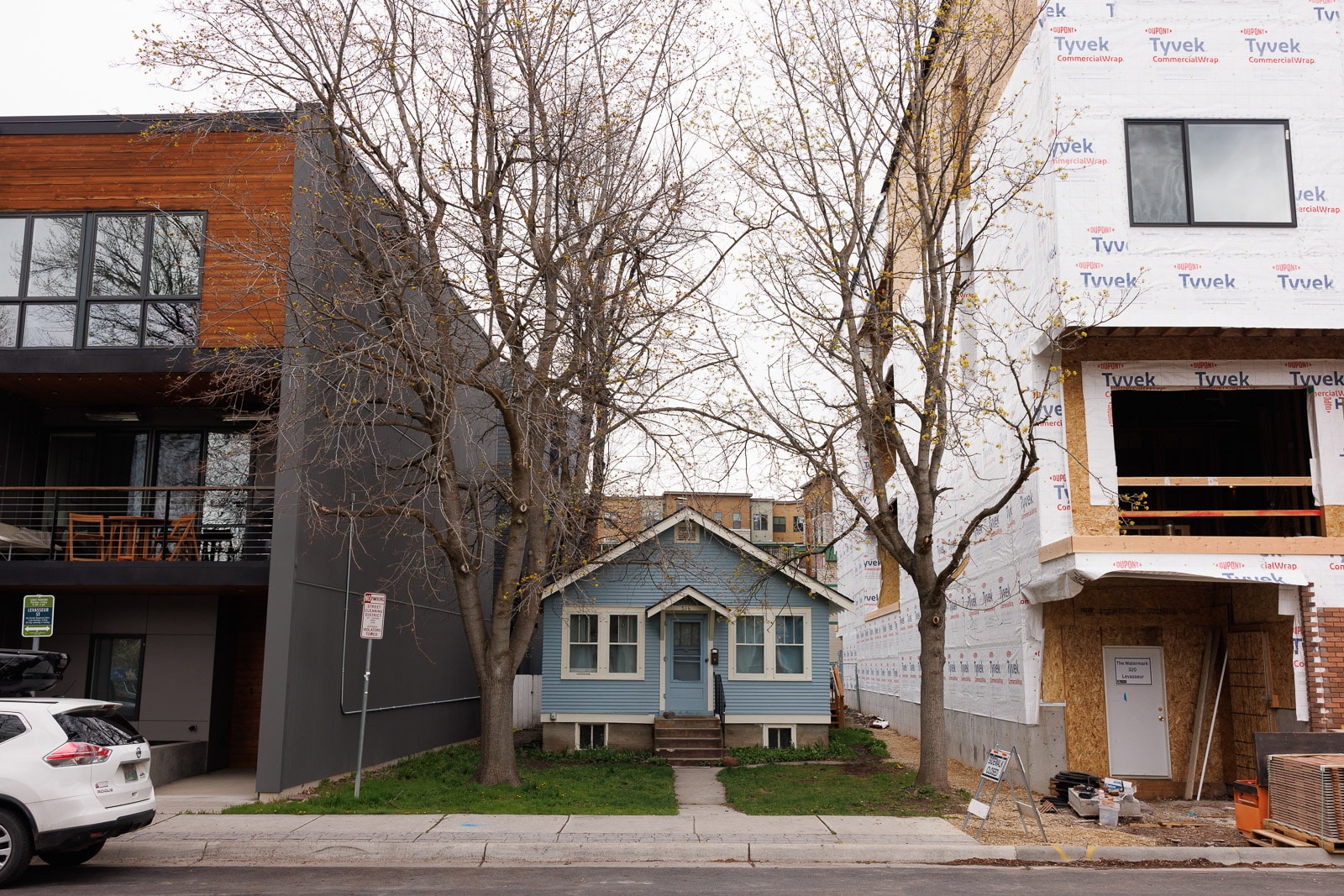
On a drizzly afternoon in late March, Grace Davidson strolled slowly from one end of Levasseur to the other, describing just a few of the ways the recent condo construction has altered life in the little blue house. A tree out front has lost a few branches to a scissor lift. Parking got tricky for a while last year before contractors relocated a chainlink fence around the site. Before the heavy work even began, Davidson recalled people stopping to examine the empty foundations where two old houses on either side of the blue house once stood, tracing their fingers along features no longer there.
Lately, she said, passersby have been referring to the old craftsman itself as “the house from Up!” — a nickname inspired by the popular Pixar movie that couldn’t be more spot-on if you tied balloons to the exposed eaves.
Davidson started renting the little blue house from Alcosser and Maechling in 2022. It didn’t feel like a busy neighborhood, she said, but a lot has changed over the past few years. The biggest change came in 2023 when Alcosser called to say Maechling had died. Davidson wondered about the fate of the little blue house then, certain the project next door had more than a passing interest in the property. But as that summer wore on and her relationship with Alcosser deepened, she eventually asked – and got a clear answer: The little blue house isn’t going anywhere.
Next to walking our dogs and floating the river, debating the pros and cons of growth is one of our city’s most enduring local pastimes.
“I feel like she cares about the house, but she also cares about those of us who live there,” Davidson said.
Missoula is full of little blue houses. Not literally, of course. But that stubborn attachment to place shows up everywhere: in the concrete turtles, the bark of a 100-year-old apple tree, the faded red vinyl of an old Wilma seat gathering pollen on someone’s deck. And we’re always reminding newcomers how great Missoula was just a few years back, before inflation and “Yellowstone” and a bump in population changed everything.
The Watermark is hardly the first or biggest example of infill altering Missoula’s riverfront. Near the little blue house, a pair of dilapidated apartment buildings were replaced with private student housing. From Levasseur you can see clear across the Clark Fork to where old row houses along South 4th Street were demolished for luxury condos. A block from that, a banner for “Higgins Waterfront” drapes across the face of the old Missoulian building where former Grizzlies starting quarterback Cole Bergquist plans to spend $100 million erecting the next major residential and commercial structure. Luxury condos draw plenty of local ire, but the counterargument is straightforward: affluent buyers in new construction means less competition for middle housing.
Next to walking our dogs and floating the river, debating the pros and cons of growth is one of our city’s most enduring local pastimes. Each project attracts its share of supporters and detractors, and the arguments surface everywhere, from public hearings to barroom stools. The Sawmill District redevelopment fueled some of the more lively taphouse debates among my friends for more than a decade. Change has a way of stirring up something deeper when we feel powerless to defend what’s familiar and comforting.

And the little blue house has that effect.
“Levasseur is really compelling,” said Missoula City Council member Eric Melson, whose ward encompasses the downtown corridor, the Rattlesnake and East Missoula, “because it’s like, how do we make room for more people without kind of flattening the physical reminders of where we came from and of Missoula as it’s evolved to the point we are now?”
At a time when Missoula is neck-deep in debating its future, Melson describes the little blue house as “a home in witness.” Melson’s stint on city council has coincided with a series of in-depth debates over the adoption, implementation and amending of Missoula’s latest land-use plan, designed to guide growth across the valley through 2045. As a result, change has been on his mind a lot the past couple years. The way he sees it, it doesn’t have to come at the expense of history.
“There’s value in both,” he said. “Boston is a big, big city, and there’s a lot of modern skyscrapers, a lot of glass and steel. But amongst it are still the graves of Paul Revere and the Longfellow House, and I think that that enriches and enhances the downtown experience.”
The story of the little blue house isn’t a David and Goliath story. This is a story about the complexity of making way for the future we know is coming while protecting the things we love. Many of the neighborhood features that drew Alcosser to it are precisely what drew Edgell, too. And both Alcosser and Edgell talked about the accommodations Edgell made for the little blue house and the street’s current residents.
“It’s sort of asking, in some ways: Is this growth being integrated into the neighborhood character — into the neighborhood fabric — or is it sort of replacing that?”
Edgell acknowledges he had hoped to acquire the little blue house property for his project. But since he hasn’t, he is committed to being a good neighbor. He’s made several adjustments, from relocating utilities to adding off-alley parking and burying electrical lines along the block.
Even so, Davidson has felt the inevitable disruption around her.
“I do wonder what it’s gonna be like when there are more people living in the neighborhood, more cars driving around to get to their parking garage,” she said, as she stopped to greet the neighborhood cat, Chicken. “Is it going to feel like there are people living on top of us?”
Not long after Alcosser and Maechling bought the little blue house, they started hearing stories about the people who once called Levasseur Street home: railroad workers, cabinet makers, lawyers and horologists. They heard about floods, about the neighborhood’s fight in the 1970s to avoid condemnation. According to state records, the house’s original architect and builder have been lost to time, but its early occupants included a laborer, a postal worker, a city fireman, a U.S. Forest Service clerk — a cross-section of the working lives that were actively shaping the area.
“The stories of a neighborhood mean a lot,” Alcosser said. “You can’t just destroy a neighborhood and then add culture. We’ve learned that over and over.”
In the early 1980s, Levasseur street lost a whole second block — demolished to make way for the Holiday Inn Parkside. Other parts of the streets have been preserved and moved. In the 1930s, a young girl living along what was then known as East 1st Street, left her footprints in wet cement a couple doors down from the little blue house. According to a story written up as lore in a Parks and Recreation brochure, she drowned in the Clark Fork not long after, and the street was renamed in her honor: Levasseur.

It’s not something you’d think would survive — sidewalks crack and get pulled up and repoured all the time. But someone remembered to save it. Today, the so-called “Levasseur Panels” can be found in Bess Reed Park, a slab of nearly century-old pavement marked with footprints that tell a piece of the neighborhood’s history.
“They’re like the little blue house,” Alcosser said. “Emblematic of a colorful place and people who lived here once beside the Clark Fork and now are no more. We’re left behind to tell their stories and remember them kindly.”
That’s how houses get to us. We leave our marks on them and they leave their marks on us. Alcosser still thinks about a small red cabin she and Maechling rented up Rock Creek, where they were married. Melson remembers a house near the railyard, in an area now slated for high-density development. Edgell recalls a place in the Slant Streets where he could bike to Bonner Park with his kids. Mine was a quaint attic studio a few blocks from Bernice’s.
For Davidson, it’s the little blue house.
These spaces become the backdrops for our lives. They anchor our memories in something physical — something we may dread losing, even when we understand the reasons why it has to go. Which is why the sight on Levasseur, of a little blue house tucked in the shadows of a growing city, is so stirring. As an elected official, Melson is tasked with looking at the whole picture. And he seems sympathetic to all sides, wary of seeing parts of Missoula’s history vanish but cognizant of the community’s very real and pressing needs.
“It’s sort of asking, in some ways: Is this growth being integrated into the neighborhood character — into the neighborhood fabric — or is it sort of replacing that?” Melson contemplated. “I don’t know what the answer to that is. I think time will tell.”
As far as Alcosser is concerned, the little blue house, at least, will endure. And not just as a relic. She envisions it as a home for visiting scholars —in the arts or in preservation — ensuring it continues to contribute to the lore of Levasseur. Our history is our gold, she said. It’s a currency measured in wood siding and footprints immortalized in concrete.
“The story,” she added, “is still there.”