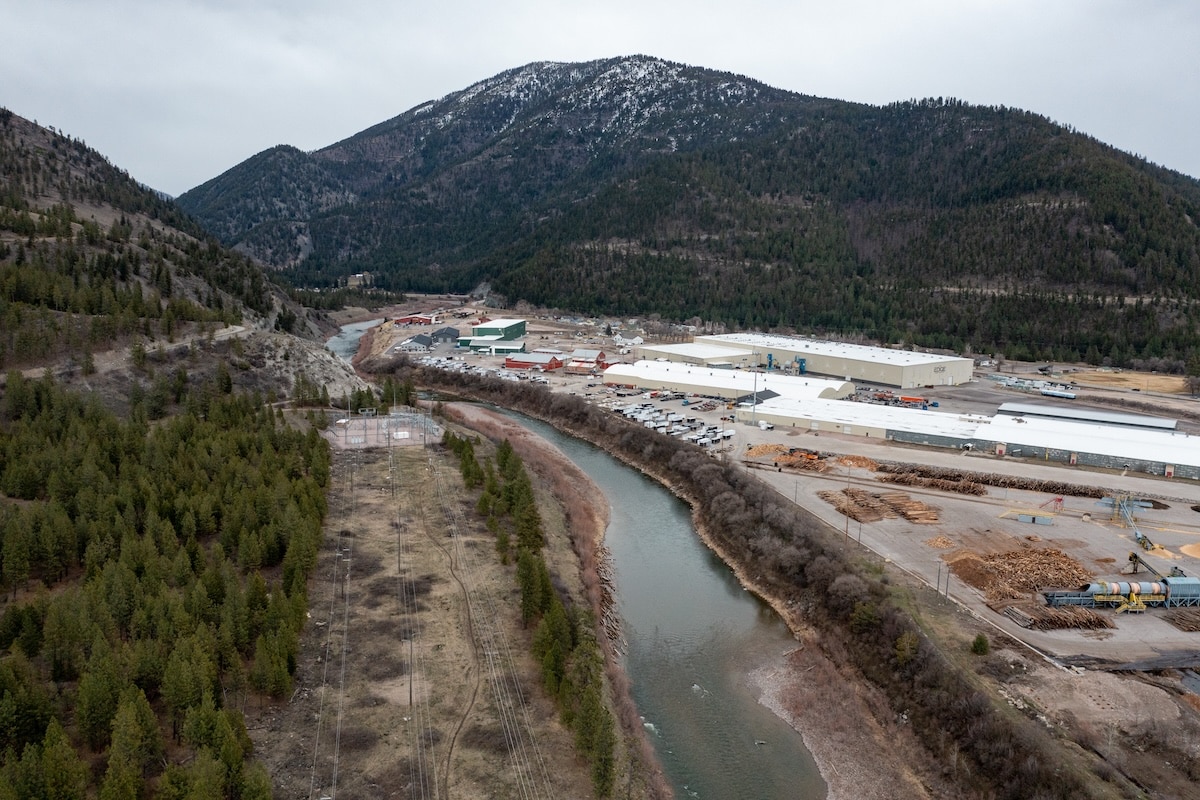
In 2020, a bitcoin mining facility at the Bonner Mill Industrial Park filed for bankruptcy and shut down. For some community members, the closure was a relief. Since the facility opened in 2017, residents had complained about the constant hum from the more than 450 fans used to cool the servers, saying the noise disrupted sleep and could lead to lowered property values. They packed community council meetings, bringing their gripes to the county.
Managers of the mill site and the mining company, Hyperblock, replaced the fans to mitigate the noise. But for the mine, the first of its kind in Montana, trouble was just beginning. In 2019, when Hyperblock started planning an expansion that would triple its power consumption, Missoula county stepped in. Commissioners adopted emergency zoning rules requiring new or expanding crypto mines to source power from new renewable energy.
Hyperblock had been using hydroelectric power already on the grid. County commissioners argued the operation’s scale strained the supply, pushing other users onto nonrenewable sources instead of contributing new clean energy. At the time, the county maintained the interim rules were necessary to hit the county’s resolution of 100 percent clean energy by 2030.
Like with the cryptocurrency boom, the building of AI data centers is accelerating nationwide as tech companies race to keep up with demand — and stay ahead of competitors.
Expansion at the mine halted, and when Bitcoin crashed in 2020, Hyperblock folded with it. A year later, in 2021, the interim rules were made into permanent zoning laws, considered some of the first of their kind in the country.
After the mine closed, the site was occupied by UFP Industries, which shut down its prefinished facility last year — citing a need to consolidate — and laying off 100 workers.
Now, a new project proposal may test those laws. In mid-March, Krambu, an Idaho-based tech company with a registered address in California, submitted a proposal to build an AI data center on the same site the bitcoin mine once occupied. And with the memories of the bitcoin days still fresh, the project has reopened old wounds.
Like with the cryptocurrency boom, the building of AI data centers is accelerating nationwide as tech companies race to keep up with demand — and stay ahead of competitors. These facilities house large networks of servers that store data and perform the intensive computing required for artificial intelligence tools. Some analysts question whether that pace is sustainable, raising the possibility of an AI-driven market bubble. Supporters argue the facilities are needed to meet growing demand and can bring local economic benefits, including jobs and tax revenue.
In Bonner, this new proposal is raising familiar concerns about noise, energy use and long-term impacts.
“I like my water for drinking, not generating deepfakes and slop.”
Complaints about the data center proposal have poured onto the county’s webpage, with people pointing to concerns like water usage while others highlighted ethical qualms about AI, in general.
“I like my water for drinking, not generating deepfakes and slop,” one post reads. “Society doesn’t need more artificial intelligence!” another states.
Krambu has applied for a special exception — a zoning requirement for projects within 500 feet of residential areas — which will be reviewed in early June by the county’s land use board. Ahead of that, the Bonner-Milltown Community Council will be taking public comment at its meeting on Monday, April 13. The special exception process examines potential traffic and parking impacts, as well as noise levels that could affect nearby residences, and looks at how the company plans to mitigate them, said Jennie Dixon, the county’s planner on the project.
During a public Q&A on March 20 hosted by Friends of 2 Rivers, Dixon directly addressed the former bitcoin project before a room crowded with around 150 people, including a panel of Krambu officials, county planners and the manager of the mill site.
“Those of you who lived through [the mine] — wow, I’m impressed,” she said. “We made it through. And that will not happen again.”
But what the county will — and won’t — consider in the process has become a key point of tension.
Besides going through the special exception review, the updated zoning from 2021 will require Krambu to prove two things: that they will use e-waste recycling and that all the power they use will come from a new renewable energy source, something Dixon called a “significant first hump.” This means Krambu must show they are adding new electrons to the grid that come from a renewable source.
Here’s what the county zoning doesn’t address about the operation: how much water will be used, how much power it will ultimately consume and who the client might be once the center is operating.
The park, as a whole, is zoned as heavy industrial, and has already existing environmental regulations.
Here’s what the county zoning doesn’t address about the operation: how much water will be used, how much power it will ultimately consume and who the client might be once the center is operating.
That knowledge gap has made issues like water use a focal point of public concern. Medium-sized AI data centers — defined as 5 to 30 megawatt facilities — can consume up to 110 million gallons of water a year to cool their servers. But Krambu officials have stated their system will use a closed-loop liquid cooling process, in which treated water circulates through and evaporates. The system will require an initial fill of about 500 gallons per megawatt and will need to be intermittently flushed. Mike Heisey, general manager of the mill site, said the water will come from private wells on the property.
In its application, Krambu said the system will not generate sanitary, sewer or storm runoff and all evaporated water will drain into an already existing onsite drainage system. Still, key details remain unclear, including how quickly water will evaporate, how often the system will need to be refilled and what chemicals will be used in treatment. Krambu considers some of these details proprietary.
At the March Q&A, a project contractor — Matt Afana of Polar Construction — described the chemicals as “non-toxic,” likening them to water softeners. He said the water will be tested and reported to the Montana Department of Environmental Quality.
Questions about electricity use have also surfaced. Krambu has applied for 3 megawatts — roughly equivalent to the electricity used to power between 1,800 to 5,000 homes — and plans to eventually expand to 20 megawatts. That scale echoes the site’s previous use. The former bitcoin mine operated at 20 megawatts and at times consumed as much electricity as one-third of Missoula’s households. It had sought to expand to 60 megawatts before county regulations halted those plans.
Heisey, the site manager, told The Pulp that he only has onsite infrastructure for 30 megawatts, and believes it’s unlikely the center will expand beyond that.
Dixon, the county planner, said that it doesn’t matter the amount of wattage Krambu uses “as long as they use new renewable energy.”
Tax revenue from data centers in Loudoun County, Virginia — known as “Data Center Alley” — has helped offset local tax rates and support thousands of jobs.
Krambu officials say they will pay to bring power to the site and that the project should not affect local utility rates. The company plans to work with NorthWestern Energy to transmit electricity from an external supplier, covering the cost of any needed infrastructure upgrades. The company has not said who the supplier would be, but they have stated it would not come from Missoula’s local utilities, NorthWestern Energy and the Missoula Electric Cooperative.
But questions remain about long-term impacts on the regional grid and whether additional demand could indirectly affect costs or reliability — questions that have surfaced in other communities.
The county does not regulate transmission. The Montana Public Service Commission oversees utility rates, and state law requires certain large new electricity users to demonstrate that their demand will not negatively impact the public. Whether that requirement applies to the proposed data center remains an open question. The answer may depend on how the project ultimately sources its power, including whether it’s treated as a new large load or as an extension of existing infrastructure already connected to the grid.
In Montana, the Bonner proposal is part of a broader wave. NorthWestern Energy has signed agreements with multiple companies to develop data centers in Butte and Yellowstone County and is in discussions with at least 11 more developers, according to the Daily Montanan.
Krambu has argued the project would benefit the local economy, estimating about two employees per megawatt plus contract construction jobs. (The bitcoin mine directly employed about 19 workers.) Research suggests these benefits can vary. America’s Rural Future’s January symposium found employment benefits from data centers are “variable and often overstated” due to the duration and accessibility of the jobs offered.
For some communities, however, data centers have stimulated the local economy. Tax revenue from data centers in Loudoun County, Virginia — known as “Data Center Alley” — has helped offset local tax rates and support thousands of jobs.
The center will run at somewhere between 50 and 55 decibels in accordance with the new regulations — about the same volume refrigerators hum.
Still, opposition has become a defining feature of the industry’s expansion. An estimated $64 billion of data center projects were blocked or delayed between May 2024 and May 2025 due to local opposition.
Krambu itself has roots in the crypto industry. According to a 2020 Spokane Journal of Business article, Krambu previously focused on blockchain technology before making an early expansion into AI, which allowed the company to survive the crypto crash and make “millions in sales over the course of a few months.”
Krambu officials have distanced themselves from the legacy of Bonner’s former bitcoin mine. At the March Q&A, CEO Steve Wood criticized the bitcoin computers, calling them “garbage,” and saying, “They had these awful fans.” Krambu representatives say the data center would use newer, more efficient equipment.
Company officials say the operation will feature dampeners to mitigate vibrations below what the human ear can detect. The center will run at somewhere between 50 and 55 decibels in accordance with the new regulations — about the same volume refrigerators hum. These details will be examined by the land-use board in June, which typically makes a decision within the day — meaning the data center could move on to the next step as early as June with zoning compliance.
As AI continues to drive this rapid development of data centers, whether projects like the one proposed in Bonner will deliver long-term local benefits or follow a boom-and-bust cycle similar to cryptocurrency remains an open question.
The Bonner-Milltown Community Council will be discussing Krambu’s proposed data center at its meeting on Monday, April 13, at 7 p.m. in the Bonner School Cafeteria or via Zoom. More info here. Or contact bcommunitycouncil@gmail.com.