April 9 is Local News Day, a nationwide initiative to promote local news and help people find and support the journalists covering the communities where they live.
While the initiative has grown to include more than 1,200 participating news organizations across the country, it grew out of a Montana newsroom: Montana Free Press, a statewide nonprofit news site founded a decade ago by former Great Falls Tribune capital bureau chief John S. Adams. (It was also this reporter’s last full-time employer before decamping to Missoula for graduate school.)
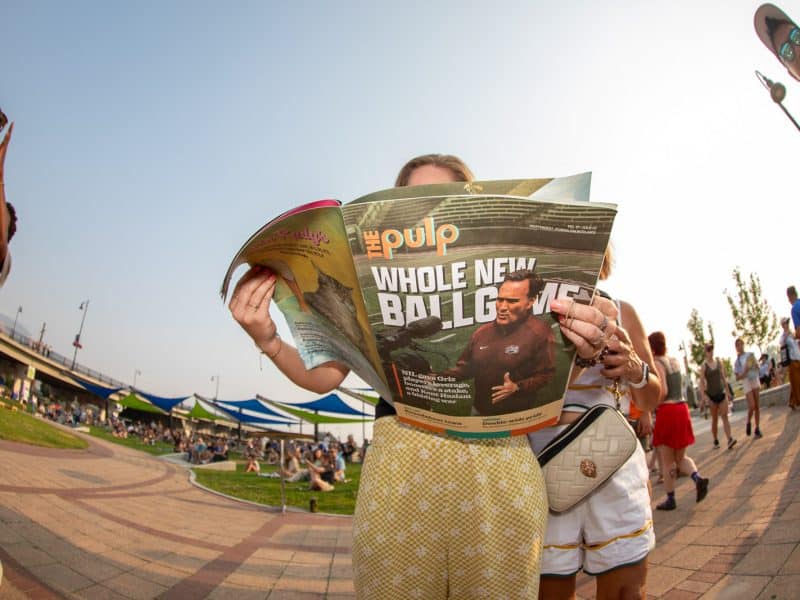
Dozens of Montana newsrooms are involved, including The Pulp, which, like MTFP, relies on readers’ support. At a time when we’re drowning in news and starving for local reporting at the same time, Local News Day is meant to spotlight the trusted institutions doing critical work in our communities.
Aside from MTFP, initiative sponsors and partners include Press Forward, a national philanthropic coalition that supports local news, The New York Times, Google News Initiative and the Missoula-based Headwaters Foundation, among many others.
As Local News Day approaches, we sat down with Adams to discuss how a conversation over coffee in Helena sparked a national movement.
The Pulp: So, what should we expect on April 9 itself? Is this a donation and subscription drive? A public event?
John Adams: We’re not really being prescriptive. It’s a day of action and a day of awareness, primarily. What we hope to see is a massive social media campaign where people are going to be amplifying Local News Day all across the country. And we hope they visit localnewsday.org, which we’re hoping will become the most comprehensive directory for trusted local news on the internet.
How did this get started?
In December 2024, I was having coffee with (Missoula’s) Matt Singer, who had started National Voter Registration Day. The idea behind that was there are a lot of people who aren’t registered to vote because they lack awareness. The idea was to make people aware of registration and get more people signed up before registration deadlines. We thought, Why isn’t there something like that for local news? The narrative has been one of decline, decay, desertification — this idea that local news is disappearing. But you and I both know that there’s a lot of actually great stuff happening on that front. There just isn’t enough attention.
“We want people to discover something that’s right under their noses and be moved by it. “
So the idea is: Let’s take a page from the playbook of Voter Registration Day or Giving Tuesday and create an annual holiday of sorts for celebrating local news — to flood the information zone, get people curious, get people engaged. It’s also a galvanizing opportunity to do some great journalism and experiment with audience development.

It’s kind of like Record Store Day. People are really excited about the tangibility of something physical, something local, something they can feel a part of. I think there’s an opportunity with sort of the exhaustion people have — when people talk about tuning out the news, being exhausted by the news, they’re not talking about their local newspaper or TV station, for the most part, but they’re talking about what they get from their national outlets. We want people to discover something that’s right under their noses and be moved by it.
Who else is involved? How is this run?
It’s technically a project of Montana Free Press. We have a steering committee made up of a diverse array of folks around the country — journalists, former journalists, publishers, hyperlocal people. It’s a volunteer group of folks who meet regularly to help advise it. We have between 170 and 180 partner organizations. We were hoping to get 500 participating newsrooms. We’re now at more than 1,200. We’ve been really pleased.
So is this just for new-age nonprofits like Montana Free Press or The Pulp?
This isn’t really about your business model or your tax status. Obviously, my focus for the last decade has been on the nonprofit model for Montana because that made the most sense for me for the type of work that we do here. But [Local News Day’s] steering committee has a subcommittee that is reviewing applications from folks who are not as traditional. Maybe you’re an SMS news service — we know that there are podcasters, influencers, YouTubers, who are doing high quality local news in different formats.
And it’s being embraced by more traditional outlets like, in Montana, the Billings Gazette, Bigfork Eagle and Choteau Acantha, among many others.
But I imagine your experience in Montana and with Montana Free Press has informed this effort, right?
My interest in this kind of sprang out of conversations I’ve been having for a couple of years with publishers all across the country. As we’ve tried to build both an audience and revenue that can sustain growth of our news operation, we’ve really done a lot of work to try to build a strong relationship with our audience. Building reader loyalty through engagement, responsiveness, writing about things people care about and want us to be writing about, focusing on the issues that matter to them — building that trust with our audience over time has paid off not only in how many readers we have but the percentage of those readers who contribute financially to Montana Free Press, even when they don’t have to.
“If you’re just relying on a handful of grants, or one major advertiser to keep you afloat, you’re one major grant or advertiser away from disappearing.”
When I talk to orgs all over the country about audience and revenue, we just weren’t hearing people putting a lot of thought into that. They don’t put as much effort into thinking about how do we actually grow our audience, grow our revenue. If you’re just relying on a handful of grants, or one major advertiser to keep you afloat, you’re one major grant or advertiser away from disappearing. Let’s grow audience for local news, and let’s also train and incentivize a news organization to think about your relationship with your audience.
The short answer of why Montana Free Press is that nobody else was doing this. And I couldn’t find anybody else to take it on. I do think having it kind of originate in the heartland, if you will, as opposed to one of the coastal cities, gives it a sense of authenticity that I think makes small and rural newsrooms quicker to buy in.
People find we write about issues in a way that they can make sense of. It might not be about the place you’re in, but it helps you understand the issue. Montana, for example, has one of the smallest percentages of undocumented immigrants anywhere in the country. But the immigration crackdown still affects local communities and people here.
Here’s what you can do on April 9: Share a story that mattered to you — with a friend, on social media with #LocalNewsDay, or both. If you’re not already getting The Pulp’s newsletter, sign up here. You can find other local newsrooms across Montana and across the country at localnewsday.org. Adams has more on how the initiative came together here.