In 1971, a smokejumper-turned-astronaut named Stuart Roosa took a pocketful of tree seeds with him on a trip around the Moon, curious if space would have any effect on them. When he returned to Earth, the government grew the seeds into seedlings — “moon trees” — and distributed them across the country as part of the 1976 bicentennial celebration. Missoula got one. Maybe two. And then, as in other communities that planted moon trees, the fanfare faded. Now, 50 years later, not only are Missoula’s moon trees gone, but we hardly remember them.
The Pulp asked me, a historian, to unearth the story of the trees. But little was written about Missoula’s moon trees at the time, and the passage of time meant that people involved with the plantings have passed away or their memories are cloudy. Still, in some ways, all of the country’s moon trees are more present than ever as coverage of the 50th anniversary of their planting returns them to our orbit — an awareness that has many wondering whether moon trees were planted in their communities and, if so, what happened to them. And that awareness has brought back into view the strong link between the Earth and Moon that the moon trees have always represented.
To think about this link, let’s go back a little further in time, say about 4.5 billion years ago. That’s around when a gigantic protoplanet, Theia, slammed into the young Earth, blasting material into space that eventually coalesced into the Moon. Despite this rather violent origin, the Moon helped stabilize the Earth’s wobble, like a good friend steadying us home from the bar. The Moon may even help explain our existence: The impact that formed it may have changed Earth’s atmosphere in a way that enabled early life, while its stabilizing effect on Earth’s wobble may have created a climate suitable for the evolution of complex life, like trees and humans.
We know a lot of this history because of the science-focused Apollo program of the 1970s, which shifted beyond the Cold War-driven “space race” of the 1960s. The 1971 Apollo 14 mission, on which Roosa served as Command Module Pilot, was one of these science-focused space missions. When he was selected for the Apollo mission, Roosa hatched a plan with the chief of the Forest Service (the agency he had worked for as a smokejumper) to bring tree seeds into space. Scientists had long been interested in how space might affect living organisms. Roosa’s seeds were not part of a formal experiment, but they were born of the same curiosity about the effects of space on terrestrial life. It also seems that Roosa just had a love of trees, and so he squirreled away about 500 tree seeds, along with his wife’s wedding ring, in his small “personal preference kit.”
Trees, of course, take a long time to grow. And in the meantime, people’s minds move on to other things.
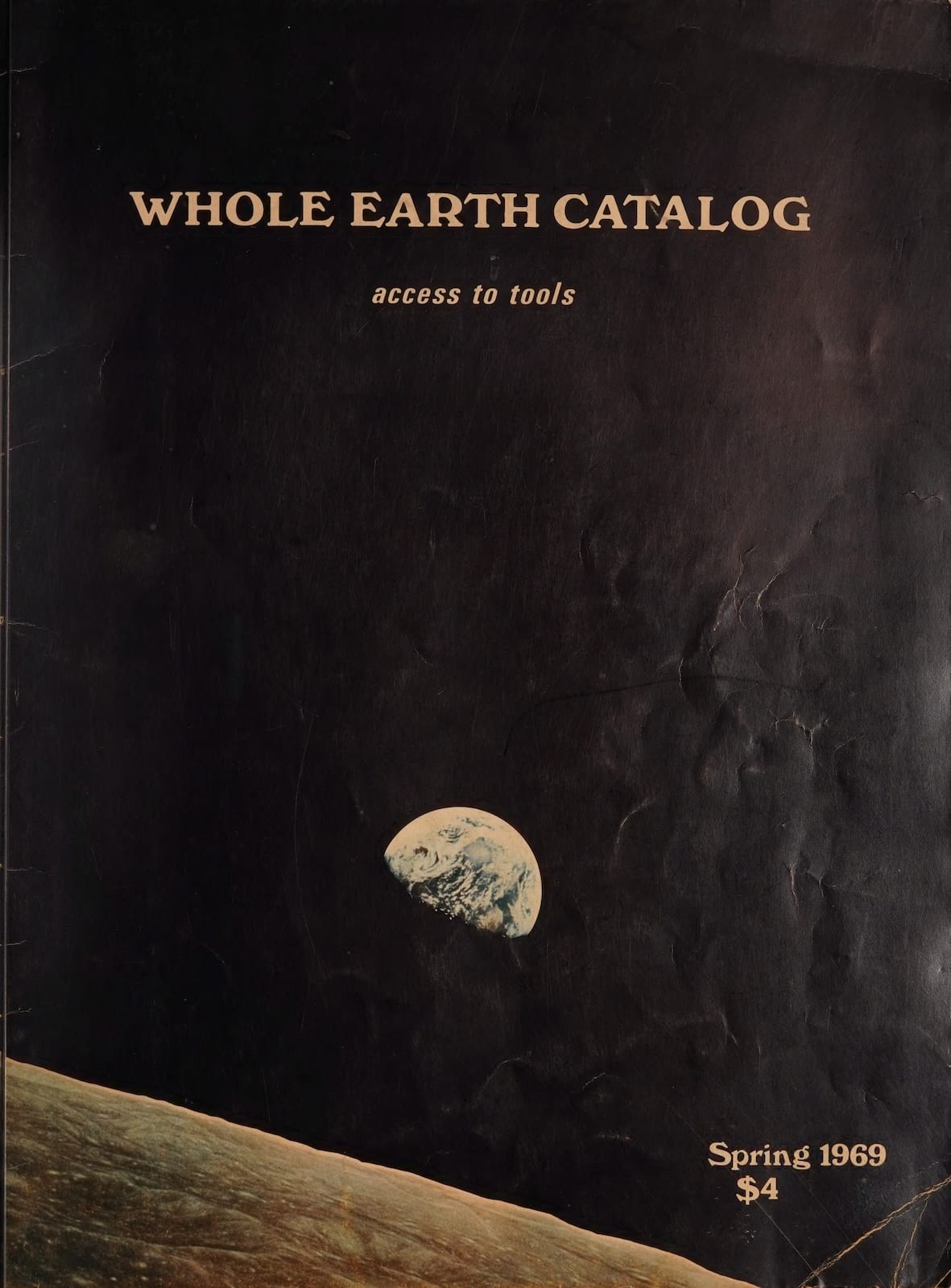
Back on earth, an environmental movement had gained momentum and, by the early 1970s, was especially active on campuses like the University of Montana, which launched one of the country’s first environmental studies programs. One 1971 course included among its assigned readings the Whole Earth Catalog, an underground magazine at the forefront of the back-to-the-land and appropriate technology movements. The catalog’s name came from a campaign its publisher, Stewart Brand, launched in the 1960s to get NASA to publish a photo of the whole earth from space. NASA took note, although the agency was already working to publish photos of the Earth from space. When NASA published photos of Earth, Brand used them on the cover of the magazine. The images, which underscored the vulnerability and singularity of planet Earth, inspired other environmentalists, such as Sierra Club founder David Brower, as well. The Apollo space program, for all its lunar gaze, ended up pushing Americans to think harder about life on Earth.
The post-war environmental movement culminated in the first Earth Day in 1970. The next year, Roosa’s seeds went around the Moon and returned to Earth, where the Forest Service grew them alongside seeds of the same species — loblolly, sycamore, redwood, sweet gum, Douglas fir — that had not been into space. But the moon trees showed no effects from their time in the great void, and the Forest Service probably didn’t expect much from this experiment anyway. So it decided to give the trees away, mostly as part of the national bicentennial celebration in 1976.
Most seedlings went to state forestry departments, which distributed them to schools, universities and other organizations. It was not a highly structured distribution process, except in getting the appropriate tree species to appropriate habitats. In spring and summer of 1976, in a sort of rolling conjuncture of festivities — Earth Day (April 22), Arbor Day (late April), and the 4th of July — officials and students across the nation shoveled out little earthen craters, planted their moon seedlings, and waited for them to grow.
Trees, of course, take a long time to grow. And in the meantime, people’s minds move on to other things. In most places, the moon trees offered a brief moment of excitement and then many were forgotten. There are few stories in newspapers about moon trees in the first two decades after they were planted. But in the late 1990s, as the result of a trickle of questions from people about moon trees, a NASA researcher, David Williams, began researching them more and eventually built a website and database to catalog them. Since the 2000s, many communities have researched and documented their moon trees, and a clearer national story of the moon trees has emerged.
What about Missoula? NASA’s list of moon trees shows only one for Montana and lists it as having been planted at the University of Montana. But a little research shows that there were actually two moon trees scheduled for planting in Missoula. A May 1, 1976, Missoulian photo shows two students standing with forester Bob Storer who holds a Douglas-fir seedling with the caption reading: “As part of Arbor Day observances around Missoula, the division of forestry of the state Department of Natural Resources and Conservation Friday presented a ‘Space Age tree’ to pupils at Target Range Grade School.”
Coincidentally, one of the Target Range students was named Serena Moon. Serena has since died, but her older brother Colin Moon (who was not at Target Range at the time) said it’s likely that tree ended up at that school because their father, Gareth Moon, was the state forester at the time.
Beyond the brief newspaper caption, we do not know much about the planting. But according to two teachers who worked at Target Range after the tree was planted, Holly Raser and Kaye Ebelt, the planting was successful and the tree grew in the area to the south of the school for several decades. That area became a bit of a space-themed outdoor nook, with a 10-foot-tall space rocket replica and some tomato plants grown from seeds that had flown on a different space mission that Ebelt had been given as part of a NASA teachers program.
According to Ebelt, the moon tree was cut down in the mid-2000s as part of a redevelopment of the area south of the school that included a new track. Ebelt had a special interest in teaching kids about space, and she remembers the removal of the moon tree being contentious. She was a track coach, but felt the removal of the tree was unnecessary.
“That just broke all of our hearts,” Ebelt said. “It was so sad.”
Much of the Target Range moon tree’s past remains hard to reconstruct. Ebelt was not able to positively identify the moon tree in older pictures. Some former students and teachers remember it only vaguely if at all. But we know the basics of what happened to it: that it was planted, where it was planted, how long it lived, and what happened to it. The same is not true of the University of Montana’s moon tree.
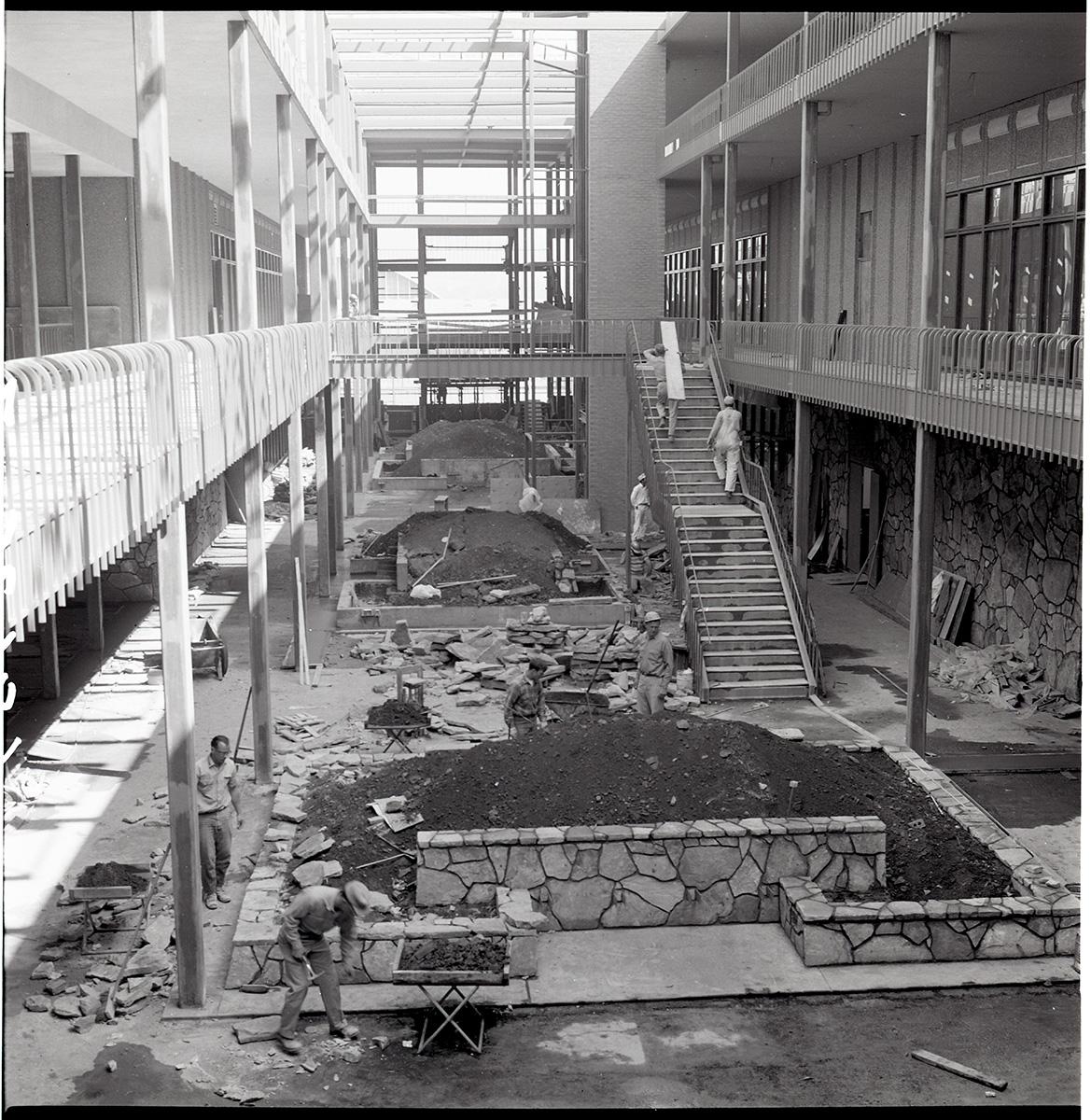
The University of Montana has a strong tradition of forestry research and Missoula has a strong connection to the Forest Service and smokejumping, so it is no surprise that one of Roosa’s moon seedlings landed at UM. What is surprising is where it apparently landed: inside the University Center “mall,” or what is now called the atrium — the open area filled with plants and light that feels like you’re walking in a greenhouse.
In 1968, UM built the large, modern University Center. At first, the atrium was uncovered, open to the elements and planted with hardy, native plants. That, however, proved to be an energy inefficient and uncomfortable building design, so in 1971 UM enclosed the building. After a period of neglect, the indoor garden got a new life as a tropical wonderland managed by a free-spirited gardener, Eugene Beckes. It was Beckes who was in charge when the moon tree was scheduled for planting on July 17, 1976.
Several big shots in forestry science were appointed to conduct the planting ceremony, including Roger Bay, the director of the Intermountain Forest and Range Experiment Station, and Robert Wambach, the dean of the School of Forestry. According to UM’s press release at the time, the ceremony was to symbolize “the progress made in forestry research over the last 100 years as well as the important role the UM School of Forestry has played in that progress.” So UM and the Forest Service used the moon tree as an opportunity to connect forestry science to what many people regarded as the ultimate in advanced science: space exploration.
The story of the moon trees isn’t really about us losing something we once strongly valued. It’s about realizing we lost something that we now strongly value — something some of us didn’t even know was missing until now.
But here’s the thing: The moon tree was a Douglas-fir seedling — a temperate tree species — and yet the press release indicates (twice) that the tree was to be planted inside the UC mall. In other words, in a tropical greenhouse. A Douglas-fir tree would die in that environment, as any forester in Montana would know. That’s like announcing that the most eminent tropical forest scientists will be celebrating 100 years of research progress by planting a banana tree in Glacier Park. It doesn’t make any sense. And yet the only description we have of UM’s moon tree planting comes from this press release and a brief Missoulian announcement that also says it will be planted inside the mall. So the question is: Was a moon tree actually planted there?
In addition to the biological implausibility of planting a Douglas-fir seedling inside a tropical greenhouse, the atrium managers from this time do not remember the moon tree. Kelly Chadwick, who took over managing the UC garden in 1983, does not remember hearing anything about it. Chadwick also reached out to Beckes, the garden manager in 1976, but Beckes likewise said he had never heard of the moon tree. The tree, of course, would not have survived for long, but Beckes would likely remember the ceremony and the attempt to plant a Douglas-fir in the tropical garden he managed.
Oddly enough, despite what sounds like a fairly elaborate planting ceremony, there was no follow up article about the planting in the Missoulian or Kaimin newspapers. Did the ceremony get canceled? Was the tree even planted? Was the press release misworded in suggesting the planting would be inside the UC, and the tree was actually planted on the grounds somewhere?
There are various gardens around the outside of the UC and plenty of green space to plant trees in between buildings. However, Chadwick says that Beckes would have been aware of plantings on those places, too. If there was a tree planted near the UC, it does not seem to have survived. And the few Douglas-firs near the UC, are much too big to be the moon tree (and are clearly visible in pre-1976 photos).
My guess is that, given the connection to the Forestry School, the tree might have been planted near the Forestry Building. And then, over the next 10 or 15 years, its origins might have been forgotten, and with further campus developments — new buildings, parking lots, etc. — inadvertently removed.
But then again: a 2006 history of the Intermountain Station includes this brief note in a timeline for 1976: “Director Roger Bay planted a Douglas-fir seedling in a ceremony at the University Center Mall at the University of Montana. The seedling was grown from a seed that was taken to the moon in 1971 on the Apollo 14 mission.” If this is based on Bay’s memory, perhaps they did plant the seedling in the mall after all? Unfortunately, Bay has died, as have the three other participants listed in the UM press release. So we will probably never know.
In the end, what we are left with is what Chadwick said to me when I first reached out to her: “I really wish I knew more about this tree and that it survived at UM.”
Could we have – should we have – foreseen the value these trees would later have? For Ebelt and a few others, moon trees were always valued. But many Missoulians — and Americans, more broadly — were unaware of moon trees for decades. Some had already disappeared, but even the moon trees that survived became separated from their origin story. To most people, they were just trees. The story of the moon trees isn’t really about us losing something we once strongly valued. It’s about realizing we lost something that we now strongly value — something some of us didn’t even know was missing until now. Stuart Roosa is barely remembered today, but when he is, it’s almost always for the moon trees — which didn’t even merit a mention in his 1994 obituary. We’re not always good at predicting what we’ll care about in the future. Time capsules, for example, are often a massive disappointment when we dig them up — filled with newspapers, class photos, commemorative coins and all sorts of self-consciously historical objects that turn out to mean less than expected. But some things accrue meaning in ways we didn’t anticipate, and the moon trees are one of those.
But why do we care about moon trees?
Part of it is the wonder it sparks of these trees that came from space. Just the name “moon tree” conjures something otherworldly or fairy tale-like.
Part of it is their origin story, where a guy who loved trees used some of his precious personal space to take tree seeds with him on one of the most incredible voyages in human history.
And part of it, too, I think, is the way moon trees can remind us of the connection between the Earth and Moon: the way they are bound up with each other geologically, and how the Moon has perhaps shaped life on Earth. It hasn’t been proven, but there is a strong possibility we might not exist without it. We know that because we went to the Moon and explored it — and exploring it changed the way we understood home.
Edgar Mitchell, who was on the same Apollo 14 mission as Roosa, came back from the Moon describing what he called “interconnected euphoria” — a sudden, overwhelming sense of the fragility and connectedness of life on Earth. Roosa brought us something to plant and Mitchell brought us something to think about.
We value moon trees now more than ever, because unlike time capsule junk, they are revelatory and meaningful. They provoke our imaginations, they give us a storied landscape, and they make us think deeply about ourselves and our world. But it is worth remembering, also, that the moon trees do this symbolically. There is no lunar essence in them. Space did not affect them. They are physically identical to regular trees.
But then again, the fact that the Moon might have given us the very climate that gave us trees (and our own lives) is extraordinary on its own. Every tree is remarkable, if you follow the story back far enough.
Missoula’s moon trees are sadly gone. But the story of the moon trees is not gone and neither is our ability to think about them. You can still look up through the branches of any tree, through the canopy, up to the Moon and think about everything that connects us to it.