In bear country, safety comes with a price tag. While on a trip in Alaska in 2021, Holly Longen and Ryder Febo visited a fish ladder near Cooper Landing where they came across several freshly killed salmon. They had two realizations: one, a bear was nearby, and two, they really should have brought bear spray.
The only rental place nearby was closed, and buying a canister just to throw it away after a couple days seemed wasteful. They resorted to knocking on strangers’ doors, hoping someone might lend them some. Eventually, the front desk clerk at a hotel gave them a canister left by a guest. But they had no idea if it worked. If the former owners had deployed it, there might not be enough to deter a bear. And even if it were full, had it been stored right? Heat and improper storage can weaken the propellant. That’s the thing with bear spray: The only way to know if it works is to use it when you need it.
Frustrated, they drove down the Kenai Peninsula toward Seward. Why, in one of the most bear-dense places in the country, was it so hard to find bear spray? As they continued to drive, a roadside coffee shack — a tiny trailer in an empty dirt parking lot — came into view. And that’s when it came to them: Why not a bear spray shack?
In the 40 minutes it took to reach Seward, they mapped out their vision for Bear Spray Shack, a fully automated bear spray vending machine. That night, they bought the website domain while waiting for their dinner reservation.
Five years later — after two years of development and a soft launch in 2023 — their bear spray vending machines are equipping visitors with the potentially lifesaving deterrent, from Glacier and Grand Teton national parks to Denali.
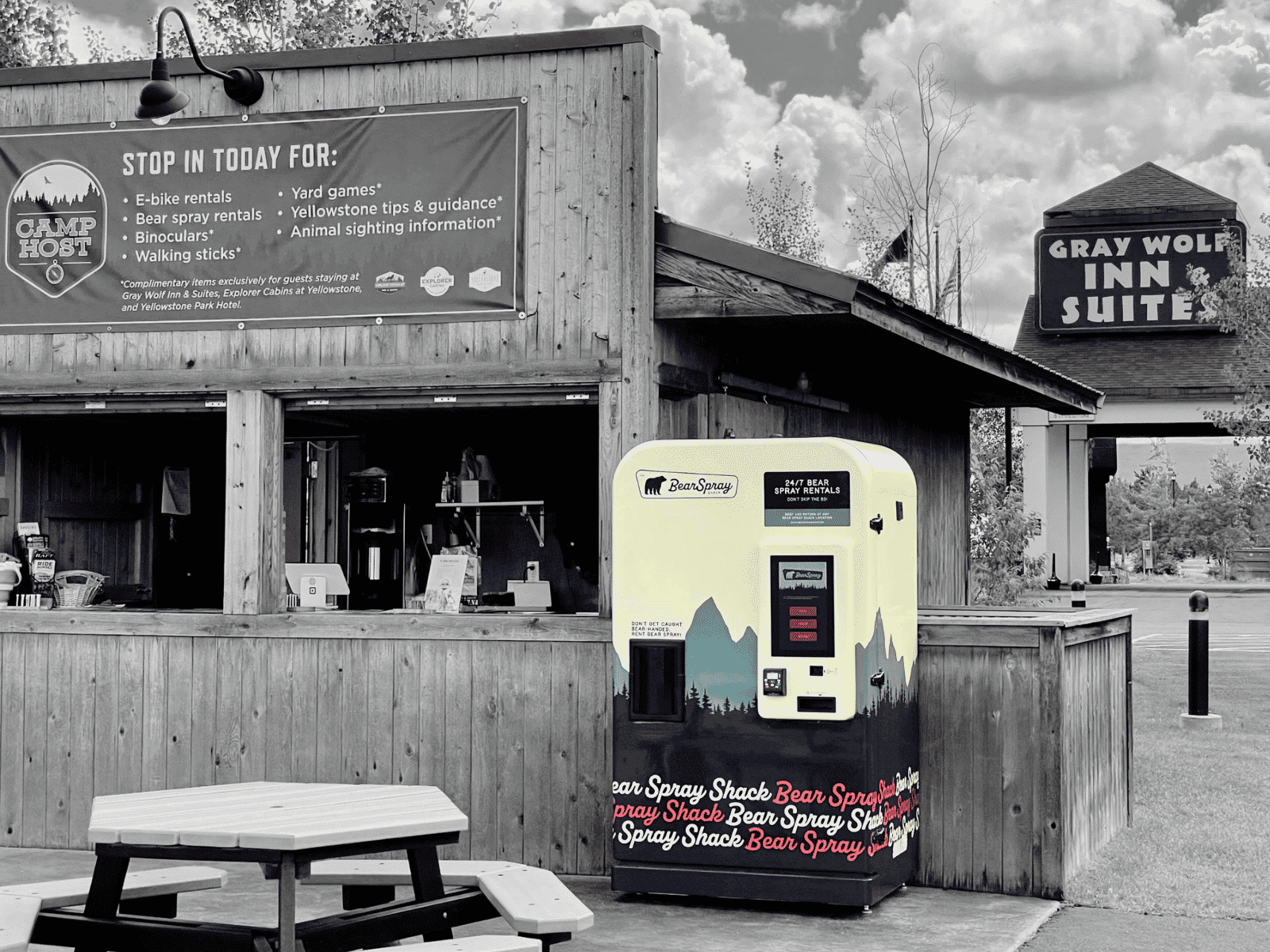
The process is simple: Customers swipe their ID and credit card — the machine requires renters to be 18 or older and agree to a digital waiver — and out pops a canister of bear spray complete with a belt holster. They return the canister to any machine when they’re done hiking.
“Last season, we put over 7,000 canisters in people’s hands over five machines,” said Febo.
It costs $10 the first day and $5 per additional day to vend a canister — low enough to change the calculus on one of the biggest barriers to carrying bear spray in the first place. Renters are only charged the full canister price if it isn’t returned, or if it’s deployed — at which point, most people would agree, it’s worth it. But spending $40 or more to buy a canister, especially when it’s not allowed in checked or carry-on luggage, is hard to justify for many visitors. And if you’re only going for one hike, it seems easy to opt out — and many do.
“We have a captive audience. We’re going to use that time to make sure you’re getting some bear spray education.”
But it’s a gamble, and one I’ve lost before. I took my parents hiking in Alaska in 2022, exactly a year after Longen and Febo’s trip. We chose a popular trail less than an hour from Anchorage. The parking lot was packed, so when I realized I’d forgotten my bear spray, I didn’t worry. There were so many people around, I assumed bears would steer clear.
I was wrong. Less than a mile into our hike, my mom heard rustling in the brush. I told her not to worry, but secretly stayed alert. Not five minutes later, I threw my arm out, stopping my parents in their tracks as a black bear barreled across the trail toward a large group of people at an overlook. They screamed, and the bear veered off into the woods — a bluff charge. No one had reached for their bear spray. Carrying it and being ready to use it, it turns out, aren’t the same thing.
Managing the coexistence of people and bears is no small task. Glacier, for instance, is home to more than 1,000 bears, and earlier this month the park closed 10 hiking trails after a hiker was killed in an apparent bear attack — the first fatality there in nearly 30 years. Bear spray was found nearby. Investigators haven’t disclosed whether the victim had managed to deploy it. After the infamous 1967 “Night of the Grizzlies” incident, in which two campers were killed by two different bears on the same night, Glacier implemented bear safety policies that remain today: bear-proof trash cans, food storage lockers, public education, and the relocation of problem bears. These have reduced conflicts at campgrounds and backcountry campsites, but they can’t prevent a close encounter on the trail.
Bear spray offers no guarantees, and how to handle bear encounters is a perennial debate in outdoor circles. But a 2010 study in the Journal of Wildlife Management found bear spray — which sprays a cloud of deterrent up to 40 feet — stops aggressive bear behavior more than 90 percent of the time. To Longen and Febo, the challenge isn’t whether it works but whether visitors have it when they need it.
Before starting Bear Spray Shack, Longen and Febo had no prior business experience, but they did have backgrounds in programming and engineering that allowed them to design and build the machines in the garage of their Salt Lake City home — literally in-house. The shacks’ retro exteriors pay homage to the iconic national parks artwork commissioned by the WPA during the Great Depression. But the minimalist shapes and clean lines of the artwork belie the complexity of what goes on inside.
“We stumped a lot of experts in the vending machine field,” Febo said. “Bear spray isn’t symmetrical so you can’t stack them like cans of Coke. And the machine needs to be able to check the canister before it’s rented out again.”
Each canister must pass six inspections before it can be re-rented. Any that fail are pulled into a reject pile and recycled.
The machines are designed with a visitor like Juan Melli in mind — open around the clock, so there’s no race to beat store hours. I found Melli online while looking for people who had used Bear Spray Shack. He’d planned his first Glacier trip from Hoboken, New Jersey, and wanted bear spray waiting when he arrived. He texted the number on the website to confirm the Columbia Falls kiosk was stocked and heard back within a minute. When the machine gave him an error message, one of the founders logged in remotely and dispensed the canisters while he was still on the phone.
“I was beyond impressed with the responsiveness of the owners and the use of technology,” he said.
Some visitors arrive with bear spray but don’t know how to use it. Longen and Febo have thought of that, too.
Canisters rented from the shacks have a QR code linking to their “On the Go Guide” on bear safety, which includes how to use bear spray. This year, they’ve added a multilingual demonstration video that plays on the kiosk’s screen while the canister dispenses.
“We have a captive audience,” said Longen. “We’re going to use that time to make sure you’re getting some bear spray education.”
Navigating the logistics of installing kiosks inside national parks has proven to be one of their biggest challenges. Small businesses are often excluded from national park contracts in favor of bigger companies. Longen and Febo have had little success securing contracts inside Glacier or Yellowstone — the five shacks associated with those parks sit outside hotels and gas stations in nearby towns such as Whitefish and West Yellowstone.
Grand Teton National Park is a different story. There, a partnership with a nonprofit concessionaire got them two machines inside the park — a model they’re now using to pursue similar arrangements elsewhere.
“It’s a very complicated path to being in the park,” Febo said. “You have to find the right threads to pull.”
While they’re not alone in the bear spray rental space — Bear Aware and TrailQuipt have lockboxes around Yellowstone — they have the only fully automated machines and the largest network by geography. A customer can rent a canister in Grand Teton and return it in Alaska.
Last season was their first in the black, and they’ve since taken on an investor. They hope to hire their first employees this year and commit to Bear Spray Shack full-time.
This season, they’re installing six new machines, including one at the entrance to Denali and another at the National Elk Refuge in Jackson Hole — going from five machines to 11. One is at Cooper Landing on the Kenai Peninsula, where the idea for Bear Spray Shack was born. It’s a new model, more compact but with the same capacity, built from everything they’ve learned so far.
Now, they hope, someone who shows up without bear spray won’t have to knock on a single door. They can find a machine and do what they came there for: hitting the trail.