When Cody Marble filed a civil suit against Missoula County and the state of Montana in 2021 alleging wrongful conviction, he sought compensation—and closure—nearly five years after a Missoula judge effectively overturned the 2002 rape conviction that sent him to prison when he was 17. But on Tuesday evening, a Missoula jury concluded, after a seven-day trial, that Marble failed to prove his innocence.
The verdict means the high-profile legal saga that began in the juvenile wing of the Missoula County Detention Center more than 22 years ago—and later became one of the Montana Innocence Project’s signature victories—will remain mired in uncertainty.
The two sides’ arguments amounted to a retrial, dredging up the ugly details surrounding the alleged rape of 13-year-old Robert Thomas, who originally testified against Marble and later recanted. Thomas committed suicide during a standoff with police in Havre 10 years ago.
Marble again asserted his innocence when he took the witness stand last Thursday, and slammed Missoula County for its aggressive defense given that its own county attorney, Kirsten Pabst, motioned to dismiss the judgment against him in 2016 because his conviction, she wrote, “lacks integrity.” That motion was granted by former Montana District Court Judge Ed McLean in early 2017.
“They want to act like they’d do the right thing unless I … ask to be paid for it, and then no,” Marble said. “They want to make sure they get all the money, profit off my misery, and I get nothing.” He motioned to the private attorneys from the Carey Law Firm representing the county. “That law firm right there.”
Missoula County has paid the Carey firm more than $212,000 in attorneys’ fees and another $68,000 in costs to defend the county against Marble’s claim in District Court through the end of March. That $280,000 total doesn’t include trial fees and costs.

Marble’s exchanges with one of those attorneys, Andrew Huppert, grew combative as Huppert cross-examined Marble on Friday morning.
“You know what I want? Truth,” Huppert said.
“You got it,” Marble shot back. “You don’t like it. So you keep trying to warp it.”
The county’s attorneys were tasked with defending the conduct of the county employees involved in charging and convicting Marble more than two decades ago—and defending against the county having to write him a check. Marble’s claim was the first filed under a law the Montana Legislature passed in 2021 to compensate individuals exonerated of their crimes. He sought $758,000 in damages, with Missoula County on the hook for 75 percent of it.
His claim is also the last filed under Montana’s wrongful conviction compensation law because, about a year ago, Gov. Greg Gianforte vetoed a bill that would have extended the law beyond its June 2023 expiration.
The defense team emphasized that Marble’s vacated conviction fell short of legal exoneration, and therefore his claim failed to satisfy the requirements of the law.
The county’s attorneys’ strategy in the case included attacking the Montana Innocence Project, which took up Marble’s conviction in 2009, for how it obtained Robert Thomas’ recantation over the course of four meetings with him in 2010. The attorneys seized on a memo containing notes from one of those meetings written by the Innocence Project’s former director, who quoted Thomas saying of the alleged rape, “Yeah, it happened.”
Marble’s attorneys dismissed the memo as merely reflecting an established pattern: Whenever the issue of perjury came up, Thomas backpedaled on his recantation. But the memo “stunned and disappointed” Judge McLean, who had vacated Marble’s conviction. After reviewing the memo for the first time earlier this year, McLean signed an affidavit in February stating he was deceived by the Montana Innocence Project. Had the group’s former director and legal director “told the truth about their interactions with Thomas,” he stated, “I never would have granted Marble a new trial or dismissed his case.”
Former Missoula County Attorney Kirsten Pabst also submitted an affidavit in February, stating the Innocence Project misled her and that the memo “negates Marble’s current claim of ‘actual innocence.’”
To further help make their case, the attorneys defending Missoula County brought Great Falls Police Department Lt. Aaron Frick to the witness stand on Monday. Frick was among the negotiators called to Havre in April 2014 to assist in a situation involving a suicidal male armed with a gun—Robert Thomas.
“He was very clear that he would not be going back to jail, that he had been raped by another male in jail and would not go back,” Frick testified.
He described how Thomas had said he was going to take his own life when the sun set, and then hung up the phone. “As soon as the sun went behind the buildings in downtown Havre, we heard a gunshot.”
Frick also said when cross-examined that during the standoff Thomas never named Cody Marble.
On Monday, the jury heard from Thomas himself, as an attorney read the testimony he gave during Marble’s trial in 2002. He described being one of the younger kids at the juvenile detention center, and being sexually teased. ”They would, like, call me their bitch and stuff,” he said. He testified that he was tricked into going into the showers with Marble, and once inside Marble told him to “pull my damn pants down and grab my ankles.”
“He told me not to tell everybody, that it was just a joke and that nothing happened,” Thomas said. “And that if I did tell anybody that I would regret it.”
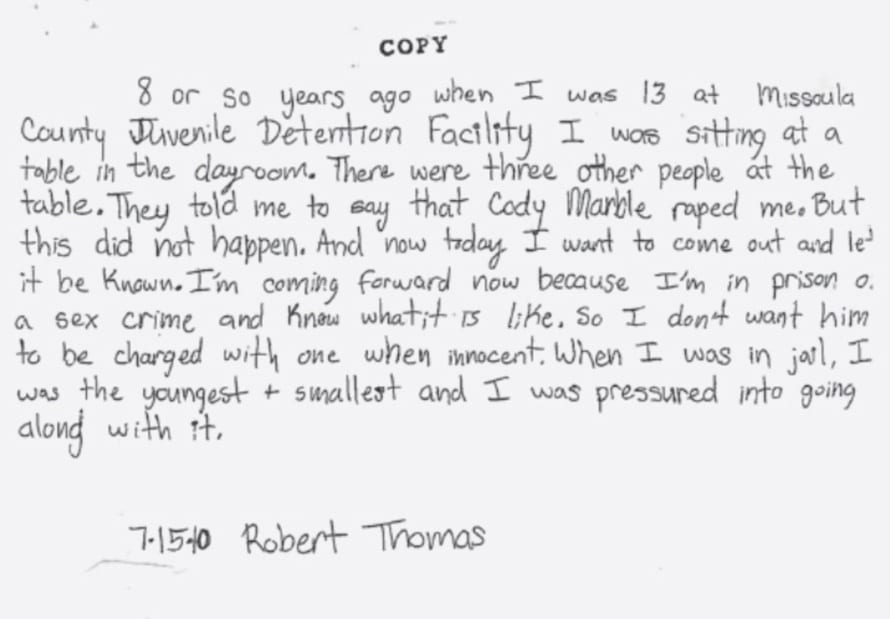
Later, of course, Thomas, while in prison after being convicted of a sex crime himself, signed a statement saying he was not raped by Marble.
During closing arguments on Tuesday, Marble attorney Mark Kovacich’s message to the jury was that, however Missoula County’s attorneys attempted to sow doubt about Marble’s claim of innocence, nothing they brought forward hadn’t been considered by the county several years ago when it declined to prosecute a new trial.
“In 2016, when the state and county reviewed all of the evidence in this case, they got it right,” Kovacich said. “You’ve heard a lot about Exhibit 1 during this trial—the motion to dismiss from 2016. … Exhibit 1 is what they said when this case was about truth and justice. Now that it’s about money, they’re going to tell you that it was superficial.”
Kovacich went on to list the ways in which original witness statements were “outrageously inconsistent,” describing their stories as a crude conspiracy against Marble. And he said the idea that the Montana Innocence Project memo somehow changed the county’s view of the evidence is “completely ridiculous.” Marble’s attorneys argue the document, taken as a whole and in context, actually bolsters his case, which is why it was among the evidence included two and a half years ago when they filed the wrongful conviction claim.
Kathleen Bousman, an attorney representing the state of Montana in the case, delivered the state’s closing argument.
“Twenty years ago, the burden was on the state to prove beyond a reasonable doubt that Cody Marble raped Bobby Thomas,” Bousman said. “Today, that has flipped. Mr. Marble has to convince all of you that he did not rape Bobby Thomas 20 years ago, and that he neither raped him nor committed the lesser included offense of sexual assault.”
“This is not about money,” she continued. “This is about Mr. Marble asking you to exonerate him and say that he is innocent. This is about Bobby and his story and his justice. Please don’t forget that.”
In delivering the closing argument for Missoula County, Huppert also spoke to the high bar set by Montana’s wrongful conviction compensation law.
“Did you hear any proof whatsoever that he is innocent,” Hupper asked, “other than he said, ‘I didn’t do it’?” What other proof is there he’s innocent?”
On Tuesday evening, the jury decided that Marble had not met that burden. He had not proven by a preponderance of the evidence that he didn’t commit the offense of sexual intercourse without consent for which he was convicted, the jurors agreed, nor did he prove he didn’t commit the lesser offense of sexual assault.