Photos by Maddie McCuddy
All change - don’t you know when you
play at this level there’s no ordinary venue?
It’s Iceland - or the Philippines - or Hastings - or -
Or this place!
—From Chess the musical’s “One Night in Bangkok”
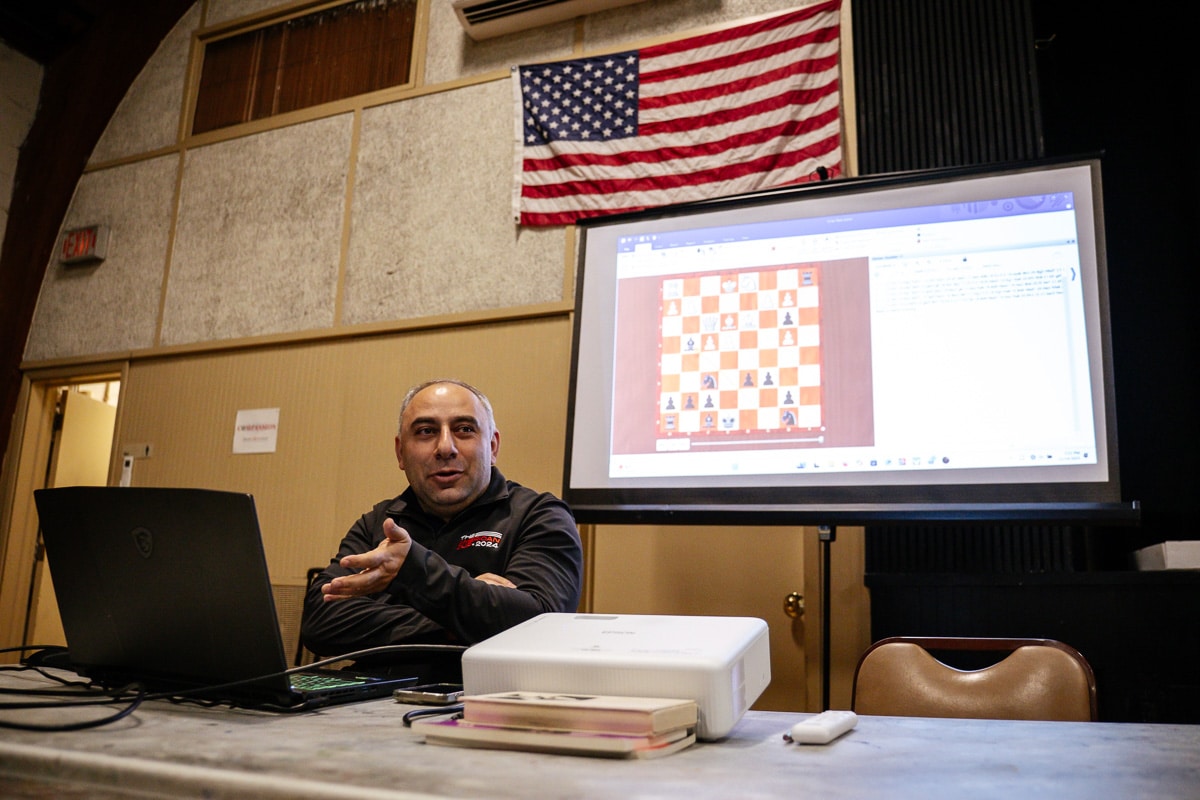
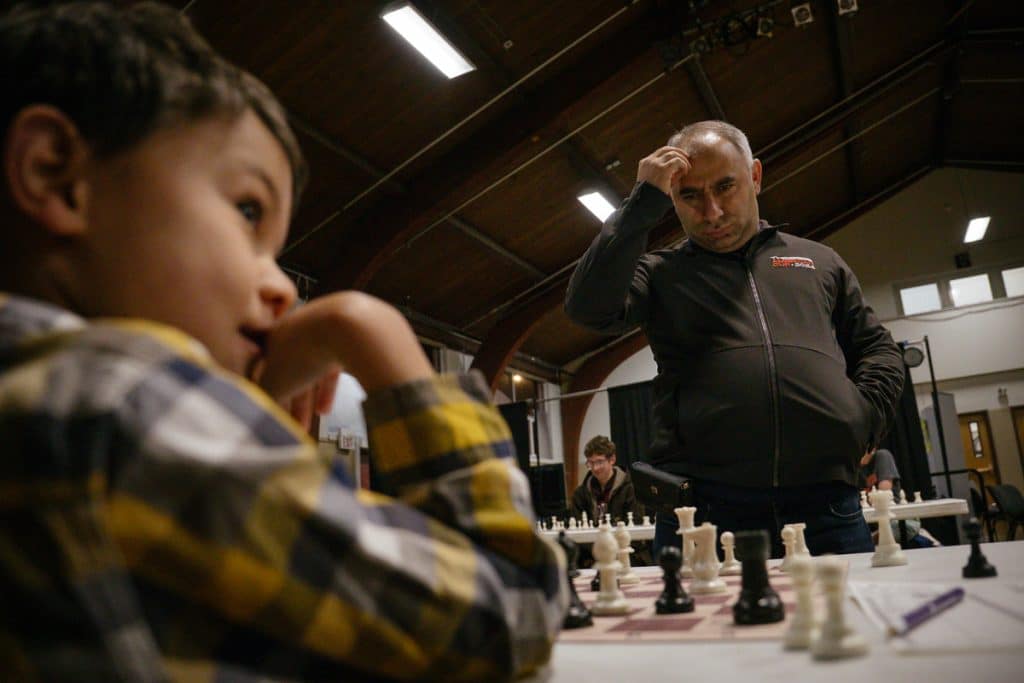
Last Friday, this place in the chess world was the Loyola Sacred Heart High School gym, where about 40 people came to hear Chess International Grandmaster Varuzhan Akobian reveal his game secrets, and half that number came to fight him for them.
At one end of the cramped basketball court, the audience sat on folding chairs around Akobian and his laptop, below a screen projecting a chessboard and the blizzard of moves, counter-moves and potential moves Akobian made against another grandmaster years ago, when he was ranked among the top 100 players in the world.
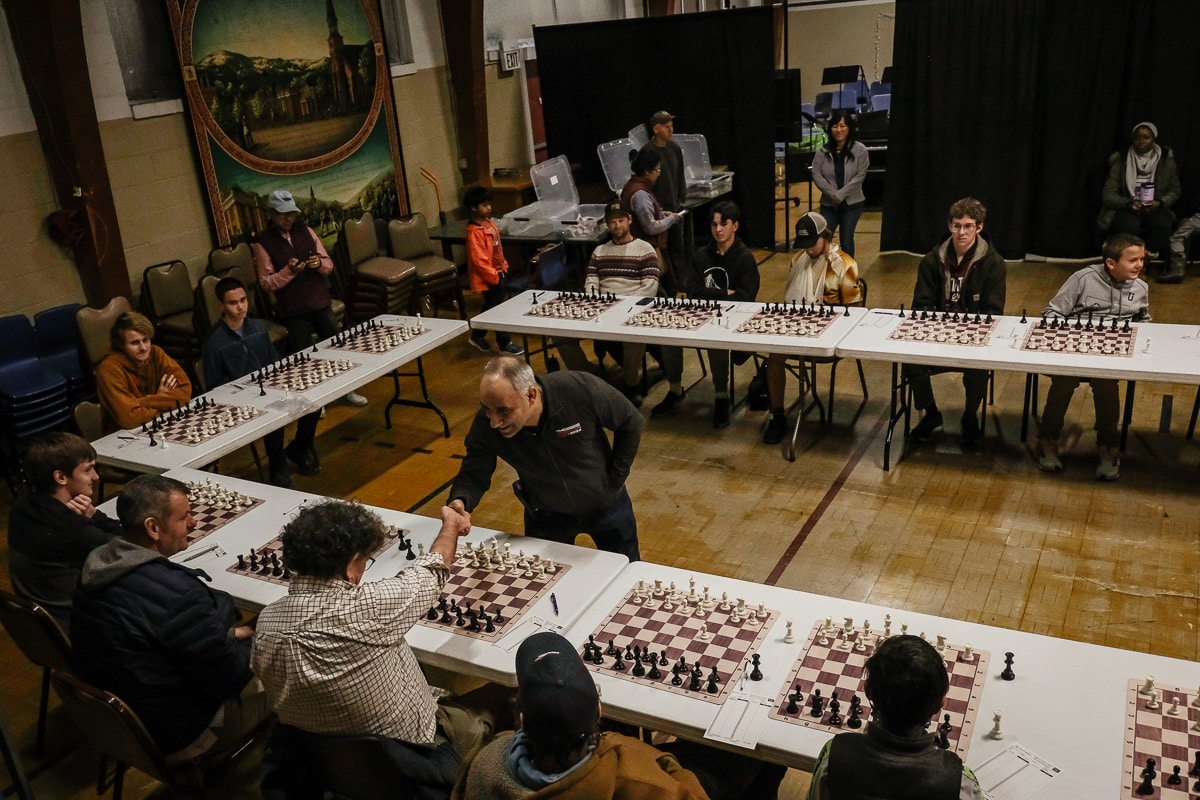
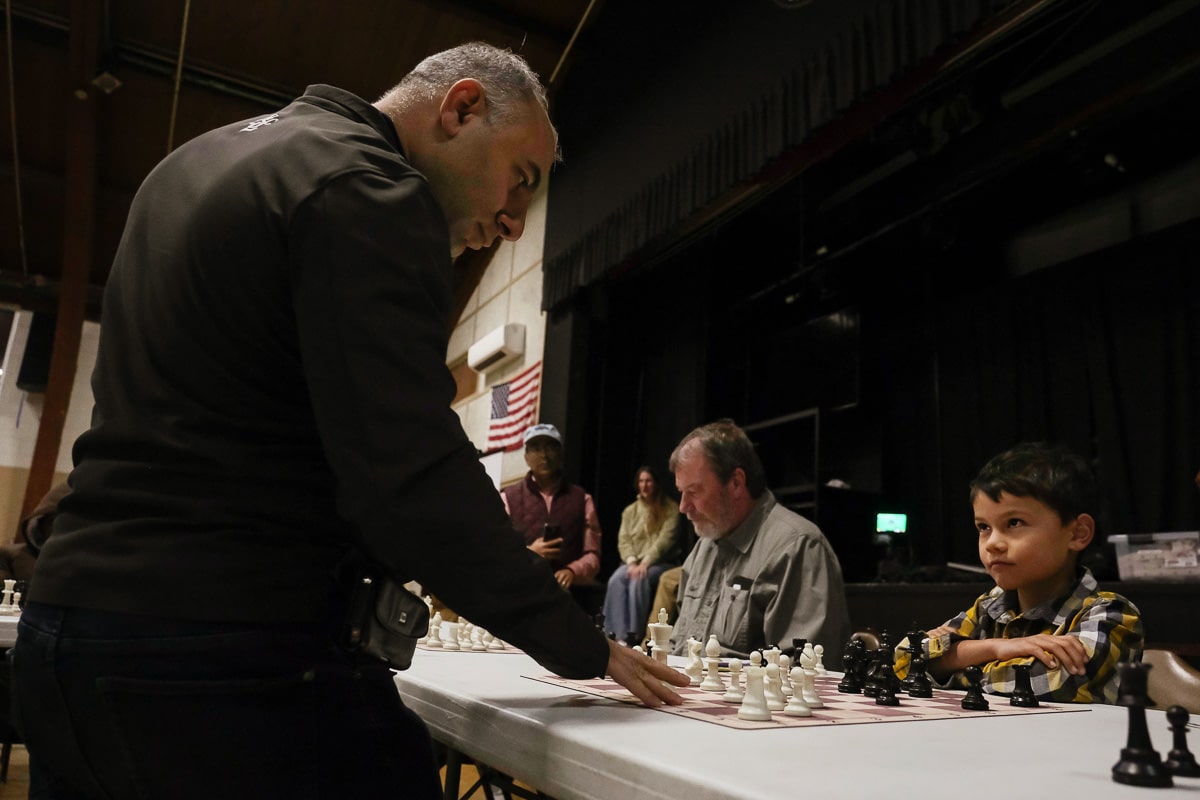
The other half-court was covered with tables covered with chess sets. After about an hour of tactical lessons, members of the Missoula Chess Club and guests from a three-state region spread the tables into a big oval. Eighteen took seats on the outside, in front of ranks of black chess pieces. Akobian stood in the middle. At 6:05 p.m., the simultaneous match began. At 6:41, the first player resigned defeated. By 8 p.m., Akobian had beaten all but one. He accepted a draw from Matteo Nero, Montana’s 16-year-old state champion from Bozeman.
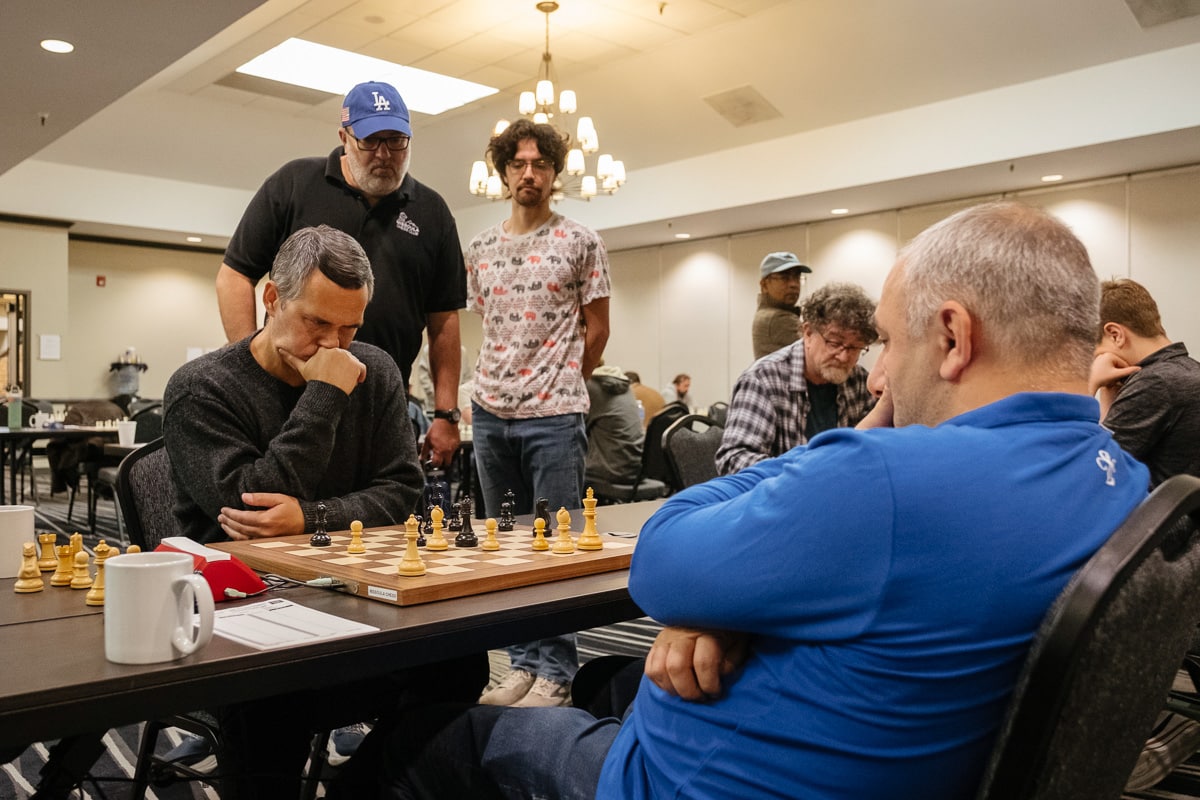
Other challengers had been “pushing wood” in gatherings like this since Romie Carpenter and the late Bill McBroom organized a statewide competition in 1981 (pushing wood is slang for playing chess, and a “woodpusher” is a snub for someone playing random moves). Last weekend was the 44th annual Missoula Turkey Open. The Friday “simul” was mostly for fun and a chance for young players to get their scoresheets autographed by a living grandmaster. The Saturday and Sunday matches in the Holiday Inn Parkside ballroom were for official ranking points and real money, contributed by sponsors such as Whitefish Credit Union and Missoula Motors. In addition to a turkey-topped trophy, prizes of $400 to $1,000 went to top contenders.
Each game of chess
Means there’s one less
Variation left to be played
Each day got through
Means one or two
Less mistakes remain to be made
—From Chess the musical’s “The Story of Chess”
Like almost every other game in this age of computers, chess has been atomized by the analysis of millions of games. Back in 1981, Matthew Guthrie was Montana’s youngest state champion at 17, before Nero eclipsed his record. Before his chance to play Akobian in the simul, Guthrie used an online chess “engine” to find every game Akobian had won playing white.
“Somebody that good never loses the same way twice, so there’s not much value in studying his defeats,” said Guthrie, now 61. Instead, Guthrie sifted Akobian’s wins for examples that exposed weaknesses in his style. Then Guthrie devised a trap he might lure Akobian into.
Nero said he did not study Akobian’s games beforehand: “I’m just playing to win. I’m watching for how he does his traps.”
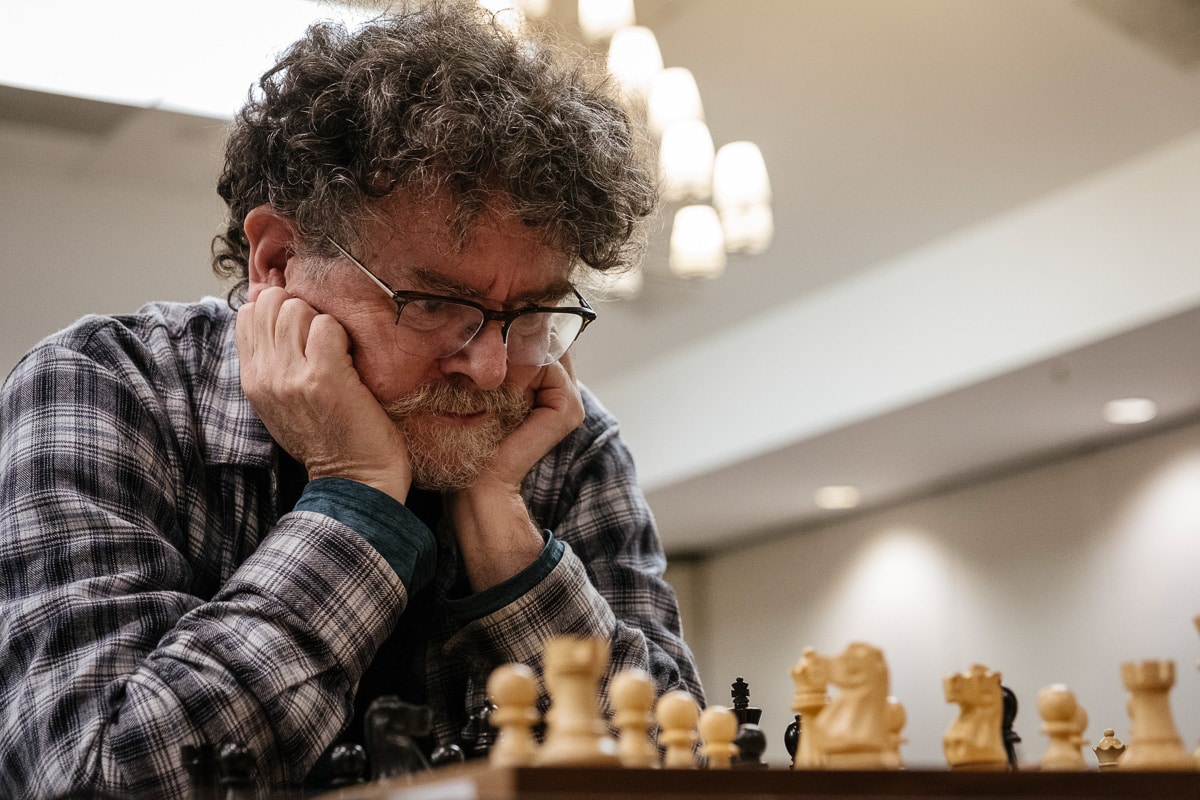
About 25 minutes into the simul, Guthrie was elated to see Akobian appear to take his bait. It didn’t last.
“Imagine if you’re the Grizzlies [football team] and you’re up by a field goal at the end of the first quarter,” Guthrie said. “But you’re playing Alabama. He crushed me.”
“Imagine if you’re the Grizzlies [football team] and you’re up by a field goal at the end of the first quarter. But you’re playing Alabama. He crushed me.”
Eight-year-old Stanley Pribik of Bozeman was the second player crushed in the simul, but he considered it a victory anyway. As the multi-player match progressed, Akobian would stand before each opponent and wait for them to move a piece. Then he would move his own piece with a slight flourish and sidestep to the next person. In the two minutes or so it took to complete a circuit, Pribik would scoot many of his own pieces to possible spots, testing his advantages and vulnerabilities. He lasted 46 minutes.
“I thought I’d get destroyed,” Pribik said. “I thought I’d get 15 moves, but I lasted 22.”
As soon as he tipped his king over and resigned, Pribik zipped over to watch Nero’s match. The two have become friends through chess, according to Pribik’s mother Hiromi.
Oh I’m the arbiter
I know the score
From square one
I’ll be watching all sixty-four
From Chess the musical’s “The Arbiter”
At Saturday’s start of the Turkey Open, Missoula Chess Club organizer Eric Walthall of Florence warned everyone to not just silence their cell phones, but to turn them off.
“We’ve had issues with this, from the grandmaster level on down,” Walthall said. “It’s an automatic forfeit.”
The chess world has been rocked with drama recently. On Oct. 20, 29-year-old Grandmaster Daniel Naroditsky was found dead by apparent suicide after facing cheating accusations by another grandmaster. Much of the controversy played out through forums such as on Chess.com, which counts more than 225 million users and hosts 20 million games daily. And on Sunday, the stage drama Chess returned to Broadway.
In a way, Chess the musical mirrors the cyclical popularity of chess the game. Its characters reflect 1970s’ grandmasters Bobby Fischer and Boris Spasky whose “Match of the Century” in 1972 was considered a nerd proxy for the Cold War. ABBA composers Bjorn Ulvaeus and Benny Andersson teamed up with lyricist Tim Rice (Jesus Christ Superstar, The Lion King) to capture the Soviet Union’s (and disco’s) collapse, personified by dissident grandmaster Garry Kasparov defeating USSR loyalist Anatoly Karpov in 1985. The concept album scored an unexpected hit on MTV with the songs “One Night In Bangkok” and “I Know Him So Well.” However, the live musical lasted just two months on the New York stage.
A London West End revival in 2008 leveraged singers Josh Groban and Idina Menzel into a new album and film. That coincided with the 2007 debut of Chess.com, one of three online chess networks that unleashed a surge of internet play. A decade later, Anya Taylor-Joy debuted in Netflix’s “The Queen’s Gambit.”
Guthrie explained that show’s impact this way: International Grandmaster Yasser Seirawan, currently considered the “John Madden of chess,” wrote several popular chess strategy books starting in the 1990s. The Montana chess community got him to play a tournament in Butte in 1979, and Guthrie kept in touch. Last Christmas when they met, Seriawan told Guthrie his old books typically earned him a comfortable annual royalty check. But in 2021, Seirawan’s check arrived for about seven times the typical amount. The publisher credited it to the impact of “The Queen’s Gambit.”
In his book “Seven Games,” game-theory expert Oliver Roeder recounted how chess’ accumulated match histories nurtured the predictive algorithms of artificial intelligence. When Kasparov famously lost a tournament to IBM’s Deep Blue chess program in 1997, it was widely seen as the beginning of the end of our mastery over machines.
Since then, chess is widely considered to be “solved,” in that a computer can find a winning solution to any challenge a human might offer. Modern chess engines, Roeder wrote, are “ungodly chess beings sprung from the secretive labs of trillion-dollar companies, play[ing] a hyper-advanced alien chess, exotic and beautiful, something no human is capable of fully understanding, let alone replicating, but so full of awesome style.”

But even the human programmers of those machines still saw value in playing the 1,500-year-old game.
“They allow us to do other things better,” Murray Campbell, part of IBM’s Deep Blue computer team, told Roeder. “When people play chess, they might say, ‘Well, what do I learn from playing chess?’ Well, I become more disciplined, more systematic about how I think about the options in my life, more willing to look ahead a few steps and think about consequences, better able to take losses … Deep Blue wouldn’t learn any of that.”
Which might explain why the Missoula Turkey Open has survived 44 years. There’s only one winner, but everyone leaves having looked a few moves ahead, considered consequences, and — like Guthrie — learned from losses.
In the end, Guthrie placed second to Akobian in the Turkey Open. Lee Brian of Spokane took the third-place prize, and Mike Muller of Bozeman won a special award for the best performance against higher-ranked opponents. Nero placed 8th.
“I can never calculate perfectly in the way that Deep Blue can, but that doesn’t mean I shouldn’t try to calculate as well as I possibly can,” Guthrie said afterward. “And sitting down at the board with someone who was until recently ranked in the top 100 in the world is really exciting. That would never happen in tennis.”