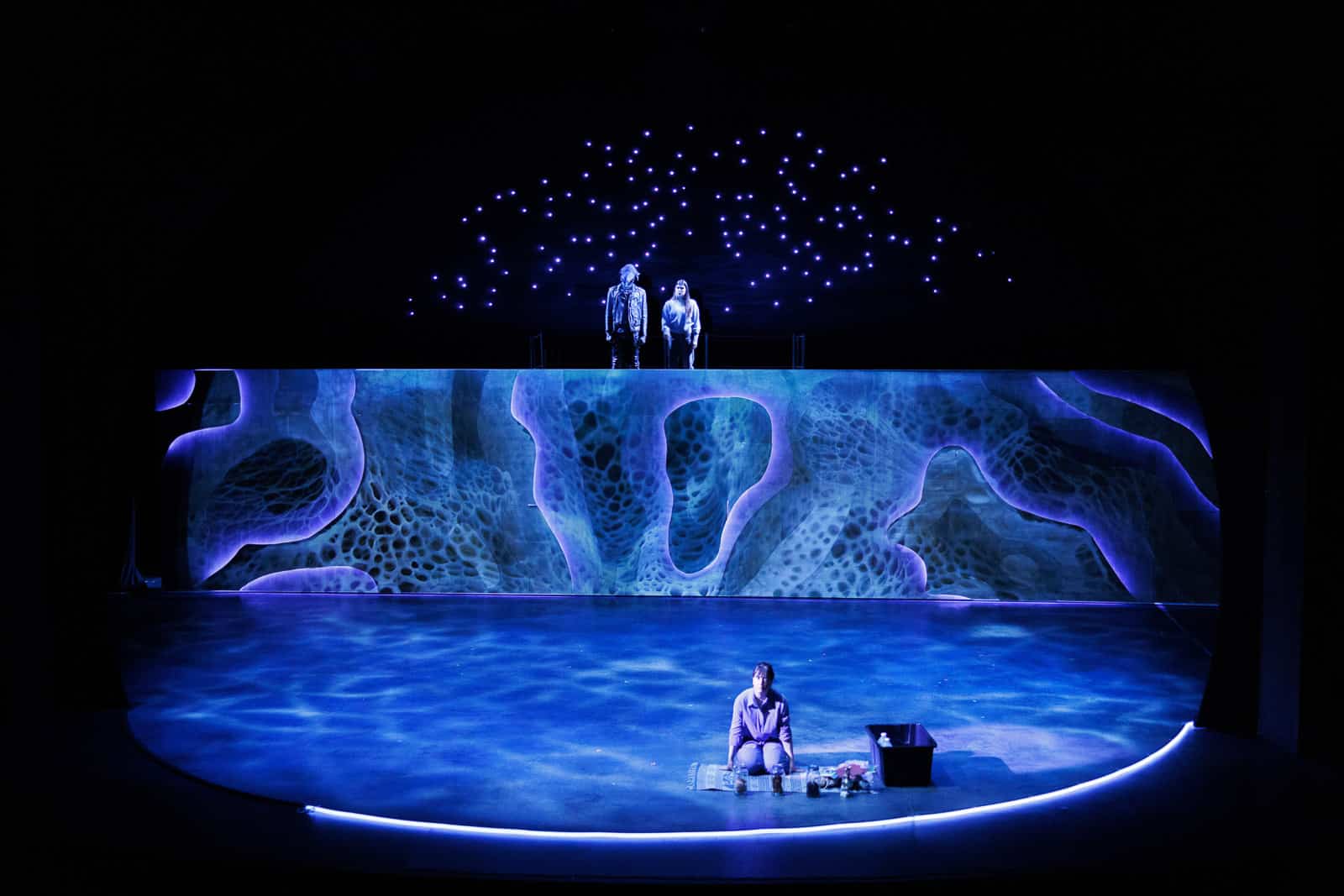
In the beginning, Kendra Mylnechuk Potter did not want to write Can’t Drink Salt Water. The idea for the play had come to her in a vision, right in the middle of teaching a yoga class on Zoom, in the midst of the pandemic. In this dreaming moment she saw a woman in an underwater place, alive and being visited by Salmon Woman — a divine mother figure of Lummi creation stories. Salmon Woman was bringing her home. Not to her earthly home, Potter said, but back to where we all came from.
Potter understood the meaning. She knew this woman was missing. That people back on land were looking for her and that they would never find her. And she knew this vision she was having was a play — one that she had to write, no matter how much she didn’t want to step through that door into the story.
Potter is an active Native actor and playwright in Missoula, who told part of her story of being adopted by a white family and exploring her Lummi heritage in the film Daughter of a Lost Bird. We wrote about Can’t Drink Salt Water in 2023 when Potter received funding and held a staged reading presented by the Montana Repertory Theater. This week, the fully staged production is showing at the Montana Theater, starring a mix of local actors and equity actors flown in from New York and Los Angeles, many of whom are Native.
This production — wow. Montana Rep landed a “transformative” grant from the Roy Cockrum Foundation. Which is why the play boasts the highest theatrical production value that Potter and others at the theater company have experienced in Montana. It was designed by New York professional designers The Swader Brothers, and UM scene design students created it, including the rigging of a waterfall and building 48 large wood-framed walls, among other things.

There are also dozens of professional Indigenous artists involved in the making of the show. And the process of writing the script included the cultural consulting of Carissa Heavy Runner, the Blackfeet and Diné activist and mother of Mika Westwolf, who was killed in a 2023 hit-and-run near Arlee. We interviewed Heavy Runner in November 2023.
“She has shown up so much more than I would have ever felt like I had a right to ask,” Potter says. Because Heavy Runner’s real-life experience with investigators of her daughter’s death had been so difficult, they focused on that part of the script, especially. “We rewrote and rewrote and rewrote the scene with the detective until she nodded and said, ‘Yes, that’s right.’”
Potter says there was a moment partway through rehearsals when the director, Meghan Finn, looked at her and said “If this is the only thing we get out of this play — Carissa feeling seen, and her experience with law enforcement represented in a way that feels accurate to her — then the whole thing is worth it.”
“So that felt amazing,” Potter says.
Can’t Drink Salt Water is about a mother searching for her missing daughter and a young woman who arrives at a fictional evangelical shelter for victims of sex trafficking. It essentially follows three storylines: the young woman in the shelter run by well-meaning white Christians, the grieving mother looking for her daughter and, finally, the underwater world.
“I hope the play is a time capsule. I hope there’s a time that it’s like, ‘Oh, remember the missing and murdered Indigenous people era? I’m so glad we’re out of that.’”
When I asked her what’s changed in the script since its stage-reading, Potter noted a few shifts. But when I asked her how the changes in the world since 2023 have affected how she sees the play now she said, “I hope the play is a time capsule. I hope there’s a time that it’s like, ‘Oh, remember the missing and murdered Indigenous people era? I’m so glad we’re out of that.”
And while she didn’t want the script to be situated in the Trump administration, she has reflected on how more recent events do provide openings for new interpretations in the script.
“Something that makes it so frustratingly timely is these fucking Epstein files,” she says. “Where I had been thinking of the play primarily as an MMIP story that also highlights trafficking, in this moment — depending on how someone is walking into this [play] — it could also be a show about trafficking, where some women die.”
So, of course, Can’t Drink Salt Water is a hard story, but Potter has built into it the tools and resources audience members need to walk away from it feeling empowered. The play does deal with issues of rape and other violence, but doesn’t show it. And even mothers, she said, who want to bring their tween or teen daughters to the play can do that, as long as they’re willing to have these tough conversations. That was important to her.
“In the play and in the lobby, all of the screens have a QR code on them,” she says. “It’s attached to ‘10 Things to Do if a Loved One Goes Missing.’ And that is also baked into the script. It’s in the play. We go over it. You have it, you can save it on your phone, it’s in the program, and the actors say it to you. I really wanted the play to be impactful. Not in a way that’s putting people in a freeze state, but putting people in an ‘I want to participate in healing’ state.”
None of this surprises me. Potter is an incredibly talented actor and playwright, and she is also, among other things, an educator and birth doula. She pushes audiences — especially non-Native audiences — to stretch their worldviews and wrestle with complex ideas. But she’s not one to drop figurative bombs without making sure people will come out of the experience with a way forward. She brings people into the harsh, cold light of the script with care and empathy, which, I think, is the best way to induce care and empathy at a time when fear seems so much easier to cling to.