The Big Sky Documentary Film Festival celebrated its 21st year in February, but also said goodbye to its longtime director, Rachel Gregg, who had worked for the past eight years to build it up and put it on the map as an internationally renowned and locally beloved event. (Gregg, full disclosure, sits on The Pulp’s board of directors.) This week, the Big Sky Film Institute, which is home to the festival, announced its new executive director, Julia Sherman. The role is a big one to step into considering Gregg’s accomplishments and the current position of the festival as a premier venue for non-fiction in the American West—one that runs for 10 days, draws an audience of 20,000, hosts 200 visiting artists, and presents about 150 films selected from hundreds across the world. Besides its film screenings, the festival also features the Doc Shop, a conference featuring filmmaker and industry panels; Big Sky Pitch, which offers filmmakers a chance to pitch their films for funding; and the 4th World Media Lab, an artist fellowship that supports emerging Indigenous filmmakers (48 fellows since BSDFF joined the 4th World partnership in 2018 ).
It’s a lot to take on, but Sherman ends up being an obvious choice. She’s been with Big Sky for the past eight years, too, most recently as the education director and grants manager. She’s worn other hats there as well, including operations manager and associate programmer, so she’s seen the festival from a lot of angles.
Sherman says she even took a job with the prestigious Tribeca Film Institute at one point, before deciding that BSDFF was where she wanted to be most.
“I moved to New York for that work,” she says, “but I really missed that sense of connection to the community and that kind of intimacy that Big Sky cultivates so well.” Since then, she’s been all-in with Big Sky, writing grants to support artist initiatives and helming the education department’s suite of six youth education programs. She’s helped grow the education arm of the film institute from 4,000 engaged participants to 10,000, and partnered with the Montana Office of Public Instruction and the Montana Western Learning Collaborative to lead workshops and trainings in media literacy and documentary across the state.
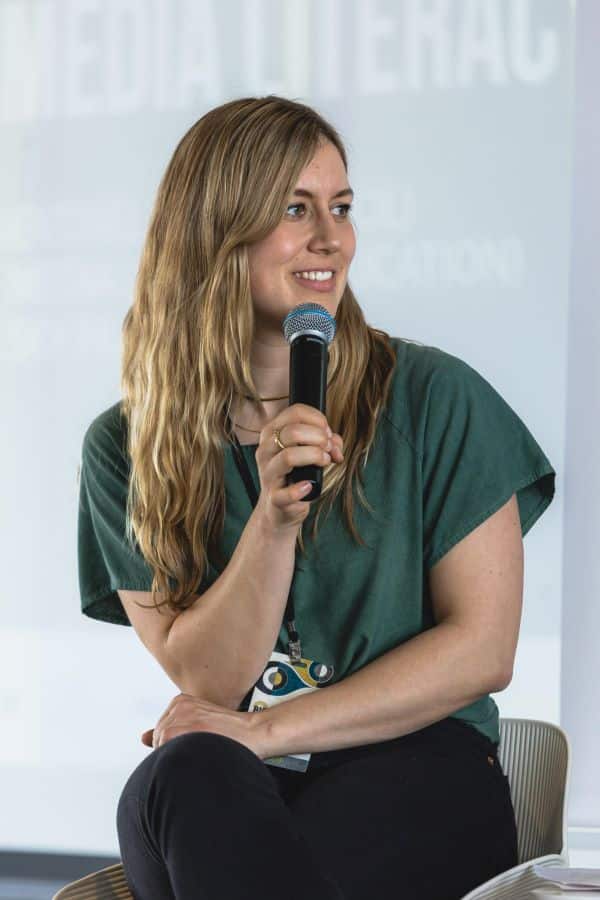
Sherman is in her late 20s, which is fairly unusual for an executive director hire. Her interest in film bloomed from her background in African American history in Montana, she says. For a while, she worked at the University of Montana’s archives while volunteering for the film festival.
“I was kind of obsessed with this idea of how you use archival footage to tell modern stories,” she says. “How you weave historical elements into the art and craft of documentary film was always something that got me really excited as a history nerd.”
This week, as film submissions start rolling in for the next film festival, Sherman has hit the ground running. But she took a little time out of her day to answer a few questions from The Pulp about the future of the festival under her leadership and what drives her passion for documentary films.
This interview has been lightly edited for clarity.
The Pulp: You’re obviously filling some big shoes coming in after former executive director Rachel Gregg, who devoted her tenure to really building an identity and reputation for the festival. What do you see as the next chapter for the festival, especially in terms of programming and education?
Julia Sherman: Rachel has done so much for this organization over the last eight years, and I have been so lucky to learn from her and work so closely with her. Seeing Big Sky’s reputation grow, and the community really turn out for it—it’s been really nice that I’ve been such a close part of that. I think when you have a new leader, people are really excited for all the new things that are going to get introduced. But I think what we’re doing right now, we’re already doing it really well. My goal is to continue to bring this diversity of stories and expand our engaged community of filmmakers and patrons and community members and students that are excited about filmmaking and the documentary form. In a lot of ways, it’s so helpful that I have been such a pivotal part of those conversations and part of fundraising and at the educational arm. Stepping into this role, I’ll be learning a lot of new things, but it will all be very familiar. I’m excited for that.
There seems to be a lot of instability right now in the film festival circuit due to a multitude of issues—post-pandemic effects, but also the shift in distribution platforms, like streaming services, and a loss of major sponsors. Tell me what challenges you’re seeing out there, and how you think Big Sky Documentary Film Fest is navigating those obstacles.
Definitely. This last year, in particular, we saw so many big shifts, and major funders—specifically in the doc space—no longer being pools for funding. It is kind of a nerve-wracking time. At the same time, I think that we’re really living in an era where documentaries are being made and viewed more than any other point in history. And with that, the diversity of major funding sources is diminishing, which is kind of a crazy contrast.
We’re seeing these commercial [streaming platforms] supporting a really specific type of documentary—stuff that’s more centered around celebrity, true crime, sports stories, which is amazing for those films and filmmakers that really fit that mold, but there’s not a lot of other opportunities for those that are outside of that type. And I think filmmakers can find themselves trying to fit their films into the formula of those major distribution goliaths. What Big Sky and the film festival market does, in general, is to really meet the needs of the local community and audience members that are going to view and talk about these filmmakers’ work. Providing that space to connect, to harness constructive conversations—in a time where intentional space is really limited and when the documentary form is really struggling—is really important now more than ever. Documentary filmmakers are being put into a position where they’re having to think really creatively about how their films navigate this saturated market and how they positively contribute to the larger documentary ecosystem. And I think film festivals like Big Sky are a huge player in that ecosystem.
How would you characterize Big Sky among other festivals on the circuit?
We’re a filmmaker-focused festival. We take that work really seriously as a platform for artists’ work and a hub for community conversations. We make space for those organic opportunities to come where you don’t know who’s going to be there and see your work. And as we grow our reputation in the filmmaker and industry market, Missoula has just shown up so much year after year. I think that’s what makes Big Sky so unique is having a community of people that are going to show up and support that work. It’s just as important as making space for filmmakers to connect with other filmmakers and industry members. And we have that balance down in a really lovely way. We’re a mid-sized film festival, I would say, and I think that’s kind of the sweet spot. I feel like the bigger you get, the farther away you get from the artists and the people creating the work. All [festivals] are important, and they’re all pieces of the puzzle, but I think we’ve hit our sweet spot with our size and our audience and reach.
I know you’re a film buff—and not just in terms of documentaries. Can you tell me about a film or two that really made you want to do this kind of work?
It’s always hard to pick just one, especially when you’re working in [filmmaking]. But the film that kind of keeps coming back to me is not actually a documentary, but it is by a documentary filmmaker. I think a lot of his principles and practices are borrowed from the field of documentary. My background was in African American studies in history and I studied the LA rebellion and wrote my thesis on it and was deep in it. So it’s Charles Burnett’s film Killer of Sheep. Have you seen that film?

That one really sticks out for me, because it was the first real narrative film I saw that got me thinking about the power of the documentary style, incorporated and borrowed in narrative film. The film itself doesn’t really have a super strong plot arc. It’s more fly-on-the-wall, with the character development built around the day-to-day human trials and tribulations. Watching that film got me interested in his documentary work, and in the more poetic style. That film is an honest portrayal of African American experience, bringing you into this world, unapologetically. And films like that really stick with me.
Any favorite docs from Big Sky?
Throughout the years working at Big Sky, there have been so many films. If I’m going to pick a specific doc, one that really stands out was a film that we screened, say, four years ago now called In My Blood It Runs, which is about a 9-year-old Aboriginal boy from Australia who is up against an education system that’s not supporting Indigenous history. He really struggles. But the film, itself, is shot so cinematically.
We brought it into our Native Filmmaker Initiative Film Club, where we curate Indigenous-made documentaries built around curriculum … and we were talking about this idea of not only the importance of identity and the power of community, but also the myriad of ways that our identities form and the impact that has on young people. To tell stories powerfully and well through a 10 year old is really hard to do. That stuff always moves me. I love that [a film like that] brings you back into the headspace of being young and unfiltered and just kind of creative and existing and reacting. That film really has stuck with me over the years. It’s definitely a favorite. They also did an incredible job through their educational and social impact campaign on changing legislation and requiring the education system [in Australia] to incorporate Indigenous stories. So you can see the change that came from it, which is—I mean, that’s always a goal of film that I think is so impressive.
What do you personally love about the Big Sky Doc Film Fest experience, as a staff member but also as a viewer?
There are so many things. I love how interconnected the festival is—it truly feels embedded in Missoula. And I think the fact that we pop up in different venues like the Wilma and the Roxy and build our own theater in the ZACC really folds us into downtown in a way that feels really intimate. If you were just visiting from out of town, you could just pick up a program and be like, ‘Oh, wow, maybe I’ll pop into this theater.’ Getting people excited about these stories or histories or ideas they wouldn’t have otherwise been exposed to, and really making that an easy thing to be a part of, is one of my favorite things and it’s what’s kept me here for so many years. I also just love who I work with—the crew of people that do this—because they are passionate about the work and they love the form. It’s such a cool group of people that kind of feeds off itself. We all get each other excited about [the festival] and so coming back year after year to do the work is really rewarding and makes me feel like, “OK, yeah, I can do this for another year.”
Keep an eye out for dates and news about the next Big Sky Documentary Film Festival on the website and/or follow them on Instagram @bigskydocfest