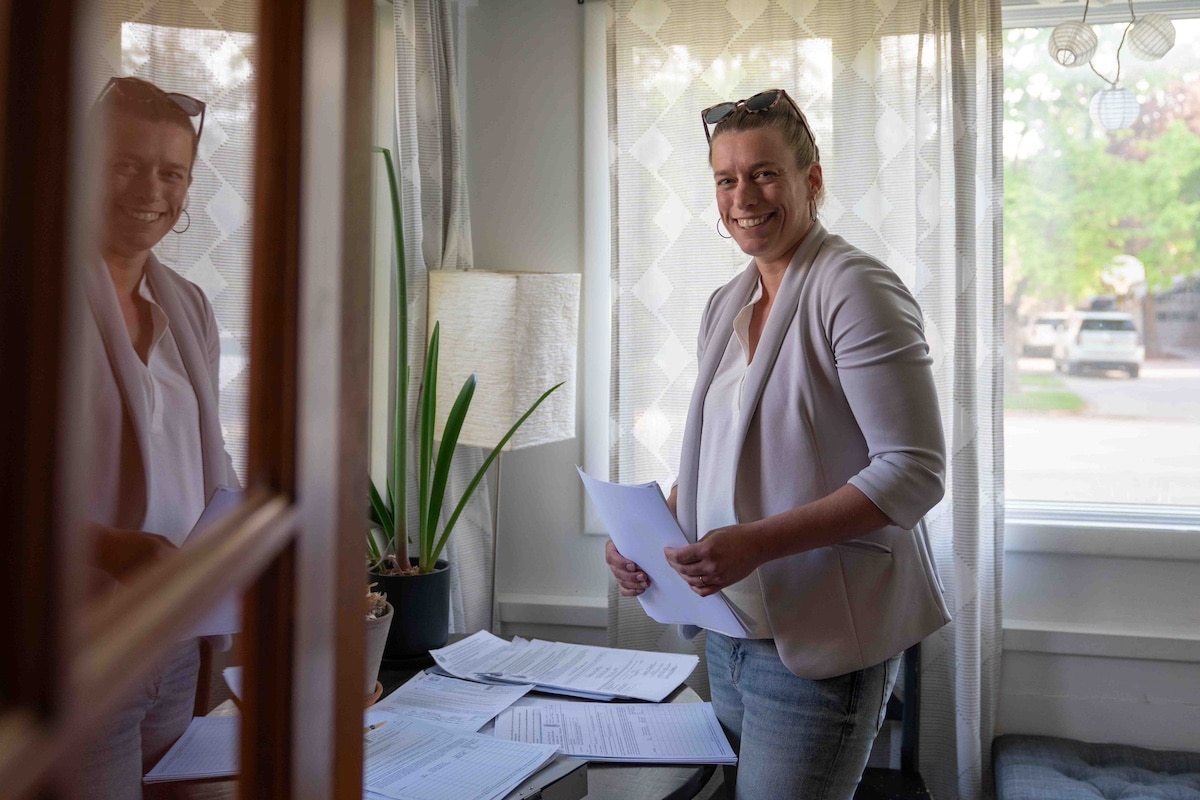
Elena Evans did not plan on running for office this year. But the extreme cold snap in January and ensuing high energy bills shifted her family to budget billing and prompted the Missoula resident to look into the race for the Public Service Commission—the agency that regulates monopoly utilities.
Evans was surprised to find no one running against the District 4 incumbent Jennifer Fielder, a far-right Thompson Falls Republican who voted for NorthWestern Energy’s 28 percent rate increase last October. The district includes parts of Missoula, Ravalli, Mineral, Sanders, Lake, Flathead and Lincoln counties.
In April, Evans began collecting the 3,050 signatures she needs to get on the November ballot as an Independent. Evans must submit signed petitions by May 28.
“We just can’t wait four more years to have somebody setting the stage for the future,” she said. “A lot of infrastructure changes would take years to implement, and there are technologies we have to start thinking about now.”
As an Independent, conversations with voters about the PSC and the private, investor-owned utilities it regulates get right to the issues, Evans said. She did not consider running under a party banner.
“Frankly, I don’t think the Public Service Commission really needs to be partisan,” she said. “There’s a clear job and I know I could do a good job of it.”
As absentee voters who already received their June 4 primary ballots know, Missoulians will either see Fielder’s name or a blank space in the Public Service Commission District 4 spot.
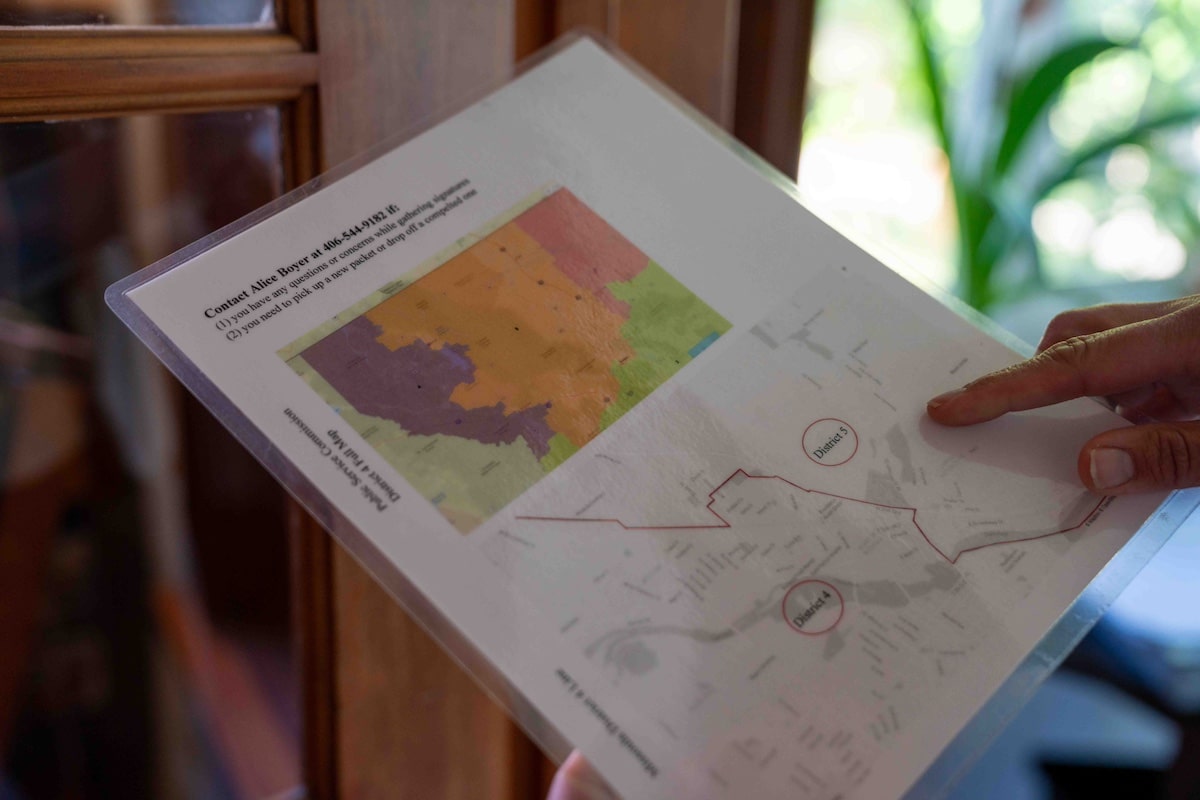
About 17,000 voters, mainly in the northeast portion of Missoula County, will see the race on their ballots even though they are ineligible to vote in it, according to a county press release. Following last year’s redistricting process, these voters are now in PSC District 5, which is not up for election this year.
A former state senator, Fielder is running for her second four-year term on the Public Service Commission.
Fielder did not respond to phone calls or emails requesting an interview for this story.
The Public Service Commission regulates monopoly utilities, including NorthWestern Energy, by far the state’s largest electricity and natural gas provider. It’s the PSC’s job to balance the interests of captive ratepayers with the need to maintain a financially sound utility, allowing only profits it decides are “just and reasonable,” per state law.
In October, the commission approved NorthWestern Energy’s electric and natural gas rate increase of 28 percent compared to August 2022. A reduction in NorthWestern’s property tax bill and a “true-up” process designed to square NorthWestern’s forecasted market power purchases with its actual expenditures brought the projected rate increase down slightly, as Montana Free Press reported in January.
Republicans have held all five Public Service Commission seats for more than a decade. The last person from Missoula—and one of the last Democrats—to serve on the commission was Gail Gutsche, who in 2012 narrowly lost her first reelection campaign to Hamilton Republican Bob Lake. Gutsche challenged Lake in 2016 and lost again.
“Frankly, I don’t think the Public Service Commission really needs to be partisan.”
Commissioners earn an annual salary of $115,880 and they’re allowed to hold other jobs. More than half of commissioners elected in the last 30 years are former Montana legislators.
This year, seats in districts 2, 3 and 4 are up for election. Two Republicans and a Democrat are running for District 2 in south-central Montana and three Republicans and a Democrat are running for District 3 representing southwest and central Montana. If Evans makes the ballot, she’ll be District 4 Republican incumbent Fielder’s only challenger.
The 2024 election is the first—and probably the last—using a new district map redrawn by Republican legislators last session that, as a Montana District Court judge ruled in February, was likely gerrymandered to disadvantage voters in cities.
PSC districts are the only state government districts drawn by the Legislature. After nearly 20 years without updating the map, a lawsuit filed in 2021 called for changes to address disparities between the number of voters per district due to uneven population growth.
In March 2022, a panel of federal judges ruled the map unconstitutional and ordered the use of a new map submitted by the Secretary of State, noting the Legislature had the right to redraw it during the 2023 regular session, as the Billings Gazette reported at the time.
While lawmakers began with considering the court-ordered map, Sen. Keith Reiger, a Kalispell Republican, introduced an amendment that redrew the districts to split up Billings, Bozeman, Helena, Kalispell, Missoula and Great Falls.
In late February, District Court Judge Chris Abbott concluded that the redrawn map likely violated anti-gerrymandering laws because it was designed to dilute urban voting blocs to the advantage for Republican PSC candidates.
The judge denied the request to prevent the map from being used in this year’s election. Abbott said the lawsuit would be expedited so there would be a decision in time for the 2025 Legislature to draw another, fairer map.
The current map puts most of Missoula in District 4, with some areas north of the railroad and Interstate 90 in District 5, including the Rattlesnake, some of Northside, some north Reserve, Grant Creek and East Missoula.
That means residents living in those northern parts of Missoula are represented by Kalispell physician Ann “Annie” Bukacek, who was elected to the District 5 seat in 2022. Bukacek is perhaps best known as an outspoken critic of vaccinations, which made her appointment to the Flathead City-County Board of Health in late 2019 controversial. The physician she replaced, Dr. David Myerowitz, called Bukacek’s appointment “unconscionable”—and that was before Covid-19. When the pandemic hit, Bukacek, in April 2020, organized a protest of state and local measures intended to slow Covid’s spread, which intensified calls for her ouster, as the Flathead Beacon reported. She resigned in 2022 in order to run for the PSC.

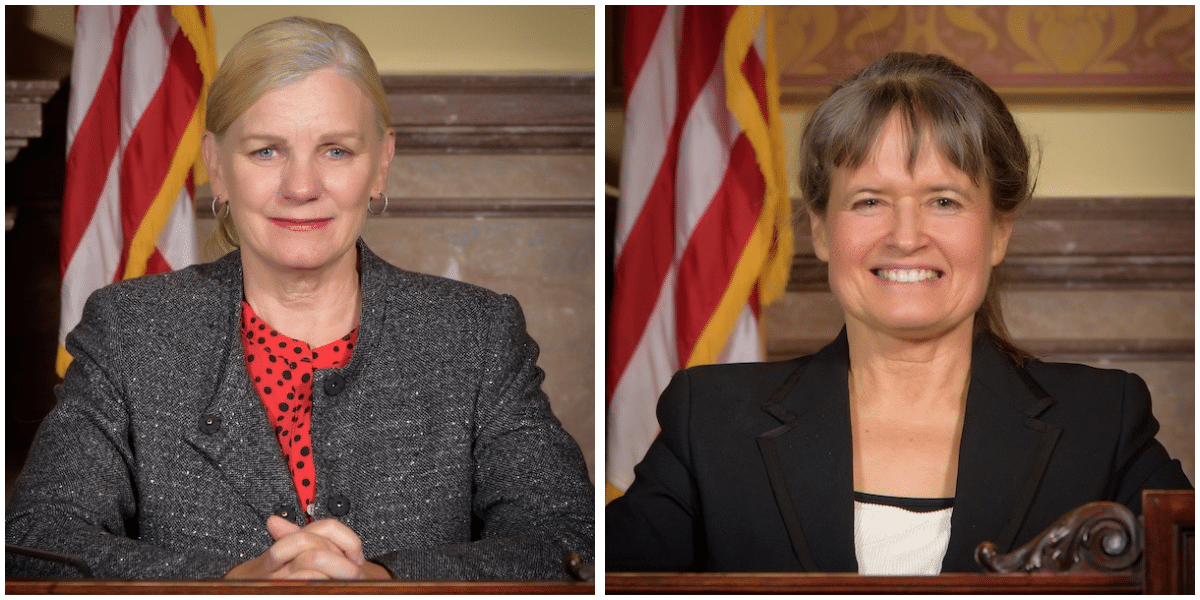
District 4 Commissioner Fielder represents most Missoulians, as well as those in more rural surrounding counties. Fielder served two terms in the state Senate from 2013 to 2020, chairing the Senate Fish and Game Committee in 2019.
The former owner of a planning, design and construction firm, Fielder is the CEO of the nonprofit American Lands Council, which advocates for the transfer of federal public lands to states and is aligned with the Bundy family’s anti-government extremism.
In January 2018, Fielder spoke on a panel in Sanders County with Cliven Bundy, his son Ryan Bundy and others about what they call federal government overreach, Montana Public Radio reported at the time. In 2014, Cliven Bundy, a Nevada cattle rancher, led an armed confrontation with the Bureau of Land Management over the cattle he illegally grazed on federal public lands. Two years later, his sons Ammon and Ryan Bundy led a weeks-long occupation at the Malheur National Wildlife Refuge in Oregon to protest against the “tyrannical” federal government.
Fielder was one of three public officials who called to pressure St. Peter’s Hospital in Helena over a patient not receiving unapproved treatments for Covid-19 in October 2021, Lee Enterprises’ Montana State News Bureau reported. In a letter to PSC employees, Fielder said she was not acting in her capacity as a commissioner when she made the call. The voicemail Fielder left with the hospital referenced a potential lawsuit and suggested her “friends” in the Montana Senate would not be too happy to learn about the situation, according to a report from the Legislature’s special counsel.
As vice president of the PSC, Fielder has been “instrumental in transforming the once beleaguered agency into a model of good governance,” according to her website. In her time on the commission, Fielder has worked on strategic planning initiatives, software modernization and overhaul internal policies and procedures, her website states.
“At a certain point you just have to stand up and decide to do it yourself.”
In January, the Legislative Audit Division published a performance audit of the PSC recommending that the committee adopt a code of ethics and work to address a high turnover rate among staffers. In response, PSC President James Brown defended the PSC’s leadership and said he and Fielder have spearheaded the adoption of 17 new policies intended to improve the commission’s culture, as Montana Free Press reported.
Evans is running as an Independent for the District 4 seat because she is disappointed in the PSC’s failure to address concerns around rising costs and barriers to implementing new technology.
“At a certain point you just have to stand up and decide to do it yourself,” she said.
Evans, 39, manages water and air quality programs for Missoula County. That work, and Evan’s former role as executive director of Montana Association of Conservation Districts, would help her tackle the detailed and complex rate cases the PSC considers, she said.
If elected, the commission seat would be Evan’s full-time job, which she pointed out is not the case for all current commissioners.
“What I can bring [to the position] is a combination of science and understanding rules and regulations,” she said. “Pair that with lived experience of having a budget and being impacted by decisions that the Public Service Commission makes when it comes to my family and our costs. That seems like it’s something a little unique when it comes to the PSC right now. It’s a little difficult to be representing folks when it doesn’t really impact you the same way.”
The commission seems to lack enthusiasm or interest in what newer technologies could provide to utility customers, Evans said.

During the October meeting when the commission voted on NorthWestern Energy’s rate increase, Fielder said she had reservations about the high cost of the company replacing meters with useful life left in them. Fielder introduced an amendment directing NorthWestern to present an economic analysis of its switch to advanced metering technology during its next rate case.
The new smart meters—which, compared to other utilities, NorthWestern was slow to adopt to begin with—provide customers more usage data, and help the utility measure the impacts of residential rooftop solar, among other advancements.
Instead of pushing NorthWestern Energy to use out-of-date technology, Evans wants to know how such upgrades could bring costs down for customers. Other companies use new technology because it helps them improve their bottom line and compete, she said, and it wouldn’t make sense if monopoly utilities weren’t pushed to do the same.
“The PSC can help push the utilities to plan for the future in a way that really helps the customer and really makes sure that there’s certainty in terms of having those utilities provide the service that is needed,” Evans said.
The signature-gathering process has allowed Evans to learn from residents what they know about the PSC, their concerns and ideas, she said.
“I’m not sure if everybody running for office should have to talk to 3,000 people, but I’ve sure learned a lot from folks from talking to them,” she said. “It’s been a lot of work but I’ve really appreciated learning from folks and hearing what they want to see. I think that will be an asset to me if or when I do serve on the PSC.”
The most common concern among residents are rising energy bills on top of other increased costs, Evans said.
“People are feeling pinched,” she said. “Their pocketbooks are not stretching as far as they used to. A lot of concerns are those costs just going to keep going up.”
Evans’ campaign has collected more than 2,000 signatures, leaving about 1,100 to go in the next week to ensure she makes it on the November ballot. District 4 residents interested in signing the petition can visit Evan’s website to find times and locations to do so. Missoulians unsure if they live in the district can enter their address in the state’s interactive map.
“I hope to get on the ballot and hope to continue this effort and visit people where they’re at, to drive around the district and connect with people about what they’d like to see and also show people how important the [PSC] decisions are,” Evans said.