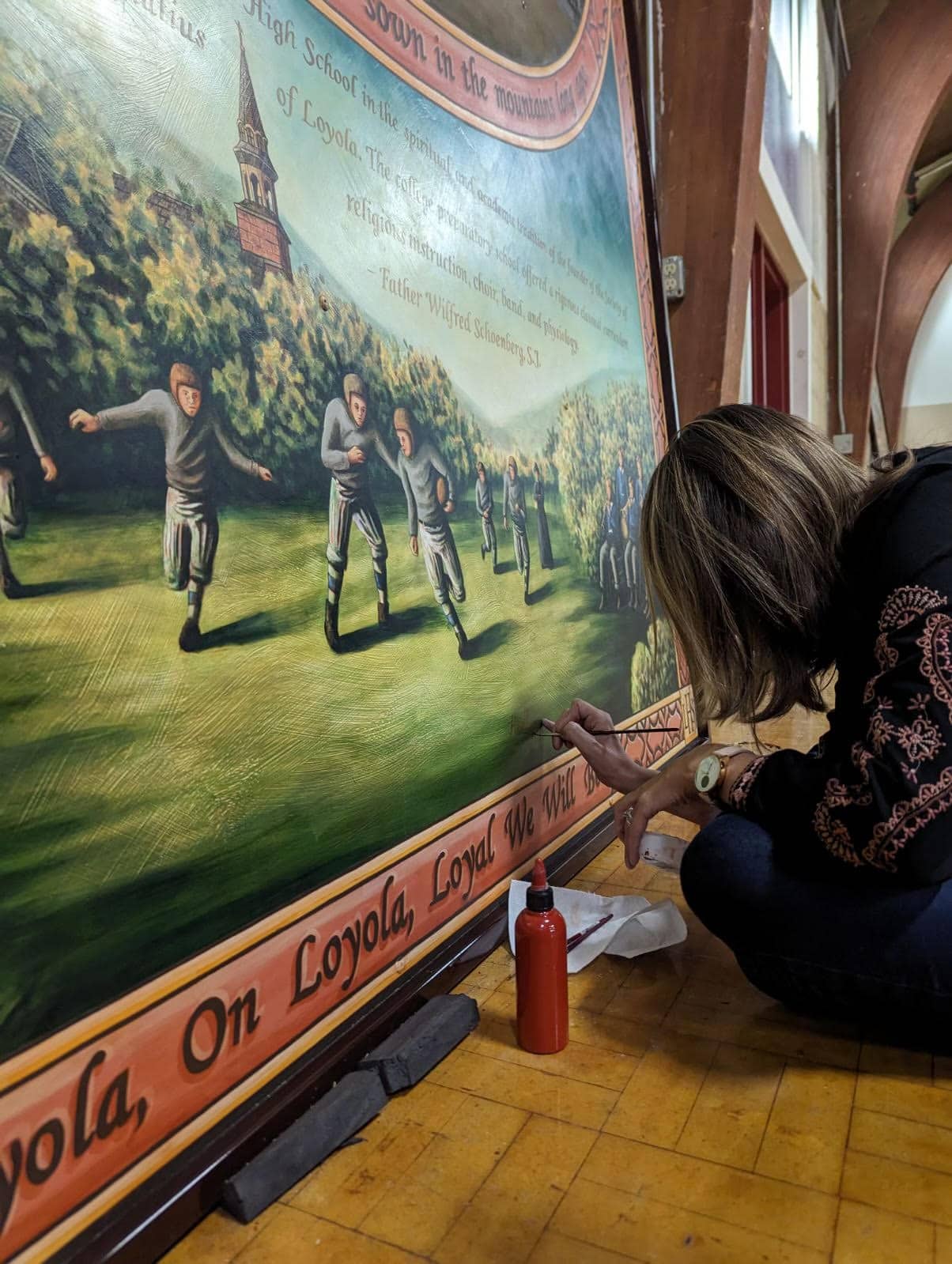
Artist Hadley Ferguson has made a name for herself in Missoula — and across the state — as a prolific painter and muralist. And over the past two decades, she has continued to create an impressive body of work for which she’s pushed herself both in scale and technique — even when her body began to fail her. It was in 2009, only four years after she completed her first major Missoula mural, “Heart of Missoula,” that Ferguson began experiencing neurological issues: numbness and muscle tightness. In 2010, still only in her early 30s, she was diagnosed with young-onset Parkinson’s and, later, the much rarer diagnosis of multiple systems atrophy. The road to that second diagnosis was rocky, paved with frustrating periods of unanswered questions, dismissive doctors, medical debt, and self-doubt. That road also led her to take action, by starting an organization, Summit for Parkinson’s, to support those with Parkinson’s and Parkinson’s-adjacent diseases, and becoming an advocate for others searching for similar answers.
Recently, Catherine Armsden, a longtime writer friend of Ferguson’s who also lives with Parkinson’s, wrote a book titled “An Alert, Well-Hydrated Artist in No Acute Distress,” which came out last December. It’s based on a blog series Armsden wrote about Ferguson in 2015 for the Huffington Post. The title comes from a line in one of Ferguson’s doctors’ notes after she spent time at the Mayo Clinic and was sent home without a diagnosis and with an indication that it might all be in her head. The book is about the friendship between Armsden and Ferguson, and it’s also both a critical commentary on the American healthcare system and a primer on Parkinson’s disease.
The book project ended up launching a film project, The Passion to Persist, directed by filmmaker and Parkinson’s advocate Dave Iverson, along with co-director/editor Damon Ristau. The Passion to Persist, which screens this Thursday at the Wilma, is a portrait of Ferguson in her most raw moments — like in the morning, during which time the effect of MSA on her body can often mean she needs 40 minutes to just get out of bed. The film features candid interviews with her husband and daughter, and also captures her perseverance as an artist who is not just known for her wildly positive outlook and generosity, despite everything, but also is an artist whose work seems to get more vibrant all the time.
I’ve known Hadley Ferguson since grade school, growing up in Missoula. At a young age, she’d already had a remarkable life, having spent time living in New York City and other places around the world, including Japan. And I saw the way art transformed her, particularly when we were teenagers. I remember her move to Portland after we graduated, where she painted murals for McMenamin’s at the Kennedy School, and I recall other milestone moments: her first giddy dates with her now-husband John, and the arrival of their daughter, Sarah. I also remember 2009, when the first symptoms arrived. She described them to me when we ran into each other at a seated event, and she gave me a quick recap of her recent experience. She was puzzled over a sudden onset of numbness and rigid jaw, and she seemed to be walking a tightrope between calm and alarm. I empathized with her fear and, still, since we were both just barely into our 30s, my mind couldn’t imagine the symptoms would last, even though an uneasiness lurked in my gut. But finally, when it was clear she was dealing with an unfathomable and uncertain disease, I remember how she kept making art. Not just making it, but pulling off feats more breathtaking than the one before, like an unstoppable magician.
In 2014, I got to interview her for a feature in the Missoula Independent, just when she’d been diagnosed with the Parkinson’s-adjacent MSA. Even back then, she knew her story held the power to help other people, and 10 years since that interview, she’s continued to work toward the twin goals of creating a thriving life of art-making and empowering people faced with similar health challenges by providing them with community and information.
I also knew that as much as she was good at sharing her story in a warm, open, matter-of-fact way, the reality for her has been more complicated — which is what both the film and book have worked to capture. In advance of the film screening and Radius Gallery opening, I caught up with her about the evolution of her art throughout this experience and how she came to understand the power of her story better, once she started having compassion for herself.
The Pulp: You’ve been sharing this journey with people for a long time as a way to help others. And from an outside perspective, this really is an inspiring story of passion and persistence. But how has it been for you to share this journey over the years, and how do you see it now, with the release of this documentary and book?
Hadley Ferguson: I’ve shared my journey, but I’ve been careful to just scratch the surface. I mean, I’ve shared the expected parts, you know? For a long time, I didn’t believe in myself, but because I was helping others with the story, I was able to keep that lack of belief at the back door and just push forward. But I was always, always, always in denial. The difference with this project — the film and book — is that I’m sharing every part.
And it might seem like I’ve always shared my story, but the book that came out last December was actually a blog from way back in 2015. It was published on HuffPo, but I never actively shared that blog with anybody. I understood my general story as a path to helping other people, but I wasn’t about to share my personal story. I had had so many doctors doubt me in the past, and I was fearful that somebody would read about this period of doubt — and about my diagnosis — and that they would also be doubtful. I certainly didn’t want a medical professional to read it, and I didn’t want my friends and family to read it. There was something shameful about the story to me, and it was because I just didn’t believe in myself.
It really wasn’t until 2020, when I got this feeding tube situation that went awry and landed me in the hospital for a very long time, that I realized in that moment, “Boy, I’m in it thick. I may not even come out of this alive. There’s no way I’m making this up.”
Oh, wow. So the doubt from medical professionals had made you doubt yourself.
Yeah, I still worried — I was still thinking, “Am I tricking people?” But that hospitalization was my first wake up call, after 10 years of it, where I thought, “No, this really is happening to me. There’s no going back. I can’t be making this stuff up.” Then, in 2022 I had to have a surgical procedure. And again, I was in the hospital. When I came home and was recovering, I watched a seven part documentary series on Netflix by Lisa Sanders who’s an MD with The New York Times. It’s called Diagnosis and it’s based on her column. In the series, she crowdsources all of these different medical cases, and she ends up helping people find out what’s wrong with them.
I remember being really taken by it, and I thought, “That’s interesting. She understands the difficulty of getting a diagnosis.” And I decided I was going to read the blog about me with that new lens. So, this time, when I read the blog, I took myself out of it completely. And I realized that this really is a story that needs to be published. That it could help other people. It was the first time I could remove myself from the story.
And that led to the book and film?
Yeah, so it led me to reaching out to Catherine about publishing it as a book. And Dave was a mutual friend who not only made films but published books, and I asked if he could write the forward. But then, we got to talking with Dave, and this film idea morphed, and it became this whole thing.
It was a really huge turning point. I realized that if I’m able to show myself on the camera — this raw footage of what it’s like to live in my shoes — it could make an impact. I have no desire to have a film about myself out in the world, just to have a film about myself. But it was the idea that it could help others. So when you ask me what’s the difference between how I feel about my story now from how I felt about it before, there’s actually a huge difference, because now I believe in it. I’m compassionate toward myself, and I believe in myself. And if I can do one thing in life, it’s to help another person. And this project can do it, that would be a life dream of mine.
When I wrote about you in 2014, I felt like you were really open with me. But it’s interesting to hear you say all this now. I remember you telling me stories about doctors saying there was nothing wrong with you, or outright accusing you of lying. I knew it was upsetting for you and I felt outraged with you. But looking back, I guess I also did sense you were wrestling with it on a deeper level — that their voices had really gotten into your head.
Oh, yeah, they certainly did. You know, in 2015 I got this baclofen pump, which is for suppressing abnormal nerve signals and muscle spasticity. This was three years after the Mayo Clinic. And the way they determine if you can get a baclofen pump is they basically put this medicine through your spine and then see how you react on it. I was so terrified to go in for that, because I thought I was going to be caught in some big trickery. So that doubt really did plague me.
One of my memories about you from high school is how transformative art class seemed to be for you. Was that a defining time for you?
The big moment for me was much earlier, in New York City, because my mom took me to the museums and after school programs. I was also doing a lot with my music, but she opened my world up to art. I specifically remember sitting in the Metropolitan Museum of Art, and there was this older painting of these ladies with all their dresses and buttons. And I remember just sitting on a bench and staring forever at the painting, trying to see how the paint created all those shapes. And I took art classes in Japan. But when I came back to Missoula in third grade, I started piano lessons and playing the flute and I had already predetermined that my path was going to be a path of music. But you’re right — it was my junior year when I took an art class, and I loved it. My senior year, I withdrew from band and filled all my class periods up with art classes.
Did you know then that you wanted to do art the rest of your life or were you just enjoying it at the time?
When I first started college, I was minoring in art and majoring in piano. I was a really good piano player, but I was a terrible performer and I didn’t want to teach. And basically, if you can’t perform and you don’t want to teach, there really isn’t much else except composing. And I wasn’t composing. So I said to my teacher, “You know, I’m kind of wondering if I’d be better to switch and major in art and minor in music.” And without hesitation, he said, “I think that’s a great idea.” [She laughs.] I was like, “OK, well … thanks for the encouragement.” So I minored in music, and I minored in Japanese. And I majored in art, but the funny thing is, I did everything to avoid painting in college.

What do you mean?
I was never a painter in college. I was a sculptor — it was a sculpting-drawing focus. And I did a lot of installations. When it all changed is when I moved to Portland, Ore., and applied to work with the McMenamin Company. I’d only done two paintings, so I put a portfolio together of two of every type of art — two paintings, two sculptures, etc. — so it wouldn’t look weird to have just two paintings. And they hired me to paint murals. So I basically learned how to use color on that job. But what I did was very decorative, so it wasn’t like the stuff I paint today. When I came back to Missoula I realized that I really enjoy spending my days working that way. So I just went around town asking if anybody wanted a mural, and I did everything I could to get out there.
And how did you go from there to being in galleries and doing major murals, like the one at the capitol?
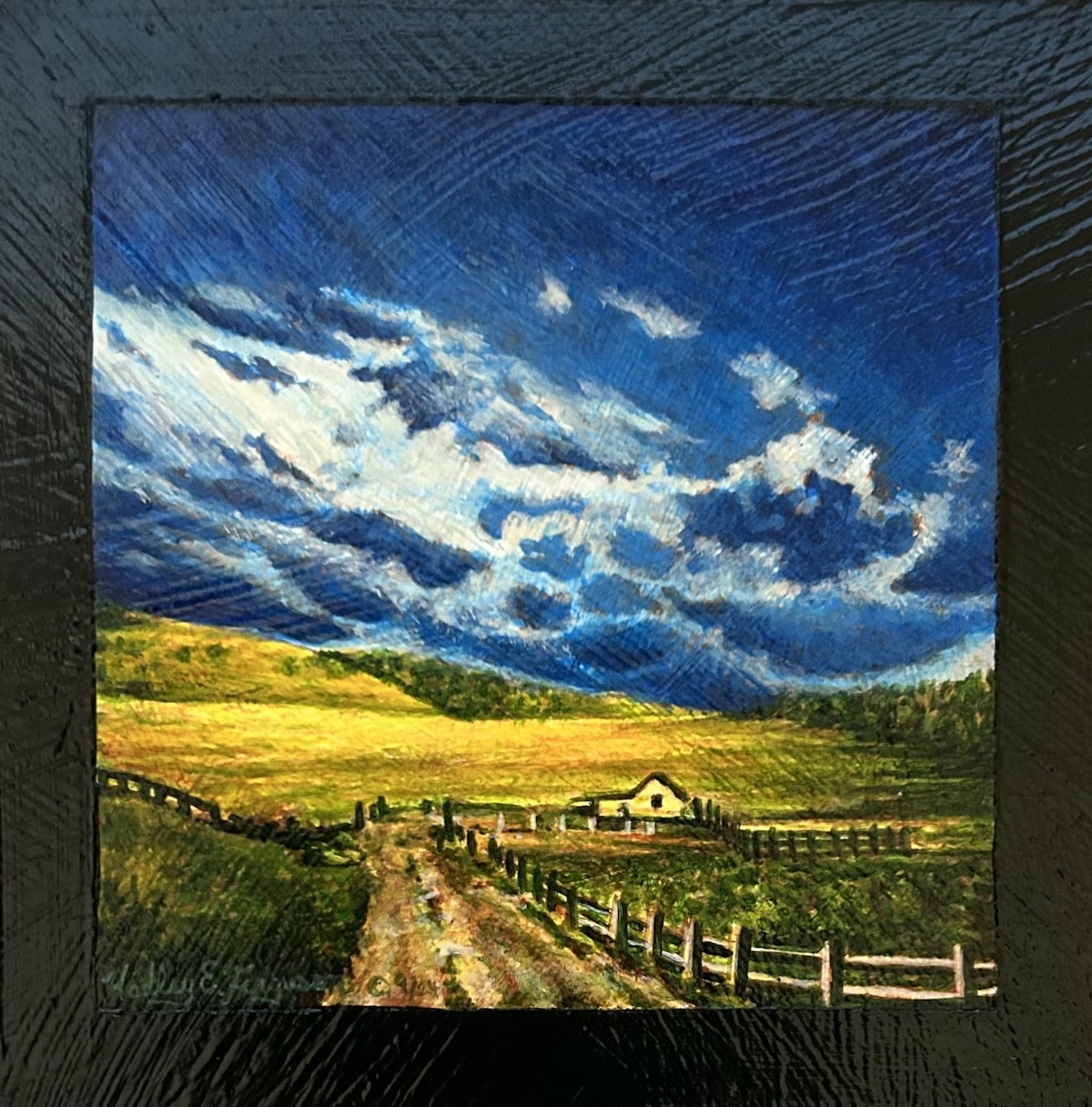
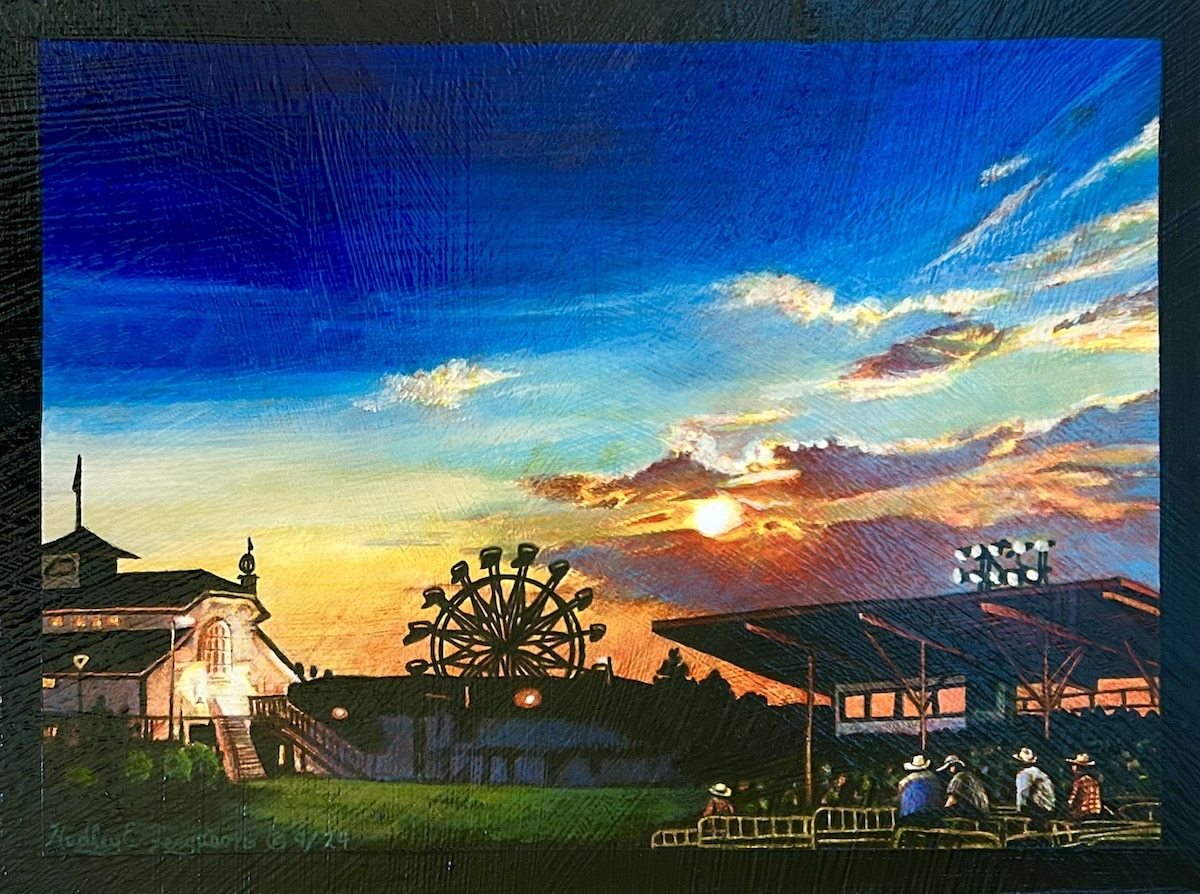
I did plein air paint outs with the Dana Gallery, and it was around the same time that I did the murals on Higgins and Broadway. For those, I used a technique designed just for that mural where I did most of the underpainting in sepia and then I glazed color over it. So, the color was not very saturated, not very vibrant or anything. I spent about six years doing work in the Dana Gallery, and you can see in my work how it started to increase in saturation, but it never had a lot of depth in the color. And then I think the Capitol murals took it to another level. And now, every year when I do work for the Radius Gallery, my color has become more and more vibrant each year. It’s really exciting, because I taught myself how to do all of that, and it’s really cool to see that happen.
I did notice that! I’ve always liked your color palette, but I really love how it’s gotten brighter — how all of a sudden we’re seeing, for instance, a bright blue that we’ve never really seen in your work before.
I didn’t like my color palette back in that earlier time period. I wanted to strive for more vibrancy, but I didn’t know how to do it, because I really wasn’t a colorist. And so that’s something that’s really pleasing to me now.
Are all these paintings for the Radius Gallery show created from photos?
Yes, all of these are from photos. Some are photos I took, like the one with the field and the one with the barn. There are a couple that I’ve really changed, created from a collection of three photos, and another that’s two different photos turned in this way and that. But a lot of these photos come from the photographer Briar Diggs. He travels a lot. And there’s this one street scene — I’m not even sure where it is, but it’s somewhere else, maybe in Europe, which is what drew me to it: the cobblestone street and slanted tile rooftops. The photo he gave me was in gray and white tones, and very washed out. And so for the painting, I brought my color ideas to it. So, that street scene is really me.

Like, you mean, it embodies who you are?
Yeah. I love scenes like that. I love traveling. People love the landscapes I do but I always throw in one of my street scenes, which usually include a person in them. For me, Briar has been wonderful, because I can’t get out and take photos like I would have done when I did plein air painting and when I would have just gone places and taken photos and done my own thing. So, I feel like those photos are a little window into another world for me.
And I noticed some of the photos have things I’ve never seen you paint before, like boats and a ferris wheel.
I’ve been trying to throw in more grounding objects. And what I liked about the boats was that little bit of light that caught on the backs of them. And so for me, it’s not necessarily that I want to paint a boat, but that I really love the play of light on the boats and the water.
I don’t paint a piece without having a sense of light. Even the one with the house, where there isn’t a strong light source, it’s all about the way the color of the sky brought out the greens and the hills. It has a strong light factor, even though you can’t see the sun beaming through.
The Passion to Persist: The Hadley Ferguson Story screens its world premiere at The Wilma, Thu., Oct. 17. General admission doors at 6:45 p.m. and screening at 7 p.m. General admission donation is $25. More info and tickets here.
“The VIP Experience” starts at 6 p.m. and includes a pre-show drink, plus meet and greet with cast and contributors. Limited prints and signed and unsigned copies of “An Alert, Well-Hydrated Artist in No Acute Distress” will be for sale. RSVP with a donation to reserve your VIP seat here for $100.
A portion of all the proceeds goes to Summit for Parkinson’s.
Visit the Radius Gallery from 4 p.m. to 6 p.m. for Hadley Ferguson’s art show opening and silent auction of her latest painting.