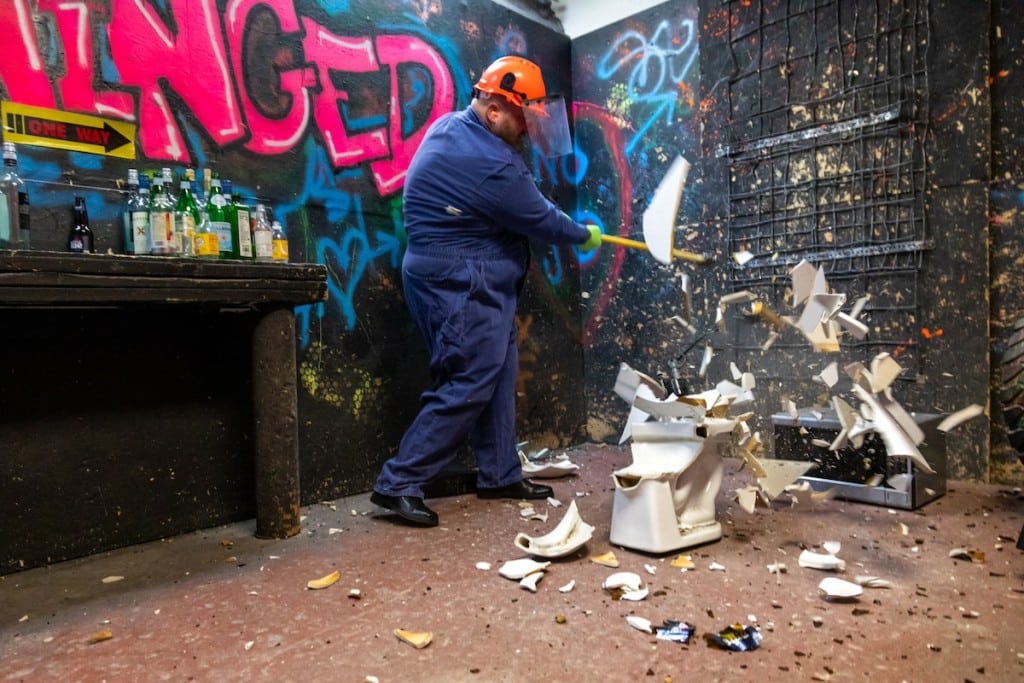
If you’ve seen the tip of Mike Nugent’s right ear in the last few weeks, you may have wondered if he got in a bar fight.
He didn’t. But he did have a run-in with this hard-hitting reporter.
After months of campaigning to be Missoula’s next mayor, I thought some sanctioned destruction might be a nice outlet for Nugent. So I asked him on a “candi-date” to Missoula’s rage room to smash glass, ceramics and electronics. He said, “YES!”
There was no way to predict that the night would end with Nugent’s ear bleeding and my fingers covered in super glue.
OK, there probably was.
The rage room, called Unhinged, provides each patron with a hard hat equipped with a full face shield, ear plugs, gloves and an unflattering upcycled blue jumpsuit straight out of a mechanic’s shop.
When I walked in to meet Nugent, I noticed a few things. One, the getup really made his black leather dress shoes sing. Two, his jumpsuit once belonged to an “Alex,” according to the name patch. And, three, was it OK that his neck was glaringly exposed?
We were ushered into our destruction room—a small, artfully graffitied space with ax-shaped holes in the ceiling. Our tools sat in one corner: a golf club, a tire iron, a baseball bat. Our canvas lay before us: two shelves of glass and ceramics, several electronics and what turned out to be the holy grail of smashables: a toilet. And then they cranked the music. Nugent picked AC/DC, which felt right on the nose.
As the first-term city councilman took a baseball bat to beer bottles and small ceramic goose-shaped candle holders, I asked what he was thinking about. He didn’t want to say, so I filled in the blanks.

What part of town would you destroy and rebuild as if with a magic wand (or tire iron)?
Reserve Street.
What piece of recent state legislation would you smash to smithereens?
“All the bills that take away people’s right to be independent and who they are,” Nugent said.
At some point a shard of obliterated something or other grazed his ear. I actually noticed the blood before he did. Fortunately, the woman working at Unhinged would have band-aids and a well-used tube of super glue on hand.
My turn up to bat. I picked up a wine bottle, aimed at metal caging affixed to the opposing wall, and threw. The dang thing hit the wall and ricocheted right back under our feet—similar to when I was throwing axes (poorly) with his opponent Andrea Davis. This would continue to be a nuisance, much like some of the issues facing Missoula right now.
Take property taxes, which I brought up later on our candi-date, in a booth at the Laughing Grizzly as the super glue was setting on his ear. How might Missoula keep property taxes—which are rising across the state due to soaring residential property values—in check?
He said one way to advocate for Missoula at the state level is to team up with other communities to lobby the legislature. He suggested a ballot initiative that would give local governments the option to offset property taxes with, say, a tourism tax.
“It’s time for the cities to stand up and be the leaders of that,” he said. “Instead of pointing fingers, it’s time for us to act.”

Amid the tax hikes, Missoula City Council last month voted to pull a levy from the November ballot that would have funded fire and emergency services to the tune of about $7 million in its first year. Other money for the department comes from the city’s general fund but is capped under state law. Nugent voted to nix the levy—as did every other city council member except one—because he said that’s what fire chiefs wanted.
“They were worried about the support,” he said. Priorities for the fire department include a new station on Mullan Road and adding personnel for the first time since 2008.
The fire department also houses the Mobile Support Team, which, since 2020, has been responding to behavioral health-related emergency calls, diverting people from jails and hospitals when appropriate. Nugent called the program “an absolute priority.”
He said the state missed “a tremendous opportunity” to invest in public safety with the $2.5 billion budget surplus it started the year with.
That’s one of the many examples where Missoula finds itself at odds with state leadership. But in communities across the state, Nugent said, the city is—and can increasingly be—less of an outlier and more of a leader, and reject the us-vs.-them approach.
The mayor of Missoula should be “someone that can help the region and the state understand the challenges we’re facing in one of the faster-growing places” and show that solutions can translate across communities, Nugent said.
Back in the destruction room, we kept swinging. If you’ve ever wondered what would be the most fun to smash—please, allow me. Computer monitors and microwaves? Not that fun. The glass plate inside a microwave once removed and tossed spinning in the air? More fun. And, truly, there’s nothing as satisfying as the chonky, baritone breakage of toilet bowl porcelain (I’d recommend applying either the back of an ax or a tire iron).

One thing that may have fueled the muscle behind Nugent’s swing was the July complaint about the combined $135,000 donated by the National Association of Realtors and the Missoula Organization of Realtors to a pro-Nugent group operating under the vague name “Missoula Mayor Independent Committee.”
Nugent said the group is a political action committee working independently from his campaign, and campaign finance laws prevented him from knowing about the group’s activities. A decision from the Montana Commissioner of Political Practices is pending.
“I have been amazed at the amount of misinformation that supporters of my opponents have willingly put out there suggesting this went down in a way that it didn’t,” he said.
Campaign finance aside, Nugent’s more than 20-year career as a real estate agent, as well as serving on the Missoula Housing Authority’s board, informs his approach to the city’s housing crisis. It’s an all-of-the-above strategy—his website refers to solutions ranging from “the unhoused to the over-housed”—that acknowledges the inevitability of Missoula’s growth. He emphasizes the need for more inventory, more investment in public-private partnerships, as well as city code and zoning reform.
On the rise of houselessness, Nugent lamented a 2018 9th U.S. Circuit Court of Appeals decision that he says put “handcuffs” on Missoula and other Western cities by limiting their ability to regulate camping on municipal property. (Dozens of local governments are asking the U.S. Supreme Court to overrule the decision.)
Still, he said the city has to do a better job navigating the crisis, pointing to the controversial Johnson Street shelter. It’s an important resource, he said, but he’s been highly critical of the city’s process for reopening the shelter, saying the surrounding neighborhood has been given little opportunity to provide input.
He stressed that the unhoused is not “one collective group,” and they should be treated with both dignity and accountability.
“People don’t need to just camp however they want,” Nugent said. “I think we can provide more safety and security and encourage people to work through programs like the Temporary Safe Outdoor Space that are making a difference.”
On how to provide more of those spaces, he noted preliminary discussions with developers about using low-income housing tax credits to build a mixture of transitional housing and shelter.
Between the folks utilizing subsidized housing and those with the most expensive housing are a group Nugent doesn’t want to overlook—what he called the “forgotten middle.”
Nugent mentioned his two children. “I want them to at least have the opportunity, if they choose and if they work hard, to be able to live here,” he said.
He also said budgeting for childcare and other family needs makes him more attuned with Missoula’s working families than Davis, his opponent. “It’s very real to us right now,” he said.
And his kids were part of his plan the next day: walking in the University of Montana homecoming parade. He hoped parade-goers wouldn’t notice the toilet paper glued to his ear wound.