Kevin Wilson was cruising east on Missoula’s Broadway Street around 6 a.m. on Jan. 11 when the Uber and Lyft driver got a pickup request from a downtown hotel. He had a few minutes to spare, so he hung a right, crossed the Orange Street Bridge and filled his tank at the Exxon.
When he got back on the road, Wilson heard a tapping sound coming from his tire. He pulled over to knock out what he assumed was ice—it was, after all, 25 below zero outside. But when he felt around his tire in the dark, he hit something sharp.
Holy crap. What’s that sticking out of my tire?
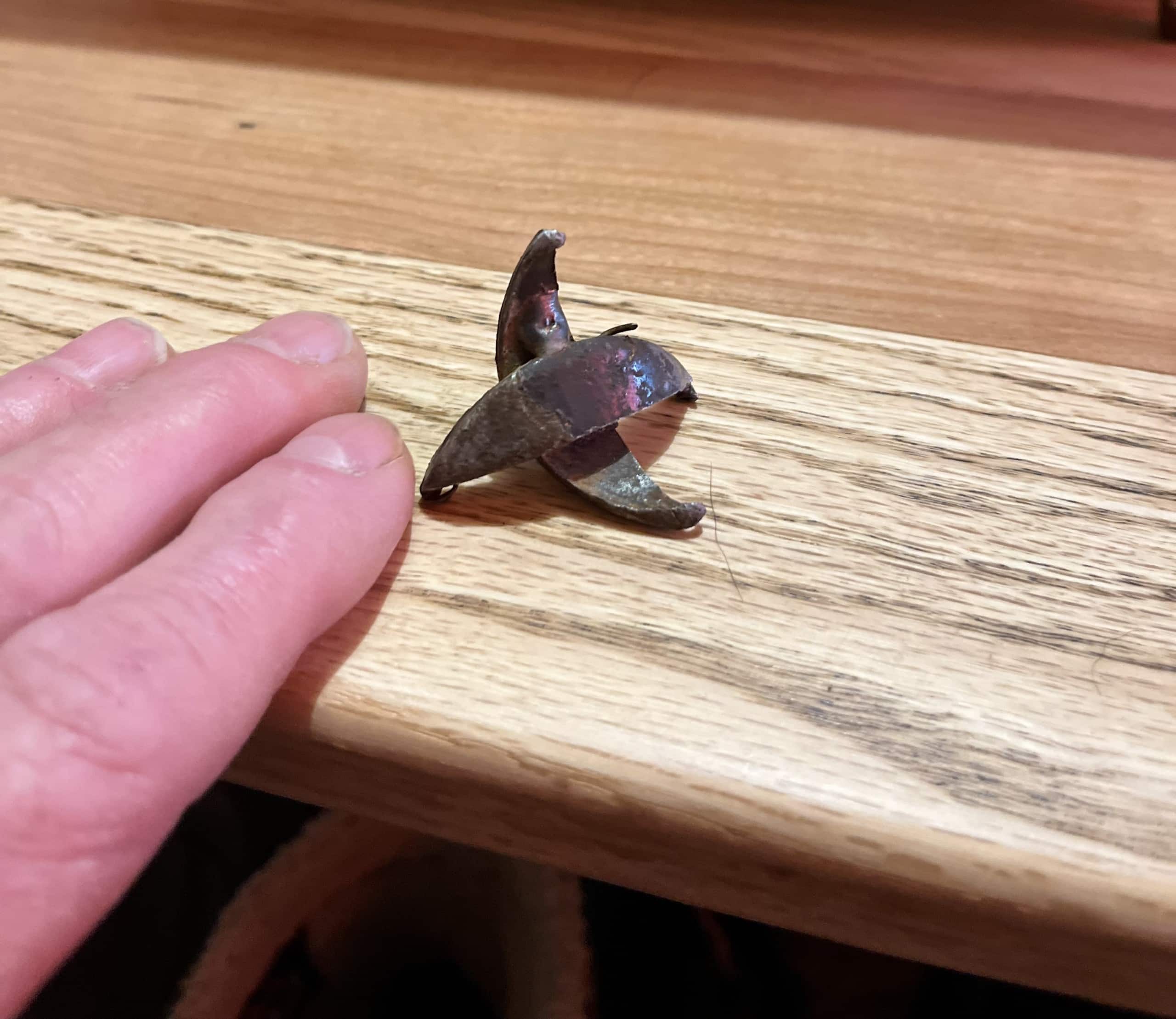
It was a homemade caltrop.
A caltrop is a four-pronged, heavy gauge steel puncturing spike that, according to the U.S. Department of Defense Non-Lethal Weapons Program, can cause “immediate, irreparable, catastrophic failure of pneumatic tires.”
It looks as vicious as it sounds: two half-rounds of rusty cut metal welded together at the middle so the sharp prongs stick out in opposite directions.
Wilson canceled his hotel pickup and drove (with the caltrop still lodged in his tire) to the nearby Tire-Rama on the corner of Orange and Pine streets. When the shop opened about an hour later, he was surprised that the mechanics weren’t surprised. Shop manager Darryn Barron opened a drawer beneath the service counter and pulled out an envelope containing four caltrops identical to Wilson’s.
When I paid Barron a visit a few weeks later, he squinted his eyes to read the pencil scratched on the front of that envelope—East Front Street, Cooley, Orange and Spruce—locations where drivers think they picked up these caltrops. He estimates he’s seen about eight of them come through his shop over the last couple months. The most recent incident was a tire on a Providence St. Patrick Hospital vehicle that went flat in the hospital’s loading bay, Barron said.
The Hellgate Conoco Service Center on East Broadway Street reported a similar number. Seven other shops The Pulp reached out to weren’t familiar with the trend.
Barron was collecting the information for the police, whom he’d reported the caltrops to, in the hopes of tracking down who’s making them and where they’re being planted. But it’s hard for drivers to pinpoint exactly where they picked one up. Often, tires take a few miles to start flattening. And this time of year, a plow could easily push a caltrop some distance before it gets its claws in a tire.
Wilson is worried about safety. He mentioned school buses: What if a bus full of kids picks up a caltrop and then gets a flat on the interstate?
If the plot sounds familiar, perhaps you saw the 2003 horror film, “Jeepers Creepers 2.” (In fact, Wilson got his first good look at the caltrop when a Tire-Rama mechanic brought it out of the shop and into the office, slammed it on the counter and proclaimed: “You’ve been jeeper-creepered!”) In that story, the shadowy culprit feasts on the humans of a rural community every 23 years for 23 days. On its final feeding day, it targets a bus full of high schoolers, by flattening a tire with a—you guessed it—homemade caltrop. (Though that one was made from teeth and bones.)
In Missoula, thankfully, there have been no reports of humans being eaten. But Wilson had to eat $1,000. His 2012 Hyundai Santa Fe, like any four-wheel-drive or all-wheel-drive vehicle, requires all four tires be changed at once. That cost irks him (neither his insurance nor Lyft paid him back). He’s given a lot of thought to who might be doing this.
“I’m a remodel guy,” said Wilson, who works construction during the warmer months. “Whoever’s doing this is a construction guy or a plumber guy.”
He rattled off a list of contextual clues. He thinks the caltrops are made from the ends of finished plumbing pipes cut with a machine into uniform U-shapes that are then welded together. He suspects the culprit works a job where he/she has access to piles of pipe ends.
Wilson daydreams about investigating on his own time. He owns a large magnet on wheels—a tool he uses to cleanup nails after roofing jobs—and has been thinking of passing it over the spot he suspects his tire picked up the caltrop: the used car lot at the intersection of Russell and Idaho streets, where he’d done a U-turn just before heading to Exxon.
“I’m telling you, it’s CSI,” Wilson said. “The only thing we need is a metal sample.”
Ed McLean, detective captain with the Missoula Police Department, said on Wednesday he hadn’t heard of the incidents. When he tapped Wilson’s name into the system, he said that case was closed because there were no suspects. I suggested he speak with Barron, who said he’s reported one of the caltrops to the non-emergency police line, and has that envelope of evidence waiting in his shop.
“I appreciate you kicking the tires on it,” McLean said with no vocal affect, leading me to believe he missed his own pun. “Actually, you probably just kicked off an investigation now.”
(A call to Barron a few hours after I spoke with McLean revealed that the detective had, indeed, swung by Tire-Rama to scoop up the shop’s caltrop collection.)
Wilson, meanwhile, is avoiding the areas he drove that fateful morning, despite the fact that he gets fuel discounts at the station there. “I don’t go to that Exxon any more,” he said. “I’m actually afraid to go in that area.”