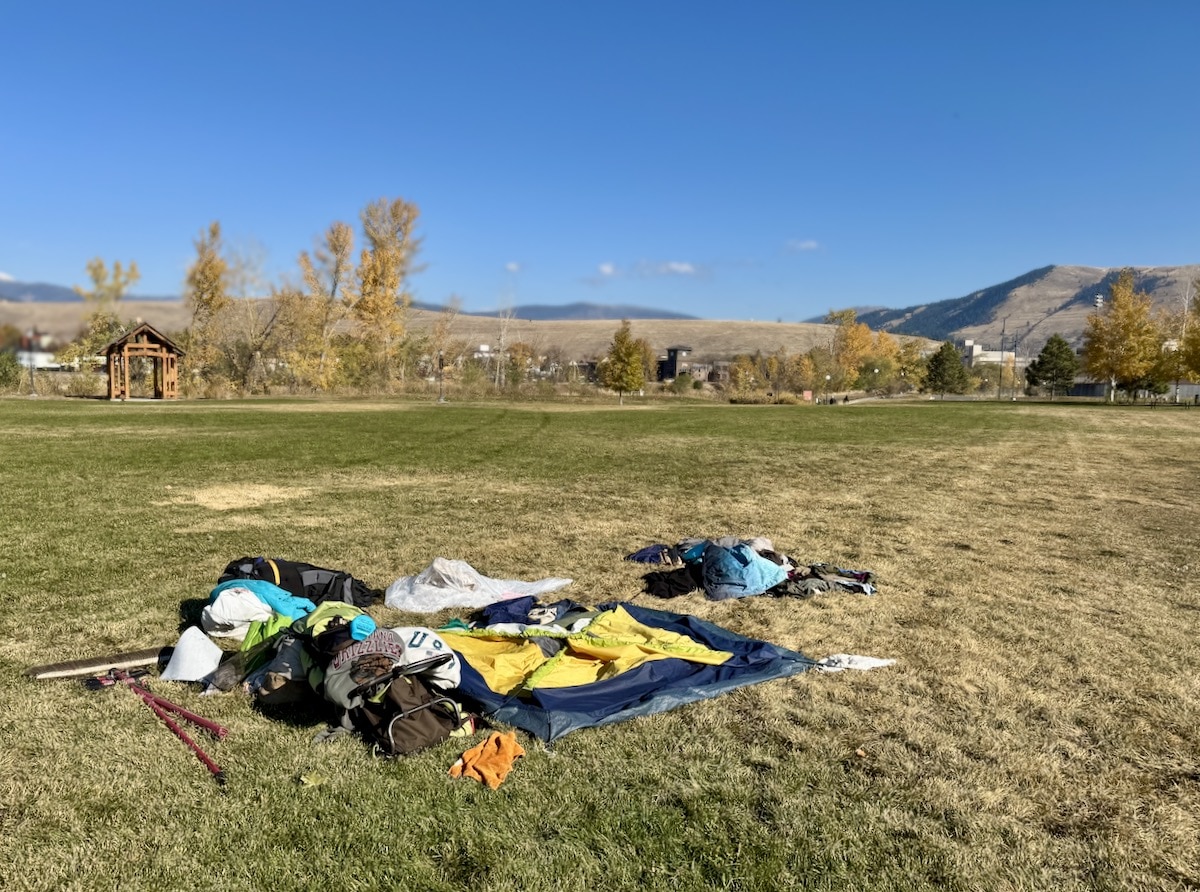
The Missoula City Council voted late Monday night to criminalize camping in city parks.
The 9-3 vote, which followed a substantial period of public comment and debate that stretched to the midnight hour, codifies several amendments to the urban camping law that the city approved in June despite significant opposition from public commenters. That ordinance created a patchwork of regulations limiting where and when people could camp, but ultimately left some parks open to campers during certain hours of the night.
“Legislating at a municipal level is an endless attempt at threading the needle,” Amber Sherill, the city council president, said Monday evening. “This ordinance, along with the changes that we are proposing, is my attempt to do that. I believe the vast majority of our community does not want people camping in our parks, and neither do I.”
“I believe the vast majority of our community does not want people camping in our parks, and neither do I.”
Changes to the law have been brewing for a couple of months. In October, several members of the council announced that they would introduce a ban on camping in parks. By that time, a Missoula resident and former Republican state legislator named David “Doc” Moore had organized a neighborhood group called No Camp Missoula and started gathering signatures on a petition to ban camping in parks. Supporters of the campaign said they were concerned about the presence of needles and human waste and potential safety risks for children. The group had gathered 1,300 signatures, Moore said at this week’s meeting; its webpage now boasts: “Victory!”
The amendments, sponsored by Sherill, council members Sandra Vasecka, Bob Campbell, Stacie Anderson, Gwen Jones and Mike Nugent, ban camping in parks outright and harshen the penalty for alleged violators from a warning followed by a municipal infraction fine to a misdemeanor penalty and a potential $50 fine. City police and attorneys told council members Monday that the previous restrictions were difficult to enforce and prosecute, if necessary.
The changes also received support from council members Sierra Farmer, Eric Melson and Mirtha Becerra.
For years municipalities in the West couldn’t enforce outright bans on urban camping because such laws had been deemed unconstitutional by the 9th Circuit Court of Appeals. But the U.S. Supreme Court reversed the 9th Circuit in late June — just a few days after Missoula passed its law regulating camping in parks.
Council members Daniel Carlino, Jennifer Savage and Kristen Jordan voted against the changes on Monday. Carlino introduced a suite of amendments of his own that would have prevented enforcement of the law if there is no option for an individual to “access adequate indoor shelter for sleeping” — if all shelter beds are full, in essence — as well as remove the criminal penalty, among other changes to reduce the severity of punishment. Each of his proposed amendments failed.
Carlino argued that the changes would punish people for sleeping outside when they have nowhere else to go, perpetuating a downward cycle.
“I think that’s all very counterproductive and is going to keep people experiencing homelessness for a longer period of time than if we didn’t do those things,” Carlino said. “With our limited resources, we should try to put more of it towards real solutions and not waste so much money making peoples’ lives incredibly hard who are already struggling so much in our community.”
Savage, who voted for the restrictions back in June, said she could not support an outright ban on park camping if the city couldn’t designate another place for unsheltered people to go.
City staff said Monday that Missoula has roughly 650 homeless people, while the city’s shelters have capacity for between 300 and 400 people.
“We are at capacity, we fluctuate night-to-night, but we are at capacity,” Liam Seymour, a Poverello employee who spoke in his own capacity, said Monday.
The law as passed Monday allows camping on some city property, such as vacant city-owned lots and along some trails and rights-of-way. One amendment also lengthened the time that people can camp in allowable areas to 6 p.m. to 8 a.m. from Nov. 1 to March 1, when the winter weather is at its fiercest.
Service providers are also investigating the feasibility of operating an authorized designated camp site, Mayor Andrea Davis told the council in November. Monday’s changes included language promising that the city “will continue to coordinate, collaborate and communicate with service providers and willing community partners regarding programs to address the needs of homeless individuals without access to shelter.”
City staff said Monday that day-use lockers will soon be available at the library.
Other amendments passed Monday make changes to the vehicle permitting system that the city established in June, disallowing unpermitted vehicles to park for up to 120 hours and allowing permitted vehicles to park closer together.
Supporters of the restrictions have said that they feel compassion for homeless people and want to encourage them to access shelters where they can receive wraparound services.
But that’s not realistic, Clayton Shaya, an unhoused Missoulian and organizer with the Missoula Unhoused Neighbors Union, told The Pulp.
“What a fallacy the [Johnson Street Shelter] is, how often it’s at capacity when we say it’s an open shelter,” he said.
He said that enforcement of rules at the shelter is capricious and hard to follow, so people get kicked out.
“There’s a direct equation year after year,” he said. “As soon as we don’t have enough beds and shelter, things that were not a problem yesterday are now temporary outs. And now you’re not allowed to camp.”
David Quattrocchi, an organizer with Missoula Tenants Union, said the city can’t expect people to want to use services that people feel are dangerous or dysfunctional.
“So many people have tried that, they’ve been abused in there, they’ve gotten outs or punishment that has an explanation that doesn’t make sense to them,” he said. “You’ve got to make it usable for them.”
He recommends more oversight of the shelter system, but also acknowledged the fundamental problem is a lack of funding.
Council member Gwen Jones encouraged those calling for the city to offer more services to speak to legislators and prevent the state from going after “local spending.”
“We’re heading into an era in which we’re going to have less and less resources,” she said.
The city is in a budget deficit, requiring a tax levy and millions of dollars in remittances from the Missoula Redevelopment Agency to fund existing services. Quattrocchi said he wants to see the money being put toward enforcement of the new laws instead put toward services for the homeless.
Shaya said he’s helping to organize a community potluck series to elevate first-hand narratives from unsheltered people about the difficulties of finding a place to sleep, even when shelters have theoretical capacity.
“We’re building momentum in a group that has been targeted for demoralization,” he said.
Because, he added, when it gets cold and late, “there is no port in the storm.”
The changes will take effect on Jan. 1, 2025.
Call for rants, raves and revelations! 😠 🥰 🤔
The ways in which we experience Thanksgiving, Black Friday, the onset of winter and the run-up to the holidays range widely, don’t they? We at The Pulp figure this time of intense ambivalence is grist for another round of reader-submitted rants, raves and revelations — a semi-regular series begun back in August.
We invite you to send us your most creative complaints, love notes, confessions or retellings of recent notable events, holiday-related or otherwise. The first installment will give you a sense of the sort of anecdotes and reflections we’re looking for. (Some of those were dramatically and hilariously performed on stage during The Pulp’s first-birthday variety show in early October, so know anything you share may eventually earn the same treatment!)
Any submissions we choose to publish will be done so anonymously, so feel free to let loose. But be kind. We’ll post our favorites. Send your rant, rave or revelation to [email protected] by Dec. 18 if you want it to be considered for our year-end edition. Thanks! —MF 🍊
The ledger #️⃣
65
The number of turkeys — not to mention 500 pounds of potatoes – that the Poverello Center and the Johnson Street Shelter prepared to feed about 200 people on Thanksgiving.
The week ahead 🗓️
- The Missoula City Council is holding a public hearing about the city’s Our Missoula 2045 Land Use Plan on Dec. 9 at 6 p.m. The plan is an outline for growth and development in Missoula over the next two decades — by which time the city projects there could be 120,000 Missoulians. The city will vote on the plan on Dec. 16.
- On Dec. 11 at 10:35 a.m., the council’s Public Safety, Health and Operations Committee will hear a motion directing the mayor to sign a contract with Axon Technologies to continue support of the city police department’s Taser Program.
Find a list of all upcoming city meetings here.
The feed 🗞️
Chris La Tray goes all in (The Pulp)
The ‘frozen’ Montana housing market (Daily Montanan)
‘Gray wave’ of homeless seniors overwhelms homeless service providers (MTPR)
Cities say they store property taken from homeless encampments. People rarely get their things back. (ProPublica)
Montana among 9 states poised to end coverage for millions if Trump cuts Medicaid funding (KFF Health News)
Auditors say state property tax rolls have missed $1.2 billion of new construction (Montana Free Press)
UM administrator faces $1 million in legal fines (Montana Kaimin)
The immigrants most vulnerable to Trump’s mass deportation plans entered the country legally (The New Yorker)
Their fertilizer poisons farmland. Now, they want protection from lawsuits. (New York Times)